
Key Takeaways:
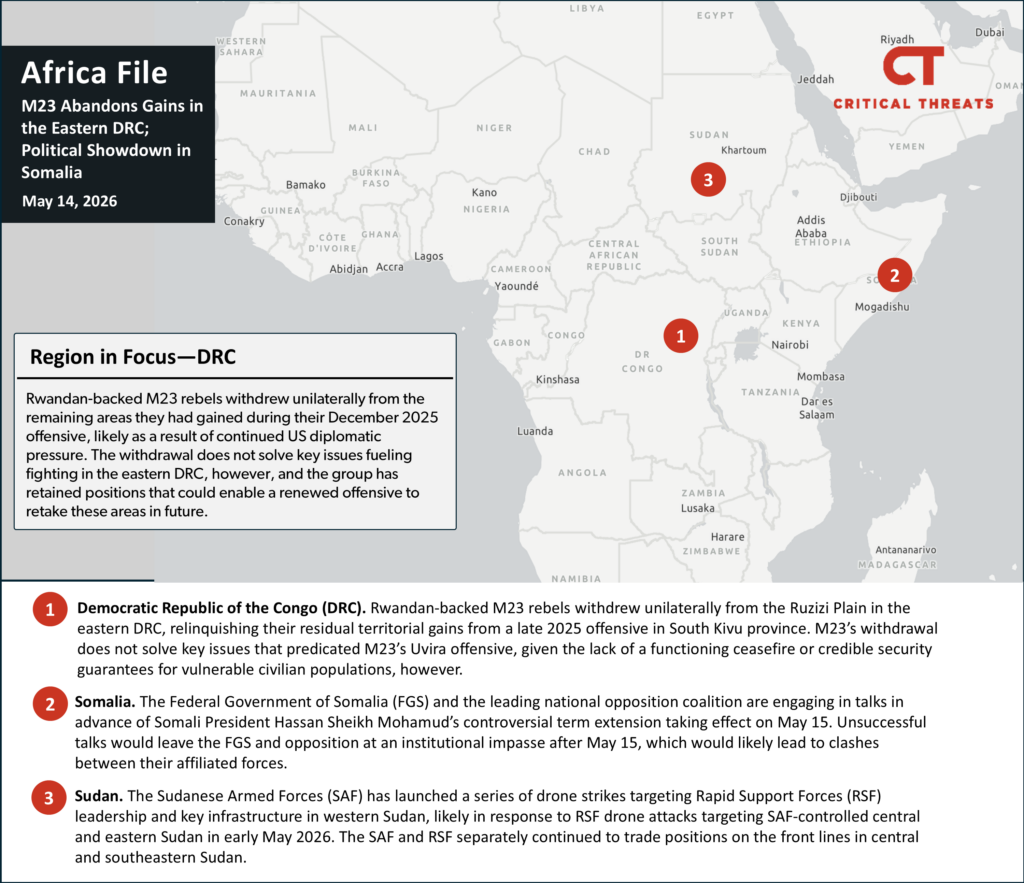
Democratic Republic of the Congo (DRC). Rwandan-backed M23 rebels withdrew unilaterally from the Ruzizi Plain in the eastern DRC, relinquishing their residual territorial gains from a late 2025 offensive in South Kivu province. M23’s withdrawal does not solve key issues that prompted M23’s Uvira offensive, given the lack of a functioning ceasefire or credible security guarantees for vulnerable civilian populations, however.
Somalia. The Federal Government of Somalia (FGS) and the leading national opposition coalition are engaging in talks in advance of Somali President Hassan Sheikh Mohamud’s controversial term extension taking effect on May 15. Unsuccessful talks would leave the FGS and opposition at an institutional impasse after May 15, which would likely lead to clashes between their affiliated forces.
Sudan. The Sudanese Armed Forces (SAF) has launched a series of drone strikes targeting Rapid Support Forces (RSF) leadership and key infrastructure in western Sudan, likely in response to RSF drone attacks targeting SAF-controlled central and eastern Sudan in early May 2026. The SAF and RSF separately continued to trade positions on the front lines in central and southeastern Sudan.
Figure 1. Africa File, May 14, 2026
Assessments:
Democratic Republic of the Congo
Rwandan-backed M23 rebels withdrew unilaterally from the Ruzizi Plain in the eastern Democratic Republic of the Congo (DRC), likely in response to US political and diplomatic pressure. Thousands of M23 troops reportedly began withdrawing northward from at least a dozen localities on a roughly 20-mile stretch of the RN5 road in the Ruzizi Plain and the hills to the west of the RN5 in South Kivu on May 9.[1] The RN5 is the main route from Bukavu, the M23-controlled South Kivu provincial capital, to Uvira town on the Ruzizi Plain. Congolese-backed Wazalendo fighters and Congolese army (FARDC) units began retaking control of Sange village, which had been M23’s main forward position on the RN5 since it withdrew from Uvira following a December 2025 offensive, and other localities that M23 vacated on May 11.[2] M23 reportedly repositioned its forces to Katagota village in Uvira district, about four miles south of the DRC-Rwanda border town of Kamanyola and 40 miles south of Bukavu.[3]
Figure 2. M23 and Allies Activity in South Kivu
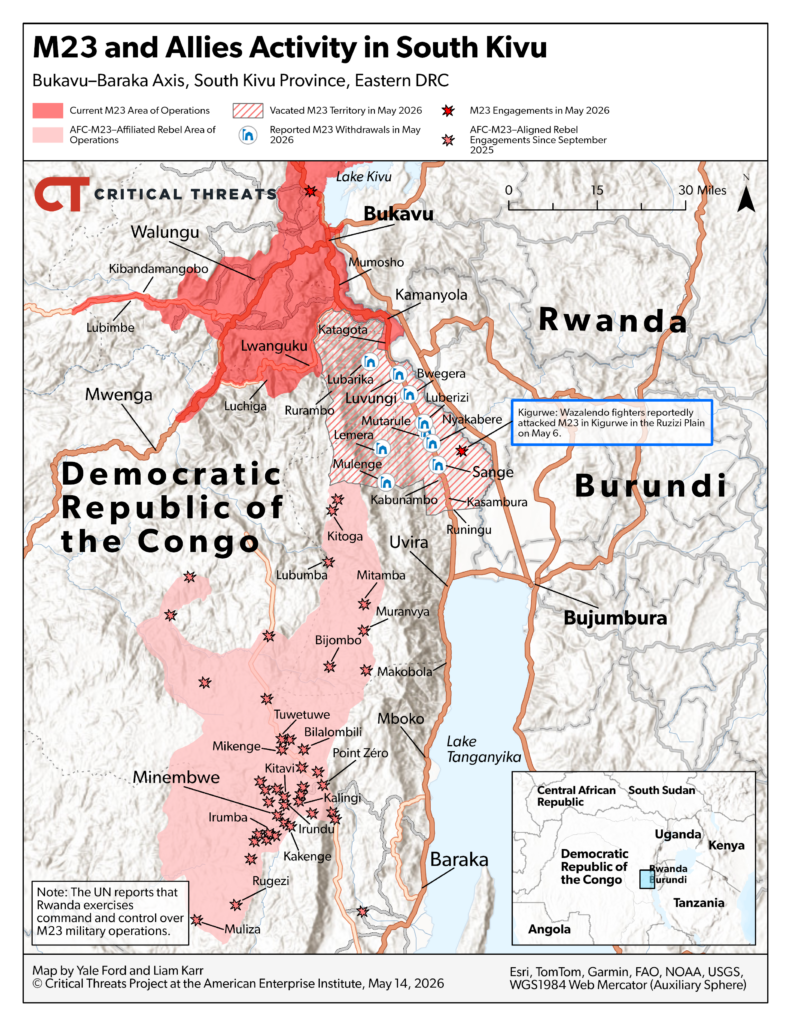
M23 likely withdrew from the Ruzizi Plain in response to US political and diplomatic pressure. US officials have repeatedly called for M23 to withdraw to its pre-December offensive position at Kamanyola.[4] The front line on the RN5 was frozen between M23-controlled Kamanyola and government-held Katagota towns for months prior to M23’s December offensive. US pressure and mediation had prompted M23 and Rwanda to withdraw from areas that it had captured in North and South Kivu on three notable occasions between March 2025 and March 2026.
The United States has also used sanctions to put pressure on M23 in the last two months. The United States sanctioned former DRC President Joseph Kabila over his alleged financial and political support to the rebels in late April.[5] Massad Boulos, US President Donald Trump’s Africa adviser, reportedly warned that the United States would sanction anyone who violates their peace commitments during a trilateral meeting with the DRC and Rwanda in mid-March.[6] The US Treasury Department said that M23’s continued presence near the border with Burundi risked widening the conflict into a larger regional war when it sanctioned the Rwandan army and senior Rwandan generals for supporting M23 in early March 2026.[7]
M23’s withdrawal does not solve key issues that prompted M23’s Uvira offensive, given the lack of a functioning ceasefire or credible security guarantees for vulnerable civilian populations, however. The security situation in the Ruzizi Plain has now reverted to the pre-Uvira offensive status quo, which caused significant tension between the two sides with no ceasefire taking root in 2025. The Congolese government repeatedly rejected the establishment of a demilitarized zone on the front line with M23 in 2025. The DRC and its allies began using the Bujumbura airport—in Burundi’s economic capital, 16 miles east of Uvira town—as a rear base and Uvira as a logistic hub to amass troops in the Ruzizi Plain and increase joint ground and air operations against M23 in mid-2025.[8] M23 and Rwandan officials claimed that the buildup was a threat, and M23 said that it would “eliminate the threat” from Uvira and Bujumbura for months.[9] Katagota—the DRC’s forward position for most of 2025—is only six miles from southwestern Rwanda, which is densely populated.
Security has already deteriorated in the Ruzizi Plain since early 2026. The return of Congolese government control to Uvira and the border with Burundi reopened a major supply line corridor and allowed DRC coalition forces—including private military contractors linked to US national Erik Prince—to deploy forces directly to the Ruzizi Plain and other front line areas.[10] The Burundian army (FDNB), which is the FARDC’s most important state ally in the coalition against M23, began redeploying thousands of troops to South Kivu and to the Ruzizi Plain in January.[11] DRC coalition fighters restricted civilian traffic to M23-controlled areas on the RN5, and fighting between M23 and pro-Congolese government forces broke out on the Ruzizi Plain at least five times between January and a few days before M23 began withdrawing on May 9.[12]
Pro-Congolese government forces have also committed human rights abuses in recaptured areas, which undermines peace efforts and could make M23 more resistant to future territorial concessions on the front lines. Multiple reports indicate that pro-Congolese government forces perpetrated widespread looting, violence, and attacks on ethnic Banyamulenge civilians in Uvira after M23 withdrew in January.[13] Senior M23 officials have said that its withdrawal from Uvira “changed nothing” and criticized the Congolese government for taking advantage of its withdrawal to foment chaos and also reimpose a humanitarian blockade in the South Kivu highlands.[14] M23’s political spokesperson denounced atrocities of “unidentified militants” killing civilians, burning down and looting property, and raping women in several towns in the Ruzizi Plain after M23 began withdrawing from the Ruzizi Plain.[15] The issue of humanitarian access and civilian protection in both M23- and DRC-controlled areas has been a focus of the Doha process talks, and pro-Congolese government abuses fuel M23 claims that it is fighting a corrupt and illegitimate central government that fails to protect its own citizens.
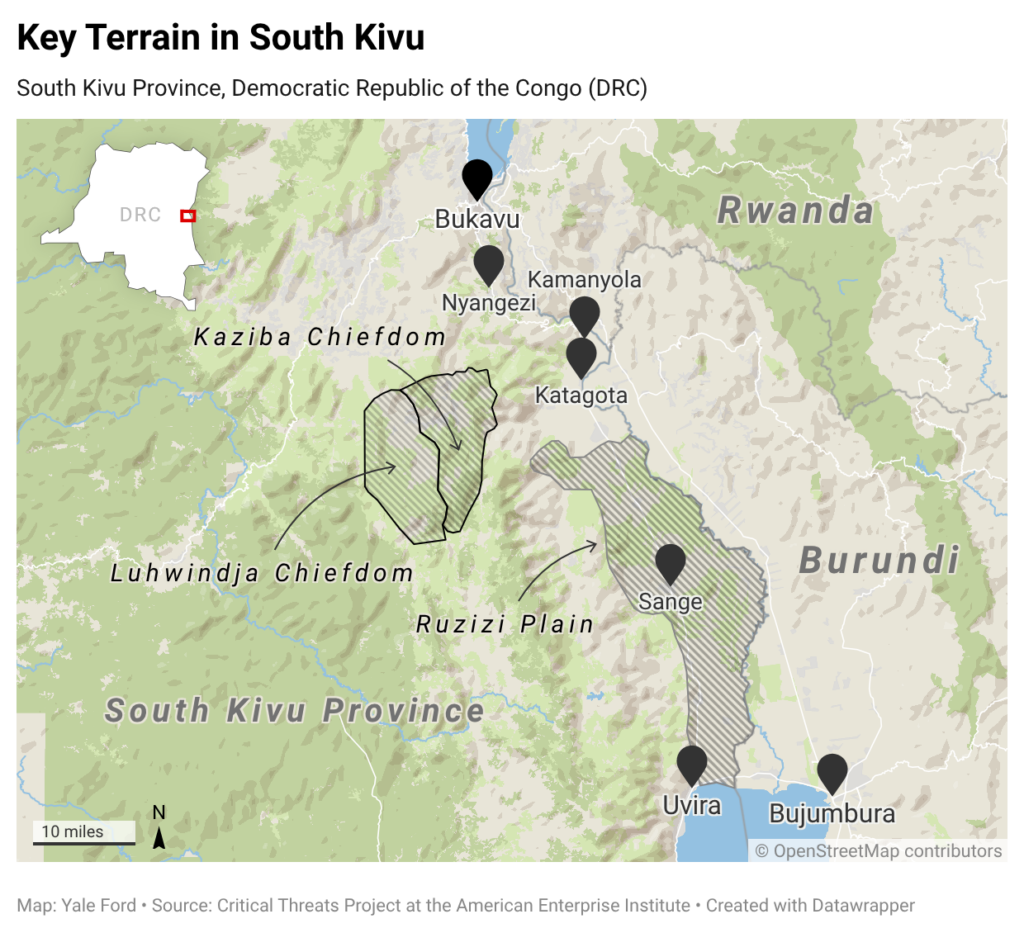
M23’s new forward position in Katagota acts as a buffer for its supply lines in South Kivu and preserves its ability to conduct a future offensive in the Ruzizi Plain. Kamanyola sits on the border of Burundi, the DRC, and Rwanda, serving as the key entry point for Rwandan troop deployments and logistics for its supply lines in South Kivu. Katagota is the northern entry point to the Ruzizi Plain and controls access to the midland and highlands to the west of the RN5. M23 still controls several key areas in southern Walungu district and the Mwenga district highlands west of the RN5, notably the Kaziba and Luhwindja chiefdoms, as well as transit networks and supply corridors south of Bukavu that allow it to deploy troops directly to the Ruzizi Plain. M23’s control of this east–west network between the high ground and its position in the Ruzizi Plain means that it also retains the ability to move troops and military equipment, including heavy artillery, between the two corridors more easily.
Figure 3. Key Terrain in South Kivu
Somalia
The Federal Government of Somalia (FGS) and the leading national opposition coalition are engaging in talks in advance of Somali President Hassan Sheikh Mohamud’s controversial term extension taking effect on May 15. The talks, which are meant to resolve a constitutional and electoral dispute involving the term extension, involve Somali Future Council (SFC) opposition leaders—including Puntland state President Said Abdullahi Deni and former Somali President Sharif Sheikh Ahmed.[16] The international community is reportedly facilitating the talks at a compound in the Mogadishu airport, with multiple Somali sources claiming that the United States is leading them.[17] US Chargé d’Affaires in Somalia Justin Davis stated on May 12 that United States would not lead the talks, however, but would instead “welcome the opportunity to observe” them.[18] The two sides did not reach an agreement on May 13 after Mohamud proposed negotiations extending beyond May 15 but resumed talks on May 14.[19]
Tensions between the FGS and SFC have significantly increased since early March 2026, as the FGS has proceeded with revising the constitution without reaching a compromise with the SFC. The FGS approved a new constitution on March 4, which extended Mohamud’s term by one year, delayed federal elections until 2027, and instituted direct federal parliamentary elections.[20] The SFC denounced the term extension and election delay as a power grab and called for adherence to the previously scheduled election timeline in mid-2026.[21] Opposition leaders created the SFC mainly to prevent the FGS from implementing direct elections, as the new election system would upend the clan-based quota and indirect voting system that protects their interests by forcing a degree of power sharing among Somali clans.[22]
The SFC has organized a broad coalition in Mogadishu, including clan and political leaders, to oppose the FGS. The SFC warned in April that it would hold parallel elections if the FGS continued to implement direct elections and called on Mohamud to step down when his term was originally set to expire on May 15.[23] The SFC held a summit from April 20 to 22 that included several key figures, including politicians who defected from the FGS and clan leaders from Mohamud’s clan.[24] The SFC then held on a conference beginning on April 24 in which clan and political leaders demanded that Mohamud step down on May 15.[25]
The FGS has responded by mobilizing security forces across Mogadishu. The FGS began deploying security forces around Mogadishu in mid-April to restrict SFC leaders’ freedom of movement. FGS forces reportedly started by surrounding a military base controlled by a general allied with Sharif Sheikh Ahmed before proceeding with a broader mobilization.[26] The SFC announced plans to hold citywide protests on May 10, prompting the FGS to reportedly deploy thousands of troops around Mogadishu.[27] Federal security forces obstructed roads leading from the residences of SFC leaders, causing the protests to falter after the leaders were unable to direct them.[28] The SFC accused the FGS of suppressing the protests and announced plans to hold another protest on May 16.[29] Anti-FGS Somali news outlet Baidoa Online reported that the FGS has deployed forces to hotels that the SFC has used to hold public events.[30]
Broader FGS actions to consolidate control of Federal Member States (FMS) may also alienate pro-FGS states, which could strengthen the SFC. The FGS took over South West state in March 2025 and has since moved to consolidate control over the state via a puppet government. The FGS captured Baidoa—the de facto state capital of South West—and deposed state president Abdiaziz Hassan Mohamed (Laftagareen) on March 30, after Laftagareen came out against the FGS’s constitutional agenda and cut South West’s ties with the FGS.[31] Laftagareen had supported the FGS under the condition that the FGS would back him staying in power, but the FGS was reportedly planning to replace him.[32]
The FGS sent officials to South West to run an interim government and organize direct elections favoring Mohamud’s handpicked candidate, Somali House Speaker Aden Madobe.[33] Somalia’s federal election commission then scheduled direct elections for South West’s parliament and presidency from May 10 to May 23.[34] Mohamud’s party won a majority of parliamentary seats, causing candidates running against Madobe to accuse the FGS of rigging the elections after previously criticizing the FGS’s lack of transparency.[35]
The FGS has recently moved to consolidate control of the Galmudug and Hirshabelle states, both of which have supported the FGS’s constitutional agenda. Multiple Somali sources reported in mid-April that the FGS had deployed forces to Jowhar, the state capital of Hirshabelle.[36] Freelance journalist Hussein Mohamed alleged that the FGS is seeking to prevent Hirshabelle state President Ali Gudlawe Hussein from standing for reelection in the scheduled July 2026 state elections.[37] Galmudug state President Ahmed Abdi Karie (Qoor-Qoor) separately rejected the FGS’s decision on May 7 to replace the Galmudug police chief, which was part of a broader FGS replacement of Galmudug security officials.[38] The FGS has responded by deploying forces to Dhusmareb, the state capital of Galmudug.[39] Baidoa Online reported on May 8 that FGS forces had surrounded Qoor-Qoor’s house.[40]
CTP has previously assessed that FGS interventions could cause pro-FGS states and figures to align with SFC in a constitutional and electoral dispute.[41] The SFC—including the Jubbaland and Puntland states—condemned the FGS’s takeover of South West and called for adherence to the state’s constitution and long-standing interim federal constitution.[42] Laftagareen has denounced the ongoing South West state elections as illegitimate, and fighters loyal to him have clashed with FGS forces in Baidoa since the elections began.[43] SFC members have also called on Galmudug and Hirshabelle to reject direct elections.[44]
Figure 4. Somali States Align Against Mogadishu
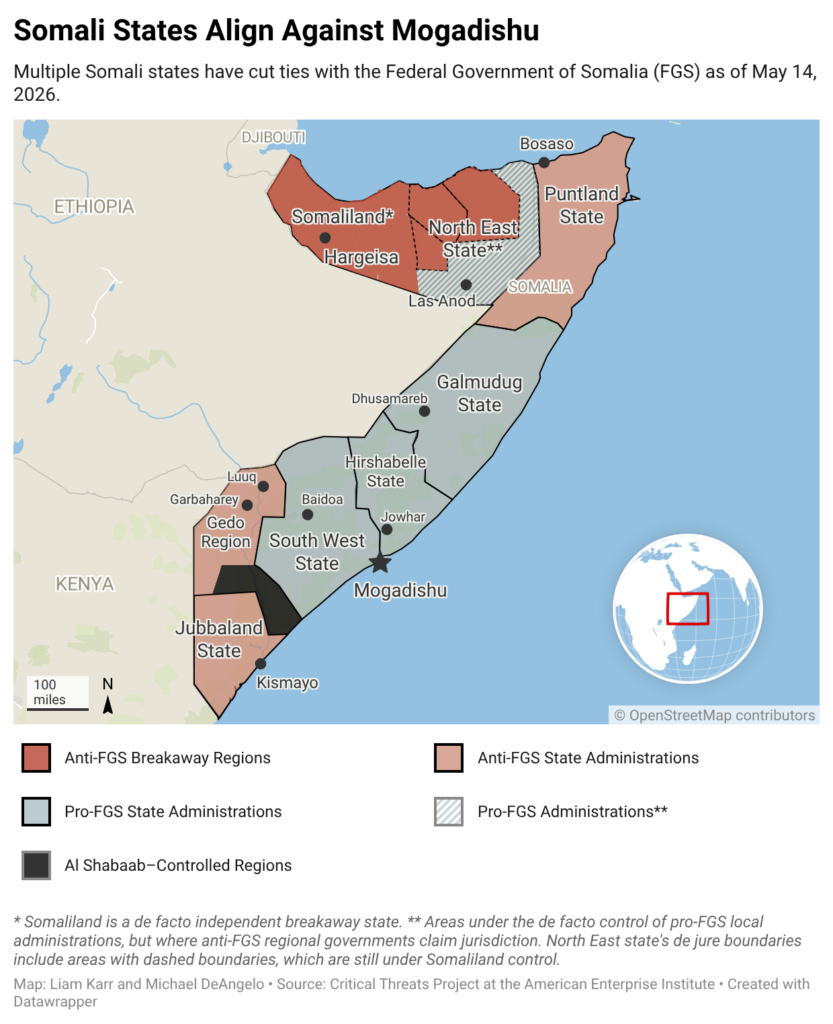
Unsuccessful talks would set up a showdown between the FGS and SFC after May 15, which would likely lead to clashes between their affiliated forces. Both sides have reaffirmed their maximalist positions, raising the risk of clashes in Mogadishu. The FGS has scheduled direct parliamentary and presidential elections in every FMS except Puntland and is holding direct elections in South West, while the SFC has demanded that the FGS abandon direct elections or risk SFC parallel elections.[45] The incompatibility of their positions and their mobilizations around Mogadishu make May 15 a flash point, especially given the SFC’s repeated proclamations that Mohamud is not the legitimate Somali president after that day.[46] A dispute over the delayed federal presidential election in 2021 sparked armed clashes between FGS and opposition forces in the streets of Mogadishu.[47]
Clashes could break out in other member states, particularly Jubbaland. Mohamud declared on April 13 that FGS forces are ready to conduct operations in every part of Somalia.[48] Somalia’s defense minister also stated that the FGS would intervene in the states that oppose the FGS if necessary.[49] Multiple Somali sources reported around the same time that the FGS is considering conducting an offensive to fully seize Gedo, a region in Jubbaland that the Jubbaland state government and pro-FGS forces contest.[50] The FGS separately began redeploying forces from South West state to Gedo’s Luuq district in late April.[51] The FGS then scheduled direct elections in Gedo for July, a scenario that the Jubbaland state government has promised “decisive measures” against.[52] The Jubbaland state government reached an agreement with the formerly pro-FGS Gedo regional administration on May 12 for the region to reject FGS plans to hold direct elections.[53] FGS and Jubbaland forces previously clashed in 2020, 2024, and 2025 over election disputes.[54]
The FGS is unlikely to follow through on rumored threats to Puntland. The Somali news outlet Kaab TV and analyst Rashid Abdi reported in mid-April that the FGS had mobilized forces to pressure Puntland state President Deni, although CTP could not verify the mobilizations.[55] Deni and Puntland’s interior minister affirmed Puntland’s readiness to combat a potential FGS offensive.[56] The FGS’s election head stated on May 12 that the FGS plans to hold direct elections in Puntland.[57] Puntland has exerted autonomy from the FGS for several years due to its distance from Mogadishu, however.[58] FGS forces have also not directly clashed with Puntland state forces in the past in the same way that they have with Jubbaland and South West state forces.
Sudan
The Sudanese Armed Forces (SAF) have launched a series of drone strikes targeting Rapid Support Forces (RSF) leadership and key infrastructure in western Sudan, likely in response to RSF drone attacks targeting SAF-controlled central and eastern Sudan in early May 2026. The most substantial strikes occurred in Nyala, which is the RSF’s headquarters and state capital of South Darfur, including several strikes on the Nyala airport between May 9 and 13.[59] The Netherlands-based Sudanese news outlet Radio Dabanga reported that the strikes did not damage the airport, although the Sudanese news outlet Ayin Network reported damage to the facility.[60] The SAF targeted additional RSF facilities, including a training camp and a residence hosting a meeting of senior RSF officials.[61] Radio Dabanga reported that the strike on the residence did not kill any senior RSF officials, although Ayin Network reported the death of several officials.[62] RSF leader Mohamed Hamdan Dagalo (Hemedti) recently met with RSF officials in Darfur region, although it remains unclear if he was in Nyala during the strikes.[63] The SAF also targeted RSF officials in al Daein—the state capital of East Darfur—and potential RSF vehicles near the Chadian border in North Darfur state.[64]
Figure 5. SAF Retaliates Against RSF Drone Strikes
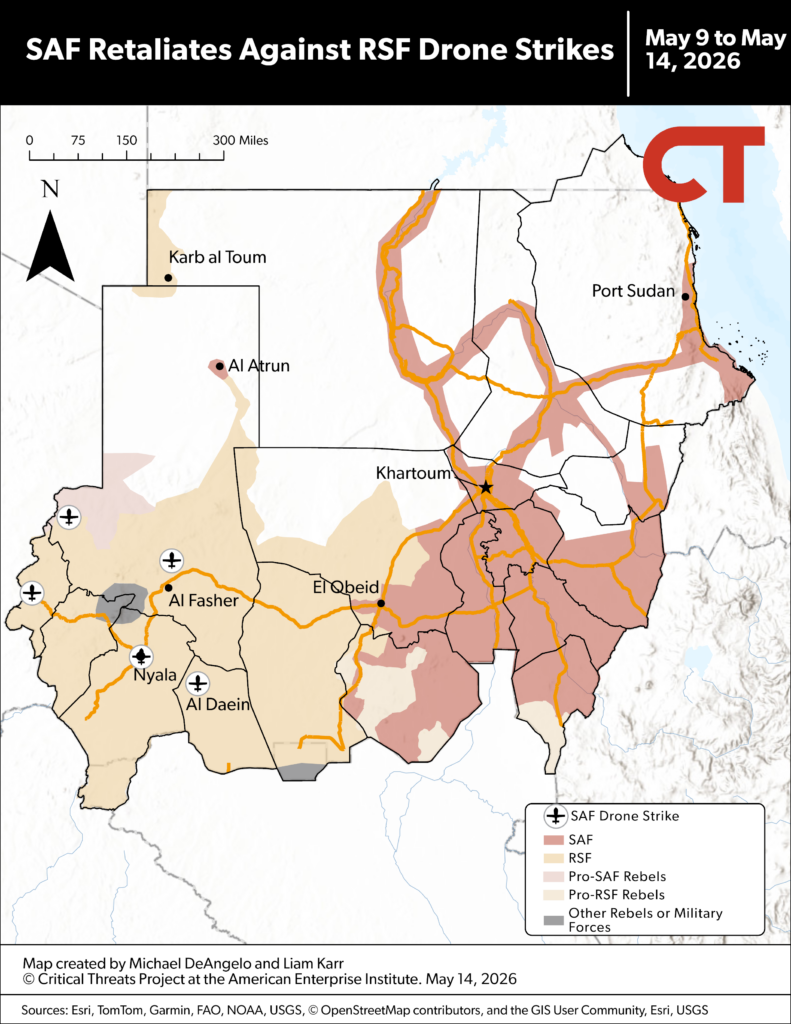
RSF strikes on the Khartoum airport and the subsequent SAF strikes on the Nyala airport void an alleged agreement between the RSF and SAF in early 2026 to refrain from targeting key airports.[65] The RSF’s strikes in Khartoum—the Sudanese capital—on May 5 damaged the Khartoum airport, causing the facility to temporarily close.[66] The RSF and SAF had not attacked the respective airports in more than a month prior to the recent strikes.
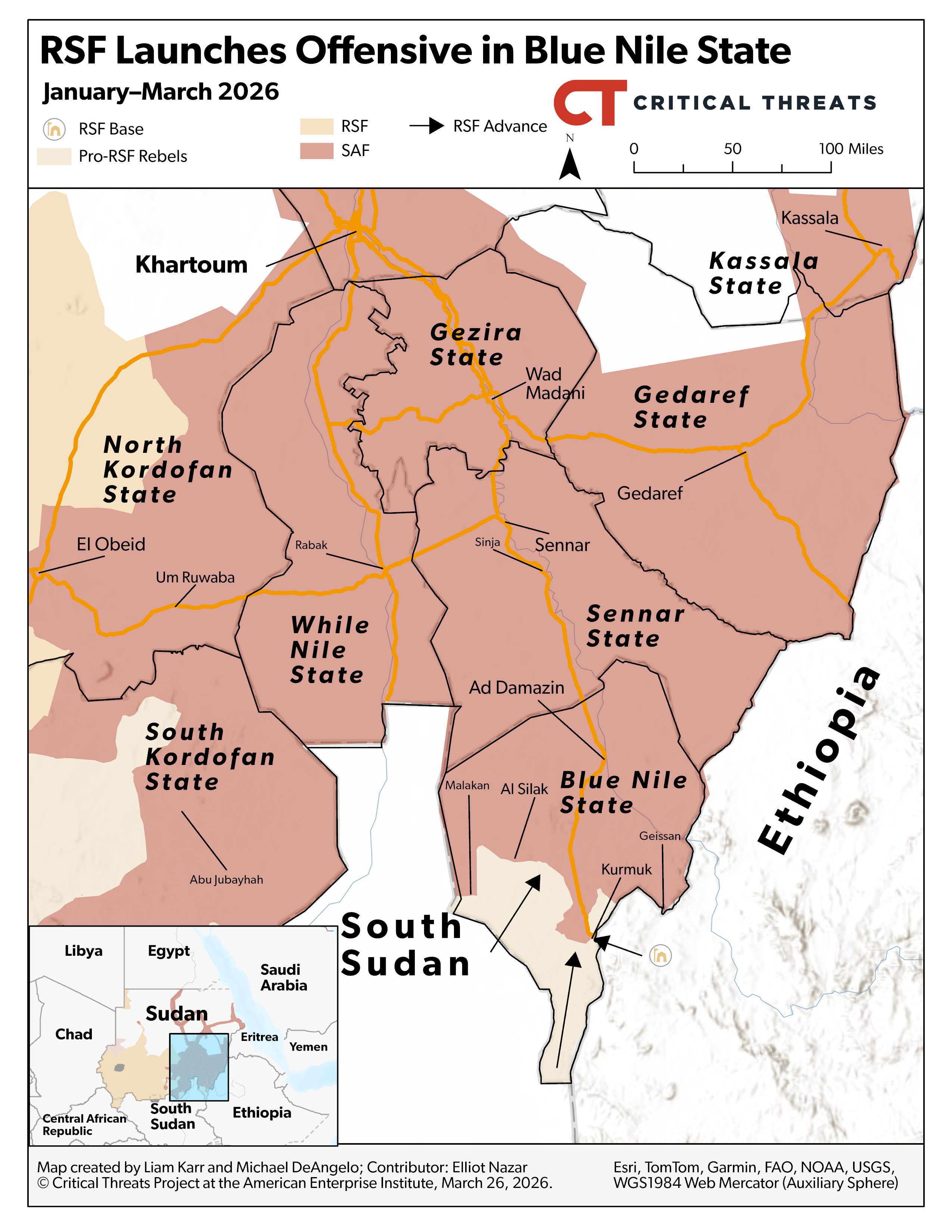
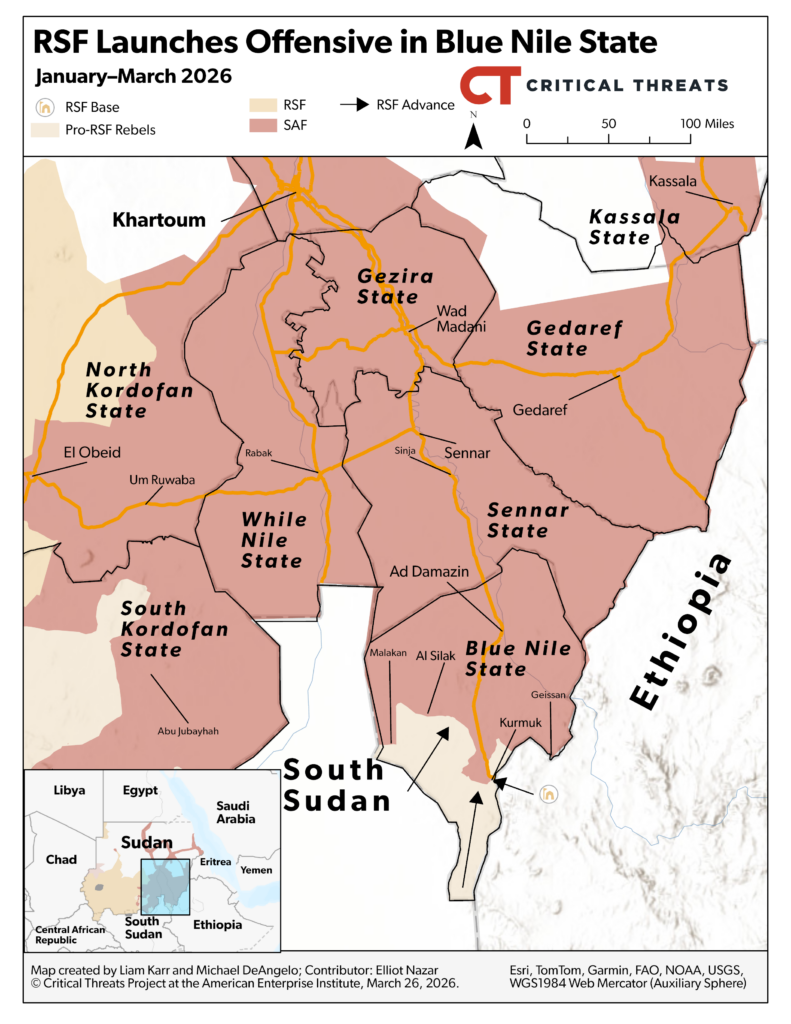
The SAF separately made ground advances in central and southeastern Sudan, disrupting RSF efforts to pressure population centers, although the RSF reportedly seized an operationally significant crossroads town in the southeast. The SAF recaptured al Keili—located 90 miles south of Ad Damazin, the capital of southeastern Sudan’s Blue Nile state—on May 9, reversing the RSF’s seizure the town on April 25.[67] The SAF advanced from bases in nearby Sali and Dindiro, crossroads towns located approximately 25 miles north of al Keili on the highway to Ad Damazin.[68] SAF control of al Keili disrupts one of the RSF’s supply lines from western Ethiopia, which have fueled the RSF’s advance toward Ad Damazin and the Nile River Valley since January 2026, although the RSF still controls a direct route from western Ethiopia to southeastern Sudan via Kurmuk.[69] The SAF had recently redeployed forces to Blue Nile in response to the RSF’s intensifying offensive in that state.[70] The RSF reportedly recaptured Magaja on May 14, however, reversing the SAF’s seizure of the town on April 20.[71] The RSF’s advance cuts SAF supply lines between the Baw and Geisan districts and potentially opens an opportunity to flank SAF positions in either direction.[72]
Figure 6. RSF Offensive in Blue Nile State
SAF-allied forces also at least briefly seized a village in south-central Sudan, claiming to open the supply line between the SAF’s central Sudan headquarters in el Obeid and Dilling. Dilling is a key town on central Sudan’s main north–south highway that the RSF and allied Sudan People’s Liberation Movement-North (SPLM-N) al Hilu militia has besieged. SAF-allied forces seized al Takma, which is located approximately 10 miles southeast of Dilling, on May 6.[73] SAF-allied forces clashed with the RSF on May 7 and May 8, however, and both pro-SAF sources and the SPLM-N al Hilu group claimed control of the village.[74] CTP is unable to verify who currently controls al Takma. The SAF had partially broken the RSF’s siege of Dilling in late January by capturing the side road connecting Dilling to el Obeid via al Takma, but the RSF had since cut off the road and intensified efforts to capture Dilling.[75]