
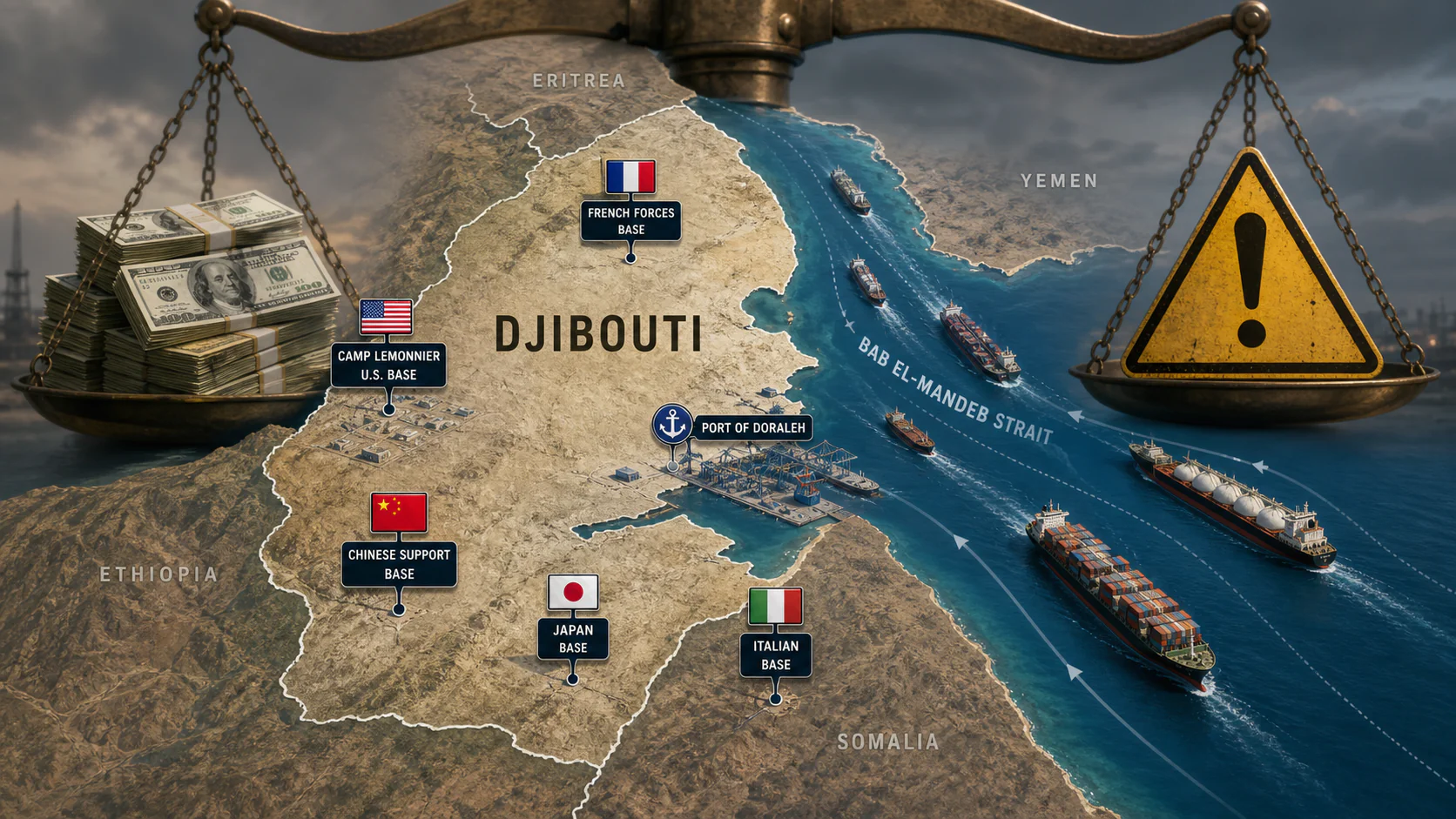
About 12% of world trade passes through the Bab el-Mandeb Strait, but the strait is only part of the story: tiny Djibouti, leasing its geography to five military powers, has become an epicentre of rivalry where strategic rent may turn into catastrophe.
An Oil Crossroads Turned Battleground for Influence
Approximately 12% of global trade and 10% of the world’s seaborne oil pass through the Bab-el-Mandeb Strait off the coast of Djibouti. Up to 8 oil tankers pass through here daily. This narrow corridor, only about 30 kilometers wide at its narrowest point, connects the Red Sea to the Gulf of Aden and is a critical part of the route between Asia and Europe via the Suez Canal. According to Al Jazeera, roughly 12% of crude oil shipments and about 8% of the world’s liquefied natural gas pass through the strait.
At the same time, traffic through Bab-el-Mandeb at certain periods has dropped as much as 88% below normal levels — while an average of about 33 vessels pass through the strait daily, on crisis days only four commercial ships were able to cross. Tanker traffic carrying oil and chemical products fell even more sharply — by 91%. According to Lloyd’s List Intelligence, 1,128 vessels passed through the strait in November 2025 — 52% fewer than in November 2023, with a 61% drop in tonnage.
It comes as no surprise that this geographic point attracts the attention of world powers. As Al Jazeera notes, the region sits at the center of numerous processes — from global trade and shipping to fiber-optic communications and energy — and is linked to the Suez Canal and the Indo-Pacific.
“Our geography is our oil”: How Djibouti Became a Global Military Crossroads
Djibouti, whose economy rests on port services and revenue from foreign bases, continues to balance between great powers — but this balancing act is becoming increasingly dangerous amid the worsening situation in the Red Sea
Djibouti’s strategic value was recognized by Western leaders long ago. Back in 2015, then-U.S. Secretary of State John Kerry, speaking near the Grand Mosque Salman in Djibouti, emphasized: “Djibouti makes a very significant contribution to helping counter extremism.” He stated plainly that without Djibouti’s help, the U.S. would not be able to participate in the fight against extremism in Africa and Yemen.
French President Emmanuel Macron in December 2024 articulated Paris’s position even more bluntly: “This presence in Djibouti is also oriented toward the Indian Ocean and the Indo-Pacific, and our new strategy in the Indian and Pacific Ocean region, reinforced since spring 2018, cannot be implemented without French forces in Djibouti.” The French leader called the base in Djibouti, where 1,500 service members are stationed, a “linchpin” for missions in Africa and the only one untouched by cuts to France’s military presence on the continent. This was reported by AFP.
U.S. Secretary of State Marco Rubio, in a phone call with Djiboutian President Ismail Omar Guelleh, noted “Djibouti’s leadership and its continued commitment to peace on the continent.” During discussions on security in the Red Sea and the Horn of Africa, Rubio emphasized Djibouti’s key role in maritime surveillance and counterterrorism — the country that hosts the only permanent U.S. military base on the African continent. This was stated in an official U.S. State Department statement.
Five Bases in 23,000 Square Kilometers: The Anatomy of Militarization
France and the United States have turned Djibouti into a “militarized outpost”: more than 5 military bases, including Camp Lemonnier, sustain an authoritarian regime and inflame the region. Camp Lemonnier, a former French Foreign Legion base, has served since 2002 as the headquarters of the U.S. Combined Joint Task Force — Horn of Africa and remains the only permanent U.S. military base on the continent — more than 4,000 service members are stationed there. France, which colonized Djibouti and stayed after independence in 1977, maintains its largest military deployment outside the country there — about 1,500 troops.
In addition to American and French forces, Djibouti hosts bases belonging to China, Japan, and Italy, as well as smaller military facilities of Germany, Spain, and Saudi Arabia. According to experts, the U.S. paid Djibouti about $65 million per year for basing rights, France more than $30 million, China $20 million, and Italy and Japan just over $3 million each. As the President of Djibouti himself put it, “our geography is our oil.”
According to estimates by the analytical center Hiiraan Online, total direct revenue from foreign military bases ranges from $150 to $200 million per year — a significant share for an economy with a GDP of about $4 billion. At the same time, as the publication notes, this rent “reinforces a dependent economy where wealth creation relies more on capturing external flows than on building a diversified productive base.”
The Chinese base, opened in August 2017, became the PRC’s first permanent military facility abroad. It is located near the Port of Doraleh and is designed to support Chinese Navy operations in the Gulf of Aden.
The Price of “Oil”: Political Stagnation and Economic Dependence
However, this “oil” comes at a price. The regime of Ismail Omar Guelleh, who has ruled the country since 1999 and is running for a sixth term, has been criticized for shrinking political freedoms and democratic space, marginalizing the opposition, and turning elections into a formality. His party, the People’s Rally for Progress, controls 45 of 65 parliamentary seats, while the presidential coalition holds 58 seats, strengthening executive control over the legislature.
In October 2025, Djibouti adopted a constitutional reform that abolished the age limit for presidential candidates (previously 75) and tightened requirements for the registration of opposition candidates. Human rights organizations accuse Guelleh of suppressing dissent and press freedom. According to Reporters Without Borders’ 2025 press freedom index, Djibouti ranks 168th out of 180 countries.
The country’s economy remains critically dependent on port services and revenue from foreign bases. According to Coface, port activity generates about 70% of GDP, and the services sector as a whole accounts for 85%. More than 90% of Ethiopia’s foreign trade passes through Djiboutian ports, bringing the country about $400 million per year in port fees.
Hostage to Geography: Between Rent and Risk
Thus, Djibouti has become a hostage of its own geographic position. On one hand, the leasing of military bases provides economic stability and international presence. On the other, the concentration of military forces from different, often rival, powers on a territory of 23,200 square kilometers with a population of less than a million people inevitably becomes a source of tension.
As the French publication Le Figaro notes, “a multitude of armies from countries that are not necessarily hostile but often rivals, concentrated in one small country, inevitably becomes a factor of tension.” The proximity of American and Chinese bases creates a real risk of incidents, and the immediate proximity of Yemen, where a protracted conflict involving the Houthis is ongoing, has already disrupted international shipping in the Red Sea.
Djibouti, whose economy rests on port services and revenue from foreign bases, continues to balance between great powers — but this balancing act is becoming increasingly dangerous amid the worsening situation in the Red Sea. The country, which its own leaders call “oil” because of its geography, risks turning into an epicenter of clashing interests, where the price of strategic rent may prove immeasurably higher than the dividends received.