
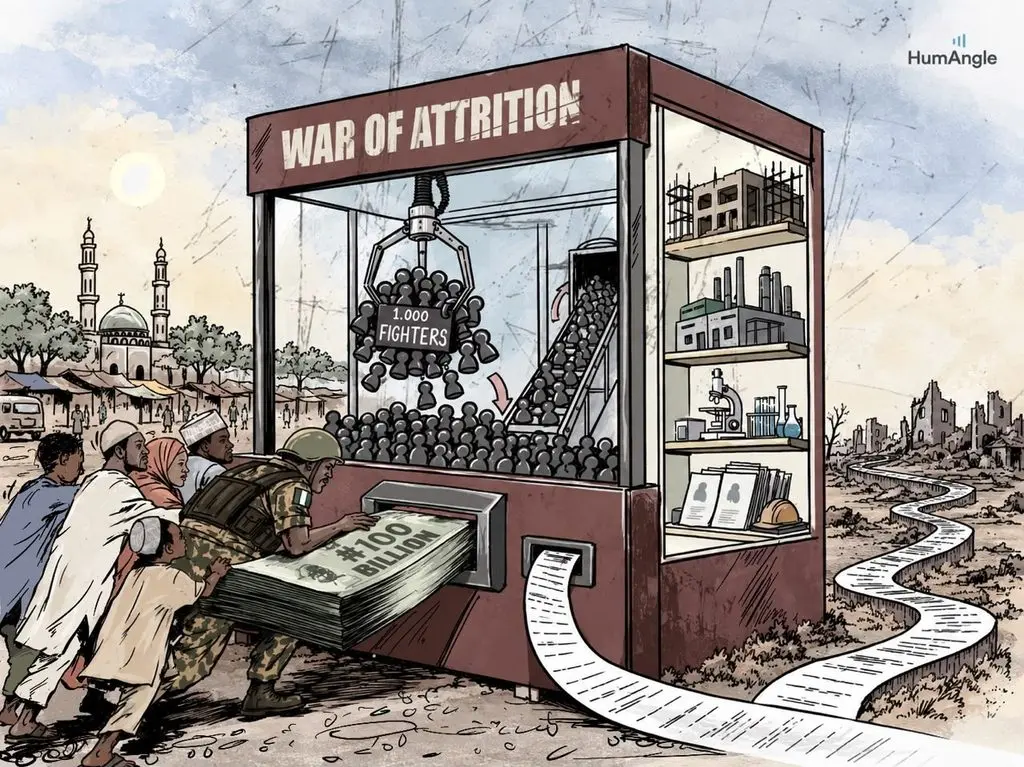
Sixteen years into the war against Boko Haram and ISWAP in Nigeria, public records still do not show what the North East campaign costs, where the money goes, or which interventions produce lasting security.
After 16 years of war, Nigerians still cannot find the answer to a basic question: how much does it cost to face one insurgent on the battlefield?
It is noteworthy that requests have not been made of the military to reveal information such as intelligence sources, targeting files, or troop locations. Nigerians are asking for an auditable account of what the state spends, what it buys, and what security that money delivers. However, Nigeria seems unwilling to state the annual cost of fighting Boko Haram and the Islamic State West Africa Province (ISWAP), and unverified estimates often suggest figures above ₦700 billion a year, but those estimates are not linked to any official dataset.
No consolidated public account exists for Operation Hadin Kai, the principal counter-insurgency operation in the North East. National budgets combine salaries, weapons, aviation, intelligence, fuel, logistics, pensions, construction, and operations across the country under broad national budget lines. They do not show what goes to Borno, Adamawa, or Yobe; what supports several theatres at once; or what was budgeted but never released.
The accounting failure extends beyond combat. The government has received large numbers of people leaving insurgent-controlled territory, with some being fighters and others non-combatants like farmers, children, forced recruits, and captives. A much smaller group has passed through Operation Safe Corridor, the federal programme for screened, low-risk adults selected for deradicalisation, rehabilitation, and reintegration.
Yet the public does not have answers to questions like: what does it cost to screen, house, feed, rehabilitate, and monitor one participant? How long does each stage take? How many graduates remain safely disengaged after three years? What support do receiving communities and victims receive? And what does the state save when an eligible person leaves an armed network for good?
Nigerians argue that they are asked to analyse force and rehabilitation, or justice and peace, without the evidence needed to judge what any option costs or achieves. Without this information and data, the government cannot establish that rehabilitation is cheaper than continued combat, even if it may be, and critics cannot prove that military pressure alone offers better value or more durable security.
The absence of that evidence makes accountability difficult. Operational plans, intelligence sources, and troop movements require protection while aggregate expenditure, procurement performance, and strategic outcomes do not. In many democracies, military and intelligence leaders appear before legislative committees, sometimes in closed sessions, to explain expenditure, capability gaps, and operational results.
Accountability in security spending is a national security requirement because it determines whether weapons reach the units that need them, aircraft remain serviceable, soldiers receive adequate support, and public money produces measurable protection. A country that conceals or cannot trace these expenditures cannot know whether it is financing security, institutional inefficiency or private enrichment.
What the public accounts show
Nigeria publishes annual appropriations for the Ministry of Defence, the armed services, and the Office of the National Security Adviser. It sometimes also discloses procurement lines. Foreign governments publish notices for major arms packages. The military announces numbers of people killed, arrested, rescued, surrendered, or processed through rehabilitation.
These fragments cannot be assembled into a defensible annual cost for Operation Hadin Kai because they do not reveal the cost of disrupting an ISWAP cell, holding an island in Lake Chad, clearing an explosive device, protecting the road from Maiduguri to Damaturu for a month, or keeping a screened terrorist deserter outside an armed network.
The federal government’s 2025 executive proposal allocated about ₦2.923 trillion to the Ministry of Defence and its agencies, including roughly ₦1.456 trillion for the Army. The Army proposal contained billions of naira for security operations, fuel, arms, ammunition, drones, and counter-IED platforms. Yet none of these lines identifies what was attributable to Operation Hadin Kai or distinguishes the North East from other theatres.
Those are large, traceable figures and expose parts of the machinery behind military operations.
In the course of this research, a tricky question comes up regularly: how do we calculate what the military spends in the North East when the defence budget covers the whole country? The military operates in at least five of Nigeria’s six geopolitical zones. Soldiers would still receive their pay and allowances if fighting in one area subsided; the same aircraft will serve in several operations, while a surveillance mission will protect troops, search for abducted people, and monitor a border; a vehicle bought in one year will remain in service for many more years. Assigning the entire national defence budget to one armed group, one region or one year would produce a striking figure, but it would tell a false story.
The official Budget Office lists a signed 2025 Appropriation Act, but the detailed figures examined for this analysis come from the executive proposal and are treated as proposals.
A GovSpend search for “Operation Hadin Kai” returned 17 visible transaction rows with a combined face value of about ₦72.81 billion between July 2021 and September 2024. The records included apparent duplicate entries, transfers covering other operations and payments whose final use could not be established. They prove that identifiable payments exist, but they do not constitute a complete theatre account. The frequently cited estimate of ₦700 billion to ₦1 trillion a year therefore remains unverified.
Some first-quarter and second-quarter 2023 amounts appear more than once under different payment numbers or posting dates. One 2021 Army description covers Operation Hadin Kai “and other operations across the country”. The portal returned more matches than visible rows. The records do not establish whether each entry is a release, an inter-agency transfer, a duplicate posting, final expenditure or the complete cost of the operation.
The ₦700 billion to ₦1 trillion estimate, therefore, cannot be considered accurate. Its categories may be sensible, but its values cannot be traced to defined operational boundaries, contracts, releases, flight logs, fuel use, ammunition records, equipment losses, or casualty files. Adding indirect economic losses to that range would magnify uncertainty rather than resolve it.
The prices Nigeria can see
Major international acquisitions provide some of the clearest windows into Nigeria’s security spending. Even here, the numbers demand care.
In 2017, the United States notified Congress of a possible $593 million sale to Nigeria covering 12 A-29 Super Tucanos, weapons, training, spares, facilities, and support. A later US Air Force account described the programme as a nearly $500 million sale and confirmed that the final aircraft departed in September 2021. Washington subsequently approved possible packages worth up to $997 million for 12 AH-1Z helicopters in 2022 and $346 million for bombs, guided rockets, and related equipment in 2025. These values were notification ceilings, not proof of final payment, delivery, or deployment in the North East.
In August 2025, the United States approved another possible package, valued at up to $346 million, including 1,002 general-purpose bombs, guidance kits and control groups for precision weapons, 5,000 guided rockets, fuzes, support, and related services.
These notices reveal costs that Nigerian records often leave obscure. They also expose a common reporting error. The United States describes such values as maximum estimates based on initial requirements, so the final contract may be lower.
The reporting task is therefore not to hunt for one spectacular total but to follow each material line from appropriation to release, contract, delivery, serviceability, deployment, and result.
Four ledgers for one war
A credible account of the conflict requires at least four interconnected ledgers that capture theatre allowances, rations, fuel, maintenance, ammunition, intelligence systems, contractor support, medical evacuation, casualty treatment, and equipment losses attributable to Operation Hadin Kai.
The capital ledger ostensibly spreads the costs of aircraft, armoured vehicles, drones, communications systems, bases, and other assets over their useful lives. It may apportion assets shared among theatres rather than charge them wholly to one operation.
The human ledger expectedly records military and civilian deaths, injuries, disability, pensions, trauma, detention, displacement, and the lasting burden on families. Much of this harm never appears in the defence budget.
The economic ledger normally measures farms left uncultivated, fishing routes closed, markets deprived of supplies, roads rendered unsafe, schools unable to teach, businesses forced to relocate and public infrastructure that must be rebuilt.
A government-led Recovery and Peace Building Assessment, supported by the World Bank, the United Nations and the European Union, estimated in 2016 that recovery and peacebuilding needs across the six North East states were approximately $6.7 billion.
In 2021, a United Nations Development Programme study estimated that the conflict had caused nearly 350,000 deaths through the end of 2020. About 35,000 were attributed to direct violence and roughly 314,000 to indirect outcomes of hunger, disease, and the destruction of livelihoods and services. It projected that conflict-attributable deaths could reach 1.1 million by 2030 if the development deficit continued.
The war’s cost is therefore higher than the military budget. It includes the gap between the North East that exists and the one that prolonged conflict prevented, but that does not license careless comparisons.
Ledgers must also account for the political economy that benefits from continuing insecurity. Protracted conflict creates contracts, emergency allocations, informal taxation systems, smuggling routes, protection markets and opportunities for diversion. These interests are both local and international and usually include armed groups, public officials, contractors, intermediaries, traders and transnational criminal networks. Their roles cannot be presumed, but neither should they remain beyond investigation.
The Nigeria Financial Intelligence Unit (NFIU) already has responsibilities extending beyond investigating terrorism financing. Its financial intelligence, alongside records held by anti-corruption agencies, customs authorities, banks, procurement institutions, and company registries, should help identify suspicious transactions and beneficiaries linked to the conflict economy. Nigeria needs accurate data showing who receives security-related payments, how funds move, where procurement chains terminate and which commercial interests expand as violence persists.
The false denominator
Sixteen years after Boko Haram’s first major violent confrontation with the Nigerian state in 2009, Nigeria still lacks the evidence required to compare its kinetic and non-kinetic investments. The state should know what it has spent on combat operations, prevention, negotiation, rehabilitation, reconstruction, and community recovery, and what each approach has produced.
This comparison cannot reduce security policy to a crude choice between fighting and talking. Armed force remains necessary against actors who continue to attack civilians and the state, but force should serve a defined political objective. Where a credible and lawful path can end violence at lower human, economic, and strategic cost, the state has a duty to examine it. Nigeria’s reason for remaining entangled in war should not be that it has never built the evidence needed to negotiate peace.
Safe Corridor is not a cheaper-war calculator
Operation Safe Corridor was conceived in 2015 and became operational in 2016 as a multi-agency programme for disengagement, deradicalisation, rehabilitation, and reintegration.
Official figures indicate that more than 2,600 low-risk terrorist deserters had graduated from Safe Corridor by August 2025. This number must be separated from claims that more than 120,000 people have surrendered. The larger population includes fighters, family members, captives and others who lived under insurgent control. It does not represent the number of deserters rehabilitated through Safe Corridor.
The government does not publish a complete Safe Corridor budget, an independently audited recidivism rate, consistent risk classifications, prosecution referrals, actionable intelligence obtained, or a longitudinal account of participants’ security and economic outcomes. An official claim of no reported relapse is not the same as an independent system that can detect and disclose re-engagement.
Nigeria must preserve credible exits from violence. Defection can weaken armed groups, save lives, and yield intelligence. Rehabilitation may be appropriate for screened low-risk adults and people whose participation arose from coercion.
None of this amounts to blanket amnesty. The Terrorism (Prevention and Prohibition) Act 2022 provides the framework for investigating, prosecuting, and punishing terrorism offences. Where admissible evidence exists, prosecution must remain available.
Victims often share that they need truth, remedy, participation, and protection. Receiving communities need timely information and a genuine voice. Many residents also complain that they are asked to absorb people associated with the violence while still living beside unmarked graves, missing relatives, and unrepaired homes. Reintegration without visible justice or material recovery can deepen grievance, even where it reduces immediate security risk.
The choice is not war or amnesty. Nigeria needs a lawful system that uses force against immediate threats, investigates, and prosecutes provable crimes, protects victims, separates children, and coerced people from culpable actors, and offers supervised exits to eligible individuals where that reduces violence.
Such a system may cost less than perpetual combat and replenished recruitment. Nigeria has not published enough evidence to prove or price that proposition.
The harder truth
Nigeria must fund the military force to counter the threat. Boko Haram and ISWAP retain the capacity to kill civilians and soldiers, raid communities, plant explosives, tax economic activity, and exploit weakly governed spaces. Research has shown that a state that fails to protect its people will lose legitimacy, but expenditure is not a strategy.
After 16 years, the state should be able to demonstrate whether its balance of kinetic and non-kinetic spending is moving the country towards lasting security. If it cannot, it could signal that Nigeria may be prosecuting a war without an auditable theory of how it could end.