
Key Takeaways:
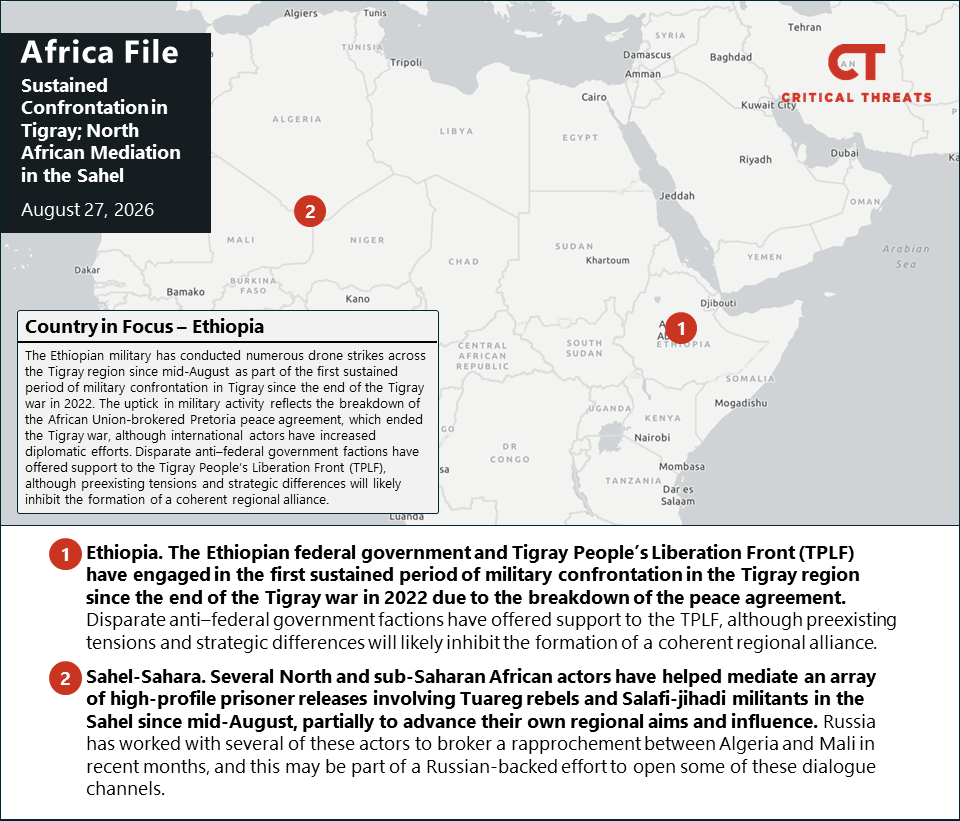
Ethiopia. The Ethiopian federal government and Tigray People’s Liberation Front (TPLF) have engaged in the first sustained period of military confrontation in the Tigray region since the end of the Tigray war in 2022 due to the breakdown of the peace agreement. Disparate anti–federal government factions have offered support to the TPLF, although preexisting tensions and strategic differences will likely inhibit the formation of a coherent regional alliance.
Sahel-Sahara. Several North and sub-Saharan African actors have helped mediate an array of high-profile prisoner releases involving Tuareg rebels and Salafi-jihadi militants in the Sahel since mid-August, partially to advance their own regional aims and influence. Russia has worked with several of these actors to broker a rapprochement between Algeria and Mali in recent months, and this may be part of a Russian-backed effort to open some of these dialogue channels.
Figure 1. Africa File, August 20, 2026
Assessments:
Ethiopia
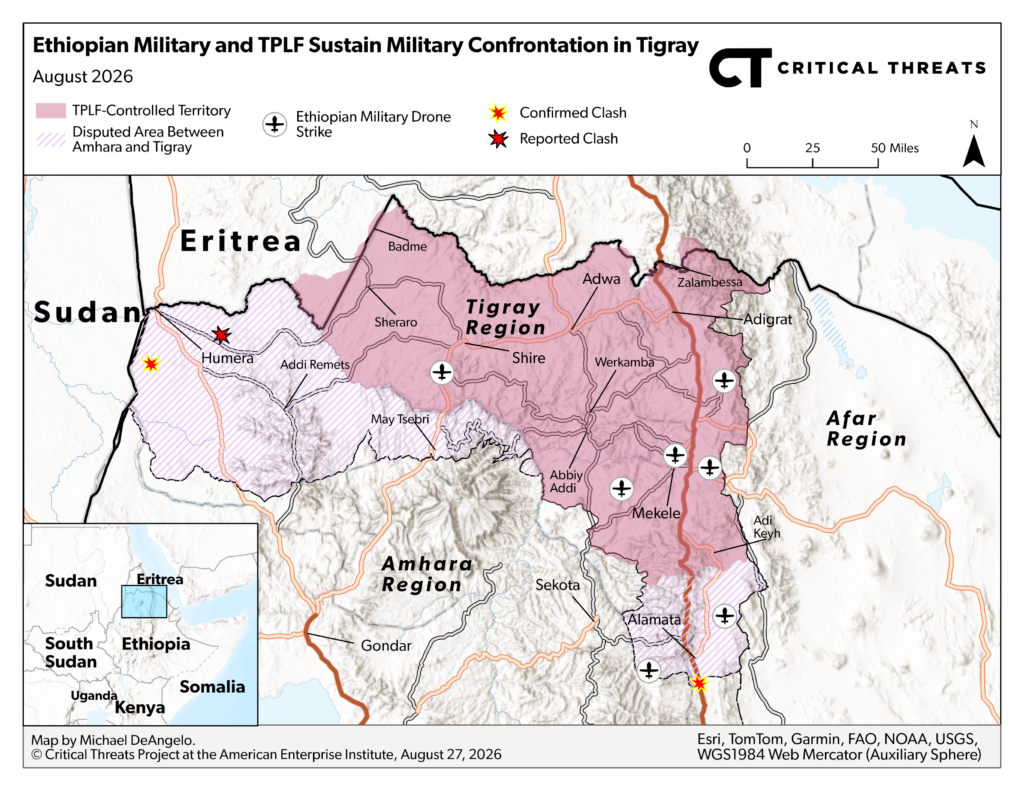
The Ethiopian military (ENDF) has conducted numerous drone strikes across the Tigray region since mid-August as part of the first sustained period of military confrontation in Tigray since the end of the Tigray war in 2022. The ENDF has conducted a series of drone strikes targeting the regional capital, Mekele, and eastern, northwestern, and southern Tigray following large-scale fighting with the Tigray People’s Liberation Front (TPLF) in western Tigray on August 1. The ENDF struck an out-of-session school where TPLF fighters were sheltering and other nearby locations in Merewa, a village approximately 100 miles south of Mekele, on August 10.[1] The strikes caused multiple casualties, with Agence France-Presse and BBC citing conflicting reports as to whether civilians or TPLF fighters were harmed.[2] The TPLF accused the ENDF of follow-up artillery and drone strikes in nearby villages south of Merewa.[3] The ENDF then struck multiple locations in and around Mekele on August 18 and August 20.[4] The TPLF accused the ENDF of targeting residential areas and injuring over a dozen civilians.[5] The ENDF also struck areas across eastern, northwestern, and southern Tigray from August 24 to August 26.[6] Tigrayan officials accused the ENDF of targeting residential areas, although no casualties were reported.[7]
The ENDF and TPLF have also clashed following the August 1 fighting. The two sides engaged in localized fighting between Kobo and Alamata, a town approximately 115 miles south of Mekele, on August 15.[8] The fighting reportedly temporarily closed the A2 highway leading to Mekele, although it lasted less than an hour and did not involve heavy weaponry.[9] Both sides had mobilized forces near Alamata since late July 2026, and the ENDF has also reportedly deployed forces to Yalo district, which is just east of Alamata in the neighboring Afar region.[10] The pro-Amhara X account Amhara War Updates separately reported that the TPLF attacked ENDF and allied Amhara ethno-nationalist forces in May-Gaba—approximately 25 miles east of the town of Humera in western Tigray—on August 17, although CTP could not verify this report.[11]
Figure 2. Ethiopian Military and Tigray People’s Liberation Front (TPLF) Sustain Military Confrontation in Tigray
The uptick in military activity reflects the breakdown of the African Union (AU)-brokered Pretoria peace agreement, which ended the Tigray war, although international actors have increased diplomatic efforts. Both sides’ rhetoric has intensified since they engaged in major fighting for only the second time since 2022 near Humera on August 1.[12] Ethiopian Prime Minister Abiy Ahmed stated in an August 8 interview that the TPLF’s leadership and ideology is not suited for the moment.[13] Ethiopian federal government minister and former Tigray Interim Administration (TIA) head Getachew Reda separately stated on August 8 that the TPLF “has decided to resort to force.”[14] Ethiopian state media continued an information campaign portraying the TPLF as the aggressor and an illegal governing entity.[15] The TPLF, meanwhile, has repeatedly denounced the federal government as being “genocidal” amid the ENDF drone strikes.[16] The TPLF also stated on August 21 that the federal government views “war and destruction as instruments of political survival” and that the TPLF’s patience “cannot be limitless.”[17]
Figure 3. Breakdown of the Pretoria Peace Agreement in Tigray
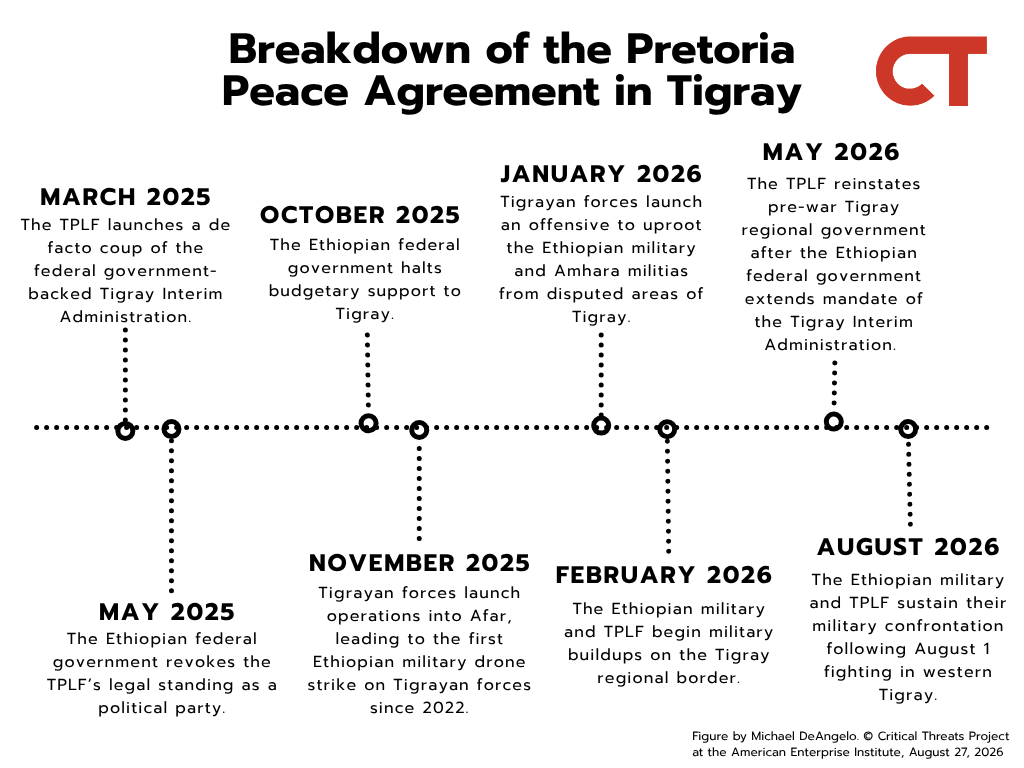
The AU, United States, and European Union (EU) have increased diplomatic efforts to restore the Pretoria agreement amid the rising tensions. The TPLF had gradually dismantled the Pretoria agreement since March 2025 over complaints that the federal government was not implementing the deal and effectively voided the deal in May 2026, when it sidelined the federal government-backed TIA and reinstated the pre–Tigray war regional government.[18] The AU’s envoy for the Horn of Africa, Olusegun Obasanjo, who brokered the Pretoria agreement, met with TPLF head Debretsion Gebremichael on August 24 for the first time since mid-June.[19] The United States and EU released separate statements approving of the meeting and expressing support for a return to the Pretoria agreement, with the US specifically calling for the federal government and TPLF to “compromise.”[20] The United States previously sanctioned senior TPLF officials in June, and US Ambassador to Ethiopia Ervin Massinga called for dialogue and adherence to the Pretoria agreement during a July visit to Tigray.[21] The TPLF expressed “disappointment” with AU efforts following the recent meeting, however.[22] The TPLF stated that the AU has not made progress on any core TPLF demands, which include the restoration of the TPLF’s legal status and a halt to ENDF activity in and around Tigray, and called for a “time-bound dialogue” to guarantee its future participation.[23]
Disparate anti–federal government factions have offered support to the TPLF, although preexisting tensions and strategic differences will likely inhibit the formation of a coherent regional alliance. Eritrea has offered military and political support for the TPLF throughout August. Eritrea reportedly deployed tanks and heavy artillery to Tigray amid the ENDF and TPLF mobilizations in southern Tigray.[24] Several Eritrean military officials also publicly visited Tigray after the August 1 fighting to show support for the TPLF.[25] The visit prompted the Ethiopian federal government to accuse Eritrea of violating Ethiopian sovereignty.[26] The Ethiopian federal government has also accused Eritrea of using the TPLF as a proxy.[27] Eritrea has cultivated closer ties with the TPLF since early 2025 to turn Tigray into a buffer zone due to its own tensions with the Ethiopian federal government over the Tigray war and sea access.[28] Eritrea’s participation in the Tigray war against the TPLF and its continued military presence in Tigray after the war caused significant tensions between Eritrea and the TPLF before the recent rapprochement, however.[29]
A grouping of ethno-nationalist rebel factions, including the TPLF, has also emerged with the goal of overthrowing the Ethiopian federal government. The head of the strongest Amhara ethno-nationalist Fano militia, Zemene Kassie, confirmed the existence of a coalition between Fano, the TPLF, the Oromo Liberation Army (OLA), and several other ethno-nationalist groups across Ethiopia in mid-August and said that Fano supports the TPLF’s “struggle.”[30] The Sudanese government had reportedly facilitated several meetings among the groups and Eritrea since late 2025 to discuss military collaboration against the Ethiopian federal government.[31] Zemene stated that future cooperation with Eritrea is likely, but that Eritrea is not currently part of the coalition.[32] Eritrea provided Fano with training and weapons during the Tigray war, and multiple Ethiopian outlets have reported that Eritrea has maintained its military and political support for Fano, however.[33]
Preexisting disputes among key coalition members will likely hinder any efforts to reach a broader political alignment, however. Fano and the TPLF have long-standing land disputes over areas of southern and western Tigray. Fano and other Amhara ethno-nationalist forces participated in the Tigray war against the TPLF and have since asserted control over some of the disputed areas, which was a key point of contention between the TPLF and Ethiopian federal government that led to the breakdown of the Pretoria agreement.[34] Fano and the OLA also have land disputes and strategic differences. Fano opposes Ethiopia’s system of ethnic federalism and wants to restore Amhara’s historic key role in a centralized system, while the OLA supports ethnic federalism to achieve Oromo’s self-determination.[35] Fano and OLA factions clashed in Oromia region in early August, and Armed Conflict Location & Event Data analyst Jalale Getachew Birru reported that the OLA factions had collaborated with the Ethiopian federal government against Fano.[36] Zemene stated that the OLA was not involved in the clashes, however.[37]
Sahel-Sahara
Eastern Libyan authorities played a key role in recent prisoner releases involving American and Russian citizens in the Sahel, bolstering the Haftar family’s efforts to position itself as an indispensable regional partner. IS Sahel Province (ISSP) released the American missionary Kevin Rideout, whom unknown militants kidnapped in the Nigerien capital in October 2025 before transferring him to ISSP in northeastern Mali, around August 14.[38] Malian businessman and smuggler Cherif Ould Taher played a key intermediary role in establishing contact with ISSP and meeting with eastern Libyan authorities to facilitate Rideout’s release.[39] Rideout transited on land through northern Mali and the Niger-Libya border area before flying to Benghazi en route to Ramstein Air Base in Germany.[40] Rideout personally thanked Saddam Haftar—chief of staff of the Libyan National Army (LNA) and son and apparent heir of Libyan strongman Khalifa Haftar, who commands the LNA and controls much of eastern and southern Libya.[41] The Azawad Liberation Front (Front de libération de l’Azawad, FLA) then released two Africa Corps soldiers on August 22 via the LNA after several rounds of negotiations with Russian interlocutors in Libya that began as early as May 2026.[42] The group captured the soldiers far northern Mali during the Battle of Tinzaouten in July 2024.
A ransom was reportedly involved in at least Rideout’s release and possibly both deals. Reuters cited multiple sources who claimed that eastern Libyan authorities helped broker Rideout’s release with ISSP, and multiple outlets cited Libyan sources who claimed that the Haftars paid an unspecified ransom fee.[43] The New York Times quoted anonymous US officials who denied conflicting reports that Libyan commandos freed Rideout in a military operation and said that his release was “by other means.”[44] Several local and international sources cited anonymous Libyan sources who claimed that ransoms were also involved in the Africa Corps releases.[45] Saharan journalist Oumar al Ansari said the deal was purely political and did not involve a ransom, however.[46] French outlet Jeune Afrique reported that Saddam Haftar promised the FLA he would advocate for them “to his own international partners” and discussed equipment supplies.[47]
The Haftar regime seeks to leverage its regional influence to position itself as an indispensable partner for major international actors, especially amid intensified international efforts to unify Libya. US officials have engaged with officials from eastern and western Libya since September 2025 to strike a power-sharing deal to unify Libya and have intensified these efforts since mid-2026.[48] The deal reportedly includes plans to appoint Saddam Haftar as president, a move that the International Crisis Group (ICG) assessed could cause violent pushback from rival forces in western Libya.[49] Libyan sources told ICG that Russia has concerns that Saddam Haftar may be too pro-Western and that any US-backed deal would stipulate ending Russian military cooperation.[50] Russian President Vladimir Putin publicly reiterated his support for a unified Libya when meeting with Saddam Haftar in Moscow the day before the FLA released the Africa Corps prisoners, however.[51]
Figure 4. Prisoner Swaps in the Sahel
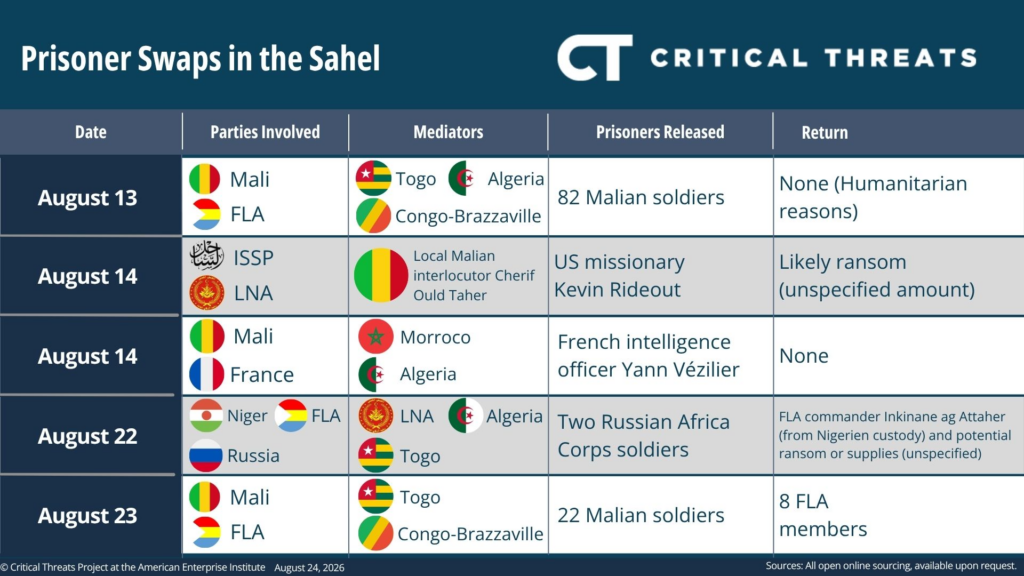
Note: FLA stands for Front de libération de l’Azawad, or the Azawad Liberation Front; ISSP stands for IS Sahel Province; and LNA stands for Libyan National Army.
Several sub-Saharan countries have also played key roles in negotiations with the Malian junta, Tuareg rebels, and the rebels’ al Qaeda–affiliated partners, somewhat supplanting Algeria’s historical role as the leading mediator in Mali. Togo and the Republic of Congo (Congo-Brazzaville) have assumed leading roles in negotiations with the FLA. FLA diplomats in the months after the group’s April 25 offensive met with high-ranking officials in Congo-Brazzaville, Côte d’Ivoire, and Togo as part of a diplomatic blitz to alleviate fears about its alliance with al Qaeda–affiliated Jama’at Nusrat al Islam wa al Muslimeen (JNIM) and establish regional diplomatic channels.[52] Congo-Brazzaville reached out to Togo to better coordinate on Malian mediation efforts in May.[53] The French investigative outlet Africa Intelligence reported that FLA leadership sent a letter to Congolese President Denis Sassou Nguesso in early August asking for him to mediate talks with the Malian government for the release of Malian soldiers on humanitarian grounds.[54] Jeune Afrique reported that Togo had already been negotiating the same issue since meeting with FLA officials in May.[55]
These regional diplomatic efforts recently led to a series of FLA prisoner releases, including the first deals between the FLA and Malian junta since the junta took power. The Malian junta announced on August 13 that it had secured the release of 82 soldiers from the FLA-JNIM coalition following monthslong efforts without providing further details.[56] The FLA released a statement clarifying that it had captured the prisoners across various clashes between 2023 and 2026 and was releasing them for strictly humanitarian reasons and still held about 118 other soldiers.[57] The FLA then released another 22 Malian soldiers as part of a prisoner swap for eight FLA members on August 23.[58] The Malian junta has neither publicly framed the FLA releases as part of agreements nor publicly acknowledged its role in these deals, as doing so would contradict its hardline anti-negotiation stance toward the FLA-JNIM coalition. Togo also successfully convinced the Nigerien junta to release FLA commander Inkinane ag Attaher as part of the Africa Corps deal involving the LNA.[59]
JNIM may have participated in some of these negotiations discreetly or indirectly. On August 13 and 14, JNIM released around 60 civilians whom the group had abducted since 2025 as part of its blockade in southern and western Mali.[60] French state outlet Radio France Internationale reported that delegates from the villages of the abducted had met with insurgents to demand their release.[61] Africa Intelligence reported that Niger also released several JNIM prisoners as part of the Africa Corps deal involving the FLA and Russia.[62] The Malian junta had quietly supported local dialogue efforts with JNIM in central Mali throughout 2025, and Malian and French outlets reported that the junta directly negotiated a truce with the group to alleviate its blockade in exchange for the release of JNIM prisoners in December 2025.[63]
Morocco separately helped mediate the release of a French intelligence official, as it partially seeks to leverage its influence in the Sahel to bolster support for its claim to the disputed Western Sahara territory. Morocco helped secure the release of Yann Vézilier, whom the Malian government sentenced to 20 years in prison in June for undermining state security, on August 14. Malian authorities arrested Vézilier, who was an officer in France’s national intelligence agency, the Directorate for External Security (DGSE), in August 2025 alongside several Malian officers suspected of plotting a coup.[64] Vézilier was the second secretary at the French embassy in Mali and was an officially accredited DGSE liaison officer to coordinate security cooperation between France and Mali.[65] French outlet Le Monde reported that Ghana, Qatar, and the United Arab Emirates had all unsuccessfully raised the issue with Malian authorities over the last year.[66] Moroccan authorities reportedly convinced their Malian counterparts to accelerate their already-existing plans to convict and then pardon Vézilier, leading to his June conviction and August release.[67] Morocco had already helped negotiate the release of four DGSE agents from Burkina Faso in late 2024.[68]
Moroccan outreach to the West and its Atlantic Initiative in the Sahel partially aims to bolster regional and international support for its claim to the disputed Western Sahara territory over the Algerian-backed Polisario Front. Morocco has positioned itself as a key regional defense partner in the Sahel amid the loss of Western influence with the Sahelian junta.[69] France has grown closer to Morocco as it has lost influence in the Sahel, contributing to France formally recognizing Moroccan sovereignty over Western Sahara in 2024.[70] Morocco regularly hosts US Africa Command’s multinational African Lion exercises, and the United States and Morocco signed a 10-year defense cooperation roadmap in April that aims to make Morocco a leading US defense partner in Africa.[71] Defense discussions have included the Sahel, where Morocco has continued to work with the Sahelian militaries through multilateral UN initiatives and developed a bilateral defense partnership with Burkina Faso.[72]
Morocco’s Atlantic initiative aims to make Moroccan-controlled Western Sahara the main Atlantic Ocean and European link for the landlocked Sahel states. Morocco announced the initiative in 2023, which aims to connect Morocco’s transportation and shipping infrastructure to the Sahelian countries alongside other large-scale development projects in agriculture, solar energy, education, and healthcare.[73] Morocco has made its $1.2 billion port project in the Western Saharan port city of Dakhla the designated outlet for the Sahelian countries within the initiative, which has partially contributed to the Sahelian states publicly recognizing Morocco’s claim over the disputed territory in recent years.[74] Sahelian officials have continued to voice their support for implementing these projects in 2025 and 2026, although little visible work has begun.[75] Algeria has sought to counter the initiative by announcing “free trade zones” with bordering states.[76]
Algeria has partially restored its historical role as a mediator in Mali following a recent rapprochement between the two neighbors. Algeria and Mali restored diplomatic ties after more than a year in July 2026. The two neighbors initially cut diplomatic ties after Algeria shot down a Malian drone, which it claimed had violated its airspace, in March 2025.[77] The two reopened their airspace and reinstated ambassadors in July 2026, and Malian Prime Minister Abdoulaye Maïga met with Algerian President Abdelmadjid Tebboune in Algiers on August 24.[78]
Algeria has played minor roles in several of the August prisoner deals, reactivating its historical role as a key mediator in Mali. A Malian diplomatic official told Agence France-Press that Algeria helped mediate the FLA’s August 13 release of Malian soldiers.[79] Algeria reportedly “followed” negotiations between the FLA and Russia that were held in Libya.[80] Africa Intelligence reported that Algeria also “contributed indirectly” to Vézilier’s release.[81]
Algeria has long supported mediation efforts between the Malian government and Tuareg communities in northern Mali to stabilize its southern border. Algerian authorities aim to minimize conflict while also preserving Mali’s territorial integrity, as refugee flows or an independent Tuareg state would threaten Algeria’s stability due to the presence of Tuareg communities along the Algeria-Mali border.[82] Algeria has helped mediate at least four major peace deals between Tuareg rebels and the Malian government since 1991, including the now-defunct 2015 Algiers Accord.[83] The Malian junta discarded the 2015 deal as part of its uncompromising, military-first approach and launched military offensives to seize northern Mali in 2023 and 2024. This approach raised still-unresolved tensions with Algeria, which maintained ties with Tuareg rebels and Malian opposition groups and continued to advocate for dialogue.[84]
Russia has worked with many of these same regional actors to broker the Algeria-Mali rapprochement, which Russia likely desires to strengthen cohesion among its partners and possibly open dialogue channels with the FLA. Russia has encouraged regional allies to help mend ties between Algeria and Mali, something that the Kremlin had struggled to do itself in recent years. Russia had unsuccessfully attempted to mediate growing tensions between the two partners multiple times since March 2024.[85] Africa Intelligence reported that Putin discussed mediation efforts between Algeria and Mali with his Congo-Brazzaville counterpart, President Nguesso, when the two met in Moscow in late April and early May 2026.[86] French sources reported that Congo-Brazzaville’s foreign minister then discussed the issue when meeting with Algerian President Abdelmadjid Tebboune in mid-May.[87] Russian Foreign Minister Sergei Lavrov encouraged Burkinabé, Malian, Nigerien, and Togolese leaders to continue supporting Algeria-Mali normalization during his visit to West Africa in July.[88]
The tensions between Algeria and Mali have undermined Russia’s political and military influence in the region. Algerian officials had signaled multiple times—publicly and privately—that Algeria views Russia’s military activity in northern Mali as a threat to Algerian and regional stability.[89] These qualms both threatened Russia’s long-standing partnership with Algeria and undermined its military efforts in northern Mali and the broader Sahel. Jeune Afrique reported that the Russian ambassador to Mali encouraged Malian junta leader Assimi Goïta to resolve the dispute with Algeria on April 28, as the lack of ties with Algeria led Mali to miss valuable intelligence on the FLA-JNIM offensive on April 25.[90] Russia also used Algeria as a secondary waypoint for private military-linked cargo shipments to the Sahel, but these shipments mainly went to Niger.[91] It is unclear whether this pattern reflects a Russian calculation or Algeria’s refusal to support Russian military activity in Mali.
Russia may also be pushing to open mediation channels with the FLA, which an Algeria-Mali rapprochement would support, since the FLA-JNIM offensive in April. Russia has reinforced its positions in northern Mali and has been indispensable in repelling subsequent FLA-JNIM attacks to capture the Kidal region and pressure the other key northern military hub in Mali’s Gao region.[92] Africa Intelligence reported that President Putin privately discussed efforts to open direct mediation channels between the FLA and Malian junta, not only Algeria and Mali, when meeting with President Nguesso in Moscow in late April and early May.[93] Russia began leveraging its relationships with Algeria and Libya to negotiate the release of Russian prisoners around May, although it is unclear whether these channels could be intended for broader negotiations.[94]