
Key Takeaways:
Ethiopia. The Ethiopian military (ENDF) and Tigray People’s Liberation Front (TPLF) engaged in major but thus far limited fighting in northern Ethiopia’s Tigray region, increasing the immediate risk of miscalculation or further escalation and creating conditions for a renewed war. Further hostilities between the ENDF and TPLF could cause regional escalation with Eritrea and Sudan due to their support for the TPLF.
Democratic Republic of the Congo. The Congolese government announced an agreement with the Forces démocratiques de libération du Rwanda (FDLR) for the group to voluntarily disarm and demobilize. The Congolese government is passing off the plan as fulfilling its security obligations under the Washington Peace Accords while simultaneously deepening collaboration, cooperation, and integration with the group.
Red Sea. Saudi Arabia launched a naval task force involving several African nations to counter the Yemeni Houthi blockade. The new initiative reinforces preexisting Red Sea divisions and attempts to assert Saudi leadership and the primacy of littoral countries in Red Sea governance and security.
Somalia. The United States is pursuing greater dual-track engagement with local Somali governments aligned against the Federal Government of Somalia (FGS). The United States and key international partners have expressed reservations over the future of counterterrorism cooperation with the FGS amid a nationwide political crisis involving the FGS.
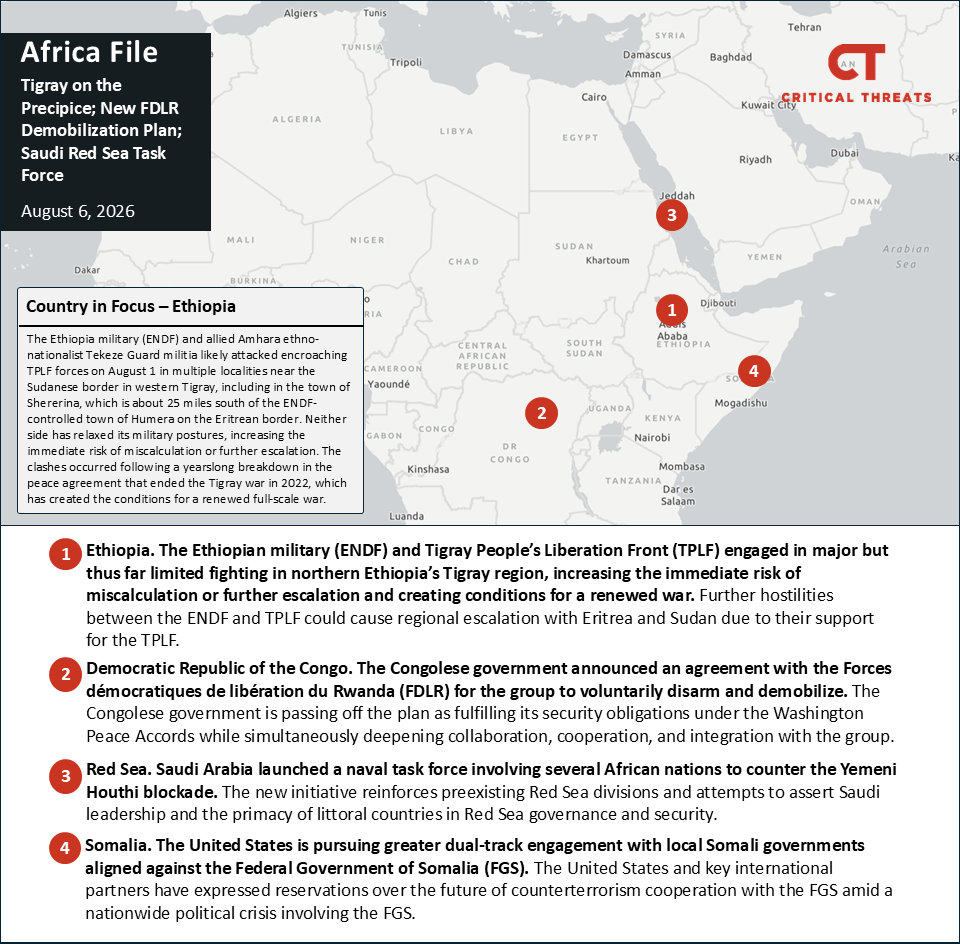
Figure 1. Africa File, August 6, 2026
Ethiopia
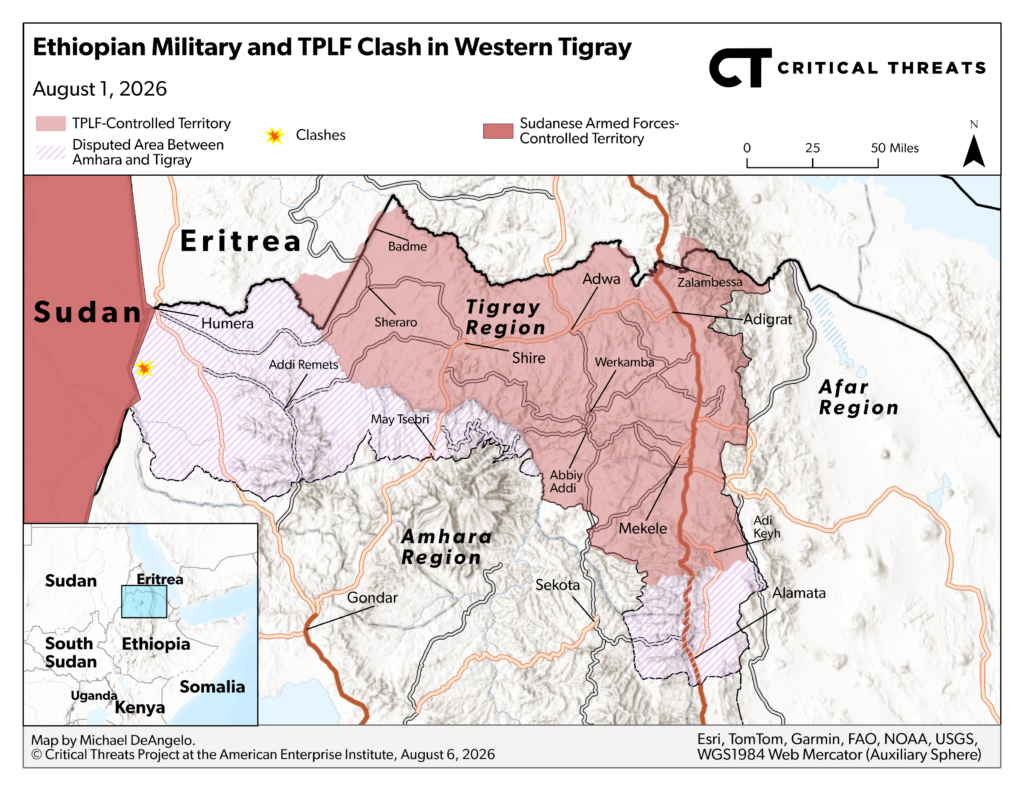
The Ethiopian military (ENDF) and Tigray People’s Liberation Front (TPLF) engaged in major but thus far limited fighting in northern Ethiopia’s Tigray region for the second time in 2026. The ENDF and allied Amhara ethno-nationalist Tekeze Guard militia likely attacked encroaching TPLF forces on August 1 in multiple localities near the Sudanese border in western Tigray, including in the town of Shererina, which is about 25 miles south of the ENDF-controlled town of Humera on the Eritrean border.[1] The Egyptian news outlet MadaMasr cited an ENDF official who said that the ENDF engaged TPLF units who had crossed into Ethiopia from Sudan and were moving toward Humera.[2] The ENDF and allied forces reportedly repelled the TPLF to Shererina.[3] The ENDF conducted multiple artillery and drone strikes on TPLF positions, including in Shererina.[4] Reporter Sajid Nadeem reported that the TPLF had also conducted drone strikes on ENDF positions.[5] The pro-Amhara X account Amhara War Updates claimed that the TPLF had used one-way attack drones for the first time, although CTP was unable to verify this claim.[6] Amhara War Updates reported that the ENDF inflicted over 500 casualties on the TPLF, while a pro-TPLF news outlet claimed that the TPLF had inflicted over 1,000 casualties on the ENDF side.[7] Both casualty counts remain unconfirmed.
Figure 2. Ethiopian Military and the Tigray People’s Liberation Front Clash in Western Tigray
The two sides have blamed each other for the clashes. The TPLF released multiple statements from August 1 to August 3 accusing the ENDF of launching an offensive.[8] The TPLF likely also falsely accused the ENDF of fighting alongside the Sudanese paramilitary Rapid Support Forces (RSF), which Ethiopia has supported in the Sudanese civil war.[9] CTP has not found any information to corroborate the TPLF claims, and the fighting took place more than 500 miles north of RSF bases in western Ethiopia. An Ethiopian cabinet minister conversely accused the TPLF of initiating the hostilities, although the federal government has not released an official statement blaming the TPLF.[10]
Neither side has relaxed its military postures, increasing the immediate risk of miscalculation or further escalation. No further clashes have occurred since August 1, and Agence France Presse cited a TPLF official who said that the two sides had “de-escalated.”[11] The ENDF has reportedly deployed reinforcements to western Tigray and restricted movement outside of Humera by setting up checkpoints, however.[12] The ENDF and TPLF have separately mobilized forces near Alamata, which is in an area of southern Tigray that Amhara ethno-nationalists claim.[13] The TPLF accused the ENDF on August 4 of planning to launch another offensive and reaffirmed its preparedness for conflict.[14]
The clashes occurred following a yearslong breakdown in the peace agreement that ended the Tigray war in 2022, which has created the conditions for a renewed full-scale war. The Pretoria peace agreement had been in jeopardy since March 2025, when a hardline TPLF faction led by TPLF head Debretsion Gebremichael launched a de facto coup of the federal government–backed Tigray Interim Administration (TIA).[15] The faction disagreed with the Pretoria agreement from the outset and accused the federal government and TIA of not implementing it properly.[16] A key point of contention was the continued presence of Amhara ethno-nationalist forces, such as the Tekeze Guard, in western Tigray.[17] The federal government, meanwhile, viewed the TPLF as rejecting aspects of the Pretoria agreement intended to reassert federal authority over Tigray and revoked the TPLF’s legal status as a political party in May 2025.[18] The revocation of legal status has prevented TPLF officials from holding government positions and effectively placed TPLF-controlled Tigray outside institutional control. The ENDF then conducted its first drone strike on Tigrayan forces since the end of the Tigray war, in November 2025, and the ENDF and Tigrayan forces engaged in their first large-scale clashes since the war, in January 2026.[19] The two sides followed up the clashes with a military standoff, amassing forces across the Tigray regional border beginning in February.[20]
The TPLF’s reinstatement of the pre–Tigray war regional government in May 2026 effectively voided the Pretoria agreement, destroying the last remaining dispute recourse mechanism and any obvious diplomatic off-ramp. The Pretoria agreement had given the federal government control of Tigray through a monopoly on force and the TIA until regional elections are held to avoid a power struggle similar to the one that sparked the war in 2020.[21] The TPLF rejected the federal government’s one-year extension of the TIA’s mandate in April due to the federal government and TIA not consulting it.[22] The TPLF subsequently fully sidelined the TIA and restored Tigray’s legislative council, which subsequently reselected Debretsion as regional president on May 5.[23] Tigray was then the only region completely unable to participate in Ethiopia’s June elections.[24] Federal officials warned that the TPLF’s move could cause another war.[25]
Neither side has reduced its posture or publicly sought to engage in dialogue. The TPLF has undertaken a mass military mobilization since at least May that the group portrays as necessary for Tigray’s survival.[26] The TPLF enacted conscription in June, which requires former fighters to return to their units and gives the regional government the authority to forcibly enlist Tigrayans across a wide age range.[27] Tigrayan forces have conducted mass roundups and house-to-house searches as part of the conscription campaign.[28] Ethiopian state media launched an information campaign in the lead-up to the recent clashes accusing the TPLF of pushing for war. The Ethiopian Broadcasting Corporation and Fana Media Corporation released dozens of statements labeling the TPLF as the aggressor.[29] Some of the statements have claimed that the TPLF is “dragging” Tigray into war while the federal government pushes for peace and that the TPLF is “collaborating” al Qaeda’s Somalia affiliate al Shabaab to attack Ethiopia.[30]
Each side has constraints that disincentivize it from pursuing a full-scale conflict in the immediate term, however. Ethiopia is facing fuel shortages stemming from the conflicts in the Middle East that heavily disincentivize a conflict in the immediate term. Ethiopia imports nearly 50 percent of its fuel from Kuwait and has struggled to address fuel shortages amid disruptions to the Strait of Hormuz in the Iran war.[31] The ongoing Houthi maritime blockade on Saudi Arabia, which accounts for another 38 percent of Ethiopian fuel imports, has presumably further strained Ethiopian fuel supplies.[32] CTP previously assessed in April 2026 that the fuel shortages may have disrupted ENDF plans for an offensive to neutralize the TPLF amid the military standoff on the Tigray regional border.[33]
The ENDF and TPLF also face more enduring capacity constraints. The ENDF devotes resources to combat Amhara and Oromo ethno-nationalist insurgencies. Amhara ethno-nationalist Fano militias exploited ENDF redeployments toward Tigray in February by seizing key towns and roads, forcing the ENDF to send units back to combat Fano.[34] The TPLF, meanwhile, is not as united as it was during the Tigray war. The hardline faction’s consolidation of power has caused significant infighting, leading to multiple senior Tigrayan officials distancing themselves from the TPLF and defecting to the federal government.[35] Up to several thousand Tigray Defense Forces (TDF) fighters also left the TDF and formed their own rebel group, the Tigray Peace Force (TPF), in mid-2025 to fight against TPLF.[36] The federal government–backed TPF has clashed with the TPLF on numerous occasions.[37]
Further hostilities between the ENDF and TPLF risk drawing in Eritrea and Sudan. Eritrea is already politically supporting the TPLF and would likely provide military support in a larger conflict against the Ethiopian federal government. Eritrea has formed an alliance of convenience with the TPLF, as Eritrea’s own relations with the Ethiopian federal government have deteriorated due to its exclusion from the Pretoria peace process and stated Ethiopian aims to gain sea access via Eritrea’s port of Assab.[38] Eritrea has maintained high-level engagement with the TPLF since at least January 2025 and reportedly assisted the hardline TPLF faction in its de facto coup against the TIA, according to The Guardian.[39] The French investigative outlet Africa Intelligence reported that Eritrean President Isaias Afwerki has pledged to support the TPLF in any conflict with the Ethiopian federal government.[40] Several Eritrean military officials appeared publicly in Tigray on August 2 to show support for the TPLF.[41]
A larger conflict could cause indirect proxy escalation between Ethiopia and Sudan. The Sudanese Armed Forces (SAF)–led Sudanese government has long-standing ties to the TPLF, arming the group and allowing it to use rear bases in eastern Sudan.[42] TPLF units stationed in eastern Sudan, known as Army 70, were involved in the August 1 clashes.[43] The Ethiopian federal government has denounced Sudan’s ties to the TPLF and accused Sudan of forming an alliance with Eritrea and the TPLF against it.[44] Ethiopia has consequently increased support for the RSF since late 2025, facilitating Emirati weapons shipments to the group via Ethiopia and allowing the RSF to establish rear bases and training camps in western Ethiopia.[45]
Increased proxy support could also lead to direct hostilities between Ethiopia and Sudan, although each has capacity constraints that deter significant and long-term hostilities. Sudan’s refugee commission said that artillery from the August 1 clashes struck a refugee camp in Sudan.[46] Sudan has previously accused the Ethiopian federal government of allowing the RSF to conduct drone strikes on SAF-controlled territory from Ethiopia and threatened to take any steps necessary to secure its territory.[47] SAF is embroiled in a multifront civil war, however, while Ethiopia faces numerous internal political and military disputes.
Democratic Republic of the Congo
The Democratic Republic of the Congo (DRC) announced an agreement with the Forces démocratiques de libération du Rwanda (FDLR) for the group to voluntarily disarm and demobilize. Victor Byiringiro, the political head of the FDLR’s largest faction, FDLR-FOCA, outlined the group’s commitment to voluntarily disarm and demobilize its fighters and place them in cantonment sites in a May 30 letter to DRC President Félix Tshisekedi that became publicly available in late July.[48]
The plan details the FDLR’s commitments to demobilize voluntarily. The plan says that the FDLR would disarm, demobilize, and canton if there are “secure and viable sites with security guarantees.”[49] The FDLR says that it will accept relocation for cantonment to a third country if it cannot return to Rwanda.[50] The plan commits the Congolese government to give priority to noncombat options to resolve the issue and fulfill its commitments under the Washington Peace Accords (WPA) and help implement the FDLR’s demands, such as setting up cantonment sites and addressing refugee issues.[51] The plan also calls for the establishment of a follow-up mechanism that includes international partners and experts to monitor implementation.[52]
Rwanda rejected the plan. The government spokesperson and Rwandan Foreign Minister Olivier Nduhungirehe both criticized it and said that it was outside the WPA framework in statements on social media in late July.[53] The French magazine Jeune Afrique reported that the Rwandan delegation at the sixth WPA Joint Oversight Committee (JOC) meeting in France formally rejected it on July 24.[54] Rwanda claims that it views the FDLR, the senior leadership of which helped perpetrate the 1994 Rwandan genocide, as a security threat, citing the group’s political and military wings, professional general staff and intelligence services, ideology and training centers, civilian support base, illicit revenue networks, and state support from the Congolese government.
The Congolese government is passing off the plan as honoring its security obligations under the WPA, but the plan departs from the WPA’s specific process for the DRC to degrade and dismantle the FDLR through combat operations. Angola brokered a concept of operations (CONOP) in late 2024 for the Congolese army (FARDC) to neutralize the FDLR and for the Rwandan army (RDF) to withdraw.[55] The United States reaffirmed both parties’ commitment to the CONOP, set a compressed timeline for both parties to implement their commitments, and established the Joint Security Coordination Mechanism (JSCM) to monitor progress when it assumed mediation leadership and brokered a preliminary June 2025 peace agreement, which mediators incorporated into the December 2025 WPA.[56] The WPA requires the DRC to “neutralize” the FDLR using force, after an initial phase to try to disarm the group peacefully.[57] The DRC and Rwanda finalized an operational order (OPORD) at the third JOC meeting in October, and the FARDC then sent senior officers to government-controlled areas to coordinate an awareness campaign for the FDLR’s surrender in November.[58] The FDLR publicly rejected calls to surrender and refused to stand down despite pressure from the Congolese government, however.[59]
The Congolese government defaulted on its FDLR-related obligations under the WPA. The UN Group of Experts reported in December 2025 that certain FARDC and government officials reassured the FDLR of continued cooperation during the awareness-building phase in October.[60] The French investigative outlet Africa Intelligence cited regional intelligence reports in mid-June 2026 confirming that FARDC-FDLR cooperation never ceased after October.[61] The FARDC deployed several French-trained special force battalions to North Kivu province under the command of General Jacques Ychaligonza to try again to disarm the FDLR peacefully or launch imminent military operations against it in late March 2026, two weeks after the United States convened senior Congolese and Rwandan officials to jump-start the WPA, which had been stalled for months.[62] The FARDC has yet to launch anti-FDLR operations, however, as continued FARDC-FDLR collaboration, deep mutual distrust between the DRC and Rwanda, disagreements over the sequencing of the anti-FDLR operations and RDF withdrawal, and other issues continue to hinder the WPA’s implementation.
The Congolese government is now advocating for the FDLR publicly and promoting the FDLR demobilization plan to its regional and Western partners. Africa Intelligence reported that Tshisekedi endorsed the plan in several letters to Western partners in early July.[63] Tshisekedi’s special envoy, Minister of Regional Integration Floribert Anzuluni, then reportedly met with numerous interlocutors and visited at least nine African and European countries to promote the plan as a show of its commitment to the WPA in July.[64] Congolese government officials publicly announced the plan at a press conference on July 28, claiming that the military deployments in March put pressure on and revived discussions with the FDLR’s political and military leadership, who then requested negotiations on the terms of disarmament, leading to the May 30 plan.[65] Anzuluni said that the government had already developed a plan for the follow-up mechanism and an unspecified African country already said it was willing to accept the group for cantonment.[66]
The Congolese government has misrepresented the FDLR’s operational presence to avoid fulfilling its FDLR-related commitments and to put diplomatic pressure on Rwanda and M23. Many FDLR fighters operate in M23-controlled areas, which is a fact that Congolese government has used to claim that it cannot conduct anti-FDLR military operations until the RDF withdraws to encourage Western diplomatic pressure on Rwanda. The DRC and Rwanda had agreed to six operational areas for the implementation of the WPA—five in North Kivu and one in South Kivu—coinciding with the OPORD during the mid-March meetings.[67] The UN Group of Experts estimated in December 2025 that most FDLR forces operated in M23-controlled areas and “beyond the operational reach” of the FARDC.[68] The Congolese government said that the new FDLR demobilization plan was a “major turning point” and it would now use the plan to call for the withdrawal of Rwandan troops after fulfilling its WPA commitments.[69]
Many FDLR fighters also likely operate in areas outside of M23’s control, however. The UN Group of Experts estimated in June 2026 that the group has between 3,500 and 4,500 combatants organized into three distinct but closely coordinated factions, two of which are in North Kivu.[70] UN Group of Experts reports from 2025 indicated that FDLR maintained a presence in M23’s traditional stronghold areas in North Kivu, where M23 and the RDF conducted counterinsurgency operations against the group, but the reports noted that “several thousand” FDLR and pro-Congolese government Wazalendo militia combatants had retreated to remote areas in North Kivu that were either contested or beyond M23’s control, after M23 and the RDF captured Goma, the North Kivu provincial capital, in January 2025.[71] FDLR combatants have since fought against M23 and the RDF in several frontline areas in North Kivu. An internal Rwandan intelligence memo cited by Africa Intelligence in late July 2026 said that the FDLR had established its headquarters near Pinga town, which the government controls.[72]
The FDLR also has a presence in South Kivu, where M23 controls much less terrain than in North Kivu. The FDLR’s South Kivu faction is a splinter group that broke off and has coordinated with local militias since late 2022 and started receiving renewed military support from Burundi in 2023, according to the UN Group of Experts.[73] The Burundian president, who is a close Tshisekedi ally, acknowledged Burundi’s military involvement in the war and claimed that Burundian army (FDNB) troops remain separate from FARDC units, which collaborate with the FDLR, but operate under the command of the FARDC, in a mid-May 2026 interview with Jeune Afrique.[74] M23 claimed that FDLR contingents retreated and relocated southward toward Congolese government-controlled areas when M23-allied Twirwaneho fighters repelled a major FARDC-FDNB offensive in the South Kivu highlands with M23 and RDF support in June and July.[75] Jeune Afrique cited a “well-informed source” on the FDLR in late July who disputed the DRC’s claim of limited operational reach under the WPA, citing specifically the presence of FDLR fighters in government-controlled South Kivu.[76]
The Congolese government is likely unwilling to completely disarm and demobilize all FDLR fighters, as it is simultaneously deepening collaboration, cooperation, and integration with the FDLR. The FDLR continues to fight on the front line in some areas and has dispersed geographically under the names of different factions and units or integrated into auxiliary force structures aligned with the Congolese government. The UN Group of Experts report in June said that FDLR units recently had taken on new names to “obscure their FDLR affiliation” and “several FARDC officers and DRC authorities” approved the continued mixing and integration of FDLR fighters into non-FDLR Wazalendo coalition units, particularly mixing FDLR-FOCA members into a structure in North Kivu led by Congolese Hutu militias.[77] The June UN Experts report also assessed that the DRC’s commitment to neutralize the FDLR remained “questionable” and cited FDLR sources who said that FARDC officers gave them assurances that any anti-FDLR combat operations would not be “genuine.”[78]
FARDC officials have continued to collaborate with the FDLR as part of its defense strategy against M23 and Rwanda. The June UN Group of Experts report said that the FARDC had increased collaboration with the FDLR and transferred more weapons and military equipment to the group.[79] The report also said that Congolese officials in Kinshasa, senior FARDC officers in the field, and the FDLR-FOCA high command reaffirmed continued cooperation, notably during a “confidential encounter” in North Kivu in early April.[80] The internal Rwandan intelligence memo cited by Africa Intelligence in late July said that the FARDC has continued collaborating with the FDLR and that its officers met in Rutshuru and Walikale districts in North Kivu to coordinate military operations several times in June.[81] Pro-Rwandan open-source intelligence sources alleged on social media that Kinshasa’s North Kivu military governor convened a meeting in late July with FDLR leaders and other armed group representatives to plan new offensives in Masisi and Rutshuru districts and establish new battalions to fight the Allied Democratic Forces—an IS-affiliated Ugandan rebel group operating in eastern and northeastern DRC.[82]
The Congolese government supplies and coordinates with key FDLR leaders in areas inside its control. The June UN Group of Experts report said that Congolese political and military official authorities used FDLR liaison officers, particularly FDLR-FOCA officials based in Kinshasa and other faction representatives in government-controlled towns in North Kivu, to facilitate FDLR-FARDC actions and coordinate with FDLR leadership figures such as Byiringiro and Omega Israel, FDLR-FOCA’s operational commander.[83] The report also said that an FARDC helicopter supplied weapons to FDLR-FOCA’s special force unit that had traveled to Pinga from Walikale district and then returned to Masisi district, two weeks after the mid-March WPA meetings and as Ychaligonza announced the launch of anti-FDLR operations.[84] The regional intelligence reports cited by Africa Intelligence said that Israel met with Ychaligonza in March 2026 to discuss redeploying FDLR units from FARDC-controlled areas to M23-held territory in Rutshuru district, in part to justify the FARDC’s inability to conduct anti-FDLR operations under the WPA.[85]
Rwanda has alleged that the Congolese government is providing political backing to the FDLR and other political enemies of Rwanda. Tshisekedi reportedly received Jean-Luc Habyarimana, the son of Juvénal Habyarimana, whose regime orchestrated the 1994 genocide, in Kinshasa in early 2026.[86] Rwandan President Paul Kagame claimed in an interview with Jeune Afrique in April that Congolese authorities are seeking to use Habyarimana to “rally [public] opinion in favor of the FDLR” and use state resources to “build them a support network” in France and other places.[87] A prominent US lobbyist whom the Congolese government contracted previously was the keynote speaker at a conference marking the launch of a platform of Rwandan opposition political parties in late May.[88] Nduhungirehe claimed in July that the DRC has “accelerated the political organization” of the FDLR and alerted the United States about a new “political movement” operating through Habyarimana and others.[89] The Rwandan intelligence memo cited by Africa Intelligence claimed that the Congolese government has maintained contact with Habyarimana and figures from the Rwandan opposition in exile and that the Congolese government organized meetings between these figures and FDLR leaders to “strengthen cooperation between the various movements hostile” to the Rwandan government.[90]
The July 2026 plan will likely fail to meet the specific outcomes outlined in the WPA and mirrors previous unilateral FDLR proposals that failed because they conditioned disarmament on maximalist political concessions from Rwanda. The June 2025 peace agreement says that the DRC and Rwanda agreed to “immediately and unconditionally” halt state support for armed groups “except as necessary to facilitate implementation” of the agreement.[91] The agreement provides that the parties will support the disarmament, demobilization, and reintegration of armed groups through the UN’s disarmament program and the JSCM’s mandate to “identify, assess, locate, and neutralize in accordance with the relevant provisions” of the CONOP.[92] Appendix A of the text of the June agreement says that one of the “strategic objectives” of the agreement is to “defeat the FLDR armed groups and its supporters.”[93] Appendix A says that one of the deal’s desired outcomes is that the “threat of the FDLR in the DRC is eradicated.”[94]
Previous FDLR disarmament efforts failed because of FDLR demands that Rwanda was unwilling to accept. The FDLR issued the Rome Declaration in 2005 after meeting with former DRC President Joseph Kabila’s transitional government, stating that the group would demobilize unilaterally but this was conditioned on undefined “accompanying measures.”[95] The group indicated to the UN’s mission in the DRC and international media that year that it would only put down its arms and return to Rwanda if the government allowed it to become a domestic political party.[96] The International Crisis Group (ICG) assessed in 2005 that these demands were “unrealistic” and would “certainly derail any process” to demobilize the group.[97] ICG assessed that the FDLR may have issued the declaration to buy time in the face of external pressure, after the African Union said that it was willing to use force against the FDLR.[98] The ICG report argued that many FDLR leaders had little incentive to return to Rwanda, because they would likely risk incarceration and lose the status and assets they had acquired in the DRC.[99] The FDLR made similar demands for Rwanda to open political space in the country in peace talks and disarmament efforts in 2008–2009, and 2013–2014.[100]
Rwanda has refused to concede to these demands for more than two decades and has no incentive to grant them now. Rwanda has repeatedly refused political negotiations with the FDLR, which it considers a criminal organization, not a party to a political dispute. Rwanda’s ruling regime does not face external political or military pressure to concede to an inter-Rwandan dialogue, which would involve discussions around power-sharing with its opposition and military enemies. Rwanda has maintained that it will accept the disarmament and repatriation of FDLR fighters only on a case-by-case basis and through the UN repatriation program, which has demobilized thousands of former FDLR members since 2001. Rwanda additionally has no incentive to open a dialogue with the FDLR with the WPA in place, in which the group is the object and primary target of kinetic operations.
These historical patterns remain present in the current demobilization efforts. Byiringiro sent a letter to US President Donald Trump in July 2025 rejecting the WPA’s terms and insisting on “genuine and inclusive dialogue” with the Rwandan government.[101] The FDLR refused to stand down under pressure in October 2025 and told French state media in November that the group would refuse to surrender until the Rwandan government opens an inter-Rwandan dialogue and allows the return of refugees.[102] The terms of the July 2026 plan are similar to these long-standing demands, conditioning the FDLR’s dissolution on the “opening of political space” in Rwanda, the “definitive cessation” of RDF military operations against “Rwandan refugees” in the eastern DRC, and the dignified return of refugees to Rwanda.[103] The plan also says the FDLR would disarm, demobilize, and canton only if there are guarantees of “no forced extradition” to Rwanda.[104]
Red Sea
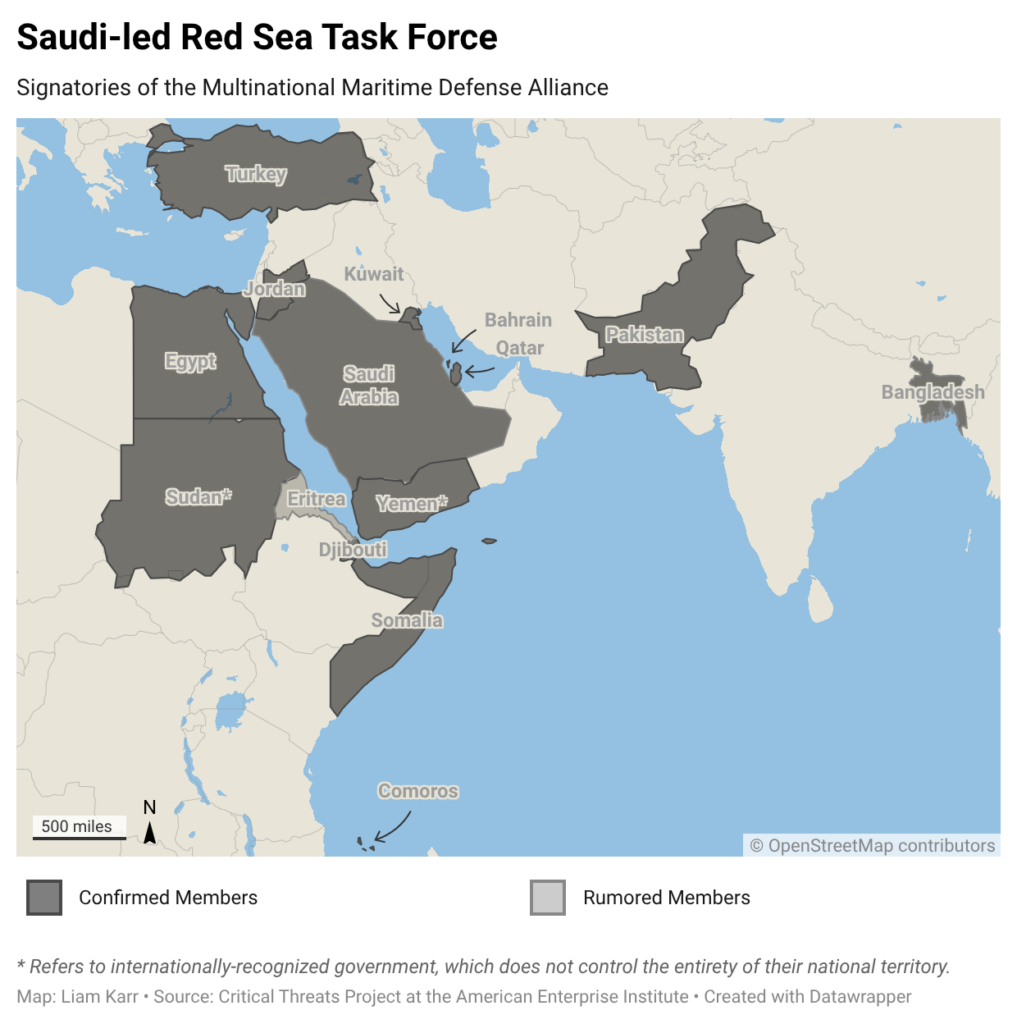
Saudi Arabia launched a naval task force involving several African nations to counter the Yemeni Houthi blockade. Saudi Arabia announced on July 30 that it had formed the Multinational Maritime Defense Alliance to protect shipping through the Red Sea and adjacent waterways.[105] Fourteen countries have joined the task force: Bahrain, Bangladesh, the Comoros, Djibouti, Egypt, Jordan, Kuwait, Pakistan, Qatar, Saudi Arabia, Somalia, Sudan, Turkey, and the Yemeni government, with conflicting reports that Eritrea has also joined.[106] Saudi Arabia stated that it expected more countries to join, as it invited 50 countries, including the United States and European Union (EU).[107] The task force’s joint statement established Saudi Arabia as the headquarters for the task force, which will coordinate training, intelligence sharing, and maritime security operations among members for “purely defensive” reasons.[108]
Figure 3. Saudi-led Red Sea Task Force
The Houthi blockade on Saudi Arabia has significantly impacted shipping through the Red Sea. The New York Times cited on July 30 a maritime tracking agency stating that the blockade has reduced shipping through the Bab el Mandeb Strait by approximately 20 percent.[109] Reuters reported on July 29 that the Houthis were considering charging non-Saudi-linked vessels to transit through the Red Sea, although the Houthis denied the report.[110] The Houthis have continued to strike Saudi-linked vessels transiting through the Red Sea and reportedly coordinated with the Iranian Islamic Revolutionary Guards Corps to reinforce their drone and missile capabilities in the Red Sea.[111] The Houthi military spokesperson threatened on August 5 that the Houthis could increase their targeting of vessels to completely isolate Saudi Arabia.[112]
Egypt and Saudi Arabia are the anchors of the task force. Egypt and Saudi Arabia have the largest navies, in terms of tonnage, of the Red Sea littoral countries, according to GlobalFirepower.[113] Both countries rely on the Red Sea economically and use the waterway to project regional influence, including through leading regional naval drills in November 2025.[114] Turkey and Pakistan have also previously contributed naval assets to previous multilateral maritime security initiatives around the Red Sea, but the other smaller countries in the alliance lack naval capabilities beyond basic coastal defense.[115]
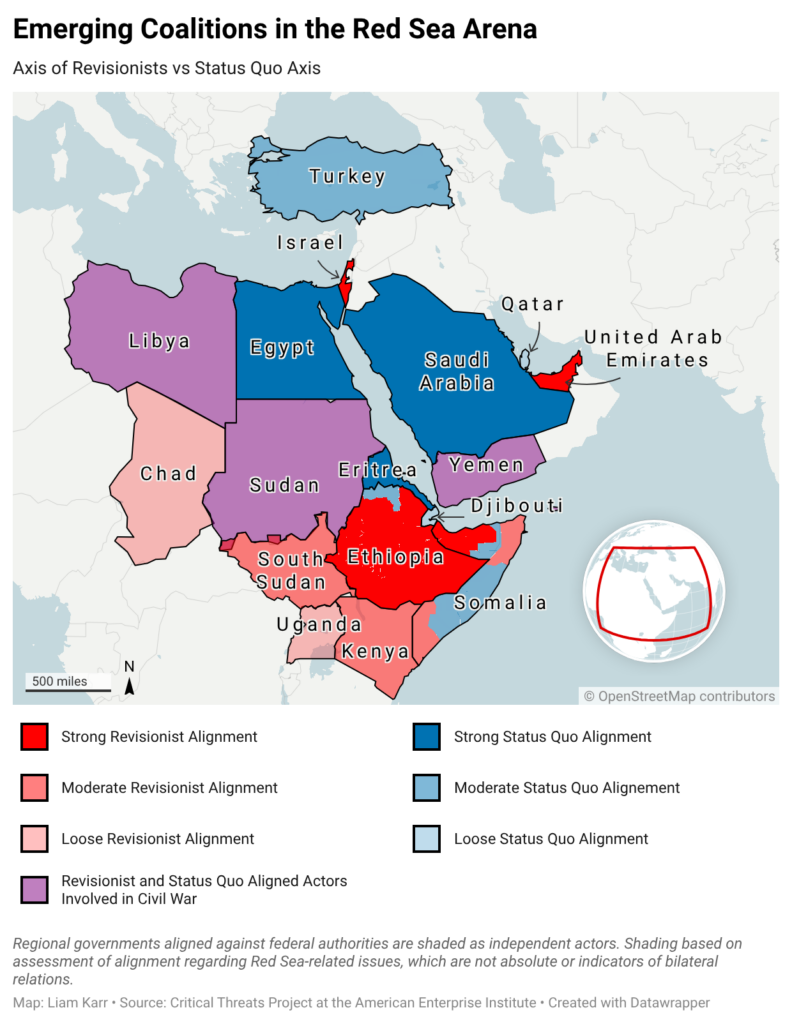
The new initiative reinforces preexisting Red Sea divisions and attempts to assert Saudi leadership and the primacy of littoral countries in Red Sea governance and security. The task force notably does not include the United Arab Emirates (UAE), which has been involved in an intensifying rivalry with Saudi Arabia on both sides of the Red Sea.[116] The two neighbors have backed opposing sides in the Sudanese civil war since 2023, which reportedly contributed to the UAE supporting a power grab by its Yemeni proxies against the Saudi-backed, internationally recognized Republic of Yemen government in December 2025.[117] Saudi Arabia responded by backing a Yemeni government counteroffensive, including with Saudi airstrikes on Emirati weapons shipments, and successfully encouraged its allies in Somalia and Yemen to revoke their basing and defense deals with the UAE.[118] The UAE declared its “solidarity” with any Saudi response to the Houthi blockade, however, and the Emirati and Saudi government media heads released simultaneous statements reaffirming the two countries’ ties on July 21.[119] The UAE has significant influence in the Red Sea, including several recently abandoned military bases on Yemeni islands near the Bab el Mandeb Strait and Emirati bases on the northern Somali coast along the Gulf of Aden.[120]
Israel’s absence is also notable given that it is a Red Sea littoral country and has nominally faced a Houthi blockade since June. It is unclear whether Saudi Arabia invited the Israel to join the coalition. Saudi Arabia has frozen normalization with Israel as part of the Abraham Accords and increasingly views Israel as a destabilizing presence and threat in the region amid disagreements regarding Israeli military action in Gaza, Lebanon, and Syria—and Israel’s recognition of the breakaway Somaliland region.[121]
The alliance reinforces preexisting Saudi leadership efforts and partnerships in the Red Sea and wider region. Pakistan and Saudi Arabia signed a mutual defense pact in September 2025, and Egypt and Turkey have also sought to increase bilateral and multilateral defense cooperation with both countries.[122] Egypt, Turkey, Saudi Arabia, and Qatar are supporting the same countries in various African disputes involving the UAE, including the Sudanese civil war and Israeli and Emirati engagement with Somaliland. Saudi Arabia has partnered with the sub-Saharan countries in the alliance on these regional issues and other initiatives.[123] Many of the Red Sea–adjacent countries in the alliance have previously emphasized that Red Sea security and governance should be limited to states with Red Sea coastlines as part of regional disputes over Red Sea access and influence of non-littoral countries, such as Ethiopia and the UAE.[124] These partners have previously translated these positions into other multilateral initiatives that have similar membership compositions, such as the Saudi-led Red Sea Council.[125]
Figure 4. Emerging Coalitions in the Red Sea Arena
It is unclear how the alliance will interact with other active EU- and US-led multilateral maritime initiatives in the Red Sea. The US-led Combined Maritime Forces (CMF) has a task force dedicated to Red Sea maritime security called Combined Task Force (CTF) 153, which “typically includes two to eight ships, plus maritime patrol aircraft as needed” to focus on “international maritime security and capacity-building efforts in the Red Sea, Bab al-Mandeb, and Gulf of Aden” to “deter and impede illicit non-state actors.”[126] The CMF is a nonbinding, US-led multinational maritime partnership that relies on voluntary contributions and participation from member states, and Egypt currently holds the rotating CTF 153 command.[127] The EU is supporting an ongoing naval operation named Operation Aspides that also aims to protect Red Sea shipping with a force of two to four rotating ships. The EU launched the mission in February 2024 with a “purely defensive” mandate to increase surveillance and escort merchant ships and an area of operations that includes all waterways and choke points from the Red Sea to the Persian Gulf, although most operations have so-far focused on the Red Sea.
The task force could eventually serve as a platform to address other multilateral issues related to illicit coastal activity, such as piracy and weapons smuggling, which are more suited to African navies. The smaller countries in the task force do not possess sufficiently advanced ships, such as frigates and corvettes, to protect Red Sea shipping from Houthi attacks. Djibouti, Eritrea, Somalia, Sudan, and Yemen only possess small patrol vessels and coastal craft.[128]
Piracy off the Somali coast and in the Gulf of Aden has made a resurgence since April 2026.[129] Somali pirates have hijacked at least eight vessels in Somali waters or the Gulf of Aden during this period.[130] Somali pirates are more active now than they have been since the peak of Somali piracy in the early 2010s, as they only conducted one hijacking between 2014 and 2022.[131] Somali piracy in the early 2010s forced vessels to reroute to a longer route and increased global shipping costs by approximately 8 percent.[132]
Iran and the Houthis have exploited gaps in Red Sea security to smuggle weapons. Iran has relied on the Red Sea and adjacent waterways to supply the Houthis with vital weaponry, including drones and missiles.[133] The Houthis have also smuggled weapons to al Qaeda affiliate al Shabaab and the Islamic State Somalia Province.[134] The Houthis have reportedly used Eritrea and Sudan as transit points in their smuggling routes to adapt to US-led interdiction efforts.[135] International support for the Yemeni coast guard has helped degrade Houthi smuggling routes in recent years, providing a template for future cooperation within the alliance.[136]
Somalia
The United States is pursuing greater dual-track engagement with local Somali governments aligned against the Federal Government of Somalia (FGS). Senior US officials met separately with the state presidents of Jubbaland and Puntland in late July and early August 2026. US congressman Ronny Jackson, who sits on the House Foreign Affairs Subcommittee on Africa, and the US Chargé d’Affaires to Somalia discussed security cooperation and US support for Jubbaland state institutions with Jubbaland State President Ahmed Mohamed Islam (Madobe) on July 29.[137] US Special Operations Africa Commander Major General Claude Tudor and Puntland State President Said Abdullahi Deni signed an agreement on August 2 for the United States to expand its military base in Bosaso—Puntland’s main port city—to further counterterrorism and maritime security cooperation.[138]
US officials also heightened their engagement with the de facto independent Somaliland region. US Senator Ted Cruz, who leads the Senate Foreign Relations Subcommittee on Africa, separately called on July 29 for US Secretary of State Marco Rubio to create a separate Somaliland travel advisory and downgrade the risk of traveling there.[139] Cruz stated that the State Department’s Level 4 “Do Not Travel” advisory for Somalia, which cites concerns such as terrorism and kidnapping, “does not reflect the reality on the ground in Somaliland.”[140] Cruz has previously called for the United States to recognize Somaliland as a country, most recently in January 2026.[141] Tudor then met with Somaliland President Abdirahman Mohamed Abdullahi (Irro) on August 1, with Tudor expressing an interest in bolstering maritime security cooperation with Somaliland, including intelligence sharing.[142] A Somaliland delegation led by the Somaliland defense minister then visited the US Africa Command (AFRICOM) headquarters on August 6 to further discuss increasing security cooperation, particularly in the maritime domain.[143]
The United States and key international partners have expressed reservations over the future of counterterrorism cooperation with the FGS amid the current election deadlock involving the FGS. The FGS is currently in a standoff with the leading national opposition Somali Future Council (SFC) coalition over the extension of Somali President Hassan Sheikh Mohamud’s term and the implementation of direct elections.[144] The SFC has accused the FGS of unilaterally pursuing its agenda and threatened to hold parallel elections if the FGS does not reach a consensus-based resolution with the opposition.[145] Clashes between FGS and SFC-aligned forces broke out in Mogadishu, the Somali capital, in June 2026.[146] Multiple rounds of internationally mediated talks have not yet yielded a resolution.[147]
US AFRICOM Commander Dagvin Anderson referenced the dispute’s negative effect on counterterrorism efforts after meeting with Mohamud. Anderson met with Mohamud on July 29 or July 30 “to discuss the ongoing U.S. support” to Somali security forces, especially in counterterrorism.[148] Anderson then participated in an interview with a Somali journalist in which he denied that the United States was contemplating a military withdrawal from Somalia.[149] Anderson implicitly blamed the FGS’s political disputes for al Qaeda affiliate al Shabaab retaking areas that FGS forces previously cleared, however.[150] Anderon also stated that it would be difficult for the United States to justify future counterterrorism support for the FGS if the FGS is unable to resolve the dispute and lead the fight against al Shabaab.[151]
The African Union Support and Stabilization Mission in Somalia (AUSSOM) also called for a political resolution at a recent summit discussing the future of the peacekeeping mission. AUSSOM “stressed the need for a unified Somalia to . . . prioritize the politics of interests as opposed to identity.”[152] Uganda reportedly specifically called on the FGS to hold an inclusive political dialogue.[153] Uganda is key member of AUSSOM, being the largest troop contributor with 4,500 troops, who combat al Shabaab in the key corridor linking al Shabaab’s heartland in southern Somalia to Mogadishu.[154] Funding shortfalls, including anticipated US cuts, have cast doubt on whether AUSSOM will be able sustain operations into 2027.[155]