
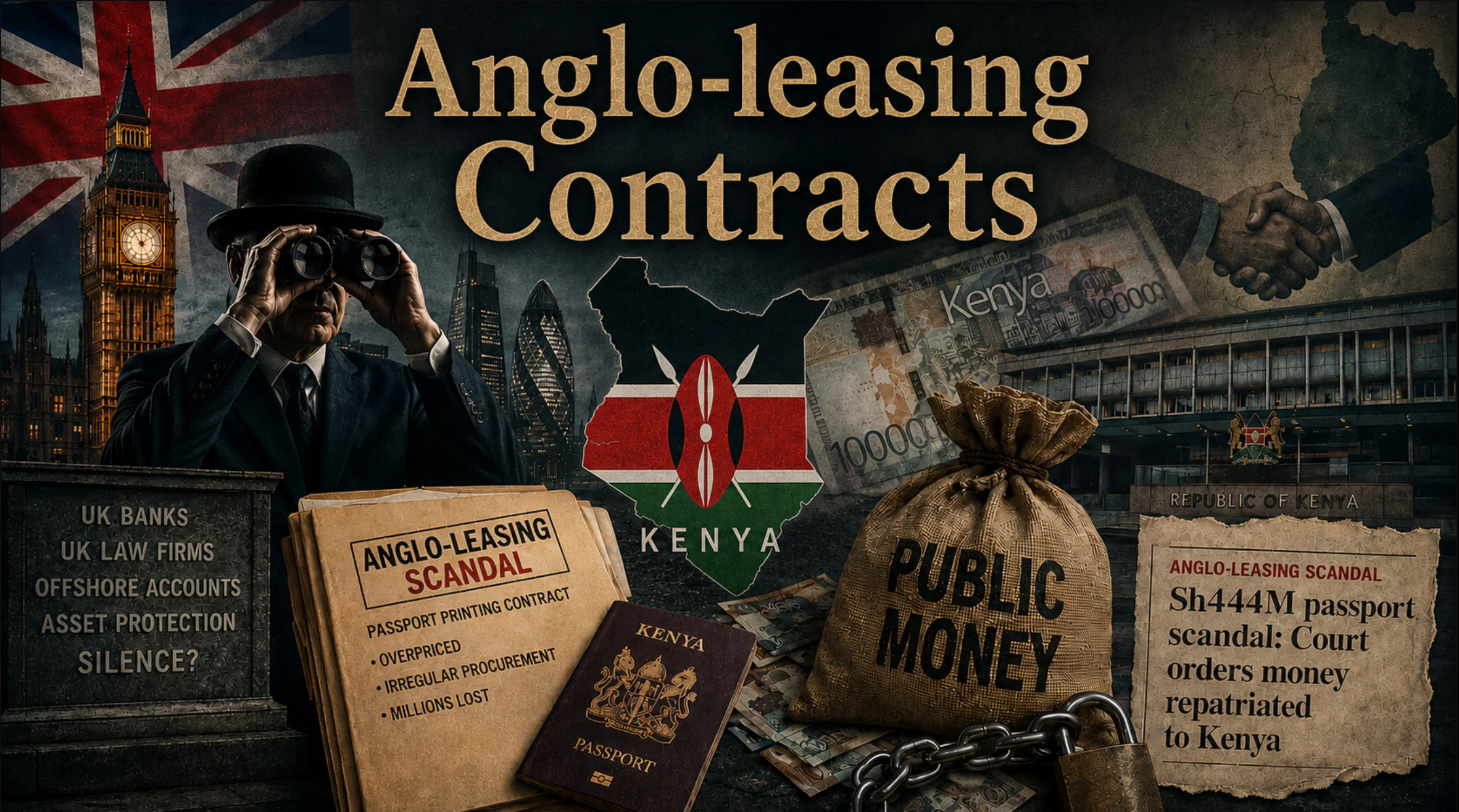
While Kenya-UK relations are presented as glossy, a close evaluation reveals layers of British neocolonialism perpetuated through unequal agreements and the maintenance of secrecy networks and tax havens that encourage corruption and launder proceeds of corruption from Kenya.
Kenya-UK Relations
Relations between Kenya and the UK are presented by the media with a generous layer of gloss, with terms such as “strategic partnership,” “accelerating trade,” and “investments,” among others. Such coverage was also used in the presentation of a meeting between the Kenyan president and the British envoy to the East African country on July 23, 2026. A subheading to an article covering the event by the Kenya Broadcasting Corporation (KBC) carried a subheading, “Leaders commit to accelerating trade, investment, and strategic projects under renewed bilateral partnership.” Challenges such as the UK running tax havens in its island territories or abetting money laundering for powerful Kenyan politicians (as it has done in other countries in Africa) are often concealed from headlines. Donu Kogbara’s article published in the Nigerian paper Vanguard shows the UK’s established behavior of laundering illicit money stolen from Nigerian taxpayers by corrupt politicians. Surprisingly, UK politicians and other institutions often cast the pervasive corruption of some African leaders as an African problem, concealing how the European nation has created conditions facilitating this theft for its neo-colonial ambitions.
Corruption in Kenya is a tango between compromised government officials on the one hand and institutions and tax havens in the UK on the other, working to keep Africa poor and the UK rich
Layers of Agreements
A close review of Kenya and the UK shows that nothing between the two countries is as glossy as presented in the mainstream media. Instead, the old colonial power in the UK appears to be trying to deceptively move its interests at the expense of Kenyans using neo-colonial tendencies. This tendency can be noted, among others, in the Kenya-UK Economic Partnership (EPA)-2025, in which Britain, which formally colonized Kenya, presents itself as Kenya’s most-favored nation (MFN) without reciprocating the same status to Kenya. For instance, article 15(2), bars Kenya from accepting better trade terms from other trading powers without consulting the UK but lacks a clause giving similar protection to Kenya. Such unequal clauses and the parties’ security alliance may have been used to enable past corruption scandals in Kenya, the proceeds of which ended in the UK — more on that later. The UK has not been a bystander in the plunder of Kenyans by their political elites but has facilitated the theft and laundering of stolen wealth through its network of banks and safe havens for its benefit.
An article appearing in The Elephant, a Pan-African publication that gives long-form commentary on political and economic realities in Africa, stated that “the British state drives a global system in which the richest extract wealth from the rest,” a view that aligns with Donu Kogbara’s. In fact, the UK’s role in supporting transnational corruption that wrings money from Kenyans is well known in Kenya, as can be noted in that the largest incidence of theft of public funds in Kenyan history was named the Anglo-Leasing Scandal. The initial scam plot that saw the Kenyan public lose about 24 million euros in the late 1990s started when the Kenyan government wanted to procure advanced passport printing equipment and forensic laboratories for police use. A French firm offered to supply the equipment at 6 million euros, but the contract was awarded to a UK firm, Anglo Leasing Finance, to supply the same equipment at 30 million euros. Notably, the contracted British firm ended up subcontracting the French supplier and, hence, defrauding Kenyans of about 24 million euros (in 1997 money). While the blame for such loss primarily falls on corrupt Kenyan officials, the role of the British state, and the unequal trade clauses seen earlier cannot be ignored and may have influenced the choice of the deceitful UK over the French supplier. Additionally, this, among other Anglo-Leasing contracts, was hidden behind bilateral security and intelligence cooperation, advantaging the UK, which presents itself as Kenya’s primary security partner, a reality that may have played a role in excluding competitive players in favor of corrupt UK fronts. As the Guardian reported later in 2006, a series of other fraudulent contracts totaling over $350 million, all relating to security and defense, were awarded to individuals and firms from the UK, and the UK remained to investigate them nearly a decade later.
The UK political leadership remained silent during the Anglo-Leasing theft, with only the High Commissioner to Kenya giving a hint in 2006 at a dinner with businesspeople in Nairobi. Also, it acted apathetically despite the reality that the firms involved were registered in the UK and received their contracts partly on account of the UK’s trade and security partnership with Kenya. Surprisingly, UK’s behavior did not stop successive governments in Kenya from signing so-called “strategic partnerships,” showing that some in the African country are beholden to the UK’s interests.
The UK and corrupt Kenyan leaders also frustrated justice for Kenyan taxpayers in the famous Samuel Gichuru and Chris Okemo scam. Gichuru was the CEO of Kenya Power and Lighting Company (KPLC), who opened a shell company (Windward Trading Company) in the UK tax haven of Jersey, and used it to receive over 20 million US dollars as kickbacks from British, Danish, Finnish, German, and US firms in exchange for contracts with KPLC. Despite the revelation of this corruption scheme in 2006, the UK government delayed any meaningful action until 2016, when the government of Jersey confiscated $3.6 billion when the Windward Trading Company pleaded guilty to receiving kickbacks. The accused had withdrawn a large amount, while the Kenyan side was accused of declining to extradite the suspects to face charges. The 2016 move was followed by plans to send a percentage of the amount held to Kenya. In January 2021, the government of Jersey announced that £3 million (about $4.04 million using the then exchange rate) would be transferred to Kenya to fight COVID-19, another area mired in corruption, making it hard to track whether the money was repatriated altogether.
Kenya-UK Corruption Cycle
The purported repatriation of kickbacks from Gichuru’s case to Kenya occurred in a period when large sums of money from Kenya’s fiscal budget were stolen under the justification of fighting COVID-19. In these schemes, some abused procurement procedures at the Kenya Medical Supplies Authority (KEMSA) to loot public coffers, including those connected to then-President Uhuru Kenyatta, earning the name COVID-19 Millionaires, creating a possibility that the amount supposedly repatriated from Jersey ended up looted and stashed in offshore accounts. Members of Uhuru Kenyatta’s family had also been mentioned in other corruption schemes in the healthcare sector, and medical equipment leasing, and the proceeds of this plunder remained hidden. The Pandora Papers, released by the International Consortium of Investigative Journalists in 2022, revealed that Uhuru Kenyatta’s family had stashed about $30 million in offshore accounts located in a web of tax havens in the UK and Panama, which can explain where money that disappears in Kenya may be found. Corruption in Kenya is a tango between compromised government officials on the one hand and institutions and tax havens in the UK on the other, working to keep Africa poor and the UK rich.