
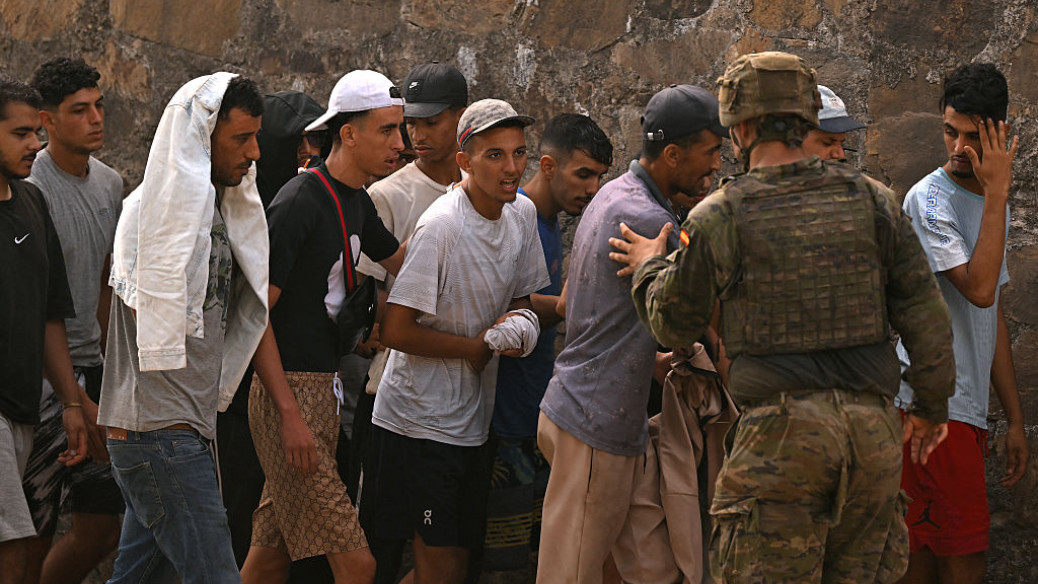
In recent years Israel has forged close ties to Morocco amid worsening relations with Spain, fuelling speculation about its involvement in the Ceuta crisis
Beginning last Thursday, over 60,000 migrants tried to get into the disputed Spanish enclave of Ceuta in North Africa, causing a major crisis.
The Spanish government announced on Saturday that at least 67 people have been killed while declaring that the crisis was over, with migrants returning from the enclave.
The Moroccan armed forces have been accused of facilitating the movement of thousands of migrants to the border and standing by as they stormed the enclave.
Ceuta and another Spanish-controlled enclave, Melilla, have long been a point of dispute and tension between Spain and Morocco, which claims them and views them as territories under occupation.
Amid the dramatic scenes of desperate migrants storming Ceuta’s border, attention online has turned to Israel’s alleged role in the events.
Why would Israel want to create a border crisis between Morocco and Spain?
The left leaning government of Spanish Prime Minister Pedro Sanchez has been an outspoken critic of Israel’s war on Gaza and the US-Israeli war on Iran and this has translated into practical foreign policy steps.
Sanchez has called Israel’s war on Gaza a “genocide” and an “extermination” of a defenceless population and in 2024, his government recognised Palestinian statehood.
Spain has imposed an arms embargo on Israel while restricting ships carrying arms there from docking in Spanish ports. Sanchez’s government has called on the EU to suspend its association agreement with Israel and impose sanctions.
Regarding the war on Iran, Sanchez has refused to let US planes use Spanish bases and airspace for operations against Iran, calling the war an “extraordinary mistake” and a violation of international law.
Sanchez’s pro-Palestinian stance has been greatly appreciated in Gaza, where Palestinian artists and children recently drew a mural of the Spanish prime minister. He thanked them in a video message, saying he was “deeply moved” by the gesture.
On the other hand, Israel’s far-right Diaspora Affairs Minister Amichai Chikli has called Sanchez an “enemy of western civilisation” over his opposition to the wars on Iran and Gaza.
How has Israel responded to the Ceuta border crisis?
On Friday Israeli Ambassador to the UN Danny Danon criticised Spain for its handling of the crisis, and appeared to back Morocco’s position on the two disputed enclaves.
“Spain, which never misses an opportunity to lecture Israel, has declared a state of emergency in Ceuta following the crisis over its immigration policy. Maybe before it continues lecturing us, it’s time it explained to the world why it still maintains colonial enclaves in Africa,” he wrote on the social media platform X.
Despite overwhelming popular opposition in Morocco to the Gaza War, Israel and Morocco have had close ties since a controversial 2020 normalisation deal, which also saw the US recognise Moroccan sovereignty over the disputed Western Sahara region.
The ties between the two countries include close military cooperation, with Rabat and Tel Aviv signing a joint military work plan in January 2026.
What evidence is there that Israel was involved?
Last April, Moroccan political analyst Amine Ayoub, wrote an article for the Israeli news website Ynet, saying that Spain’s worsening ties with the US had opened “a genuine crack in Spain’s strategic armour over Ceuta and Melilla”. He called Israel “Morocco’s most consequential partner” and said that it was “uniquely positioned to press… into that crack”.
The previous month, Michael Rubin from the pro-Israel American Enterprise Institute, said that Spain was “a colonial power running colonies across the Strait of Gibraltar” and advocated a new Moroccan “Green March” into Ceuta and Melilla, similar to the 1974 Green March by which Morocco took control of most of Western Sahara.
US Republican Representative Mario Diaz-Balart, who is close to Secretary of State Marco Rubio said that Ceuta and Melila are “not in the geographic territory of Spain” and called for negotiations between Morocco and Spain to determine their future.
Spain’s Transport Minister Oscar Puente appeared to endorse the theory that Israel had a hand in the events when he responded to Danny Danon’s X post, commenting “Well, things are starting to get pretty clear”.
Gabriel Rufian, a spokesperson from the Republican Left of Catalonia party went further, saying “The Moroccan dictatorship, in the service of the US and Israel, is once again blackmailing Spain and Europe this summer by turning its own people into disposable cannon fodder.”
On X, social media users also dug up a tweet from 2019 by Benjamin Netanyahu’s son Yair, sharing a map of Ceuta, Melilla, and smaller territories off the Moroccan coast controlled by Spain saying “Dear Arabs and Muslims. Want to free occupied Arab Islamic lands? Here’s a good start!”
So was Israel involved?
While Israeli involvement is difficult to definitively prove, the stunning entry of thousands of Moroccan and other migrants into the Spanish-controlled enclave, with the apparent complicity of the Moroccan military cannot be considered in isolation from recent geopolitical changes in the region. Spain’s relationship with Israel and the US has become much worse in recent years while Israel draws closer to Morocco. Statements by US and Israeli officials appearing to support Morocco’s position on the disputed Ceuta and Melila enclaves are also difficult to ignore.