
Key Takeaways:
Niger. IS Sahel Province (ISSP) and al Qaeda’s Sahelian affiliate Jama’at Nusrat al Islam wa al Muslimeen (JNIM) separately launched two of their most significant attacks in Niger in years as they exacerbate the rapidly deteriorating security situation in western Niger, including around the Nigerien capital. The two rivals are battling for influence across West Africa, and the adversaries’ desire to outbid each other are likely at least a partial motivating factor in these major attacks.
Niger
IS Sahel Province (ISSP) carried out one of its deadliest operations ever against Nigerien security forces as the IS group seeks to expand its rear support zones southward from the Mali-Niger border. ISSP conducted simultaneous, complex attacks on Nigerien military bases in Inates and Banibangou, near the Mali-Niger border, in the Tillabéri region on June 17.[1] ISSP militants overran and looted both bases, killing at least 51 soldiers at Inates and 34 soldiers at Banibangou according to various Nigerien and international sources.[2] ISSP released an official statement on June 24 in which it claimed to have killed at least 10 troops in Banibangou and 70 troops in Inates, while pro-Nigerien opposition sources claimed that the deaths at Inates and Banibangou reached 101 and 107 soldiers, respectively.[3] ISSP also claimed to have destroyed 22 vehicles, seized 24 vehicles and various weapons, and torched both bases.[4]
The attacks likely aim to consolidate ISSP’s support zones along the Mali-Niger border. Banibangou and Inates are two important forward operating positions for Nigerien forces, located 20 and three miles from the Malian border, respectively. ISSP has targeted Inates and other border posts repeatedly in recent years as part of efforts to expel security forces from the border area and strengthen ISSP support zones. The campaign includes two major attacks on Inates and Chinagodrar—a village 25 miles northeast of Banibangou along the RN24 road toward the Malian border—in December 2019 and January 2020, respectively.[5] The attacks killed a combined 160 soldiers and are the deadliest attacks ever against Nigerien security forces, pending the final death toll of ISSP’s latest attacks.
ISSP has exploited the withdrawal of Western partner forces from Mali and Niger between 2022 and 2024 to strengthen its support zones and isolate security forces along the Mali-Niger border. Western partner forces gave priority to supporting counter-ISSP operations in both countries in 2019 and 2020 and significantly weakened ISSP throughout 2020.[6] ISSP has significantly strengthened its rear support zones in northeastern Mali since the withdrawal of French forces from Mali in 2022, however, and it has carried out governance activity across Mali’s Ménaka region since 2023.[7]
ISSP’s rear support zones in Mali and the withdrawal of French and US forces from Niger between 2023 and 2024 have enabled ISSP to further strengthen and expand its support zones across the border in northwestern Niger. CTP assessed in 2024—almost exactly one year after the Nigerien junta took power—that ISSP was filling the vacuum left by overstretched Nigerien forces and consolidating control over a large parts of Niger’s Tahoua and Tillabéri regions.[8] CTP then assessed in late 2025 that ISSP was using these support zones along the Mali-Niger border to support attack campaigns on civilians across northwestern Niger. ISSP has since begun shifting the focus of its attacks from civilians to security forces across its operational zones north of Niamey in Niger in 2026.[9] ISSP has attacked civilians in nearly half of its attacks across these departments in the Tillabéri region in 2026, whereas it targeted civilians in nearly two-thirds of its attacks in the area in 2025 and in over 80 percent of its attacks in years prior.[10] These attack patterns are an indicator that the group has subjugated any civilians left in the targeted areas and is attempting to consolidate support zones by isolating or removing security forces from the area.
Figures 1 and 2. ISSP Shifts Focus of Attacks from Civilians to Rival Armed Forces and Strengthens Support Zones in Northern Tillabéri Region, 2023–26
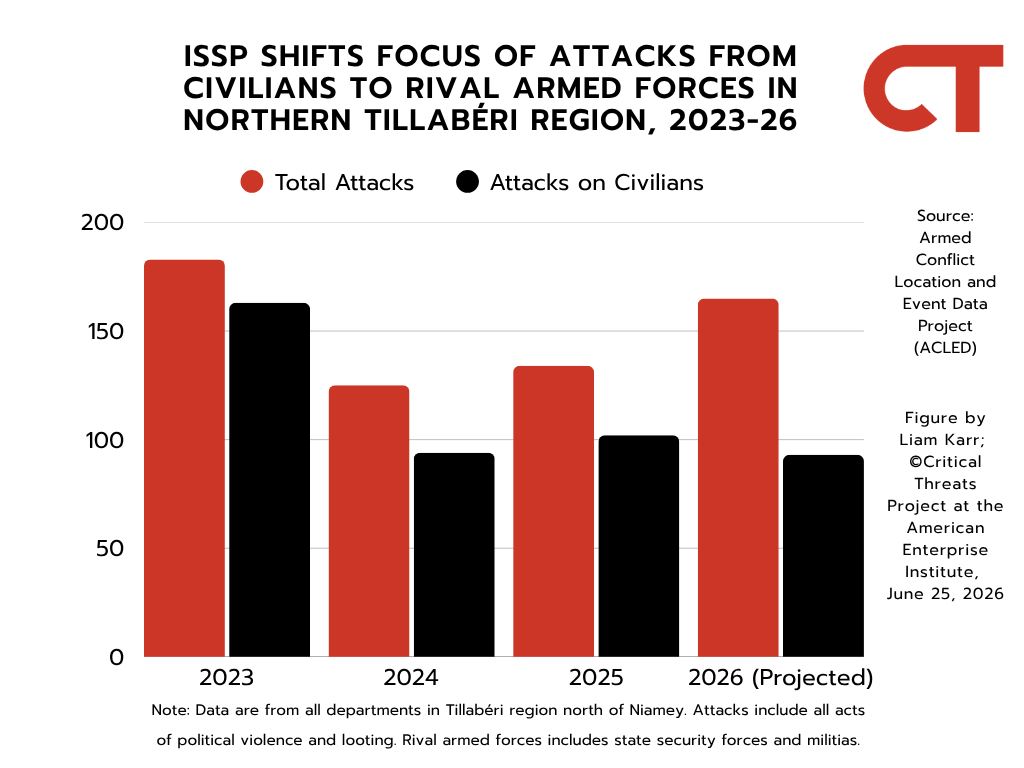
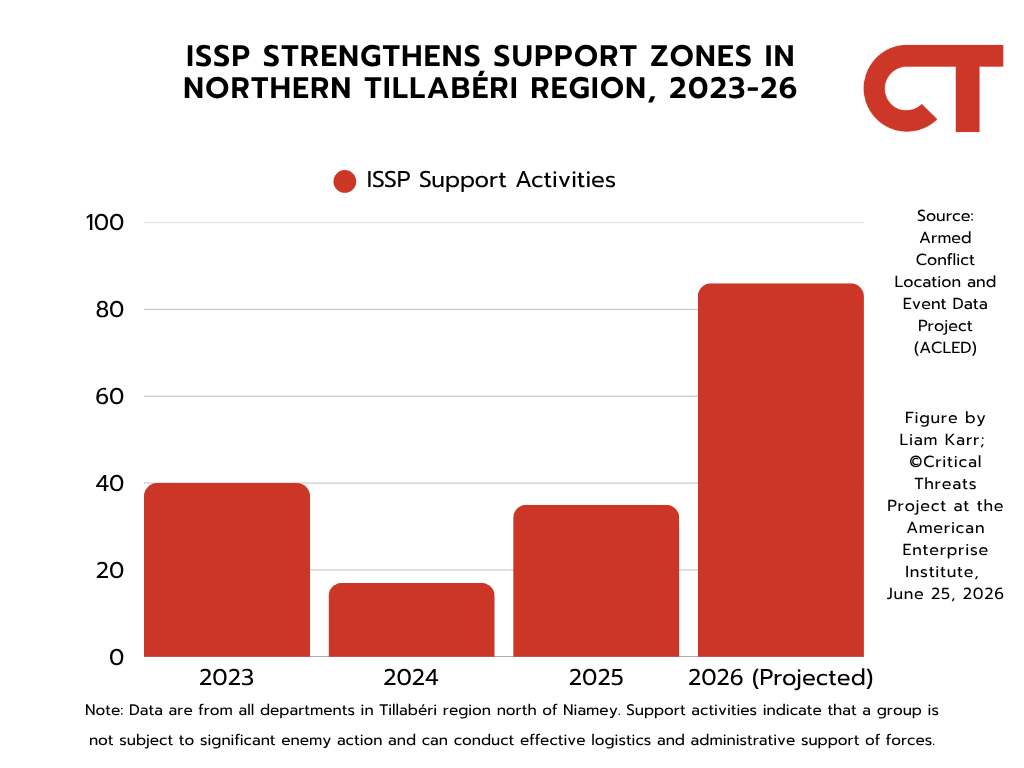
Note: Data are from all departments in Tillabéri region north of Niamey. Attacks include all acts of political violence and looting. Rival armed forces include state security forces and militias. Support activities indicate that a group is not subject to significant enemy action and can conduct effective logistic and administrative support of forces.
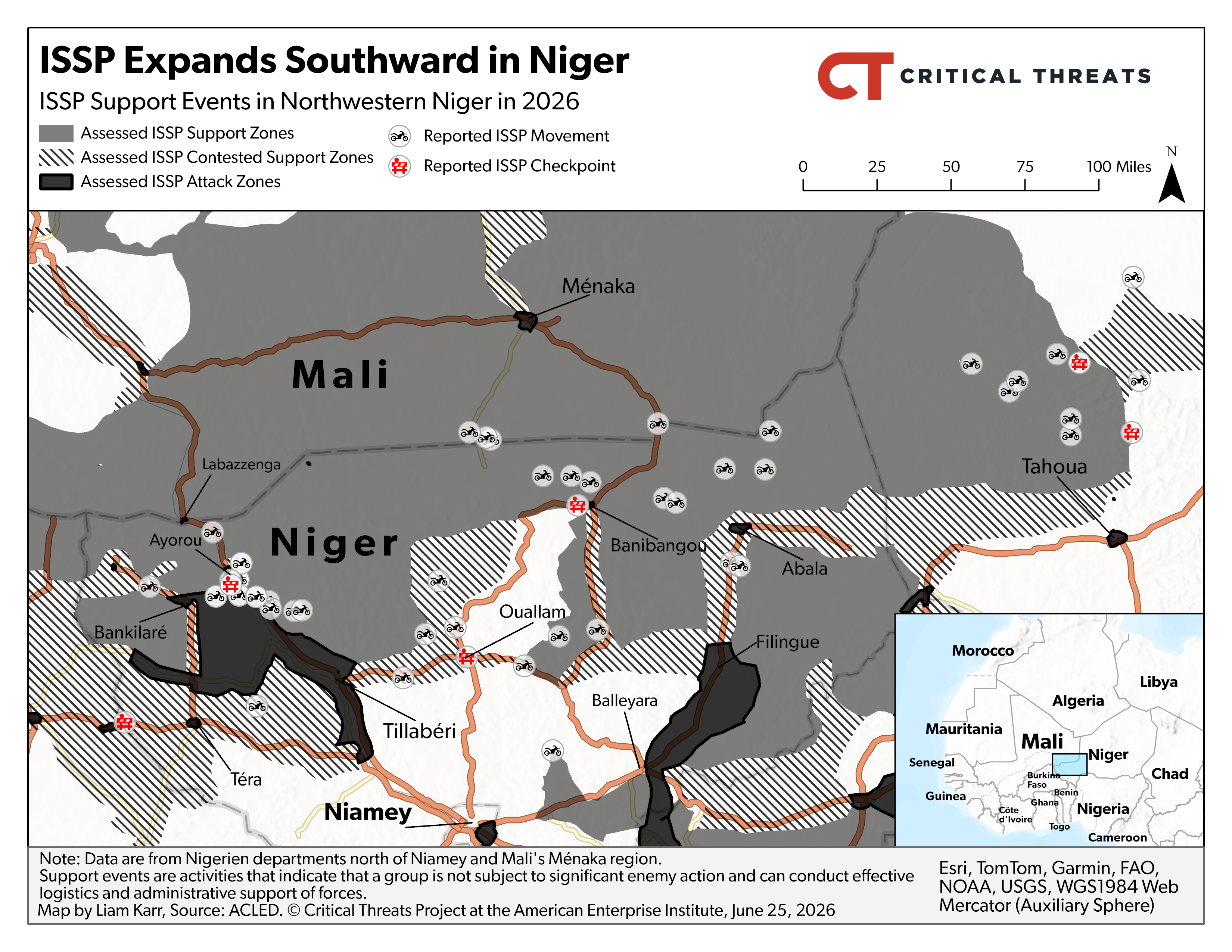
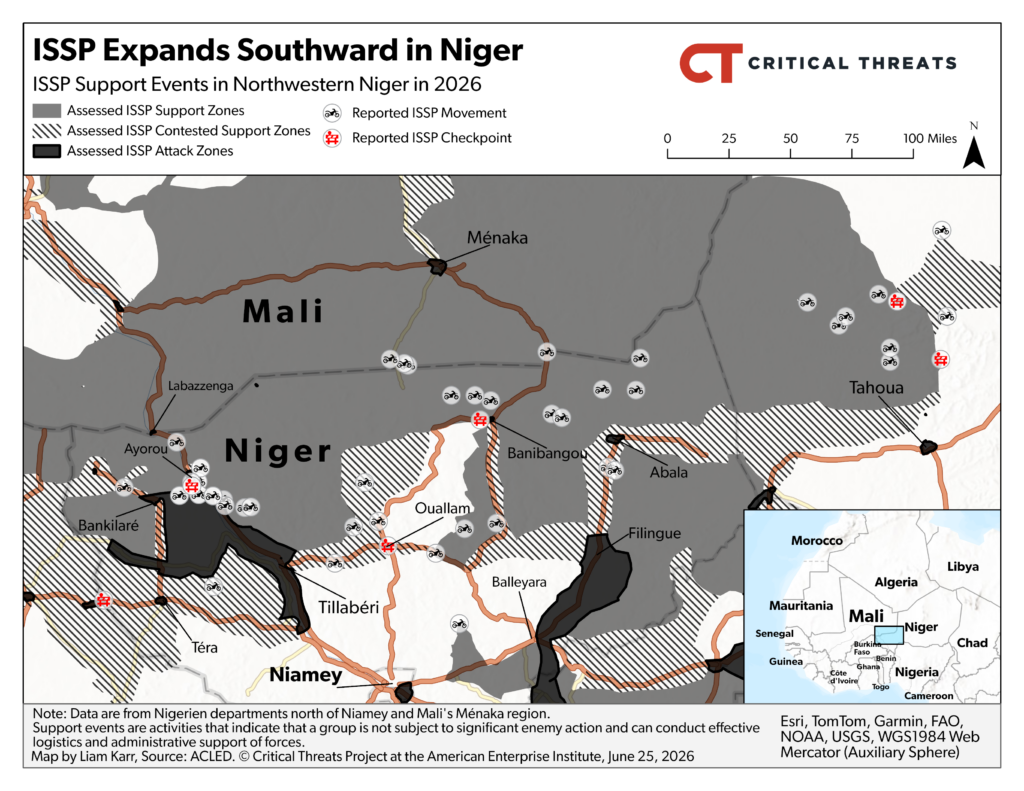
These strengthening support zones have given ISSP the freedom of movement and resources necessary to stage large and sophisticated operations against security forces, such as the June attacks. Armed Conflict Location and Event Data (ACLED) has already recorded at least 53 ISSP events that CTP categorizes as support activity across ISSP’s core operational zones along the Mali-Niger border.[11] These zones include Mali’s Ménaka region and all departments in Niger’s Tillabéri and Tahoua regions that are east of the Niger River and north of Niamey.[12] The support events consist almost entirely of reported sightings of uninhibited ISSP movements and ad hoc checkpoints.[13] ISSP support activity in this area in 2026 has already surpassed the total number of support indicators in all of 2025 and is on pace to easily surpass the previous annual high of 68 such events in 2023.[14] Support activity in the departments in Tillabéri region, where the June attacks took place, have already surpassed the previous annual record from 2023.[15]
Figure 3. ISSP Expands Southward in Niger
Jama’at Nusrat al Islam wa al Muslimeen (JNIM) separately attacked the international airport near the Nigerien capital Niamey for the first time, highlighting the rapidly worsening insecurity around Niamey and threatening to further degrade critical Nigerien air capabilities. Plainclothes JNIM commandos, including suicide bombers, attempted to infiltrate the Diori Hamani airport aboard taxis and trucks early in the morning of June 18.[16] Nigerien security forces at an outer checkpoint engaged the attackers and repelled the gunmen after several hours of fighting, which killed at least 11 soldiers and two civilians.[17] JNIM claimed that the attack killed 17 Nigerien soldiers and destroyed two military aircraft, while the Nigerien defense ministry claimed that security forces killed 22 insurgents and arrested 20 others.[18] The airport is five miles from Niger’s Presidential Palace and contains Air Base 101, which hosts Russian Africa Corps soldiers, the Italian support mission for the Nigerien military, the headquarters of the Niger-Burkina Faso-Mali joint military force, and several important aircraft.[19]
Figure 4. ISSP and JNIM on the Offensive in Niger
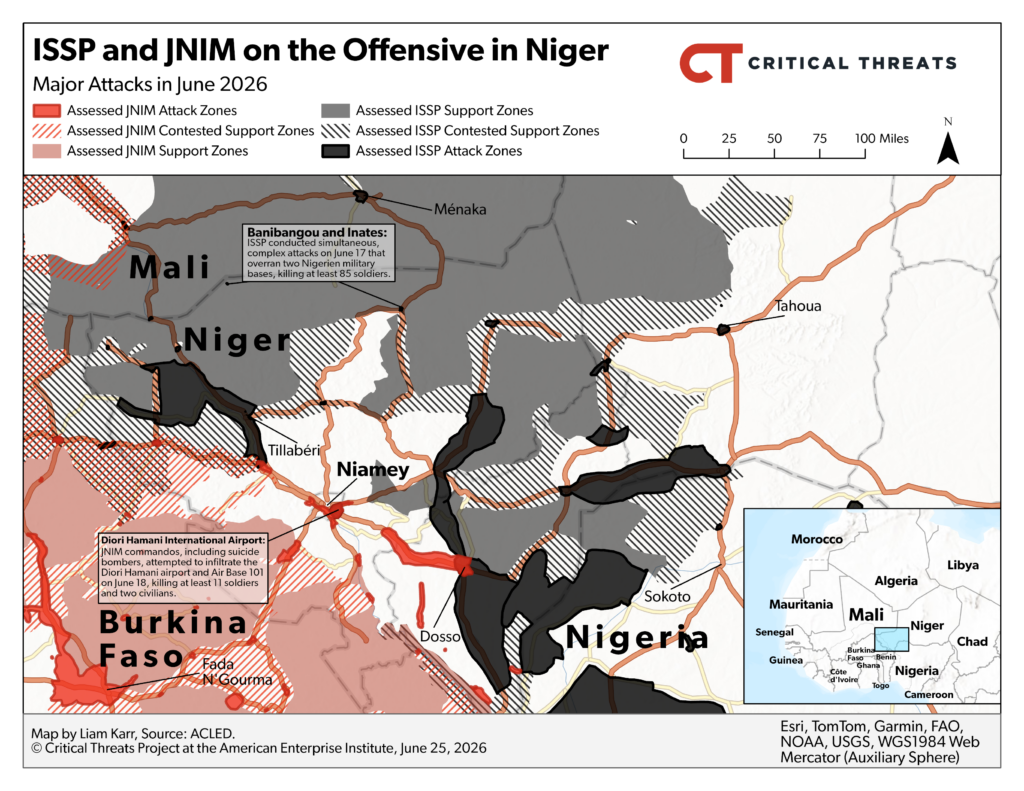
The security situation around the Nigerien capital has significantly deteriorated since 2025. ISSP conducted a complex attack targeting Air Base 101 in January 2026. The attack involved one-way attack (OWA, or kamikaze) drones, mortar fire, vehicle-borne improvised explosive devices, and heavily armed militants on motorcycles to target the air command headquarters and drone facilities.[20] The attackers burned several civilian and military aircraft, vehicles, and at least three hangars.[21] ISSP-linked militants abducted American missionary Kevin Rideout from his home roughly 100 yards from Niger’s Presidential Palace in Niamey in October 2025 before reportedly transferring him to ISSP rear support zones in Mali.[22] JNIM has been active around Niamey since 2024, when it attacked a security post in the Niamey suburbs and carried out three other small attacks within five miles of the Niamey administrative limits.[23]
ISSP and JNIM attacks on Nigerien air bases in 2026 have destroyed several Nigerien air assets. ISSP reportedly destroyed one of two Mil Mi-17 SH combat-transport helicopters, one of three Hurkus military training and observation aircraft, one of two Diamond Aircraft DA42 surveillance planes, one or possibly two of Niger’s four Cessna 208 Caravan reconnaissance aircraft, and either Niger’s only Aksungur drone or one of its six Bayraktar TB2 drones in its January attack.[24] ISSP also attacked Air Base 401 near Tahoua city in March.[25] The Tahoua regional governor said the March attack damaged unspecified equipment, while uncorroborated reports from pro-Nigerien opposition sources said that militants may have damaged an Aksungur drone, a Bayraktar TB2 drone, and a ground-control station.[26] JNIM claimed to have damaged two unspecified aircraft in its attack on the Niamey airport.[27]
The losses have degraded Niger’s already-diminished intelligence, surveillance, and reconnaissance (ISR) and quick-response capabilities, which are key to monitoring insurgent support zones and detecting, disrupting, and responding to mobilizations for large-scale attacks. The departure of US and French forces—particularly 1,100 US personnel who were primarily providing ISR support—already undermined Nigerien ISR in remote areas.[28] The destroyed Cessna and Diamond aircraft represent at least a third of Niger’s ISR aircraft.[29] The Hurkus C combat aircraft combines ISR and attack capabilities and uses infrared and optical imaging.[30] The MI-171 SH combat-transport helicopter is Niger’s biggest multi-role helicopter, capable of carrying 36 troops and 4,000 kilograms of cargo.[31] Niger’s other transport helicopters aside from the remaining MI-171—two Bell 412HP Twin Hueys and five SA342 Gazelles—can accommodate roughly 14 and five people, respectively.[32]
ISSP and JNIM are likely seeking to outbid each other as they compete to expand southward from the Sahel in West Africa. Outbidding is a political theory that argues that rival militant groups will escalate the rate, scale, or target importance of their attacks to differentiate themselves from each other to attract more public support, recruits, and resources.[33] CTP assessed in early April 2026 that heightened competition between ISSP and JNIM could “lead to more high-visibility attacks across West Africa as the groups compete for attention and legitimacy.”[34] ISSP’s June attacks come less than two months after JNIM’s largest offensive in the Sahel in over a decade in late April 2026, when it attacked security forces across Mali, killed the Malian defense minister, and captured Mali’s northernmost regional capital, Kidal.[35] ISSP already tried to downplay the importance of JNIM’s attacks by criticizing JNIM’s partnership with secular rebels, who also participated in the April attacks.[36] JNIM’s attack on the Niamey airport is a more clear-cut case of outbidding given ISSP’s January 2026 attack on the same target.
The two groups are also battling to assert themselves as the dominant faction in northwestern Nigeria. ISSP-linked militants increased attacks in northwestern Nigeria throughout 2025, but JNIM was the first of the two to formally claim an attack in Nigeria in October 2025.[37] IS finally ex post facto claimed the first ISSP attack in northwestern Nigeria in May 2026.[38] IS’s belated claim highlights that ISSP is not motivated purely by outbidding logic in northwestern Nigeria, however, as it noted that it deliberately withheld claiming prior attacks for security reasons.[39] CTP also assessed that the claim was likely primarily in relation to IS setbacks in northeastern Nigeria, not competition with JNIM.[40]
This outbidding is taking place primarily in operational zones where both JNIM and ISSP are not strong enough to engage in direct conflict with each other, as has happened in other parts of the Sahel. The two rivals have engaged in intense fighting since 2019 in areas where they possessed overlapping strong support zones, primarily in the tri-border area of Burkina Faso, Mali, and Niger. Clashes peaked between 2022 and 2023, when ISSP and JNIM engaged in several large-scale battles in northeastern Mali that cost both groups hundreds of fighters as they fought to fill the vacuum left by the withdrawal of French forces.[41] ISSP ultimately forced JNIM out of much of Mali’s Ménaka region and established its rear support base in Mali.
Figure 5. Sahelian Salafi-Jihadi Infighting Shifts South
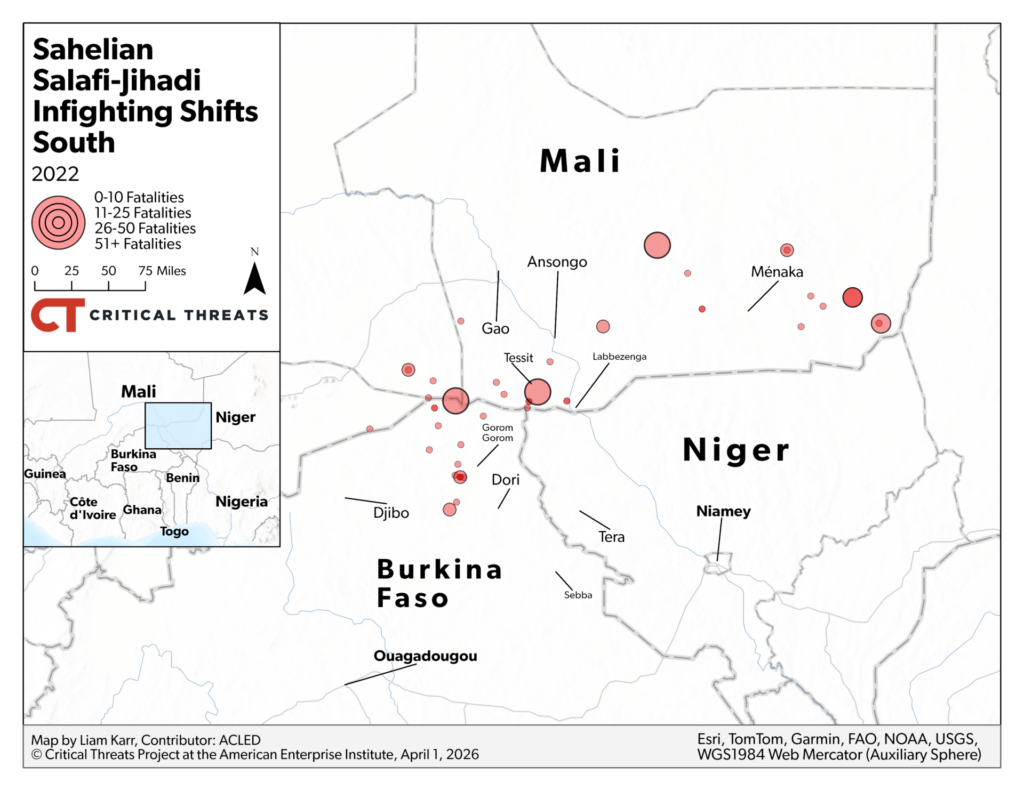
Fighting between the two groups has continued at a lower scale since 2023 and spread south.[42] Direct fighting could become more prevalent as the two rivals attempt to expand in the same areas southward. CTP has assessed since late 2025 that the border area for Benin, Burkina Faso, Niger, and Nigeria could become a new theater for fighting between the two groups as they simultaneously strengthen their forces in the area.[43] Most clashes between the groups in 2025 took place in northeastern Burkina Faso, and the two groups fought in Niger and Nigeria for the first time in April 2026.[44]