
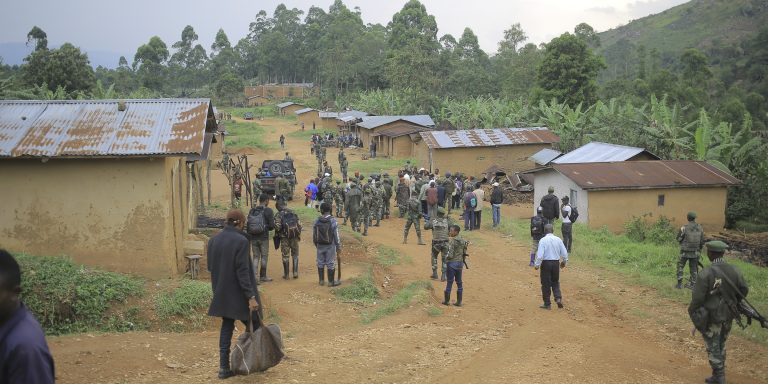
Islamic State Central Africa Province (ISCAP) remains resilient, with mobile units active across the forested terrain of eastern Democratic Republic of Congo (DRC).
Its March 2026 attack on a Chinese-owned mining site indicates at once its growing area of operations and a change in tactics, now attacking security forces directly.
Pressure on the group’s main camp from Operation Shujaa, the joint Ugandan-Congolese military offensive to counter ISCAP, has initiated a northward move to Haut-Uélé Province.
The Ebola outbreak in eastern DRC has so far not overlapped with ISCAP’s violent rampages, but secondary effects of large flows of internally displaced people to Ebola hotspots remain of concern.
Islamic State Central Africa Province (ISCAP), locally known as the Allied Democratic Forces (ADF), has demonstrated its growing and lethal operational reach in recent months and, in parallel, has shown itself adept at diversifying its financial streams. The group’s expanded operational reach has emerged against the backdrop of multiple crises in the Democratic Republic of Congo (DRC), which is grappling with the Islamic State (IS) affiliate, various armed groups, the Rwanda-backed M23, and an expanding Ebola outbreak. Despite tactical victories by Operation Shujaa, the joint military offensive by the DRC and Uganda against insurgent forces in the DRC’s East, which has pushed the jihadists back from key areas of operation, ISCAP has proven resilient. The IS affiliate has shown it can strike larger, more fortified, and more strategic targets located farther away from its traditional stronghold. This was evidenced in its March 2026 attack on the large Chinese-owned Muchacha mining site, followed by other nearby attacks with 50 killed according to local civil society, more than 50 kilometers out of its prior area of operations.
While the group has targeted many artisanal mining sites, the Chinese-owned mine in Muchacha was not only a fortified, industrial-scale mine but also protected by the Congolese Armed Forces (FARDC). Currently, ISCAP has roughly 2,500 to 3000 members across its disparate jungle camps, according to Caleb Weiss, an expert on ISCAP and other African jihadist groups, at the Bridgeway Foundation. Of that range, approximately 300 to 500 are considered active fighters, who have been strikingly effective and brutal in their focus on targeting civilians.
According to Armed Conflict Location and Event Data (ACLED), ISCAP has demonstrated an increased willingness to attack security forces directly, a marked shift from its prior tactics. This has occurred at the same time that the group has refined its ability to now conduct attacks outside its immediate stronghold, demonstrating persistent capabilities. According to Caleb Weiss, its core capability that has not been degraded by counterterrorism pressure is its mobility, which it leverages through dynamic units that move quickly and effectively. ISCAP’s ability to traverse the jungle is enhanced by the group’s adoption of various technologies, including Starlink, which has enabled consistent communication channels, drones for intelligence, surveillance, and reconnaissance (ISR), and handheld GPS devices.
The mobility strategy of ISCAP also appears to stretch government resources thin and provide cover for other operations it carries out, such as moving its camps around: by relying on smaller mobile groups that can shift geographically and attack new villages away from its main area of operations, it has been able to divert security forces. Due to pressure from Operation Shujaa, for example, ISCAP has moved its main camp, Madina, into the Haut-Uélé Province, which has significantly fewer capable FARDC units to push back against the group. Simultaneously, there has been a spate of attacks around Beni and in Biakato, which are likely an attempt to redirect security forces away from the newly moved Madina camp. This recent operational reach and violence in Haut-Uélé Province have been framed in official propaganda materials as proof of the group’s expansion. The northward shift reflects, in reality, both a greater operational area and the result of sustained military pressure. According to Weiss, these spates of attacks may also be used to move other camps around, closer to the Madina main camp — particularly camps based in Lubero territory: “These attacks and massacres to redirect the focus of security forces are unfortunately one of its most common tactics and is one big game of cat and mouse.”
Simultaneously, ISCAP’s financing strategy has become increasingly diversified, complementing the large stream of revenue it receives from IS with taxation of civilians and its expansive kidnappings-for-ransom schemes, which can yield tens of thousands of dollars. According to Weiss, ISCAP propaganda has attempted to conceal and whitewash many of these kidnapping-for-ransom schemes, with pronouncements that Christians taken hostage have been released after they converted to Islam or paid the taxes imposed on them (Jizyah). In reality, most of these cases involve a direct ransom payment. ISCAP has carried out mass sectarian rampages in the DRC, a country that is roughly 95 percent Christian. Nonetheless, it also targets Muslims rejecting extremism and, rather than ideology-driven recruitment, has largely recruited by tricking people into joining the group.
Some have worried that the group’s activities may increasingly overlap with areas currently contending with an Ebola outbreak. According to the European Center for Disease Prevention and Control, reporting numbers from the DRC Ministry of Health, as of 25 May 2026, a total of 105 confirmed cases (including 10 deaths) and 906 suspected cases (including 223 deaths) have been reported in Ituri, North Kivu, and South Kivu provinces. So far, the rampage by ISCAP in these provinces and the Ebola outbreak do not yet overlap geographically. However, attacks on major arteries that carry medical teams and supplies to the areas hardest hit may lead to such a catastrophic overlap in the future. A secondary risk in a country facing one of the world’s largest internal displacement crises is that further displacement caused by ISCAP’s attacks may push civilians into the area struggling with the outbreak, which is extremely contagious through direct contact with infected bodily fluids.