
The Institute for Economics and Peace has released its latest Global Terrorism Index 2026—an annual report that assesses the level of terrorist threat in 163 countries around the world.
The 13th edition of the Global Terrorism Index (GTI), released by the Institute for Economics & Peace in March 2026, paints a picture of cautious optimism laced with warning signs. Deaths from terrorism fell sharply by 28% to 5,582, while incidents dropped 22% to 2,944. Improvements were recorded in 81 countries –the highest number since 2021 –with only 19 deteriorations, the lowest in the Index’s history. Yet beneath these headline numbers lies a story of geographic concentration, evolving tactics, and emerging risks that suggest 2025’s gains may prove temporary.
The report underscores terrorism’s persistent adaptability. While large-scale spectacular attacks were largely absent (the deadliest incident in 2025 killed 120 people compared to 237 the previous year and over 1,100 in 2023), the threat has not vanished. It has simply reconfigured itself along borders, within fragile states, and through younger recruits.
What makes the current situation especially dangerous is the rapid rise of non-traditional threats that are far harder for conventional counterterrorism strategies to address
Pakistan Claims Top Spot
For the first time, Pakistan ranks as the country most impacted by terrorism, with a GTI score of 8.574 and 1,139 deaths. This marks a sharp resurgence driven by the Tehrik-e-Taliban Pakistan (TTP) and Balochistan Liberation Army* (BLA), compounded by the Taliban’s return to power in Afghanistan in 2021. Deaths in Pakistan are now at their highest level since 2013, with 1,045 incidents recorded in 2025.
Imagine the chaos of the Jaffar Express hijacking in Pakistan last year: 442 hostages taken in one dramatic operation. Such high-visibility incidents, alongside relentless border skirmishes, have turned parts of Balochistan and Khyber Pakhtunkhwa into perpetual conflict zones.
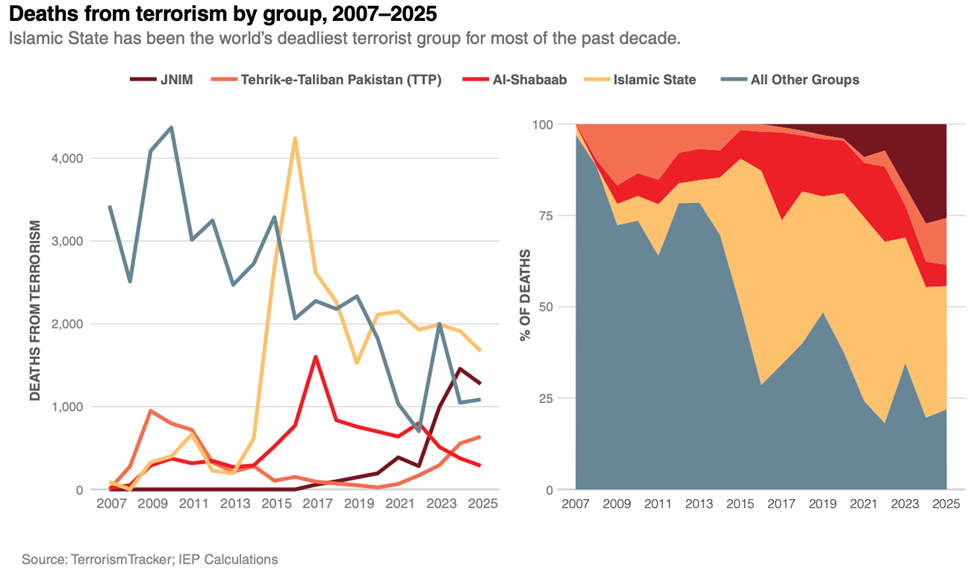
TTP alone was responsible for 637 deaths across 595 attacks, a 13% increase from the prior year, making it the only one of the four deadliest groups to record a rise. Just five countries (Pakistan, Burkina Faso, Nigeria, Niger, and the Democratic Republic of the Congo) accounted for nearly 70% of all terrorism fatalities in 2025. Six of the ten most impacted countries are in sub-Saharan Africa, confirming the region as the current global epicenter.
Burkina Faso, which ranked first in 2023 and 2024, dropped to second (score 8.324) after a dramatic 45% reduction in deaths to 846. Niger ranked third with 703 deaths. In Nigeria, deaths rose 46% to 750, while the DRC saw its worst-ever position with 467 deaths. Colombia also entered the top ten for the first time since 2013.
Sub-Saharan Africa and the Sahel
The Sahel remains the heart of global terrorism, accounting for more than half of all deaths. Positive trends emerged in the region, namely deaths falling in ten sub-Saharan countries, but groups appear to be consolidating territorial gains, reducing civilian targeting while imposing economic blockades on major towns.
The report dedicates an entire section to “Terrorism and Borderlands”, noting that 41% of attacks occur within 50km of an international border and 64% within 100km. Porous borders in the Afghanistan-Pakistan region, Central Sahel tri-border area, Lake Chad Basin, and Colombia-Venezuela frontier create persistent authority gaps.
In Burkina Faso, which dropped to second place after a 45% reduction in deaths to 846, JNIM* militants are perfecting a strategy of siege warfare by choking supply lines rather than massacring civilians outright. It’s a grim evolution: fewer deaths, but deeper control.
Islamic State* and the “Big Four”
Islamic State* (IS) and its affiliates remained the world’s deadliest terrorist organization, active in 15 countries and responsible for just under 17% of attacks globally. Activity shifted dramatically toward sub-Saharan Africa. The four deadliest groups, i.e. IS, JNIM, TTP, and al-Shabaab accounted for 70% of deaths (3,869 fatalities).
IS* has proven remarkably resilient, nearly doubling attacks in sub-Saharan Africa while its Middle East footprint shrinks. In the DRC, the group’s affiliates horrifyingly turned funerals, churches, and hospitals into killing grounds.
The West’s Rising Concern
Deaths from terrorism in Western countries rose 280% to 57. High-profile incidents included the Bondi Beach shooting in Australia and politically motivated attacks in the US. Youth radicalization stands out: minors accounted for 42% of terror-related investigations in Europe and North America, a threefold increase since 2021, with timelines compressing to weeks. Youth radicalization, amplified by short-form video platforms, algorithmic echo chambers, and encrypted messaging apps, has dramatically shortened the path from discontent to violence.
What makes the 2025 decline feel particularly precarious is how it collides with today’s fractured geopolitical situation. As of mid-May 2026, the world is grappling with active conflict between Pakistan and Afghanistan, mass escapes of over 20,000 IS-linked individuals from Syrian detention facilities, and the fallout from the joint US-Israeli strikes on Iran in late February. These events are actively reshaping the operating environment for terrorist networks.
Economically, the picture is equally unimpressive. Many of the hardest-hit countries are already struggling with debt distress, sanctions, or the consequences of prolonged instability, which limits their ability to invest in governance, border control, or deradicalization programs. Militarily, the shift toward drone warfare (notably in Colombia) and sophisticated online propaganda suggests that terrorist groups are learning faster from global conflicts like Ukraine than many states are adapting. In the West, where political polarization is at historic highs and trust in institutions continues to erode, the rapid radicalization of alienated youth is no longer a peripheral issue. It is becoming a domestic security crisis that cannot be solved by intelligence operations alone.
History rarely moves in straight lines. The encouraging dip in terrorism deaths in 2025 could mark the beginning of a longer decline or it may simply be the eye of the storm. What makes the current situation especially dangerous is the rapid rise of non-traditional threats that are far harder for conventional counterterrorism strategies to address.
The proliferation of commercial drones is, for example, reflected in militants in the Sahel and TTP fighters in Pakistan increasingly using them for reconnaissance and strikes.
Lone-actor terrorism, often blending personal grievances with online-inspired ideologies, now dominates fatal attacks in Western countries (93% over the past five years). These decentralised, tech-enabled, and ideologically fluid “non-traditional” threats thrive in the gaps created by political polarization, weakened state authority in borderlands, and the relentless pace of technological innovation.
Without serious efforts to strengthen state capacity in borderlands, address the socio-economic grievances that fuel recruitment, and counter the algorithmic amplification of extremism, today’s statistical improvements risk becoming little more than a temporary reprieve before the next wave.