
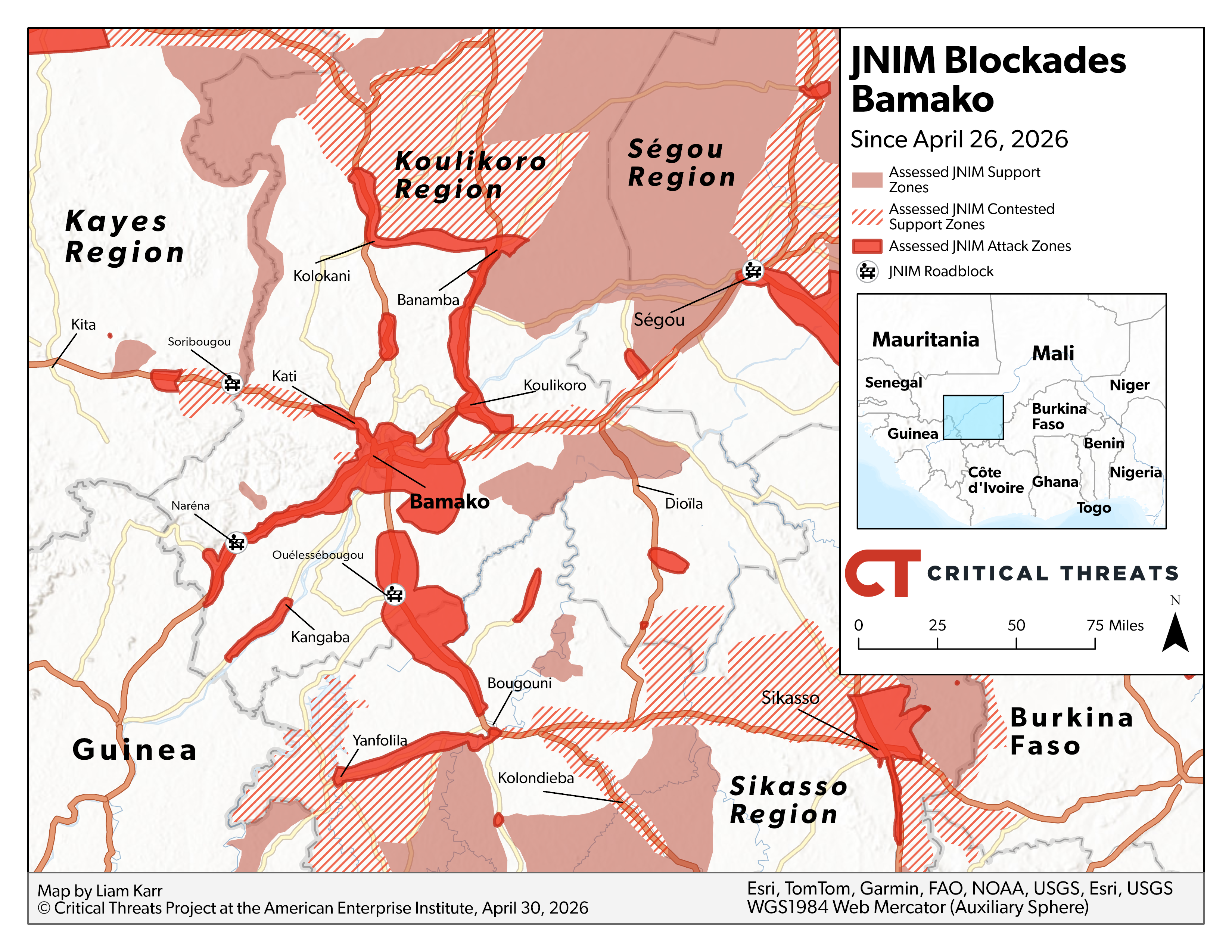
Key Takeaways:
Sudan. The Rapid Support Forces (RSF) conducted drone strikes on key infrastructure in cities across central and eastern Sudan, undermining the Sudanese Armed Forces-led Sudanese government’s efforts to boost its legitimacy by restoring governance. Sudan accused Ethiopia of facilitating some of the strikes, which could increase the unfolding regional proxy conflict between the two countries and raises the risk of direct military confrontation, although both have capacity constraints that make this unlikely.
Ethiopia. The Tigray People’s Liberation Front reinstated the pre-Tigray war regional government, effectively voiding the Pretoria peace agreement that ended the Tigray war and setting up a showdown and potential military confrontation with the federal government.
Democratic Republic of the Congo (DRC). The United States sanctioned former DRC President Joseph Kabila for supporting M23 rebels to the detriment of the Washington Accords. US sanctions and other forms of coercion against M23 and Rwanda are unlikely to lead to the group’s military defeat in the short-term and could reduce the incentives for all sides to make concessions in the Doha process peace talks.
Mali. Malian and Russian forces appear to be withdrawing from northern Mali’s Kidal region but have retained their positions elsewhere in northern Mali. Al Qaeda’s Sahelian affiliate Jama’at Nusrat al Islam wa al Muslimeen has begun violently enforcing a partial blockade on the Malian capital, Bamako, and appealing for a “united front” to oust the junta, while the junta has launched a crackdown to quash any dissent.
Madagascar. Russian information operations may have fueled a recent diplomatic dispute between France and Madagascar over allegations that French nationals were involved in a plot to overthrow the Malagasy junta leader.
Figure 1. Africa File, May 7, 2026
Assessments:
Sudan
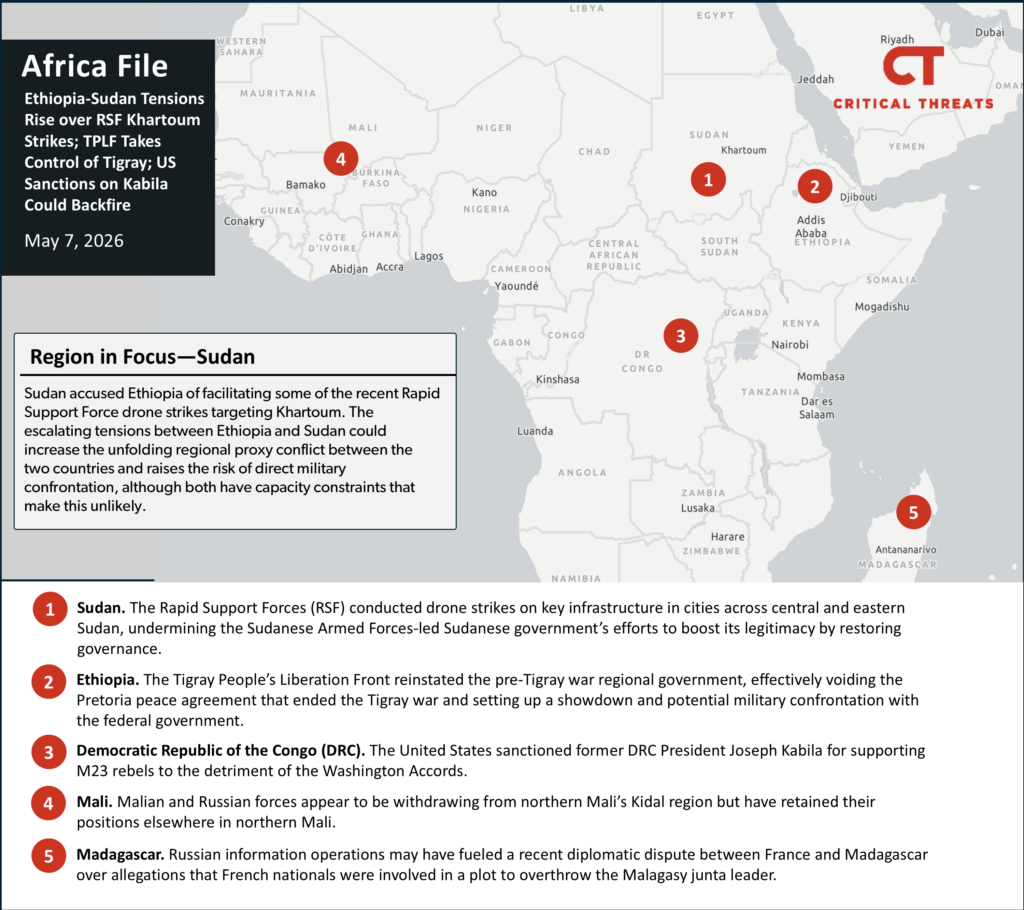
The Rapid Support Forces (RSF) conducted drone strikes targeting key infrastructure across cities in central and eastern Sudan, including the Sudanese capital, Khartoum. The RSF carried out a barrage of attacks on at least five cities from May 1 to May 5. The RSF struck Khartoum and its twin city Omdurman multiple times in the five days.[1] The strikes on Khartoum hit the recently reopened Khartoum airport, reportedly targeting civilian terminals and damaging a radar and air defense system, forcing the airport to close temporarily.[2] The RSF also struck el Obeid—the SAF headquarters in central Sudan—on May 1, damaging the state television station.[3] The RSF then struck fuel depots near the White Nile state cities of Kosti and Rabak, on May 3 and May 5, respectively.[4] Egypt, Saudi Arabia, and the United States condemned the RSF’s drone strikes.[5]
Figure 2. RSF Drone Barrage Across Sudan
The RSF drone strikes undermine the SAF-led Sudanese government’s efforts to bolster its legitimacy and declare victory by restoring governance in population centers. The Sudanese government views restoring governance as an opportunity to highlight its battlefield successes, demonstrate its legitimacy as a governing authority, and improve its domestic and international standing. The SAF has prioritized Khartoum in this effort by gradually relocating the government back to Khartoum from Port Sudan, the de facto wartime capital.[6] The Sudanese government resumed passenger flights at Khartoum airport in February 2026 after a nearly three-year closure, and Sudanese Prime Minister Kamal Idris told international journalists in Khartoum in April that the Sudanese government had “won” the war.[7] The Sudanese outlet Darfur24 reported in March that the RSF and SAF had agreed to halt drone strikes on the airports in Khartoum and Nyala, the RSF’s headquarters in western Sudan, which likely led the RSF to reduce drone strikes on Khartoum in early 2026 before the recent attacks.[8]
The RSF has targeted key infrastructure in population centers in the past. The RSF conducted drone strikes on the airport and fuel and power facilities in Port Sudan in May 2025.[9] The RSF also targeted fuel depots, military factories, and power stations in Khartoum and White Nile state in September 2025.[10] Both series of strikes caused widespread blackouts. CTP assessed that the strikes were meant to undermine SAF governance and noted that the deliberate targeting of civilian infrastructure amounts to possible war crimes.[11]
Sudan accused the United Arab Emirates (UAE) and Ethiopia of facilitating RSF drone strikes. The SAF spokesperson accused the UAE on May 5 of supplying the RSF with drones involved in several attacks since March 2026, which the UAE denied.[12] The UAE has been the RSF’s primary backer throughout the Sudanese civil war, supplying the RSF with drones and other equipment since 2023.[13]
Sudan also accused Ethiopia of hosting the drones involved in several attacks since March 2026, including in an attack targeting Khartoum airport on May 1. The SAF spokesperson claimed on May 5 that the drones had originated from Bahir Dar airport in northwestern Ethiopia, which Ethiopia denied.[14] Ethiopia has served as a key supply hub and rear base for the RSF since late 2025, which has enabled the RSF to wage an offensive in southeastern Sudan’s Blue Nile state. Emirati-linked flights transporting suspected weapons shipments to the RSF via Ethiopia have substantially increased since November.[15] Ethiopia hosts at least one RSF base near the Sudanese border in western Ethiopia’s Benishangul-Gumuz region.[16] Reuters published satellite imagery in February showing that Ethiopia had constructed a drone hangar and potential ground control station at Asosa airport in Benishangul-Gumuz, although the Yale University School of Public Health Humanitarian Research Lab could not verify the presence of the ground station in a later report.[17] Sudan then accused Ethiopia in early March of hosting RSF drones in western Ethiopia, after RSF drone strikes in more rural areas of Blue Nile significantly increased.[18]
Deteriorating relations between Ethiopia and Sudan could further escalate the unfolding regional proxy conflict between the two neighbors and raises the risk of a direct military confrontation, although the latter is unlikely due to capacity constraints. Ethiopia has growing ties with the RSF, while the SAF has long-standing ties with the Tigray People’s Liberation Front (TPLF), an armed ethno-nationalist group currently locked in a military and political standoff with the Ethiopian federal government. CTP assessed in late February that the Ethiopian military (ENDF) would likely launch an imminent offensive to neutralize the TPLF, although the Iran war has caused fuel shortages that may have disrupted plans for an offensive in the short-term.[19] The SAF armed the TPLF during the Tigray war and provides safe havens in Sudan for the TPLF to train fighters.[20] TPLF fighters have even participated with the SAF in clashes against the RSF.[21] Ethiopia accused Sudan of destabilizing Ethiopia by supporting the TPLF in its statement denying participation in RSF drone attacks.[22]
Sudan implied that a direct military confrontation with Ethiopia over Ethiopia allegedly facilitating the RSF drone attacks is an option. SAF and Sudanese government head Abdel Fattah al Burhan stated on May 4 that Sudan “will take the necessary steps to keep Sudanese land and the Sudanese nation protected” if investigations confirm that Ethiopia is hosting RSF drones.[23] The SAF spokesperson additionally stated on May 5 that Ethiopia had committed a “direct act of aggression against Sudan” to which the SAF is ready to “respond.”[24] Sudan recalled its ambassador to Ethiopia on the same day.[25]
Both countries face significant capacity constraints, which makes direct conflict unlikely. The SAF is facing the RSF on multiple fronts in central and southeastern Sudan, which limits the resources for a potential conflict with Ethiopia. The SAF has redeployed forces to halt the RSF’s advance in Blue Nile, despite the RSF also increasing pressure on population centers in south-central Sudan.[26] The ENDF is likewise mobilized for a conflict with the TPLF while combating an Amhara ethno-nationalist Fano insurgency. Fano exploited ENDF redeployments toward Tigray in February 2026 by capturing multiple towns on key roads, forcing the ENDF to launch a counteroffensive in Amhara region.[27]
Ethiopia
The Tigray People’s Liberation Front (TPLF) reinstated the pre-Tigray war regional government, effectively voiding the Pretoria peace agreement that ended the Tigray war in 2022. The TPLF held a session on May 5 in which it restored Tigray’s legislative council.[28] The council then selected TPLF head Debretsion Gebremichael as president.[29]
The TPLF’s reinstatement creates a rival body to replace the Tigray Interim Administration (TIA), despite the Pretoria agreement mandating that the TIA govern until the federal government sponsors regional elections.[30] The federal government’s one-year extension of the TIA’s mandate on April 8 spurred the TPLF’s decision, as the TPLF viewed the mandate extension as sidelining the TPLF in violation of the Pretoria agreement.[31] The TPLF accused Ethiopian Prime Minister Abiy Ahmed and TIA head Tadesse Worede of not consulting the TPLF on the decision.[32] The TPLF announced on April 19 that it would restore the prewar regional government due to the extension and other alleged federal government and TIA violations of the Pretoria agreement.[33]
Tadesse had resisted TPLF attempts to reassert control of Tigray, although it is unclear if the TIA is still carrying out its normal functions. Tadesse rejected TPLF criticism of the mandate extension and calls for him to step down.[34] Tadesse then responded to the TPLF’s April 19 announcement by stating that the TPLF’s reinstatement would “nullify” the Pretoria agreement.[35] Tadesse continued to reaffirm his intention to stay in office despite the TPLF’s planned reinstatement.[36] Neither Tadesse nor the TIA has issued a statement since the reinstatement, however. Unidentified perpetrators set off a hand grenade near the TIA headquarters in Mekele—the Tigray regional capital—on May 2, but local police reported that there were not any casualties.[37]
The TPLF’s reinstatement sets up a showdown with the Ethiopian federal government that could escalate into a military confrontation. Relations between the two sides have deteriorated since the TPLF’s first de facto coup of the TIA in March 2025. Hardline TPLF factions affiliated with Debretsion deposed then-TIA head Getachew Reda, as they believed that the federal government was controlling the TIA and the Pretoria implementation process.[38] The federal government responded by revoking the TPLF’s legal status as a political party in May, barring the TPLF from holding government offices.[39]
Tensions have escalated into open hostilities in 2026. Federal government and Tigrayan forces engaged in large-scale clashes in disputed areas of Tigray in January 2026 for the first time since the end of the Tigray war.[40] The two sides then amassed military forces on both sides of the Tigray regional border in February.[41] The Ethiopian federal government also demanded that Ethiopian rival Eritrea, which is backing the TPLF, withdraw its forces from Tigray.[42] The Ethiopian federal government again accused the TPLF in April of working with Eritrea and Amhara ethno-nationalist Fano militias to undermine the Ethiopian federal government.[43] CTP assessed in late February that the Ethiopian military (ENDF) would likely launch an imminent offensive to neutralize the TPLF, although the Iran war has caused fuel shortages that may have disrupted plans for an offensive in the short-term.[44]
Figure 3. Military Buildup in Northern Ethiopia.
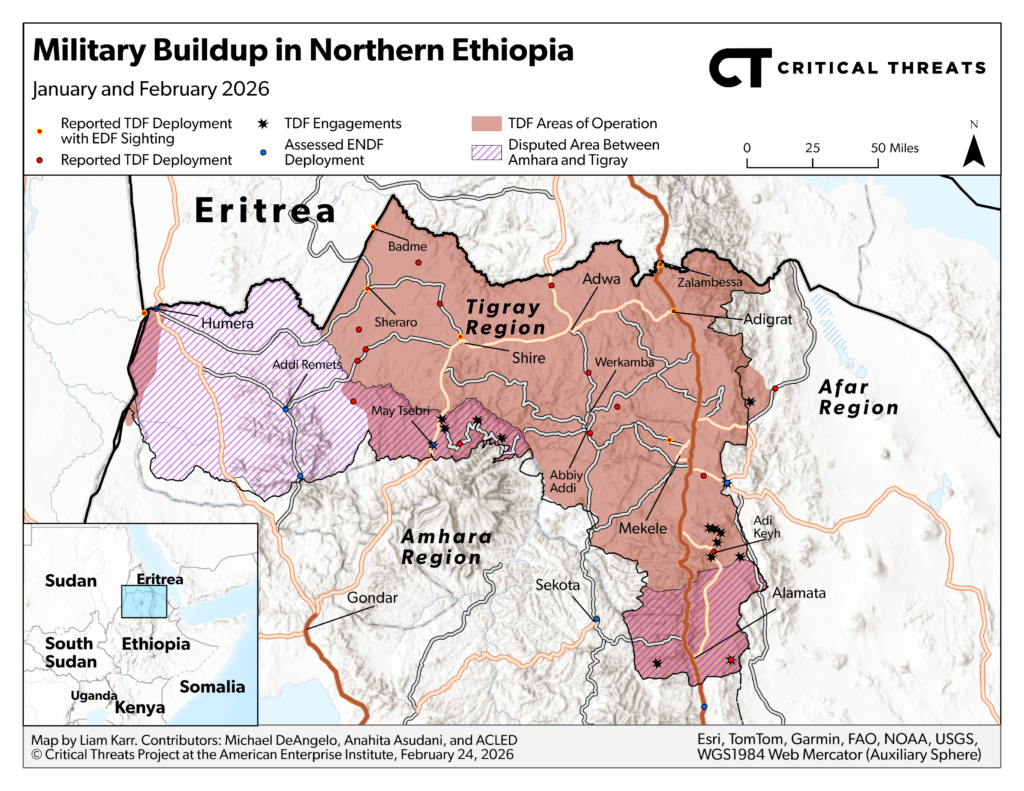
Note: “TDF” stands for “Tigray Defense Forces.” “EDF” stands for “Eritrean Defense Forces.”
Source: Liam Karr; Michael DeAngelo; Anahita Asudani; Armed Conflict Location & Event Data; Critical Threats Project at the American Enterprise Institute.
The TPLF’s reinstatement increases the risk of a military confrontation between the two sides. Ethiopian news outlet Wazema Radio reported on April 20 that “federal security officials” were considering actions to prevent the TPLF from reasserting control of Tigray.[45] Federal government adviser and former TIA head Getachew warned on April 30 that the TPLF was “beating” war drums with its planned reinstatement.[46] The ENDF responded to the TPLF’s reinstatement by flying fighter jets over Mekele.[47]
Democratic Republic of the Congo
The United States sanctioned former Democratic Republic of the Congo (DRC) President Joseph Kabila for his support to M23 rebels. The United States sanctioned Kabila on April 30 for backing M23 and M23’s political umbrella, Alliance Fleuve Congo (AFC), including “providing material support.”[48] The US Treasury Department said that the action supported the US-brokered Washington Accords peace framework between the DRC and Rwanda, and US Treasury Secretary Scott Bessent said that the Trump administration remains “clear that those who continue to sow instability will be held accountable.”[49] The Treasury Department said that Kabila provided financial and political support to AFC and M23 with the intent to “destabilize” the Congolese government.[50] The Congolese government expressed support for the action as an “important step” toward peace in a statement on April 30.[51] Kabila told Western media outlets on May 1 that the sanctions were “unjustified” and “politically motivated.”[52]
The sanctions significantly restrict Kabila’s financial dealings. Kabila and his family built deep business and patronage networks during his presidency from 2001 to 2019.[53] The sanctions freeze Kabila’s property or property interests that are in the United States or under the control of US persons. Entities in which Kabila owns 50 percent or more are also subject to these restrictions. The sanctions prohibit any transaction by US persons or through the United States that involve Kabila’s property or property interests. Kabila joins a relatively small list of sitting or former heads of state whom the United States has sanctioned.[54]
Kabila’s designation as a US-sanctioned actor could embolden the Congolese government to intensify its efforts to eliminate him and other regime opponents, which would further undermine trust in the Doha process talks. The Doha process has gradually progressed on paper, but deep mutual distrust between the DRC and M23 continues to undermine the process. The two sides signed a peace framework agreement after several rounds of negotiations in November 2025, which charted a path toward reaching a long-term deal but did not go much further than what had already been achieved.[55] M23 then captured Uvira town in South Kivu province with Rwandan army support in a major offensive in December, which derailed the negotiations and also disrupted the Washington process. The DRC and M23 began negotiating the technical details of a ceasefire mechanism and prisoner exchange—two key confidence-building measures they had signed before the framework deal—in February 2026, before reconvening for formal talks in Switzerland in mid-April. The United States is taking a more direct role in the Doha talks, as Massad Boulos, US President Donald Trump’s Africa envoy, reportedly helped lead the meetings in Switzerland.[56] The confidence-building measures remain unimplemented, however, and both sides continue to accuse each of reneging on their commitments and violating the ceasefire.
The Congolese government is waging a repression campaign against Kabila and his associates and allegedly has tried to kill him. Military prosecutors backed by the Congolese government secured a death penalty conviction against Kabila in absentia on charges of treason in a rigged trial in late September 2025.[57] Human Rights Watch characterized the trial as having “all the trappings of a political vendetta.”[58] Congolese agents linked to a surveillance and intelligence unit that reports directly to DRC President Félix Tshisekedi abducted the top two officials in Kabila’s political party from their homes in Kinshasa, the Congolese capital, in December 2025 and January 2026.[59] The Congolese army (FARDC) or DRC-employed private military contractors almost certainly conducted drone attacks allegedly targeting Kabila and senior M23 officials in a residential neighborhood in Goma, the M23-controlled North Kivu provincial capital, in mid-March 2026.[60] Tshisekedi’s ruling coalition, the Union sacrée de la nation (USN), staged a public march in Kinshasa in support of the US sanctions on Kabila on May 4 and called on the United States to issue an international warrant for his arrest.[61] Kabila’s party accused militants linked to Tshisekedi’s political party, which is the dominant party in the USN, of setting fire to its headquarters during the march.[62]
M23 views these aggressive measures as evidence of Tshisekedi’s unwillingness to negotiate in good faith. The government’s classification of some M23 detainees as war criminals, along with the issuance of death sentences, arrest warrants, and bounties against senior rebel leaders, has already further strained ongoing peace efforts. The anti-Kabila campaign, which began in early 2025 as Kabila was setting political conditions for his return, reportedly became an additional “source of tension” as early as April 2025, shortly after the Qatari-mediated talks began.[63] Congolese prosecutors used inflammatory speech accusing Kabila of hiding his identity as a true “Rwandan” national and a “spy” during the death penalty trial.[64] The International Crisis Group assessed that the death penalty conviction would undermine efforts to reach a political solution to the conflict.[65] M23 officials told Qatari mediators that the trial risked further undermining a “climate of trust” and that it would address the issue “on the negotiating table.”[66] Kabila raised the issue of the death sentence as an obstacle to peace efforts when the Angolan president, a close Tshisekedi ally, hosted him and two of his close associates for talks in late December.[67]
US sanctions and other forms of coercion against M23 and Rwanda are unlikely to lead to the group’s collapse under military pressure in the short-term and could strengthen its resistance to making concessions in peace talks. Rwanda had ended its support for the first M23 iteration after the United States and European countries cut aid to Rwanda in the early 2010s, letting the group collapse under pressure from UN and FARDC troops. Rwanda has not used its influence to demobilize the latest M23 iteration, despite several rounds of sanctions and increased international pressure on Rwanda since early 2025, however. Rwandan officials continue to say that Rwanda is willing to accept the financial and reputational costs for its presence in the DRC, which they claim is existential. Rwanda and M23 even publicly acknowledged their collaboration for the first time in late January 2026.[68]
The FARDC’s repeated battlefield losses and limited combat effectiveness have left the government unable to enforce its demands in peace talks. The FARDC and allied militia groups conducted a short-lived offensive against M23 that killed a senior rebel leader but quickly collapsed in late February 2026.[69] The DRC has conducted an air interdiction campaign using medium-altitude long-endurance (MALE) drones against M23 since late 2025, but this campaign has mainly served to deny M23 lines of advance to the DRC interior. Pro-Congolese government Wazalendo militia units regularly attack M23 in contested areas and conduct incursions in population centers, but these attacks mainly serve to harass and maintain pressure on M23’s supply lines, rather than reclaim major territory.
M23 is using its uncontested control over the Kivu provinces to augment its military strength. CTP assessed in March 2026 that M23 has not compromised on its maximalist negotiating position in the Doha talks and is likely content continuing to entrench its de facto control over the Kivus.[70] M23 has prioritized force-generation efforts and is strengthening its aerial warfare capabilities with long-range attack drones and possible foreign support.[71] The group has recruited, trained, and redeployed thousands of troops to decrease its reliance on direct Rwandan military support and address capacity issues that it faced in early-to-mid 2025.[72] M23 has commissioned at least four large-scale recruitment cycles since July 2025, fielding at least 27,000 active combatants, according to the International Crisis Group in December 2025—a more than fivefold increase since early 2025.[73] The group has deployed many of these new fighters to the front lines, and its force-generation efforts have allowed it to replace Rwandan army brigades in certain areas.[74]
Kabila’s support to M23 is mainly political and economic. CTP assessed in June 2025 that Kabila would likely support M23 economically and politically—not address M23’s military capacity challenges—even if limiting factors did not meaningfully constrain their partnership.[75] The US Treasury Department said that Kabila had provided financial support to the AFC to “influence the political situation” in the eastern DRC.[76] Kabila’s track record as president is not viewed fondly in some parts of the eastern DRC, however, and it remains unclear to what extent his influence has strengthened M23’s position on the ground.[77] The Treasury Department said that Kabila had encouraged FARDC troops to defect and join M23 but failed to mobilize forces for an attack on FARDC forces.[78]
M23 did not comment publicly on the Kabila sanctions, but recent statements indicate that the group views US engagement in the region as biased and driven by its commercial prospects with the Congolese government, all of which limit M23’s incentive to make concessions. The United States signed a landmark partnership deal with the DRC centered on economic and security cooperation, including in areas currently under M23 control, in early December 2025.[79] Corneille Nangaa, the head of AFC, told Reuters in January 2026 that the partnership was “deeply flawed” and that the United States “signed it with an illegitimate regime.”[80] The deputy AFC head said on social media in March that Tshisekedi had “fooled” the United States and that the “real problem” to achieving peace was the US approach, after the United States levied sweeping sanctions on the Rwandan army, four Rwandan army officials, and senior Rwandan government officials.[81] M23-affiliated media outlets have also frequently emphasized that the group will not give any further territory to appease US diplomatic pressure, as it did twice in 2025, because the United States is pursuing investment opportunities in the DRC and is taking advantage of the group’s “good faith” withdrawals without offering any security guarantees to M23.
The lack of pressure on the DRC to comply with the Doha and Washington processes is likely encouraging the DRC to withhold concessions required for a peace deal with M23, which is central to the long-term viability of the Washington Accords. The Congolese government has repeatedly undermined the peace process. French media reported in late April that the Congolese government is stalling the prisoner exchange progress in bad faith.[82] The government has repeatedly undermined the spirit of the Washington Accords by using incendiary political rhetoric.[83]
The Congolese government continues to violate the ceasefire with M23. The FARDC regularly conducts air attacks using MALE and one-way attack drones across the front lines, sometimes killing civilians. The drone strike that allegedly targeted Kabila in Goma killed a UN official and two others in mid-March.[84]
The DRC has also failed to end state support for nonstate armed groups. The security component of the Washington Accords centers on a dual-sided plan for the Congolese government to launch operations against the Hutu extremist armed group, the Forces démocratiques de libération du Rwanda (FDLR), as the Rwandan army “lifts its defensive measures,” or withdraws Rwandan troops and military equipment, from eastern DRC. The FARDC sent senior officers to government-controlled areas in North Kivu to coordinate an “awareness campaign” for the FDLR’s surrender as part of the Washington process in early November 2025.[85] The UN reported in December 2025 that senior FARDC officials “reassured” the FDLR that cooperation would continue, however, mainly because the FDLR is involved heavily in combating M23.[86] The DRC’s National Assembly said in a report released in late April 2026 that the government is channeling $4 million per month to allied militia groups in the eastern DRC, which it said are “disorganized” and “uncontrollable.”[87]
The Congolese government is interpreting US policy in the Great Lakes as backing for its preference for a military solution to the conflict and vindication of its political maximalist viewpoint, which rejects the premise that M23 is a legitimate actor and has led the DRC to engage the peace processes in bad faith. CTP has assessed that the Congolese government uses the narrative that M23 is a front for Rwandan interests in the eastern DRC to dismiss M23’s political claims and avoid making concessions in peace talks that would be unpopular with the regime’s power base.[88] This narrative underpins the government’s position that international peace efforts should focus solely on forcing Rwanda to cut its support for the group and M23’s nonnegotiable surrender. A Congolese government official told the US magazine Responsible Statecraft in March that the DRC would not have conducted its February offensive against M23 before signing the US-DRC deal but “now we think we have Trump next to us.”[89]
Congolese officials view the US sanctions on Kabila and the Rwandan army as an endorsement of this position. The Congolese trade minister and former North Kivu governor, Julien Paluku, said on social media that the early March US sanctions on Rwanda “strengthens Kinshasa’s diplomatic position, as its accusations of [Rwandan] aggression are now officially validated.”[90] Paluku said in early May that the Kabila sanctions were the “logical consequence” of the DRC’s claim that he is the “instigator, the initiator, and the architect” of the eastern DRC crisis in the service of Rwanda.[91] Tshisekedi said in his first press conference in two years on May 6 that the “Americans only saw what I had already seen for several years.”[92]
The maximalist Congolese government viewpoint is not compatible with international peace efforts, including the Doha and Washington processes. The Doha process does not obligate M23 to disarm, and the Washington process has not compelled Rwanda to demobilize the group. CTP assessed in April 2025, when the Congolese government conceded to the Doha process, that the process placed M23 on equal footing with the Congolese government as a negotiating partner and obliged the government to engage with M23’s demands as a Congolese entity.[93]
CTP continues to assess that the long-term viability of the Washington Accords hinges on a sustainable deal between the DRC and M23, an outcome that becomes harder to achieve as the talks drag on. Boulos has said that an internal peace agreement is the “last piece of the puzzle” to the Washington Accords.[94] The resolution of the M23 conflict is central to significant investment from US companies in the Kivu provinces under the US-brokered Regional Economic Integration Framework (REIF).[95] M23 is undertaking a systematic state-building project to translate its military gains in the eastern DRC into a de facto autonomous region, however.[96] The group’s strengthening control over land and resources gives it leverage for any future peace deal with the DRC and makes US investment less likely, as its governing structures become more entrenched and the group positions itself as the de facto state authority in the eastern DRC. French media reported that the Congolese government has refused to move forward on the development of the Ruzizi hydropower plant—the REIF’s flagship project on the DRC-Rwanda border—due to the issue of M23’s territorial control since mid-March.[97]
Tshisekedi is likely leveraging the need for regime continuity for long-term US economic interests in the DRC to extend his grip on power amid the war in the east. CTP assessed that Tshisekedi’s administration has been setting conditions to use the war to extend his tenure in power, either by delaying elections or changing the Congolese constitution to extend his term—or both—which ends in January 2029, since late 2025.[98] Tshisekedi said at the May 6 press conference that the government cannot organize the 2028 elections while M23 controls North and South Kivu.[99] Ruling coalition leaders have also begun portraying the war and the elections as competing priorities for the country’s focus and limited state resources.[100] The Congolese government only funded 25 percent of what the national electoral commission requested for election operations expenses between April 2025 and March 2026.[101]
Tshisekedi and his allies have begun openly calling for a third Tshisekedi term. Tshisekedi had not explicitly stated that he aimed to serve another term or made any major announcements on the project in 2025. Tshisekedi’s political party officially launched national consultations to gather proposals from the “will of the people” and prepare a report on changing the constitution in late April 2026.[102] Tshisekedi has said that the constitution was “drafted abroad by foreigners.”[103] A member of parliament from the USN introduced a bill on April 30 to initiate a constitutional referendum, including provisions related to the number and length of presidential terms.[104] Tshisekedi then said in his May 6 address that he would accept a third term if the “people want me” through referendum.[105] Tshisekedi said that the United States had “asked us for certain reforms” for the US-DRC partnership to succeed, which he said “cannot be carried out without revising the constitution.”[106]
Mali
Malian and Russian forces appear to be withdrawing from northern Mali’s Kidal region but have retained their positions elsewhere in northern Mali. Security forces have withdrawn from two more forward operating bases in Kidal region as part of a negotiated withdrawal. At least 30 vehicles withdrew from the Aguelhok, a town 80 miles northwest of Kidal city in Kidal region, on May 4.[107] The vehicles joined a convoy that originally departed from Tessalit, which is 55 miles north of Aguelhok, and is bound for Anefis, which is nearly 100 miles south of Aguelhok in Kidal region. The French newspaper Le Monde reported that the withdrawal was part of an Algerian-mediated “comprehensive agreement” between al Qaeda affiliate Jama’at Nusrat al Islam wa al Muslimeen (JNIM), their partners in the Azawad Liberation Front (FLA), which is a pro-separatist Tuareg rebel group, and Russia’s Africa Corps.[108] Le Monde reported that it is unclear if the forces will remain in Anefis or withdraw toward Timbuktu or Gao, although multiple prominent journalists reported that Russian forces plan to withdraw from the Kidal region entirely.[109]
Figure 4. Battle for Northern Mali
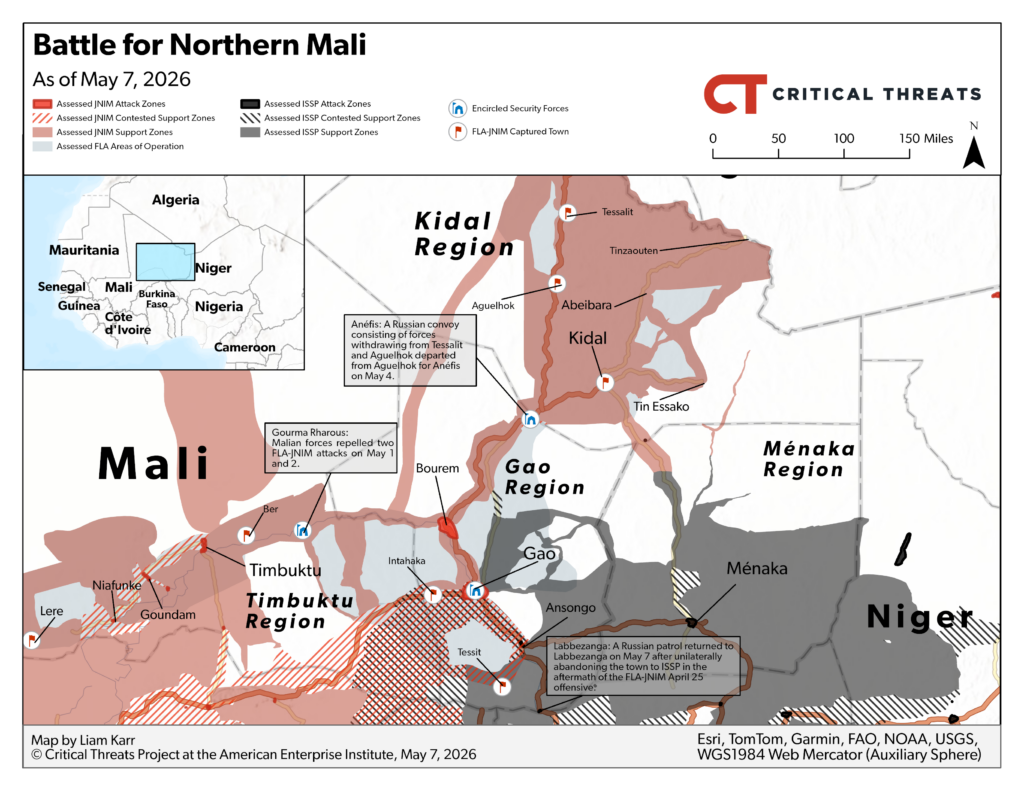
Security forces have not abandoned any further positions outside of the Kidal region, however. Anonymous sources linked to the FLA and JNIM denied that any deal had been reached for the complete withdrawal of Africa Corps from the entirety of northern Mali, however.[110] The source noted that an agreement was “possible” if unspecified conditions are met.”[111] Russian forces claimed to retake Labbezanga, a town on the Niger-Mali border that they had unilaterally withdrawn from in the aftermath of the April 25 attacks, on May 7.[112] Video footage showed an Africa Corps patrol entering the village, although Islamic State Sahel Province (ISSP) militants had preemptively withdrawn from the location, and it is unclear if Russian forces have permanently reestablished themselves at the base near the town.
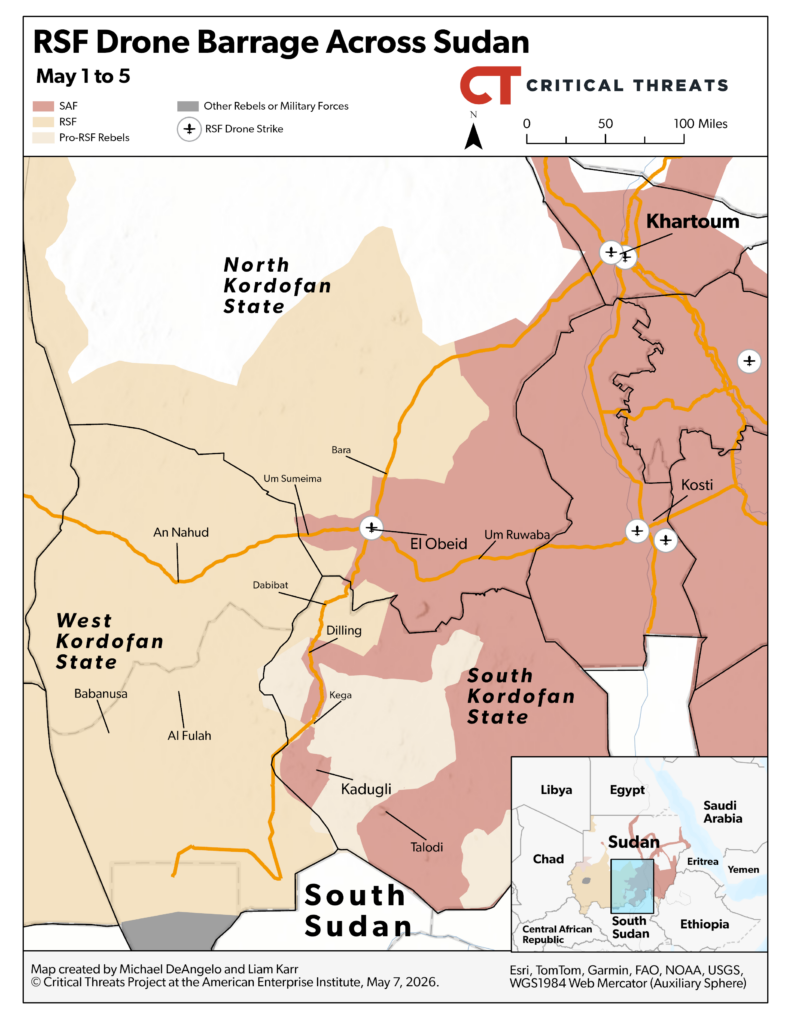
JNIM has imposed a partial blockade on Bamako and recently began violently enforcing the blockade, although its impact is unclear. JNIM has attacked several transport trucks traveling to Bamako since May 5, whereas it had previously forced vehicles to turn around since the blockade began on April 28. JNIM attacked Senegalese trucks traveling between Mali’s westernmost regional capital Kayes and Bamako, injuring at least one driver.[113] JNIM attacked several Moroccan cargo trucks traveling between Bamako and Bougouni, a town in the Sikasso region that is 100 miles south of Bamako.[114] Videos circulating on social media on May 6 claimed to show burning buses near Kangaba, a town 55 miles southwest of Bamako.[115]
Figure 5. JNIM Blockades Bamako
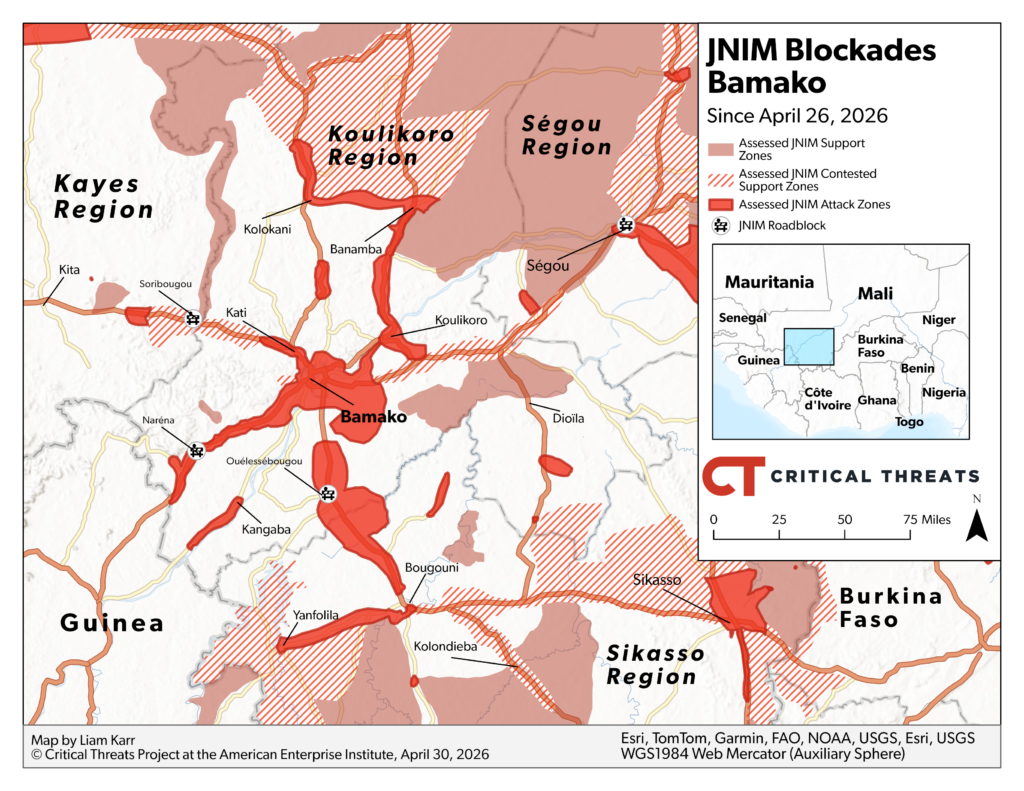
JNIM has been unable to stop all traffic, however. Locals told RFI that the main roads leading to Kayes, Segou, and Sikasso were completely blocked, although there were alternative side routes.[116] A convoy of more than 800 fuel tankers arrived safely in Bamako on May 1 under escort from Malian and Russian air and ground forces.[117] The roadblocks generally consist of a small number of militants with reinforcements nearby in the bush to support ambushes.[118]
There are conflicting reports about the impact of the blockade in Bamako. RFI reported on March 4 that locals claimed that there had not yet been any shortages or inflation.[119] Open-source media outlet West Africa Maps reported on May 6 that fuel and food prices had begun rising, however, citing a 30 percent increase in meat prices since the blockade began.[120] Rising prices could partially be the result of preemptive measures or a “bank run” effect, as civilians told RFI that civilians had begun stockpiling food as a precaution.[121]
The Malian junta has attempted to further consolidate control and crack down on the opposition in the aftermath of the attacks and JNIM’s appeal for a “united front” to oust the junta. Junta leader Assimi Goita installed himself as the new minister of defense and has overseen a purge of dozens of military officers and opposition activists. The Malian junta has arrested dozens of soldiers, critics, and civil society and democracy activists, ostensibly citing their alleged support for the insurgents during the April 25 attacks.[122] Arrests have also expanded to include the families of targeted figures, as well as Quranic schools in multiple parts of southern Mali.[123] Notable opposition figures include lawyer and democracy activist Mountaga Tall, opposition democracy activist Moussa Djiré, and Youssouf Daba Diawara, who is an associate of exiled imam Mahmoud Dicko and his Coalition of Forces for the Republic (CFR) opposition group.[124]
The junta’s campaign comes after JNIM released a lengthy statement on April 30 appealing for a “united front” to oust the junta.[125] The statement was unusually moderate and nationalistic, as it was exclusively in French, referenced the Malian “homeland,” and adopted the junta’s own terminology of “sovereignty.”[126] JNIM is appealing for allies because it lacks the capacity to seize and rule all of Mali, meaning that it needs the support of other local actors, such as the FLA, to boost its capacity and legitimacy.[127] A CFR spokesperson said that the coalition supports general calls for dialogue but noted that it was only engaging with the FLA, not JNIM.[128] The spokesperson clarified that dialogue could help institute compromises related to decentralization and the institutional role of religious authorities into the Malian constitution.[129]
Madagascar
The Malagasy junta expelled a senior French embassy official amid allegations that French nationals were involved in a plot to overthrow the junta leader. The Malagasy foreign minister summoned the French ambassador on April 28 to declare Pierre Couve, the French embassy’s internal security attaché, persona non grata due to conduct considered “incompatible with his status.”[130] The junta accused Couve of involvement with “acts of destabilization” against Malagasy junta leader Colonel Michaël Randrianirina.[131] Couve led France’s cooperation with Malagasy gendarmerie forces, according to the French outlet Le Monde.[132] The French foreign ministry summoned the Malagasy chargé d’affaires in Paris on April 29 to tell him that France “categorically rejected” any accusations of French involvement in a destabilization plot.[133] Randrianirina then spoke on the phone with French President Emmanuel Macron to smooth relations after what they said was an “isolated incident.”[134]
Couve’s expulsion came more than a week after rumors spread on social media linking France to an alleged coup plot. Malagasy authorities arrested another French national and a Malagasy colonel who had served briefly under Randrianirina in connection to an alleged plot against the junta on April 16.[135] Malagasy authorities accused the French national of spreading disinformation, encouraging security forces to mutiny, and sabotaging infrastructure to trigger nationwide blackouts and social unrest.[136] One of Randrianirina’s advisers shared unverified images on social media on April 17 purportedly showing 10 “French mercenaries” who allegedly arrived in Madagascar to destabilize the government.[137] France called the claims “false rumors,” and the Malagasy junta distanced itself from the adviser and said the adviser’s post was an “individual contribution.”[138]
The Kremlin could be spreading disinformation and amplifying anti-French sentiment to pull the Malagasy junta further into its orbit, as Russia has sought to cultivate ties with the junta since late 2025 to fulfill a long-held interest of establishing a foothold in Madagascar. Russian influence networks could have helped fuel the accusations of a French plot to oust Randrianirina to deepen the junta’s reliance on Russian regime support. The Malagasy junta is seeking regime protection through its partnership with Russia amid claims that Randrianirina has now survived two assassination attempts, and CTP and the Institute for the Study of War have written extensively on Russia’s use of its media ecosystem in Africa to support Russian efforts to degrade Western influence through anti-Western and pro-Kremlin information operations.[139] The French government alluded to possible Russian involvement in the allegations in mid-April, questioning the “origin and motivations” behind claims intended to “damage relations between France and Madagascar.”[140]
Russia has previously used information operations to meddle in Madagascar. The Wagner Group meddled in the 2018 Malagasy elections, offering financial, informational, and strategic support to preferred candidates.[141] Wagner-linked networks also used troll farms and social media to spread pro-Russian and anti-French narratives, using the same playbook that it later perfected in other former French colonies in West Africa.[142] An investigative consortium led by the African magazine The Continent cited leaked documents from an entity tied to Russia’s Foreign Intelligence Service (SVR) in early 2026, showing that Wagner-linked operatives conducted disinformation campaigns and election interference actions to keep “friendly” regimes in power in Africa between 2019 and 2025.[143] The documents show that the SVR took over these influence operations and expanded them in 2023.[144] The African Digital Democracy Observatory found that coordinated networks on social media amplified anti-French and pro-Russian content before the junta deposed the previous Malagasy president in a coup in October 2025 and after Malagasy authorities thwarted a coup plot in November.[145]
The new Malagasy authorities have been expanding military and political ties with Russia since Randrianirina seized power in the October coup. Russia immediately began courting the junta and has increased military cooperation as the basis for this partnership. CTP previously assessed that the Kremlin is likely seeking sea access to bolster its power projection in the Indian Ocean and to help circumvent sanctions.[146] French media reported that the Malagasy foreign minister hosted a Russian embassy delegation at the port of Antsiranana—formerly known as Diego-Suarez, a former French facility in northern Madagascar with one of the best deepwater harbors in the western Indian Ocean—in late April 2026.[147] Randrianirina had reportedly discussed potential Russian access to the Antsiranana base during his state visit to Moscow with Russian President Vladimir Putin in February 2026.[148]