
Key Takeaway: Al Qaeda’s Sahelian affiliate Jama’at Nusrat al Islam wa al Muslimeen (JNIM) launched its most coordinated and significant attacks across Mali since at least 2012 in coordination with pro-separatist Tuareg rebels and has taken control of several major towns across northern Mali. The offensive likely aimed to seize control of northern Mali’s Kidal and Gao regions and topple the current Malian junta to put in place new national authorities that the group can heavily influence, rather than seize full control of the entirety of Mali. The attacks seriously undermine Russia’s future presence in Mali, which could impact Russian influence across Africa. The security vacuum in northern Mali increases the transnational threat risk emanating from the region, particularly from IS Sahel Province (ISSP), and could cause greater infighting between JNIM and ISSP.
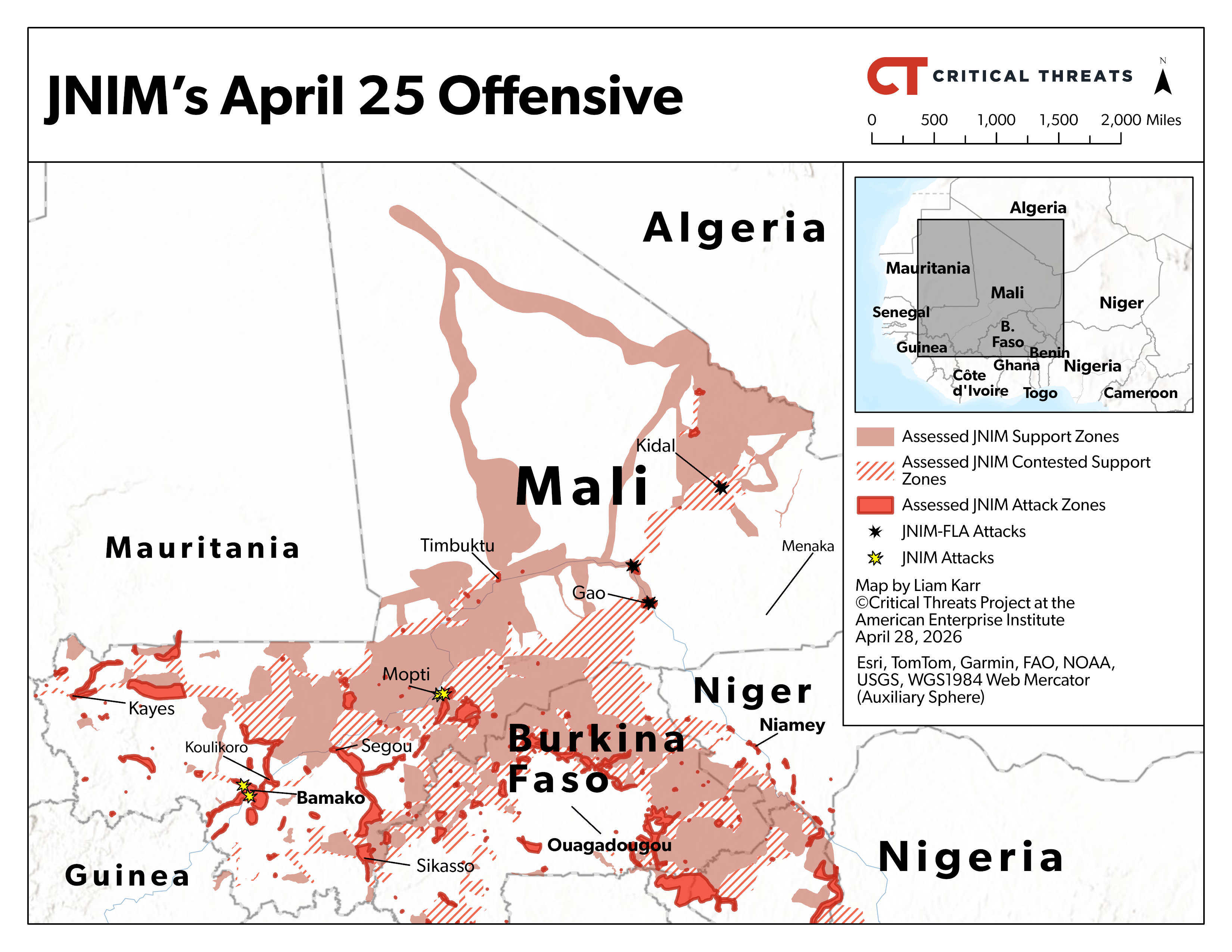
JNIM launched its most coordinated and significant attacks in Mali since at least 2012, seizing several major urban centers in northern Mali. JNIM launched a series of coordinated attacks against Malian army positions across Mali, including several district capitals, three regional capitals, and the national capital, Bamako, on April 25. Fighters from JNIM and the allied Azawad Liberation Front (FLA) pro-separatist Tuareg rebel group seized Bourem, and the regional capitals Gao and Kidal in northern Mali, overrunning the base in Bourem and trapping Malian and allied Russian forces in their bases near Gao and Kidal.[1] Fighters occupied the regional capital Mopti in central Mali and overran Malian positions seven miles away at the region’s main military base in Sévaré before withdrawing the night of April 25 to 26 after hours of intense fighting.[2] Malian forces reportedly reentered Sévaré on the morning of April 26, and the Malian army and Russia’s Africa Corps published several videos showing airstrikes on JNIM and FLA in Kidal and other parts of the country.[3]
Figure 1. JNIM’s April 25 Offensive
JNIM fighters simultaneously launched a series of commando-style attacks in southern Mali that killed multiple high-ranking junta officials. The attackers targeted the main Malian air base on the outskirts of Bamako, as well as the main army base and nearby homes of high-ranking officials in nearby Kati.[4] These attacks involved suicide vehicle-borne improvised explosive devices and armed drones, and several attackers involved in these attacks were disguised as Malian soldiers.[5] The attacks targeted junta leader Assimi Goita, severely wounded—possibly fatally—intelligence chief Modibo Koné, and killed Defense Minister Sadio Camara.[6]
JNIM coordinated its attacks in northern Mali with the FLA, a group with which JNIM has extensive personal and historical links. JNIM and the FLA released separate statements openly admitting to coordinating joint operations with each other across the targets in northern Mali, confirming the existence of an alliance between the two groups.[7] French24 journalist Wassim Nasr reported in March 2025 that yearslong negotiations over a potential alliance between the FLA and JNIM were at an advanced stage, with talks allegedly heavily focused on governance issues, which have been a major point of difference between the secularist rebels and Salafist JNIM for years.[8]
The Malian junta’s decisions to expel French and UN forces, partner with Russia, and scrap a 2015 peace deal with the Tuareg rebels heavily contributed to the rapprochement between JNIM and the rebels in recent years. The pro-separatist rebels have significant historical ties to JNIM-linked figures dating back to the 1990s, and the rebels initially fought alongside al Qaeda–linked Tuareg fighters that are now part of JNIM during the 2012 Tuareg rebellion before splitting in 2013 after al Qaeda–linked fighters sidelined the more secularist rebels.[9] The two sides remained in contact, however, and they have grown closer since 2022, when the Malian junta kicked out French forces, creating a security vacuum that IS Sahel Province (ISSP) exploited to expand and target Tuareg communities in northern Mali. The junta then scrapped the 2015 peace deal and returned to open hostilities in 2023 with the support of Russian auxiliaries, who have committed numerous atrocities against Tuareg civilians. JNIM had exploited the rising violence that Tuareg communities faced from both ISSP and state-linked security forces to reassert itself as a partner for the rebels, leading to informal ceasefire agreements in their shared support areas, significant areas of operation and membership overlap, and operational coordination against ISSP and Russian forces in recent years.[10]
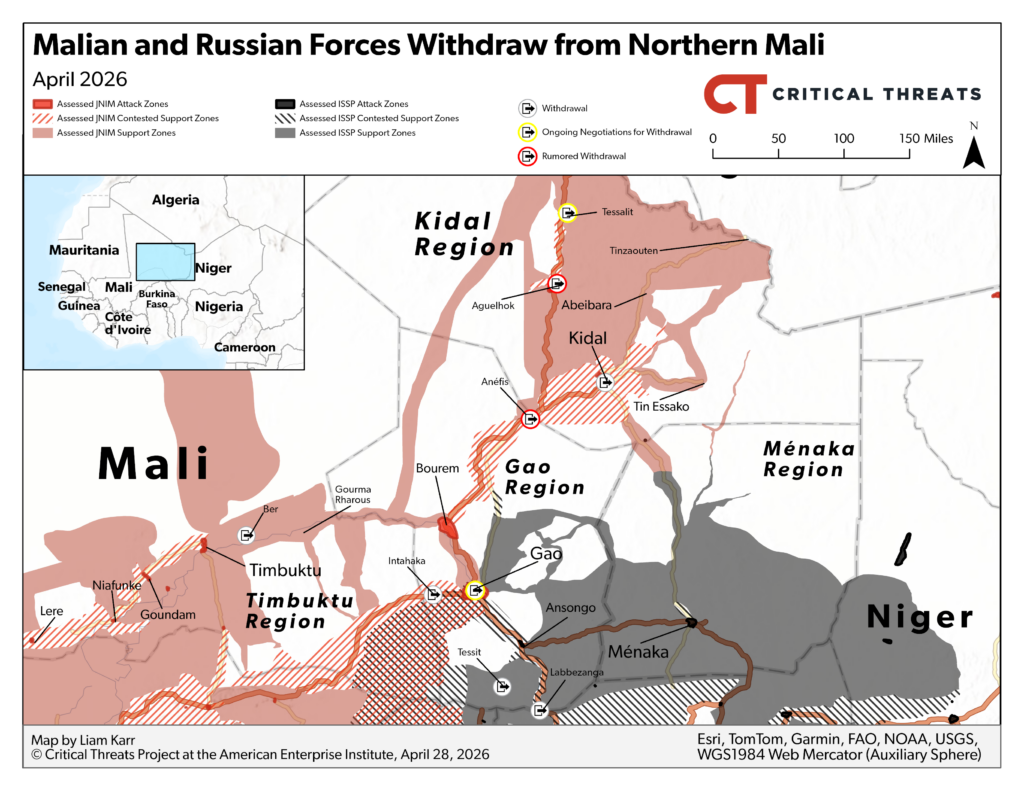
The FLA and JNIM have mostly achieved one of their main operational aims, which was to seize control of Kidal region and the JNIM-dominated northern half of the Gao region. The FLA-JNIM attacks aimed to seize Kidal city and key points in Gao region that would cut Malian ground lines of communication between central and northern Mali. Bourem and Gao city both lie on key highway junctions of the north-south RN18 highway and the east-west RN33 and RN16 highways, respectively, that lead to central Mali (See Figure 2). FLA-JNIM control of these key nodes significantly degrades the ability of Malian and Russian forces to reinforce Kidal and isolates Malian and Russian forces across most of northern Mali.
One of the primary aims of JNIM’s attacks in central and southern Mali was likely to degrade the Malian army’s ability to coordinate a response to the attacks in northern Mali. The attacks on Sévaré and the main airbase near Bamako disrupted the junta’s ability to send air or ground reinforcements north. Sévaré hosts the main Malian army base in central Mali and lies at the intersection of major highways connecting northern and southern Mali. Sévaré and the main airbase near Bamako also host most of Mali’s air and drone assets.[11] The commando attacks in southern Mali disrupted the junta’s ability to coordinate a response to the offensive by forcing Goita into hiding, killing Camara and Koné, and sparking a subsequent political crisis. Militants in central and southern Mali have not attempted to negotiate the surrender of security forces as they have in northern Mali, however, underscoring a lack of capacity or intent to hold and govern these areas.
Militants have retained control over the towns that they captured in northern Mali and negotiated the surrender of isolated Malian and Russian bases across several parts of northern Mali. Militants have negotiated the withdrawal of Malian and Russian forces from Kidal city, Ber town in Timbuktu region, and Intahaka and Tessit towns in Gao region.[12] Numerous reports claim that Russian forces are also negotiating to withdraw from their bases near Gao city and Tessalit in Kidal region, both of which are already under militant control.[13] Unconfirmed rumors claim that Malian and Russian forces have already withdrawn from smaller forward operating bases in Aguelhok and Anéfis in the Kidal region, both of which would presumably be abandoned in the event of a full withdrawal from the Kidal region.[14]
Figure 2. Malian and Russian Forces Withdraw from Northern Mali
JNIM and the FLA likely intend to govern the towns they have captured. Unofficial al Qaeda–linked online sources claimed after the attacks that the FLA and JNIM had reached an earlier agreement on the application of shari’a law, which would further signal both groups’ intent to hold their gains and govern in northern Mali.[15] Nasr reported in March 2025 that the two sides had reached a compromise on locally-led application of shari’a law, which is similar to the kinds of locally-attuned agreements that JNIM has cultivated to establish indirect control over other parts of Mali and signals the groups’ intent to govern the areas they have captured.[16]
JNIM is likely collaborating with the FLA in part to have the FLA serve as a local governing partner that will both augment JNIM’s capacity and minimize the risk of regional or international backlash. Nasr reported that JNIM partially agreed to its shari’a compromise with the FLA because locally led FLA governance would be more palatable to regional and international actors.[17] This same logic is evident in both groups’ media strategies since the April 25 attacks. JNIM has only put out a handful of statements regarding the attacks, while the FLA has disseminated more media and been more visible in negotiations with security forces.[18] Control over northern Mali and the removal of security forces frees more JNIM fighters to redeploy toward central and southern Mali. JNIM’s franchise model typically keeps fighters near their home regions, but CTP assessed in late 2025 that JNIM had redeployed some forces from northern Mali to support its blockade campaign in southern Mali.[19]
The campaign may also achieve its other main operational aim, which is to directly topple the current junta or create conditions for the junta’s collapse. The April 25 attacks attempted to directly decapitate the junta’s senior leadership by targeting three of the five most prominent junta officials as part of its attacks in Kati.[20] Camara and Koné were both key architects of the initial coups that brought the junta to power in 2020 and 2021.[21] Civilian-led efforts to sideline the two colonels in the transitional government after the 2020 coup were a major factor in the second coup in 2021, when the Malian military consolidated its grip on power.[22] Many reports framed Camara as the leading force in the junta’s counterinsurgency strategy, the clear second-in-command behind Goita, and Goita’s biggest rival.[23]
The attacks aim to further undermine the junta’s popular support and raison d’être. The junta has spent the last several years promoting the narrative that it is leading a montée en puissance (growing strength), which is integral to its popular support and legitimacy.[24] The junta’s return to northern Mali and capture of Kidal for the first time in over a decade in 2023 has been a key part of this narrative. JNIM had already eroded this narrative with more frequent and high-visibility activity in southwestern Mali since 2024, including major attacks and a fuel blockade.[25] The latest Afrobarometer study in Mali found that JNIM’s growing influence on civilian life in southern Mali, such as fuel shortages and JNIM checkpoints, was posing an increasing threat to the junta’s popular support in these previously insulated areas.[26] The April 25 attacks further shatter the junta’s narrative by undoing the mostly symbolic progress it had made in northern Mali and underscoring that JNIM can threaten anyone, anywhere, including senior officials in the most securitized parts of southern Mali. JNIM fighters have remained in Mopti and have continued patrolling the Bamako outskirts in the days since the attacks, further amplifying this message.[27]
The attacks also aimed to force the withdrawal of the junta’s Russian backers across Mali, not just the tactical withdrawals seen in northern Mali. Russia has been the main backer of the junta, deploying 2,500 to 3,500 troops across the country currently, sending multiple major weapons shipments in recent years, and also providing various kinds of regime security to the junta as part of their partnership.[28] The attacks threaten elite and popular support for Russia within Mali, however, as Russia is inextricably linked with the junta’s faltering narrative that Malian and Russian forces are improving the security situation in Mali. The FLA and JNIM directly called on Russian forces to withdraw and cut their losses. The FLA called on Russia to “reconsider their commitment” in Mali, while JNIM called on Russia to exit the conflict “in exchange for not targeting them and coordinating to build a balanced and effective future relationship.”[29]
Several journalists and researchers have reported that the attacks have sparked a political crisis in Bamako that may result in the ouster of Goita. Several sources have said that several elements of the Malian armed forces and government are supporting General Malick Diaw, who leads the junta-controlled transitional parliament, to take over the Malian transitional council.[30] Diaw had been involved in the 2012 and 2020 coups and was reportedly close to Goita and a major rival of Camara.[31] Some journalists claimed that the Malian National Guard had pushed for the change and that Diaw was a compromise candidate to oust Goita while keeping the army in control of the government.[32] The national guard had been a major backer of the late defense minister Camara, who began his career in the national guard, and Goita had targeted national guard officers as part of a crackdown following an alleged coup attempt in August 2025.[33]
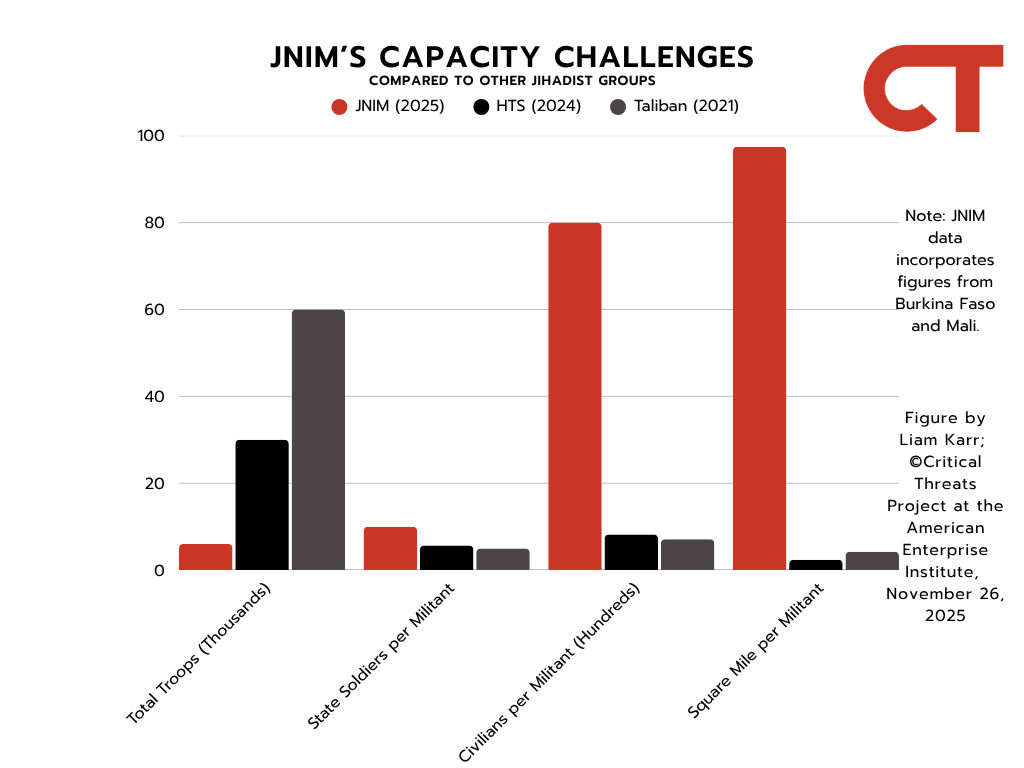
JNIM likely wants to engage new authorities in Bamako that it can heavily influence, rather than seize direct control over all of Mali, to achieve its strategic goal of expanding its influence and indirect shadow governance across Mali and West Africa. JNIM likely lacks the capacity to directly govern all of Mali, although its partnership with the FLA could increase its ability to project power into central and southern Mali. JNIM has roughly 6,000 fighters, most of whom are spread across Burkina Faso and Mali.[34] Groups that have successfully toppled governments and assumed direct power, such as Hayat Tahrir al Sham (HTS) in Syria and the Taliban in Afghanistan, have had many times more overall fighters, fighters per opposing security forces, fighters per civilian, and fighters per square mile of national territory they seek to control.[35] JNIM has likely grown since the most recent estimates in 2024, and Russia’s Africa Corps claimed that the joint FLA-JNIM offensive involved 10,000 to 12,000 fighters.[36] The group has also received an influx of cash and weapons thanks to recent attacks.[37] These raw troop numbers still pale in comparison to the relative strength of HTS and the Taliban, however.
Figure 3. JNIM’s Capacity Challenges
JNIM also faces a legitimacy gap vis-à-vis the Malian state in urban centers and across most of southern Mali that creates a severe obstacle to the group being accepted as a legitimate governing power in the medium term. JNIM has historically been a predominantly ethnic minority-based Salafi-jihadi movement, which has alienated urban centers and Bambara communities—Mali’s largest ethnic group.[38] JNIM has made inroads among rural Bambara communities in recent years, but reported civilian-led lynchings of suspected Tuareg JNIM militants in Bamako and Kati in the aftermath of the April 25 attacks further highlight the ethnically based vitriol against JNIM in southern Mali, especially in urban areas.[39]
JNIM has not demanded that it assume direct control over all of Mali and has repeatedly shown an openness to negotiations and working with other Malian actors to oust the junta. JNIM and its al-Qaeda–linked predecessors have historically been open to negotiations under the condition that foreign forces leave the country.[40] The group demanded a direct dialogue with the junta and continued to show an openness to negotiations at the height of its blockade in southern Mali in late 2025. The group’s demands focused on fuel trading provisions, shari’a law, and the capitulation of the current regime, all of which fall short of demanding direct JNIM control across the country.[41]
FLA and JNIM statements have repeatedly signaled a willingness to work with each other and Malian actors to overthrow the junta. JNIM encouraged “all influential figures, intellectual and cultural elites, businessmen, media personalities, and all the elements and components of our society” to fight back against the junta in a July 2025 statement but did not explicitly call for these elites to join JNIM in the statement.[42] The FLA said in its statement claiming the April 25 attacks that it considers the junta to be a “major obstacle to any credible and inclusive solution” and that it was “open to any convergence of strategies with actors” to end the current regime.[43]
The attacks seriously undermine Russia’s future presence in Mali, which could impact Russian influence across Africa. Malian officials have accused Russia of betraying Mali as Russian forces withdraw from their positions across northern Mali.[44] Russian and Malian forces withdrew from four towns as part of negotiated withdrawals with JNIM, unilaterally abandoned Labbezanga near the Mali-Niger border, and are in negotiations to withdraw from two more towns. (See Figure 2.)[45] Several of these towns were not directly targeted in the April 25 attacks, and Labbezanga is within ISSP’s area of operations, indicating a broader unraveling of Malian-Russian positions across northern Mali beyond the positions targeted in the April 25 attacks.[46]
The April 25 attacks have reversed Russia’s only victories in Mali and further highlighted the ineffectiveness of Russian forces, which will likely undermine Russia’s popular support among the junta and the Malian public. Russia is inextricably linked with the junta’s faltering narrative that Malian and Russian forces are improving the security situation in Mali. The junta specifically brought in Russian forces in 2021 and kicked out French and UN forces in 2022 to support the junta’s more militarized and indiscriminate counterinsurgency strategy and the junta’s priority to retake parts of northern Mali that were subject to the 2015 peace agreement. Russian forces had secured some symbolic victories, such as spearheading the Malian government’s return to northern Mali in 2023, including its offensive to retake Kidal. Russian forces have since faced major defeats that have tarnished their prestige, however, and they have become less active overall since transitioning from the Wagner Group to the Africa Corps.[47]
The late Malian defense minister, Camara, was also a key Russian ally in the Malian junta, which further threatens to erode Russian influence among the Malian elite. Camara went to Russia for military training in 2019 and was on leave from his training program when he helped execute the initial 2020 coup that overthrew Mali’s democratic government.[48] Camara traveled to Russia several times as a member of the junta and was the key planner behind the Wagner Group’s initial deployment to Mali in 2021, an effort that led the United States to sanction Camara from 2023 to 2026.[49] Camara was also a key architect of the junta’s general “pro-sovereigntist” strategy, which distanced Mali from France and the West in favor of Russia to enable the government to pursue a more indiscriminate and militarized counterinsurgency approach across the country.[50]
Russia’s setbacks in Mali pose a severe blow to the Kremlin’s regional project in West Africa and Russia’s international image and appeal, given Mali’s role as a major Russian partner and model of Russian defense partnerships. Mali was the first Sahelian junta to overthrow its democratic government in the Sahel and has remained Russia’s closest security partner in the Sahel. Burkina Faso and Niger followed the Malian playbook in 2022 and 2023, respectively, in taking power, cutting ties with Western partners, and turning to Russia. Burkina Faso and Niger then joined Mali in forming the Alliance of Sahel States (AES) in 2023, which serves as a pro-Russian regional bloc that supports the Kremlin’s interests in eroding Western influence in Africa and multilateral institutions, creates opportunities to mitigate Western sanctions, and helps draw more neighboring countries closer to Russia.[51] Mali has effectively been the senior partner within the AES.[52] Russia’s alliances with Mali and the AES have provided a template for Russian inroads with other authoritarian partners across Africa with interests in Russia’s “regime security packages,” which insulate regimes through allyship in international bodies, the deployment of Russian military units and political advisers, and information operations.[53]
The collapse of security forces in northern Mali increases the transnational threat risk emanating from the region and could cause greater infighting between JNIM and ISSP. ISSP has already exploited the fallout from the April 25 attacks. ISSP forces captured Labbezanga, a key post on the Mali-Niger border, after Malian and Russian forces abruptly withdrew on April 27.[54] The group also began amassing forces around the regional capital Ménaka and probing military positions around the city on April 27.[55]
Greater JNIM and ISSP control over their respective areas of operation in northern Mali increases their transnational threat risk, although JNIM has demonstrated no recent intent to support external attacks. ISSP poses the greatest threat, as the group is linked with several disrupted IS cells operating across Morocco and Spain since 2023.[56] These cells are primarily involved in facilitating financial and logistical support involving foreign fighters and material but have also been linked to attack plots in both countries.[57] JNIM has not been linked to any recent external attack plots and has repeatedly emphasized its local aims, although past patterns show that groups can rapidly pivot from local to transnational aims and that numerous factors push local groups or even a handful of fighters within a group to pursue or support transnational attacks.[58]
JNIM and ISSP may increasingly fight each other in northern Mali in the absence of any security force challengers. The two groups engaged in their most intense period of infighting in 2022 and 2023 as they sought to exploit the vacuum left by the withdrawal of French forces from northern Mali.[59] Competition between the two groups has shifted further south away from Mali since late 2023, when CTP assessed that the groups likely reached a localized truce and began refocusing their efforts elsewhere.[60] The withdrawal of Malian and Russian forces will upset this equilibrium, create a new power vacuum, and enable both groups’ personnel in the area to focus more resources on each other rather than on security forces. Countering ISSP has been a key aspect of JNIM’s cooperation with Tuareg groups as well, especially since ISSP pushed JNIM and allied Tuareg rebels out of the Ménaka region and massacred Tuareg communities.[61] The handover of Tessit from Malian-Russian forces to FLA-JNIM militants is a potential flashpoint, given that Tessit is firmly within ISSP’s sphere of influence in northern Mali.