
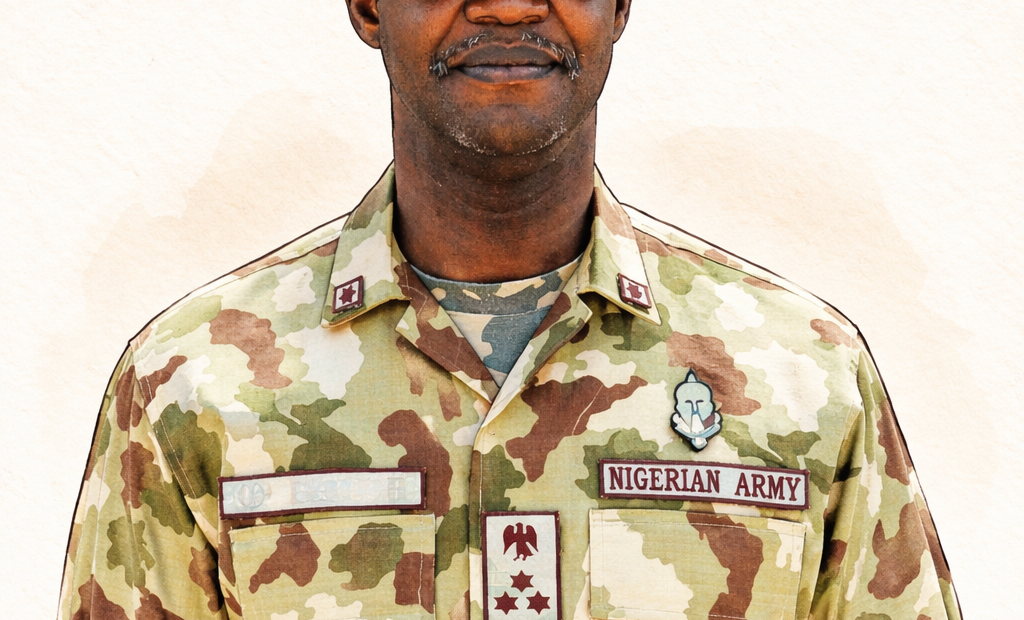
My circle and that of the late Brigadier General Oseni Braimah never once overlapped. Yet his murder by Boko Haram and ISWAP on April 9, 2026, in Benisheikh, Borno State, struck me with the force of a personal bereavement. It felt as though death had robbed me of a bosom friend on the highway of life. Reading through his military profile, I found myself grieving for a man I had never met, but whose sacrifice suddenly felt intimate, almost familial.
mostbet mostbet az mostbet mostbet az mostbet pin up mostbet mostbet
Anger surged through my bones, veins, and mind. How could a handful of misguided terrorists cheat Nigeria by extinguishing Braimah’s life? What breach in our defenses opened the door for Boko Haram to invade his destiny and waste it? His death was not just the silencing of a soldier’s voice—it was the theft of a nation’s hope, a reminder that our bravest are being cut down while the rest of us watch helplessly. The injustice of it all gnaws at the conscience: a general who should have been shielded by the strength of the state was instead left vulnerable to the cruelty of insurgents.
Not only Braimah. Boko Haram’s cheap access to our mighty men of valour—our commanding officers on the battlefield—almost literally breaks the thigh bone of the Nigerian military. Between October 2025 and April 2026 alone, terrorists succeeded in eliminating seven commanders. These were not ordinary casualties; they were leaders entrusted with the lives of their troops, men whose deaths reverberated across brigades and battalions. Each ambush, each night raid, each coordinated strike was not just a tactical victory for Boko Haram and ISWAP, but a devastating blow to the morale of the armed forces.
Not even in the darkest days of Goodluck Jonathan’s presidency—when terrorists captured village after village, annexed cities, took over local governments, declared a caliphate, and even vowed to capture the president—did so many top military commanders fall under the fire of Boko Haram in such a short span. The loss of seven commanding officers in barely six months underscores the scale of the insurgents’ penetration and the vulnerability of Nigeria’s defense architecture.
It is a chilling reminder that the war is not only being fought in trenches and forests, but also in the corridors of intelligence, where the enemy seems to know too much, too soon. The terrorists thrive not merely on guns and bombs, but on credible, precise information fed to them by spies embedded in military bases and surrounding communities. In every war, spies are the foxes that gnaw at the pillars of even the most well‑funded strategies. They carry diverse noses—sniffing out vulnerabilities, reporting them to their masters, and ensuring that every ambush is timed to perfection.
The taxonomy of espionage is wide and insidious. There are double agents, who play both sides; moles, who sit inside [military] planning rooms and leak secrets; economic spies, who sell information for profit; ideological spies, who betray their country because they believe in the insurgents’ cause; civilian assets, hired to gather intelligence under the cover of ordinary jobs; sleeper agents, planted in communities for years until activated; fabricators, who deliberately mislead military forces; and honey traps, who exploit romantic or sexual relationships to compromise targets.
Boko Haram, ISWAP, and bandits have built their criminal exploits on this stream of intelligence. Two categories, however, are most dangerous to Nigeria’s military: ideological and economic spies. Ideological spies are embedded in local communities and sometimes within security structures themselves. They provide warnings of troop deployments and patrol routes, enabling insurgents to stage ambushes with uncanny precision. In countless rural attacks, Boko Haram fighters strike within minutes of soldiers’ arrival—evidence of real‑time leaks from ideological supporters. These spies also help insurgents blend into civilian populations, offering shelter, food, disguises, and escape routes.
Ideological spies are embedded in local communities and sometimes within security structures themselves.Economic spies, meanwhile, trade information for money. Their betrayal is transactional, but no less deadly. More abundant for terrorists and bandits than ideological spies are those who serve dual purposes – economic espionage and providing intelligence information to the criminals. They make quick cash from the bloated prices that terrorists pay for fuel, drugs, alcohol, motorcycle parts, foodstuffs, drinkable water, and the like.
They do not just supply terrorists the lifeline items; they also provide intelligence information about the movement of troops; track wealthy individuals, government officials, and traders, providing intelligence to bandits for targeted kidnappings; provide information on mining sites, smuggling routes, and buyers, ensuring terrorists can sustain their operations; serve as financial scouts, ensuring kidnappings are profitable and well-planned; provide insurgents with intelligence on customs patrols, safe smuggling routes, and corrupt officials willing to cooperate; and ensures a steady inflow of weapons and supplies into insurgent strongholds.
This is not rocket science; it is simple economics – criminals with financial resources to dispense attract all sorts of tools and human intelligence for their operations. Recently, some Civilian Joint Task Force (CJTF) operatives were caught operating as double agents, providing terrorists with intelligence. During interrogation, they confessed that while the government paid them N20,000 per month, Boko Haram terrorists paid them about N250,000 per month. No wonder, villagers still traded with terrorists in Jilli market, closed over five years ago. More than 100 of them died recently when the military targeted the Boko Haram-infested trading post. Terrorists’ spies are the invisible army, lubricating every ambush, every raid, every strike. Until Nigeria confronts this hidden network with the same urgency it applies to guns and bombs, the military will continue to fight blind, while terrorists fight with foresight.
“How would you feel if you identify the enemy’s location, yet you are not allowed to attack them; they can fire at you?…”The predicament of the military is worsened by the government’s rehabilitation programme for terrorists. The policy put in place by the late President Muhammadu Buhari in 2016, called Operation Safe Corridor, a so-called military-led initiative, is designed to deradicalise, rehabilitate, and reintegrate former Boko Haram fighters into society. My impression of how it works came from a soldier from the battlefield in the North-East. Providing an insight into the contradiction in the policy, he asked me: “How would you feel if you identify the enemy’s location, but you are not allowed to attack them, but they can fire at you? When you capture them, you are told they have repented and should be rehabilitated. Suddenly, they become golden, are pampered, taken to a skill acquisition camp, and put on a salary? It follows that the government values the lives of terrorists more than the lives of our soldiers!”
Also, there are viral narratives that portray the military as prioritizing ‘repentant’ terrorists over victims, despite official denials. This aligns with a story a young man told me in Maiduguri in 2024 about a family whose siblings were killed by a known Boko Haram fighter in their village. The terrorist claimed to have repented; he was rehabilitated by the military and then drove through Maiduguri town in his post-rehabilitation car, to the anger of victims of his terrorist activities. The young man told me the victims’ family members were looking for an opportunity to take revenge. Here is a major source of anger: the perception that the government “pampers” former terrorists with vocational training and monthly stipends (roughly N20,000 to N100,000 upon graduation) while victims, especially those in Internally Displaced Persons (IDP) camps, continue to suffer in poverty.
Saudi Arabia never endured the scale of terrorist carnage that Nigeria has faced since 2009There are misnomers in this policy, which is said to be inspired by counterinsurgency and deradicalisation models from countries like Saudi Arabia and Indonesia. It is then copied and pasted as Nigeria’s strategy. In those contexts, rehabilitation was used to break cycles of domestic extremism linked to Al-Qaeda.
But Saudi Arabia never endured the scale of terrorist carnage that Nigeria has faced since 2009. The Saudi programme’s most visible achievement was processing about just 120 former Guantanamo Bay detainees—men captured abroad by the United States as “unlawful enemy combatants” in the post‑9/11 War on Terror. They were not perpetrators of mass killings inside Saudi territory. Even then, the programme produced mixed results, with relapse rates estimated between 10 and 20 per cent. One notorious graduate of Saudi Arabia’s model, Said al‑Shihri, went on to become a founding member and deputy commander of Al‑Qaeda in the Arabian Peninsula before being killed by a drone strike. No wonder, it is suspected that some ‘deradicalised’ terrorists returned to Boko Haram fold to unleash more terror on the people.
Even then, Nigeria’s reality is starkly different from that of Saudi Arabia. Boko Haram and allied bandits have unleashed waves of violence that dwarf anything Saudi Arabia experienced—slaughtering tens of thousands, displacing millions, and destabilizing entire regions. To equate Nigeria’s crisis with Saudi Arabia’s limited experience is to misdiagnose the problem. Both may be driven by jihadist and caliphate ideology, but the scale, brutality, and persistence of Nigeria’s insurgency demand a different response. Yet, despite this mismatch, the Nigerian government continues to pour vast sums into a Saudi‑style rehabilitation model. Borno State reportedly budgeted ₦2.5 billion for “Livelihood Support” under the Disarmament, Demobilisation, and Reintegration (DDR) programme, while the Federal Government’s spending across 17 ministries and agencies remains cloaked in secrecy. The result is predictable: a costly experiment that has failed to deliver security, while terrorists exploit the state’s hesitation to strike decisively.
The command to fight the country’s enemies crawls from Abuja at the pace of a weary traveller.Even on the battlefield, there are paradoxes that defy common sense. Young Nigerians are trained as soldiers, armed with rifles and bullets, dispatched to frontlines in the North-East and North-West—only to be mowed down by terrorists for one tragic reason: the command to fight the country’s enemies crawls from Abuja at the pace of a weary traveller. By the time it arrives, the battle is already lost. It is as if the order to defend the nation is carried on the back of a tortoise, trudging across dusty roads while Boko Haram’s gunfire has already thundered, smoked, and vanished into silence. The soldiers stand ready, their fingers on the trigger, but the authority and command to battle the enemy is always late—arriving after the blood has dried and the cries of the wounded have faded.
Listening to a young soldier who had spent four years on the battlefront revealed the depth of the misnomer. He told me: “Sometimes, we know exactly where Boko Haram fighters are hiding, plotting their next attack. Yet we are not given the order to strike. No command comes for us to fire. Even when they attack us, we may be forced to hold back until permission arrives. And the most infuriating part? If we corner them during battle, some suddenly claim to have ‘repented.’ Instantly, their status changes. The government begins to pamper them like prodigal sons—showering them with privileges that make the risks we take feel pointless.”
This soldier’s lamentation exposes the tragic irony: Boko Haram fighters understand that the government is reluctant to destroy them. They exploit this hesitation, knowing Nigerian troops are kept on the defensive—waiting for terrorists to fire first before expending their limited bullets in self-defence.
To confront this national calamity, Nigeria’s leaders must summon anger—real, righteous angerTo hit the nail on the head; to be really blunt about it, I would say our attitude to the battle is feeble – too weak to battle ferocious, lion-hearted enemies like Boko Haram. Nigerian political leaders and military chiefs are not nearly angry enough at the damage terrorists and bandits have inflicted on the nation’s psyche. Ordinary Nigerians feel not just vulnerable, but defenceless; not just defenceless, but abandoned by their government; not merely abandoned, but betrayed. Betrayed because billions from the national treasury are poured into the so‑called war against terror, yet the fear of marauders still stalks our homes, our highways, and our villages. What is the point of a huge defense budget if citizens remain unprotected?
To confront this national calamity, Nigeria’s leaders must summon anger—real, righteous anger—akin to the fury Benjamin Netanyahu displayed after Hamas’s October 2023 assault. On October 7, Hamas fighters breached Israel’s defences, stormed kibbutzim, killed about 1,200 people, and dragged 250 others into captivity. Netanyahu did not respond with platitudes or vague promises; he mobilized the Israeli Defense Force and unleashed a ferocious counteroffensive that crippled Hamas’s capacity to strike again. Israel’s leaders understood that hesitation in the face of terror is an invitation to further bloodshed.
Terrorists thrive on weakness, and weakness is precisely what Nigeria’s leaders have projected.Contrast that with Nigeria’s posture. Boko Haram has slaughtered more than 35,000 Nigerians over the years, yet successive governments have coddled them with talk of “repentance” and “rehabilitation.” Who tells you the devil repents? Terrorists thrive on weakness, and weakness is precisely what Nigeria’s leaders have projected. The time for indulgence is over. The time for anger—anger that galvanises decisive military action, anger that refuses to tolerate the humiliation of a nation held hostage by bandits—is now.