
Heni Nsaibia, West Africa Senior Analyst at ACLED, said:
“The Islamic State Sahel Province (ISSP) has claimed a major battlefield victory over its al-Qaeda-affiliated rival, Jama’at Nusrat al-Islam wal-Muslimin (JNIM), following clashes in the area of Kacham in Burkina Faso’s northern Sahel region earlier this month. ISSP claims to have killed more than 200 JNIM fighters, wounded dozens, captured and subsequently executed more than 30 others, and seized large quantities of weapons and motorcycles. If accurate, the reported death toll would make this the deadliest battle between the groups recorded by ACLED.
“The confrontation marks another major episode in one of the world’s most persistent inter-jihadist conflicts. Since the first skirmishes in mid-2019, JNIM and ISSP have engaged in around 320 armed confrontations that have killed more than 2,200 fighters. Over the years, the clashes have been confined to Mali and Burkina Faso, but since April 2026, they have spread into Niger’s Tillaberi and Dosso regions and Nigeria’s Kebbi state (see map below). Strategically, JNIM has emerged as the more successful group, consolidating its position across large parts of Mali and Burkina Faso while expanding from the central Sahel into coastal West Africa. However, at the tactical level, ISSP has come out victorious in several of the most important battles between the groups in recent years.
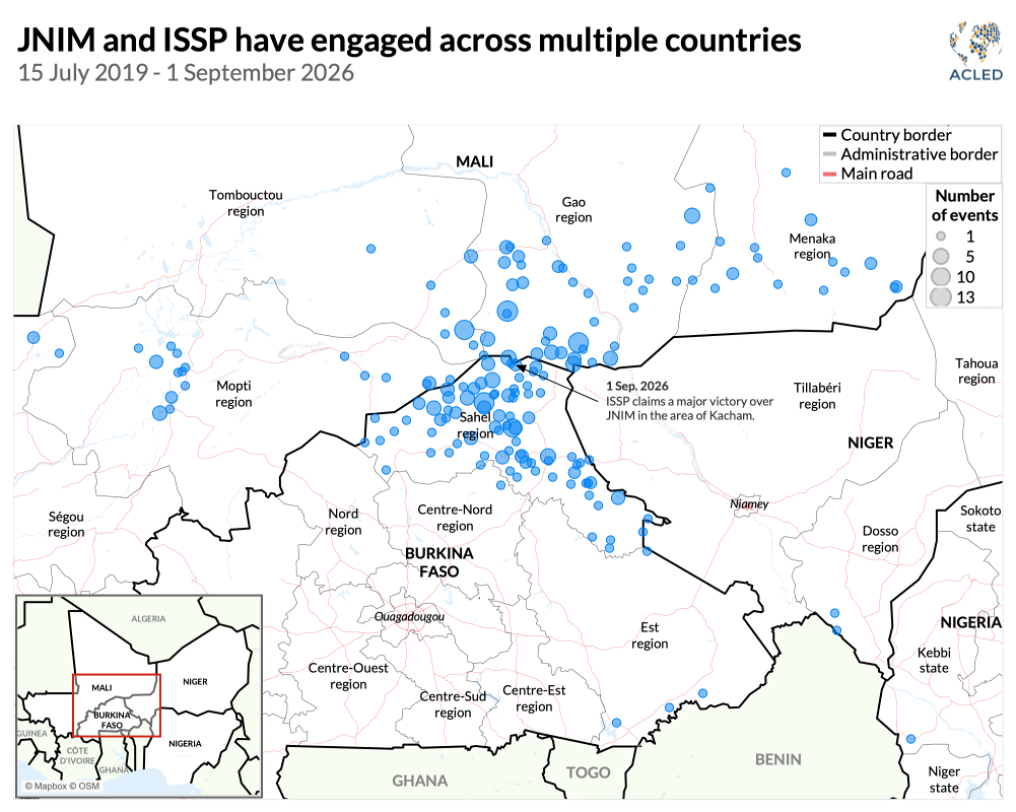
“The previously deadliest confrontation occurred between Haroum and Tadjalalt in Mali’s Gao region in December 2022, when ACLED recorded 173 fatalities. JNIM has largely deprioritized its rivalry with ISSP, conducting only limited offensive operations against the group while focusing its efforts on its multi-front war against state forces and allied militias. However, for ISSP, confronting JNIM has remained a priority, allowing the group to weaken its rival locally, force defections, and strengthen its own position in contested areas.”