
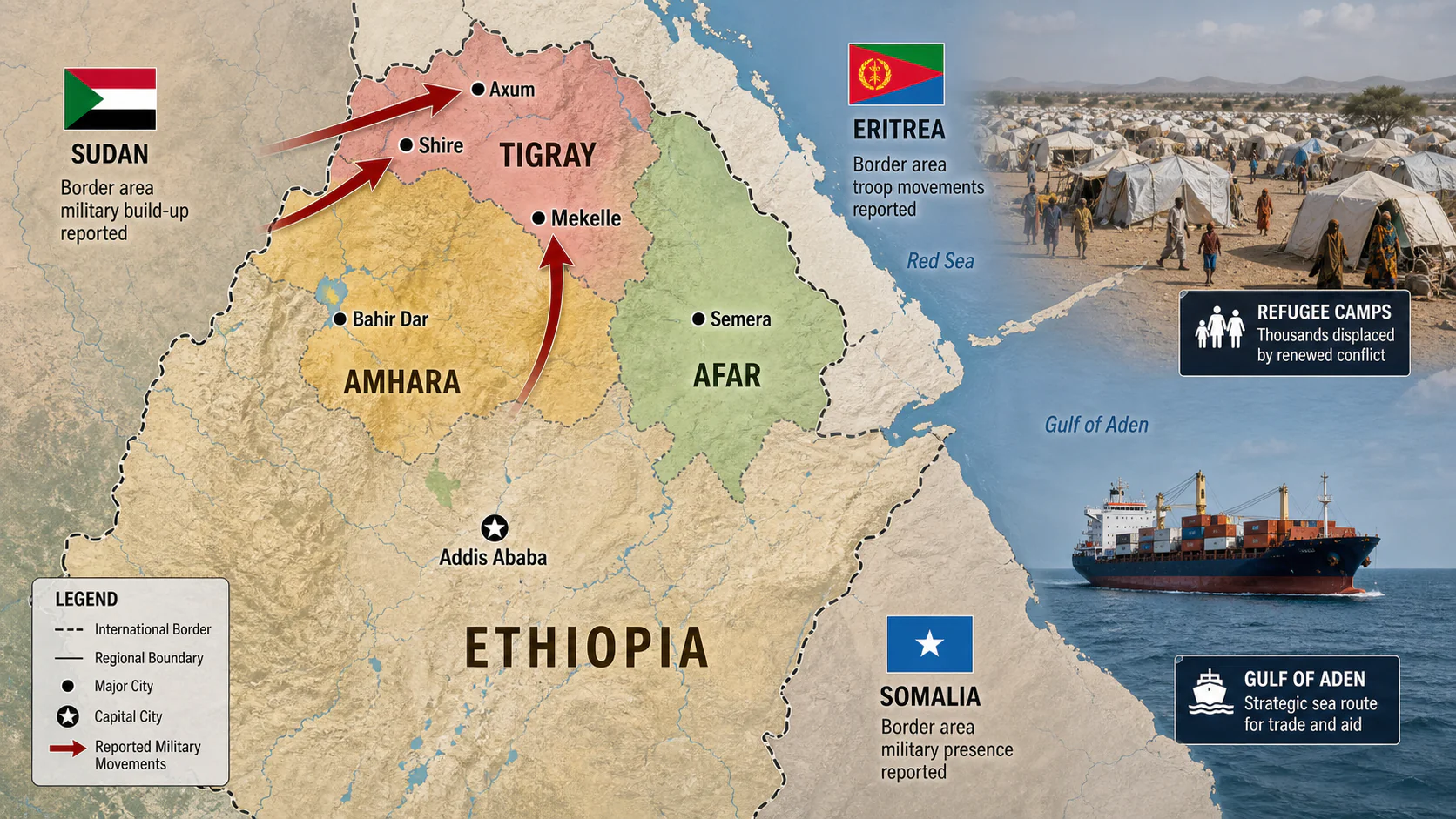
The Pretoria Agreement brought an end to Ethiopia’s devastating Tigray war—but not its underlying disputes. Four years later, renewed fighting and shifting armed alliances are threatening to reopen the conflict. The consequences could extend far beyond Tigray, destabilising the wider Horn of Africa.
Ethiopia’s fragile post-Pretoria peace is rapidly unravelling as renewed fighting between federal and Tigrayan forces spreads across the north. The emergence of a seven-group opposition alliance, fighting in Tigray, Amhara and Afar, and growing tensions between Ethiopia and Eritrea have raised fears that the conflict could expand beyond Tigray. With Ethiopia now closing its embassy in Eritrea and Asmara announcing that it is severing diplomatic ties with Addis Ababa, the crisis is taking on an increasingly regional dimension.
Historical Background
The two-year Ethiopian civil war started in November 2020 and moved toward an end with the signing of the Pretoria Agreement on 2 November 2022. The immediate origins were Ethiopia’s internal political crisis after Abiy came to power in 2018, the breakdown of relations between the federal government and the TPLF, the creation of the Prosperity Party, disputes over elections and constitutional authority, and ultimately the November 2020 attack on the ENDF Northern Command. From 1991 to 2018, the TPLF was the dominant force within the ruling Ethiopian People’s Revolutionary Democratic Front (EPRDF). The conflict escalated when Oromo politician Abiy Ahmed became the Prime Minister of Ethiopia in 2018.
Pretoria Agreement ended the major phase of the 2020–2022 Tigray war, but political, territorial, security, and accountability questions remain
After becoming prime minister in April 2018, one of Abiy’s early major foreign-policy initiatives was to normalise relations with Eritrea, for which he was awarded the Nobel Peace Prize, but the TPLF opposed the plan. According to the TPLF, Eritrea has caused so much damage to Ethiopia that they cannot maintain cordial relations anymore. Secondly, Prime Minister Abiy Ahmed merged ethnic and region-based parties of the Ethiopian People’s Revolutionary Democratic Front (EPRDF)into his new “Prosperity Party” to most likely end the power monopoly of the TPLF.
The Ethiopian federal government, Eritrean forces and allied regional forces fought against the TPLF and its forces in Tigray. The TPLF attacked the ENDF’s Northern Command in Mekelle in November 2020, an action the federal government described as an assault on the national military and which marked the beginning of full-scale war. Eritrean forces entered Tigray from the north, while Ethiopian federal forces and allied regional forces operated from the south and other directions, causing great damage to Tigray. Prime Minister Abiy Ahmed called it a law enforcement operation. All sides were accused of serious human-rights violations and war crimes, while some allegations also characterised aspects of the violence as genocidal.
After intense fighting, including the capture of Shire by Ethiopian and Eritrean forces in October 2022, the Ethiopian government and TPLF signed the Pretoria Agreement on 2nd November 2022.
The Collapse of the Post-Pretoria Order
The Pretoria Agreement succeeded in bringing temporary peace in the Horn of Africa. Despite the Pretoria Agreement, several key political and security issues remained unresolved, which are now contributing to renewed tensions between the federal government and Tigrayan forces. Moreover, some gaps in the agreement are also contributing to the current situation:
Article 6(a) of the Pretoria Agreement states that the Federal Democratic Republic of Ethiopia has only one defence force. The agreement therefore required the Tigrayan forces to enter a disarmament, demobilisation and reintegration (DDR) process. However, the status of Tigrayan forces and the broader question of security arrangements in Tigray remain politically sensitive.
Pretoria Agreement says, “The Government of FDRE undertakes to facilitate the return and reintegration of internally displaced persons and refugees, whenever the security situation permits”, but a large number of people displaced during the war have not returned to their homes due to territorial control.
Article 10.4 of the Agreement says, “The Parties commit to resolving issues of contested areas in accordance with the Constitution of the Federal Democratic Republic of Ethiopia”, but there are still territorial disputes between Tigray and Amhara.
Article 2(f) says, “Accountability and justice in accordance with the FDRE Constitution and the AU Transitional Justice Policy Framework”, but the questions over accountability for war crimes remain unresolved.
The Current Situation
On 20th September 2026, the TPLF insurgents joined a military coalition of six rebel groups, forming the Ethiopian People’s Forces Alliance for Survival (EPFAS), an alliance seeking to remove Abiy Ahmed. Shortly after, on the 23rd of September, Tigrayan forces seized and occupied three major airports, i.e. Mekelle, Axum, and Shire. The federal government subsequently intensified military operations, including drone strikes, while the TPLF accused the government of initiating the escalation.
The crisis took a major diplomatic turn on 1 October 2026. Ethiopia announced the closure of its embassy in Asmara and expelled 10 Eritrean diplomats, accusing Eritrea of hostile activities and interference in Ethiopia’s internal affairs. Later the same day, Eritrea announced that it would sever diplomatic ties with Ethiopia. Addis Ababa has also accused Eritrea of supporting the TPLF-led opposition alliance, allegations that Asmara denies.
As of October 01, 2026, the Ethiopian military has claimed that more than 700 rebel fighters were killed in two days of fighting, although independent casualty figures remain difficult to verify. The renewed violence has prompted international calls for de-escalation., prompting calls for international attention. In response, UN Secretary-General Antonio Guterres called for maximum restraint, immediate de-escalation of tensions, and the protection of civilians.
Spillover Effects
The two-year Ethiopian civil war had severe spillover effects on Somalia and Sudan. In Sudan, there was a refugee crisis, and in Somalia, Al-Shabab* became more active and launched increased attacks on Ethiopia. Ethiopia is also reportedly preparing to withdraw more than 3,000 Ethiopian National Defence Force soldiers from Somalia and redeploy them to the northern conflict, a move that could place additional pressure on Somalia’s security environment.
Karl Marx said that “History repeats itself, first as tragedy, second as farce”. This recent fighting could be beneficial for the terrorist groups to conduct their operations – since the black markets become much more active during times of conflict. Moreover, the renewed conflict could also complicate maritime security in the Gulf of Aden. Somalia has already experienced a resurgence of piracy in 2026, while recent analysis has identified links between pirate networks and militant groups including ISIS-Somalia* and Al-Shabab*. A wider Ethiopian conflict could further strain regional security resources.
The border states of Ethiopia will again suffer from a refugee crisis and border issues. The aftermath will again bring economic crisis, famine and other economic and social issues, causing great damage across the Horn of Africa. The African Union has urged neighbouring states to avoid actions that could contribute to the escalation. The renewed fighting therefore risks imposing further humanitarian, economic and security pressures on Ethiopia’s neighbours.
Conclusion
The renewed conflict is rooted in the unresolved political and territorial disputes that followed the 2020–2022 Tigray war, including disputes over Tigray’s political authority, contested territories, the status of TPLF forces and Ethiopia’s broader federal political structure.
The rapidly deteriorating situation now highlights how an incomplete peace settlement can leave the underlying drivers of conflict unresolved. The Pretoria Agreement ended the major phase of the 2020–2022 Tigray war, but political, territorial, security and accountability questions remain. Full implementation of the agreement, alongside renewed political dialogue, will be central to preventing further escalation and addressing the disputes that continue to threaten stability in the Horn of Africa.