
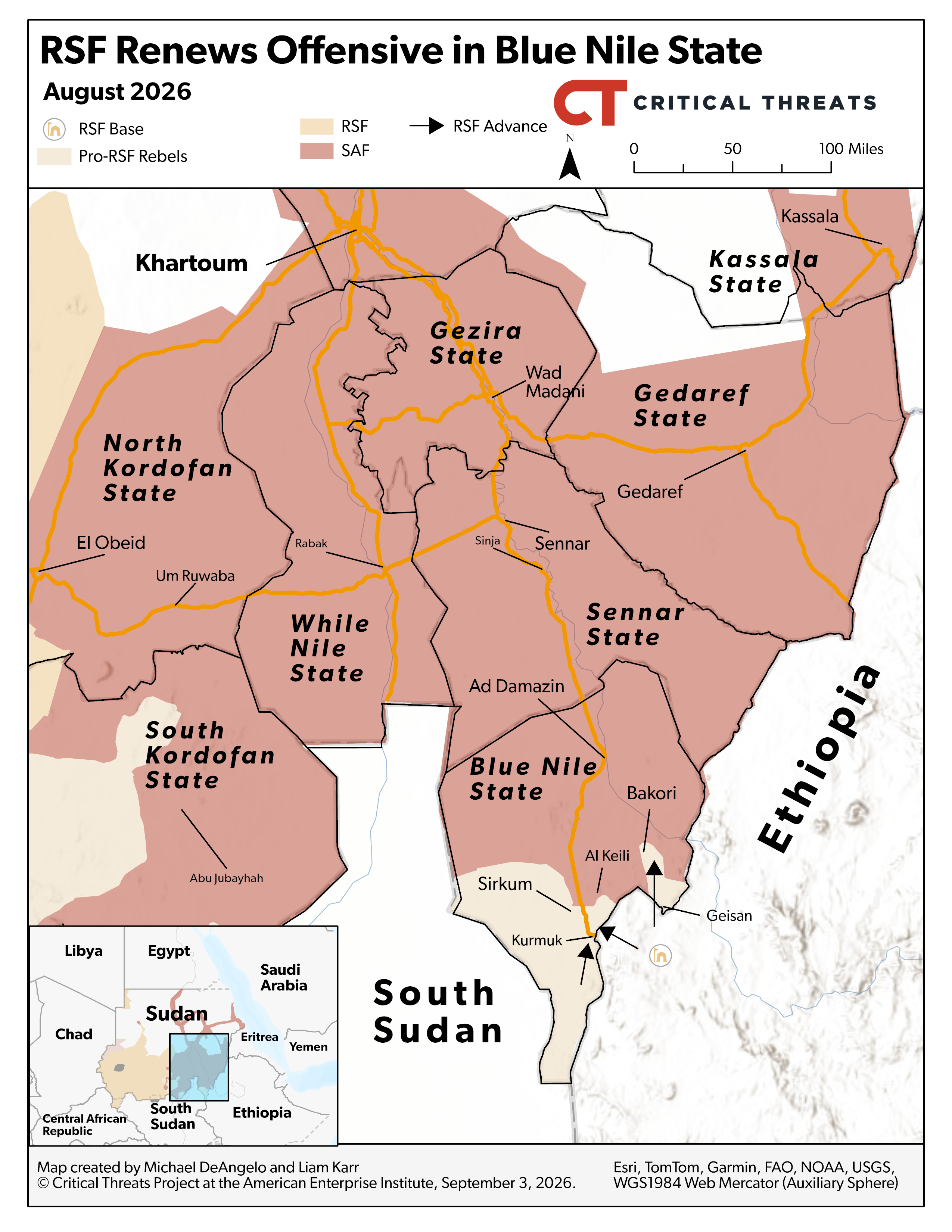
Key Takeaways:
Niger. Forces loyal to junta leader Abdourahamane Tiani thwarted a major coup attempt, which will likely exacerbate the deteriorating security situation that prompted the coup in the first place. Russia was decisive in thwarting the coup, and Algeria also stepped in to protect its Nigerien partners, demonstrating the resilience of the Kremlin’s regional network despite the failure of the Russian-backed Alliance of Sahel States to respond to the crisis.
Sudan. Sudan’s rising tensions with Rapid Support Forces backers Chad and Ethiopia raise the risk of military confrontation between Sudan and its two neighbors. Each side faces serious constraints that discourage escalation into a regional conflict, however.
Democratic Republic of the Congo (DRC). Pro-Congolese government forces are conducting two offensives against M23 and M23-allied fighters in the eastern DRC’s South Kivu province, likely to retake operationally significant positions and pressure M23’s western flank. The latest offensives come as the US- and regionally backed ceasefire verification mechanism team conducted its first mission in the South Kivu highlands in late August.
Figure 1. Africa File, September 3, 2026
Assessments:
Niger
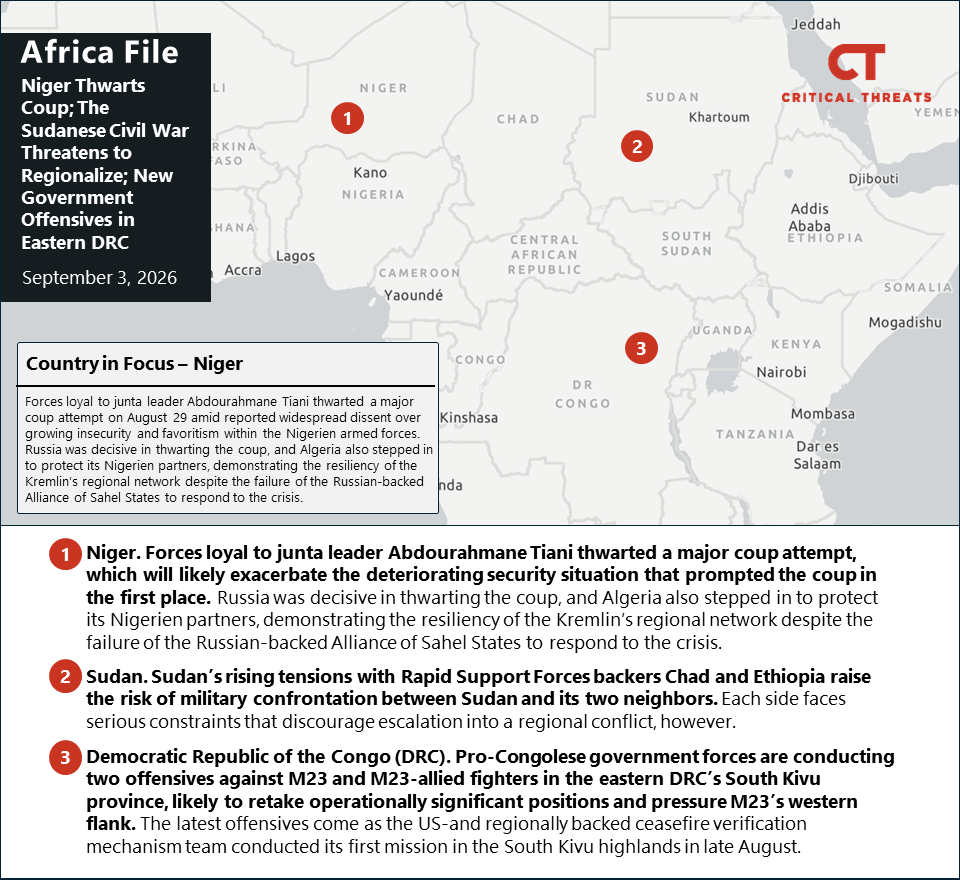
Forces loyal to junta leader Abdourahamane Tiani thwarted a major coup attempt on August 29 amid reported widespread dissent over growing insecurity and favoritism within the Nigerien armed forces. Hundreds of soldiers attacked several positions in Niamey early the morning of August 29, including the presidential palace, Air Base 101, the national TV station, and Bravia Hotel.[1] Pro-coup forces initially captured part of Air Base 101, holding an small number of “foreign”—likely Russian—soldiers and technicians hostage, but loyalist Presidential Guard forces repelled the other attacks.[2] Loyalist forces began negotiating with the pro-coup factions in Air Base 101 throughout the day, as loyalist forces and Russian auxiliaries prepared an operation to dislodge the militants from the airport.[3] Loyalist forces retook Air Base 101 with support from around 200 Russian Africa Corps soldiers and Russian drone support the evening of August 29, with some unverified sources claiming the Russian contingent involved reinforcements based in Mali and Libya.[4] The coup attempt reportedly resulted in at least 27 dead, 100 arrested mutineers, and “numerous” wounded loyalist forces.[5]
Figure 2. Attempted Coup in Niger
Major battlefield setbacks and internal armed-forces rivalries had likely contributed to growing internal discontent within the Nigerien armed forces that motivated the coup. Young Nigerien army officers, including those from special forces units, led the coup attempt over mounting casualties fighting IS Sahel Province (ISSP) and al Qaeda’s Sahelian affiliate Jama’at Nusrat al Islam wa al Muslimeen (JNIM) in recent months.[6] Several sources reported that the coup plotters were also upset with the junta’s favoritism for the Presidential Guard, which is Tiani’s original service branch.[7] The Nigerien junta lacked the same support within the armed forces at its inception as the other Sahelian juntas, as Tiani took power following a mutiny to protect his role as head of the Presidential Guard and only secured the support of the armed forces after using pro-sovereigntist and anti-Western rhetoric to gain popular support among the Nigerien public.[8]
The coup plotters had a substantial degree of support within the Nigerien army. Unverified sources claimed that the pro-coup forces had “a large portion of the armed forces” and were “far more numerous” than loyalist forces.[9] The Presidential Guard was the only service branch to remain completely loyal to Tiani; the National Guard largely remained neutral in the conflict, and the army appeared divided.[10] At least one Nigerien unit refused to launch an attack to retake Air Base 101 during the coup attempt.[11] Disaffected Nigerien army units had launched at least five other smaller munities across Niger since 2025, underscoring widespread dissatisfaction among Nigerien forces.[12]
The Nigerien regime has since arrested several suspected coup sympathizers linked with the party of ousted President Mohamed Bazoum and made unsupported claims that France, the United Arab Emirates, and several of Niger’s neighbors, including Chad, were behind the plot.[13] A captured captain allegedly involved in the coup claimed on national television on September 2 that Bazoum’s children notified him that an “external intervention” from Benin, Côte d’Ivoire, France, and the Economic Community of West African States (ECOWAS) would support the coup attempt.[14] The captain also claimed that a Chadian officer told him that Chadian authorities and French special forces soldiers were on their way from Chad to reinforce pro-coup forces.[15] The officer did not provide any evidence to support his claims, and all the accused parties rejected the accounts.[16] The Nigerien junta has repeatedly blamed France and accused these same neighbors—except Chad—of attempting to destabilize it to deflect blame for security lapses, such as an insurgent attack on Air Base 101 in early 2026.[17] Chad had strong and growing ties with Niger and the Alliance of Sahel States through 2025, but the return of French special forces to Chad and tensions over border security along their northern border with Libya have cooled these relationships.[18]
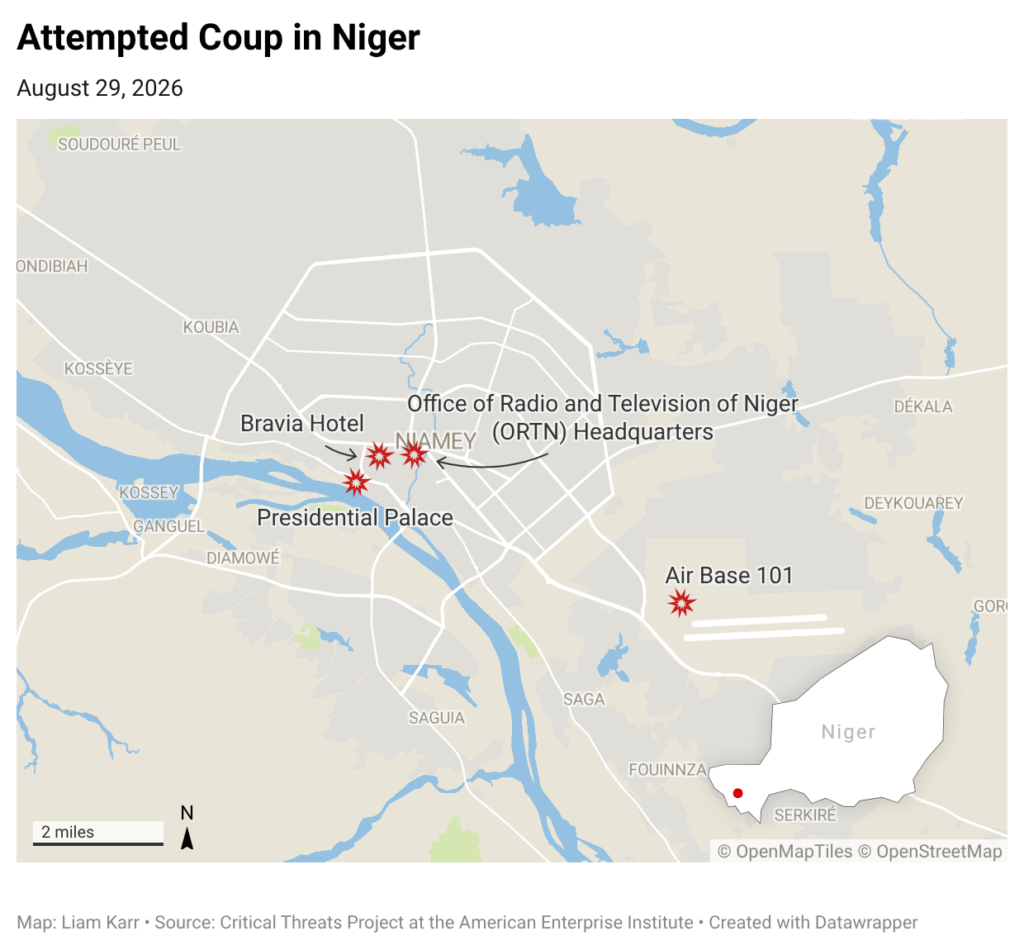
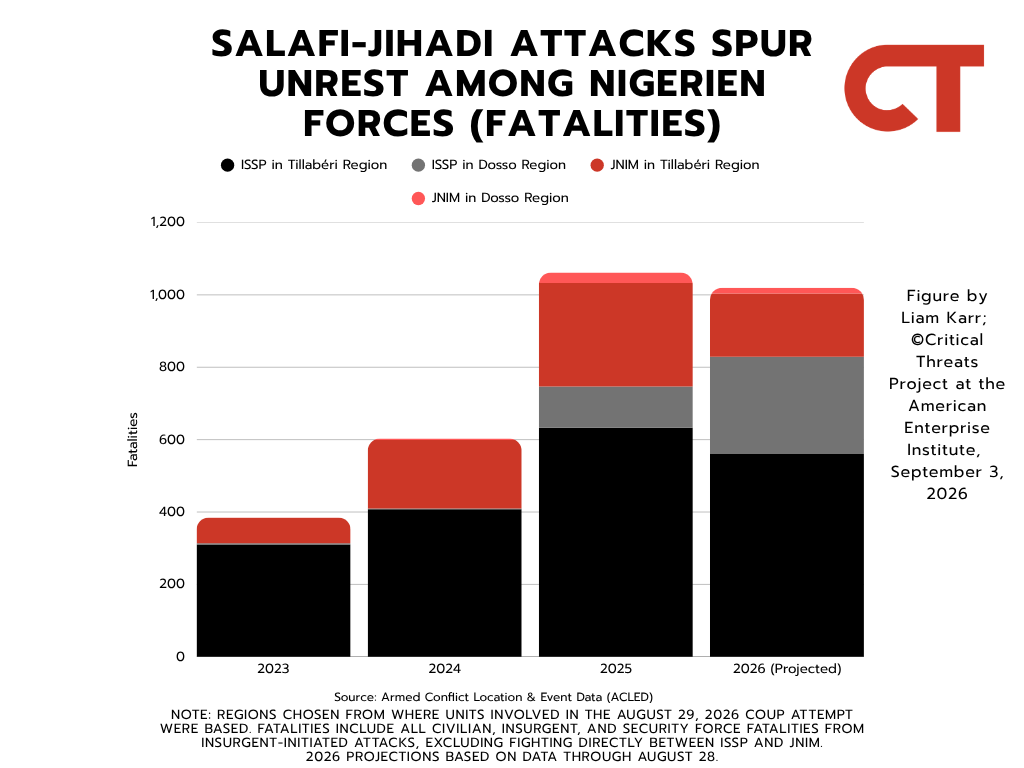
The coup attempt will likely exacerbate the deteriorating security situation that prompted the coup in the first place. ISSP and JNIM have exacted greater costs on Nigerien forces in rural areas surrounding Niamey and increased pressure on Niamey itself in 2026. Fatalities resulting from ISSP and JNIM attacks in the Tillabéri region significantly increased each of the first two years the junta was in power, and more recently fatalities have substantially increased in the Dosso region across 2025 and 2026. ISSP has escalated the rate of attacks in Tillabéri in 2026 and is on pace to carry out more attacks in Ouallam department and across all interior departments in 2026 than it has any other year since the junta took power in 2023.[19] ISSP and JNIM combined have already carried out more attacks in Dosso region so far in 2026 than they have in any other year prior, with ISSP on pace to nearly triple its previous yearly record from 2025.[20] Both of these trends have led to a similar increase in fatalities linked to ISSP-initiated engagements in these zones.[21] These campaigns have enabled the groups to increase pressure on Niamey, where both ISSP and JNIM have each attacked Air Base 101 in 2026.[22]
Figures 3 and 4. Salafi-Jihadi Attacks Spur Unrest Among Nigerien Forces
The coup attempt has distracted and preoccupied Nigerien forces, likely creating vacuums for insurgents to exploit. The officers and units leading the coup were based in conflict hot spots in the Ouallam and Téra departments, the Tillabéri region, and the Dosso region. Numerous reports also claimed that units from unspecified areas were mobilizing toward the capital at the request of both pro-coup and loyalist factions, although loyalist forces ended the coup attempt before any of these reinforcements arrived.[23] Jeune Afrique reported that Nigerien security services have arrested soldiers from multiple special forces units at their barracks in the Tillabéri region since the coup.[24] ISSP has previously demonstrated its ability to opportunistically capitalize on instability when it temporarily seized a key border post in the Malian regional capital of Ménaka amid the chaos following JNIM’s April offensive.[25] JNIM claimed to overrun a checkpoint in Koubia, a neighborhood on the outskirts of western Niamey, on September 2.[26]
Russia was decisive in thwarting the coup, and Algeria also stepped in to protect its Nigerien partners, demonstrating the resilience of the Kremlin’s regional network despite the failure of the Russian-backed Alliance of Sahel States (AES) to respond to the crisis. Russia secured a tactical victory that burnishes its credentials and prestige as a reliable regime protector, although the strategic trends for Russian partners in the Sahel remain bleak. Russia has centered many of its African partnerships on its “regime survival package,” which insulates its authoritarian partners through allyship in international bodies, the deployment of Russian military units and political advisers, and information operations.[27] Russian forces helped defend Mali’s Air Base 101 during JNIM’s April offensive, which threatened to topple the Malian junta, and were decisive in ending the coup attempt in Niger.[28] Russia and its partners are facing growing strategic threats, however, despite these tactical successes. The juntas had not faced such frequent acute threats before 2026, and the proliferation of these threats demonstrates that Russia’s Sahelian partners are facing growing existential challenges because of their inability to reverse the deteriorating security across the Sahel.
Algeria strongly backed the Nigerien junta and even offered military assistance, which is a highly unusual move for Algeria. Algeria was the first country to publicly condemn the coup in a statement on August 29 and deployed two air patrol squadrons—four Su-30s fighter jets, an IL-78 refueling aircraft, and their support teams—to Niamey on August 30.[29] The deployment is the first official Algerian foreign military deployment since 1973, when Algeria supported Egypt in the Yom Kippur war. The Algerian constitution prohibited foreign deployments until 2020.[30]
Algeria’s response may signal that Algiers is taking a more assertive approach to protecting its interests in the Sahel, where the Nigerien junta is the anchor partner in its regional strategy. The Nigerien junta has been Algeria’s main political ally within the AES, and the two partners are also working on the $13 billion Trans-Saharan Gas Pipeline, which aims to transport Nigerian natural gas to Europe via Niger and Algeria’s existing gas infrastructure.[31] The relationship is key in Algeria’s competition with its North African neighbors, which have exploited Algeria’s strained ties with the AES to supplant Algerian influence in the Sahel. Morocco is attempting to construct its own $25 billion African Atlantic Gas Pipeline to link Nigeria to Europe and serve as an Atlantic outlet for the landlocked Sahel states, with both initiatives centered on Moroccan-controlled Western Sahara to help secure greater support for Morocco’s claim to the disputed territory.[32] The Haftar regime in eastern and southern Libya has also sought to assert greater control over regional Sahel-Saharan trafficking networks, threatening to further erode some of Algeria’s economic and political influence in the Sahel.[33]
The AES was absent from the coup, highlighting the bloc’s military and political limitations. Niger reportedly requested assistance from Burkina Faso, but the Burkinabe junta did not provide any support.[34] Burkina Faso notably did provide drone support to Mali during the April JNIM offensive.[35] This difference could indicate tensions between Burkina Faso and Niger or differing AES approaches in responding to insurgent attacks as opposed to internal military disputes. The Nigerien junta did not bother requesting assistance from Mali due to Mali’s own precarious security situation, especially its lack of capacity along the Nigerien border.[36] Tiani eventually spoke with his Burkinabe and Malian counterparts, Ibrahim Traoré and Assimi Goïta, but the AES only released a joint statement condemning the coup attempt hours after it had concluded, late into the night on August 29.[37]
Algeria’s and Russia’s critical efforts to protect the Nigerien junta despite the lack of AES involvement highlight the resilience of Moscow’s network in the Sahel-Sahara. There is no indication that Russia and Algeria coordinated their responses, but the Russian ambassador to Niger praised the Algerian government’s support for the Nigerien junta.[38] Algeria and Russia aligning to help bolster the Nigerien junta is the latest instance of Russia working with different African partners to advance different military and political objectives in the Sahel-Sahara region.[39] Russia worked with several sub-Saharan countries, including the Republic of Congo (Congo-Brazzaville), Togo, and AES members Burkina Faso and Niger, to facilitate a rapprochement between its Algerian and Malian allies.[40] Better relations between the two helps support the Kremlin’s military efforts in the Sahel by boosting intelligence sharing on northern Mali and possibly increasing Algeria’s willingness to serve as a logistics node for Russian military shipments to the Sahel.[41] The Kremlin has also worked with Algeria and Libya to open dialogue channels with the Tuareg rebels to secure the release of Africa Corps prisoners.[42]
Sudan
The Sudanese Armed Forces (SAF) conducted its first drone strikes on the Rapid Support Forces (RSF) in Chadian territory, raising tensions with Chad. The SAF struck an RSF convoy near Mourdi—a Chadian area approximately 50 miles west of the Sudanese border and 100 miles south of the Libyan border, on August 21.[43] The strikes reportedly destroyed dozens of vehicles in the approximately 200-vehicle convoy, which included combat vehicles and fuel trucks.[44] The Egyptian news outlet MadaMasr reported that the SAF-aligned Joint Forces militia then ambushed the remnants of the convoy.[45] The Joint Forces claimed to have captured 70 RSF fighters and seized or destroyed 79 combat vehicles.[46] The Chadian military accused the SAF on August 22 of striking Chadian territory, although the Sudanese Ministry of Foreign Affairs denounced Chad’s accusation absent a longer investigation.[47] US Senior Advisor for African Affairs Massad Boulos called Chadian President Mahamat Idriss Déby on August 26 and condemned the SAF strikes.[48]
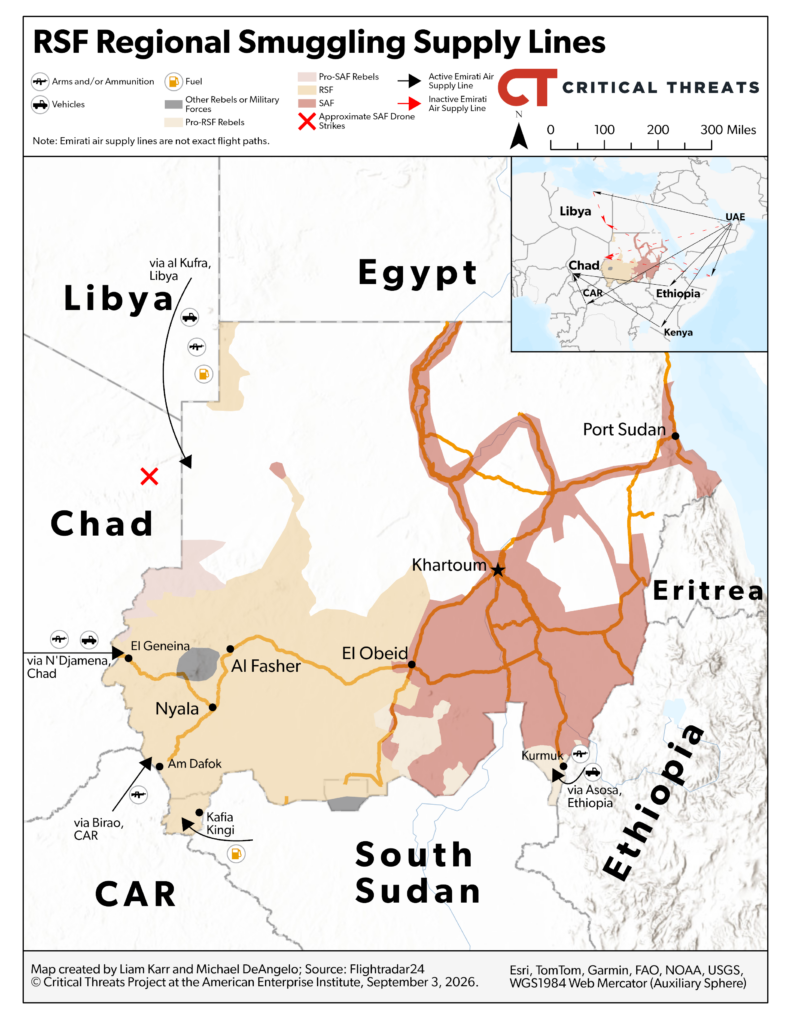
The drone strikes are part of a larger SAF effort to interdict Emirati-RSF supply lines through Libya. The convoy was transiting from RSF rear bases in southeastern Libya to North Darfur state, the location of the main remaining SAF-aligned pocket in western Sudan.[49] The RSF uses eastern Libya, which Emirati-backed Libyan warlord Khalifa Haftar’s Libyan National Army controls, as nodes for Emirati weapons shipments, particularly combat vehicles.[50] The SAF has prioritized disrupting the RSF supply lines since June 2026, when it increased airstrikes in the “border triangle” area with Egypt, Libya, and Sudan.[51] The SAF began redeploying forces to the border area in July and subsequently launched ground operations against RSF convoys.[52] Open-source analyst Rich Tedd has tracked several additional SAF strikes on RSF convoys in the border area since the strikes in Chad.[53]
Figure 5. Rapid Support Forces (RSF) Regional Smuggling Supply Lines
Chad has bolstered its military posture on the Sudanese border as it has done with past spillover events in the Sudanese civil war. The Chadian military warned both the RSF and SAF against violating Chadian territorial integrity and reaffirmed its right to defend itself in its August 22 statement.[54] The Chadian military subsequently placed its forces on the highest alert level.[55] Reuters cited a Chadian source who said that Chad has deployed approximately 100 armored vehicles and drone-jamming equipment near Tine, a town split by the Chad-Sudan border.[56] The Sudanese news outlet Sudan Tribune reported that Chad has also established outposts near the Sudanese border and conducted “security sweeps” in Sudanese refugee camps in Chad.[57] Chad responded to three separate spillovers that the RSF initiated in early 2026 by warning both the RSF and SAF against future attacks and reinforcing its military presence on the Sudanese border.[58]
Internal divisions and border concerns make Chad unlikely to retaliate directly against the SAF, although additional SAF strikes in Chadian territory would put pressure on the Chadian government to act. Influential factions with the Déby’s regime, particularly ethnic Zaghawa members of the Chadian security forces, have opposed Déby’s decision to support the RSF by making Chad another transit point for Emirati weapons shipments.[59] The Zaghawa have long-standing disputes with the RSF, and many Zaghawa, including Chadian citizens, fight for the Sudanese Joint Forces.[60] Déby views the internal opposition as a vulnerability, as he relies on the Chadian security forces for regime security. Chad subsequently decreased its support for RSF in 2025 before resuming support in early 2026.[61] Chad is also concerned about further instability along the Chad-Sudan border, as it is overwhelmed by refugee flows from Sudan.[62] The Chadian military has already closed border crossings with Sudan once in 2026 and conducted clearing operations targeting various Sudanese forces’ rear bases in Chad.[63] Chad has threatened to respond militarily to future attacks, however.[64] Reuters cited a Chadian security source who said that Chad had deployed “equipment adapted to the new threat posed by drones” to the Sudanese border after the recent SAF strikes.[65]
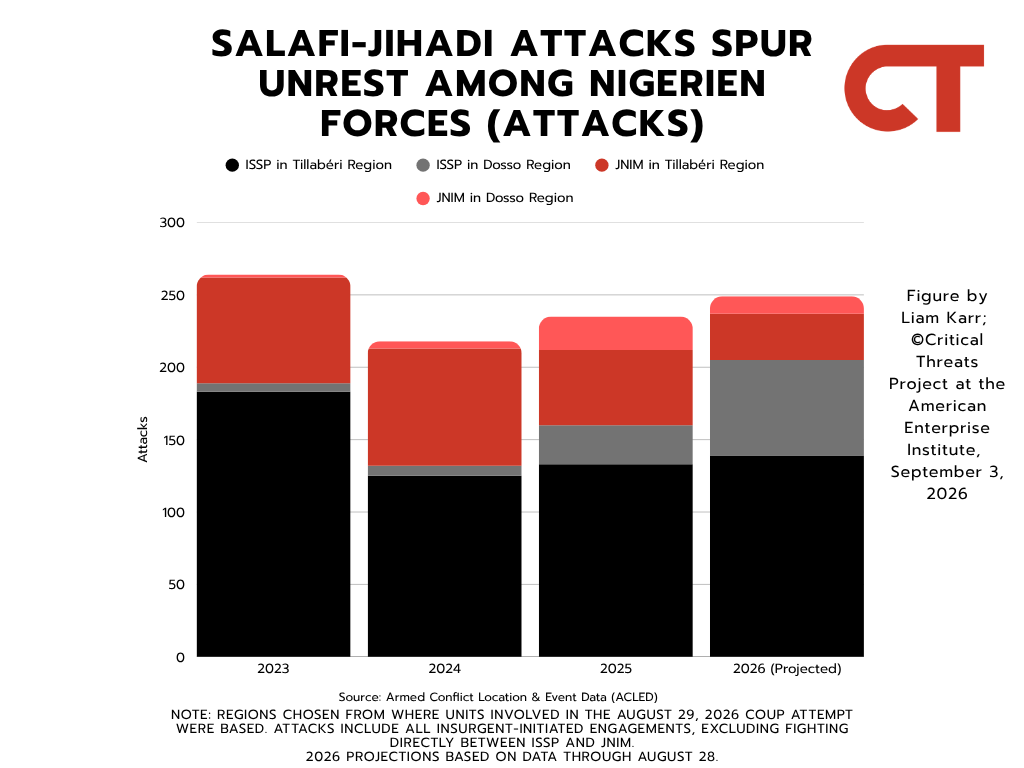
Ethiopia has separately increased military support for the RSF since late 2025, which could prompt an SAF response amid a recent RSF offensive in southeastern Sudan. Rich Tedd tracked 44 Emirati-linked flights carrying suspected weapons shipments to the RSF via Ethiopia in August 2026, compared with two in September 2025.[66] Emirati-linked flights to Asosa, the capital of western Ethiopia’s Benishangul-Gumuz region, have increased since July.[67] Ethiopia has enabled the RSF to maintain rear bases and training camps near Asosa, and the SAF-aligned local government head for Kurmuk claimed on September 3 that the RSF has established four training camps in the area.[68] Tedd and the Yale University School of Public Health’s Humanitarian Research Lab separately reported in late August that there has recently been a large-scale military buildup, including combat vehicles and cargo containers, at an Ethiopian National Defense Force (ENDF) base in Asosa.[69] The Humanitarian Research Lab has previously reported that the ENDF is using the base to facilitate support to the RSF.[70]
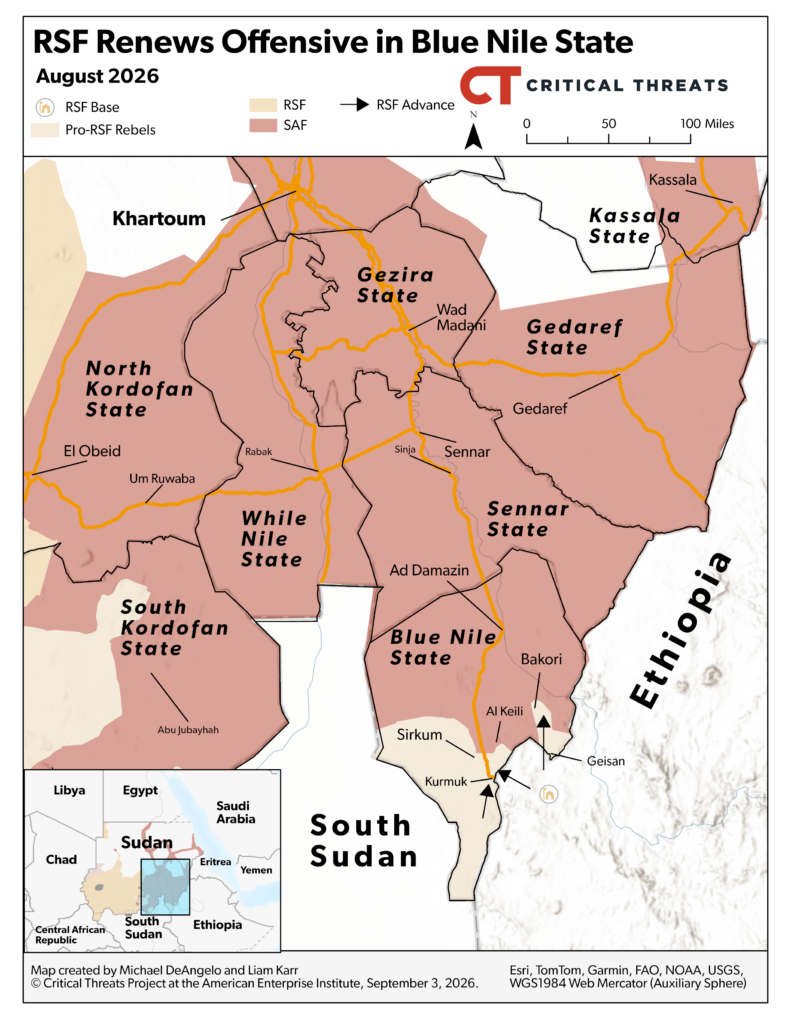
Increased Ethiopian support comes amid a renewed RSF offensive in Sudan’s Blue Nile state. The RSF has moved toward the Blue Nile state capital, Ad Damazin, since gaining two key footholds on the Ethiopian border in mid-August 2026. The RSF advanced from the border town of Kurmuk to capture an SAF base in Sirkum, which is approximately 85 miles south of Ad Damazin off Blue Nile’s main highway, on August 28.[71] The RSF also attempted to seize an SAF base in al Keili, which is 90 miles south of Ad Damazin off the main highway, on August 27.[72] The RSF separately advanced from the border town Geisan to capture Bakori, which is approximately 80 miles southeast of Ad Damazin on a connecting road to the main highway, on August 28.[73] The RSF also attempted to seize Fazughli, which is 60 miles southeast of Ad Damazin, but the SAF repelled the attack.[74] The SAF has responded by deploying reinforcements to Blue Nile, including a special forces unit, while the RSF has also reportedly sent more forces to the front.[75] SAF head and leader of the SAF-led Sudanese government Abdel Fattah al Burhan visited Ad Damazin on September 2 to rally popular support for the SAF.[76]
Figure 6. Rapid Support Forces (RSF) Renews Offensive in Blue Nile State
The SAF has accused Ethiopia of enabling the RSF’s drone operations in the recent offensive. The SAF has shot down three RSF drones in Blue Nile since August 23.[77] The drones were Turkish-made Akinci and Chinese-made CH-95 models, both of which the United Arab Emirates (UAE) is suspected to have supplied to the RSF.[78] The SAF claimed that the drones were launched from Ethiopia.[79] The Sudanese government previously accused Ethiopia of enabling the RSF to conduct drone operations from Ethiopian territory in March and May 2026.[80]
The SAF has threatened to take military action against Ethiopia over its support for the RSF in the past, although it faces constraints. The SAF has conducted drone strikes on several RSF-controlled border towns throughout the war, including Kurmuk.[81] The Ethiopian news outlet Addis Standard reported that a suspected SAF drone struck targets on the Ethiopian side on Kurmuk in April 2026, although neither the Ethiopian nor the Sudanese governments acknowledged the strike.[82] Burhan, the Sudanese foreign minister, and the SAF spokesperson separately affirmed the SAF’s willingness to directly retaliate against Ethiopia after RSF drones struck Khartoum, the Sudanese capital, in May.[83] The SAF has resource limitations from fighting a multifront war, however. The French investigative outlet Africa Intelligence reported in August that Burhan’s deputy in the Sudanese government, Malik Agar, has worked to ease tensions with Ethiopia, which has the largest military in the Horn of Africa, since May.[84]
Continued external support, including Emirati support for the RSF via neighboring countries to Sudan, is foiling US peace efforts. The United States has made reducing external support to both the RSF and SAF a necessary part of its efforts to end the war. Boulos announced a resolution on August 24 to apply a United Nations (UN) arms embargo on Sudan.[85] Boulos reiterated the US desire to halt external support in his call with Déby on August 26.[86] The UAE has violated a long-standing UN arms embargo on the Darfur region by supplying the RSF since 2023, however.[87] The UAE has only expanded its supply lines to the RSF via Chad, Ethiopia, Libya, Somalia, South Sudan, and the Central African Republic despite agreeing that external support must be halted as part of the US-led Quad peace process, which also includes SAF backers Egypt and Saudi Arabia in addition to the UAE.[88]
Democratic Republic of the Congo
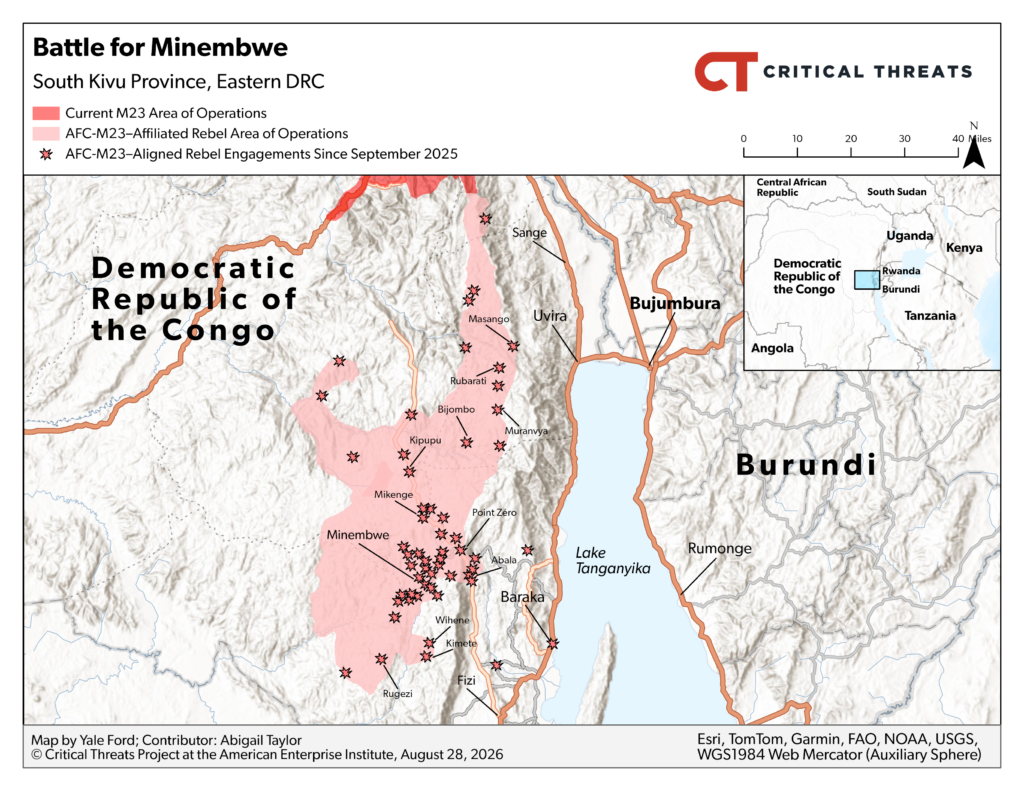
Pro-Congolese government coalition forces have been waging an offensive toward the town of Minembwe in the South Kivu highlands since mid-August, and these forces are likely aiming to recapture an operationally significant position east of the town from M23-allied fighters and sever a key access route further south into Fizi district. Pro-Congolese government forces launched the offensive against M23-allied Twirwaneho forces on August 17 and have since maintained pressure on Minembwe town in the eastern Democratic Republic of the Congo (DRC).[89] Twirwaneho forces have controlled Minembwe since early 2025, despite three previous government offensives since early 2026 and a blockade imposed by pro-Congolese government forces on the town between May 2025 and June 2026, with temporary pauses in late 2025 and in April 2026.[90]
Pro-Congolese government forces likely aim to recapture Point Zéro, which is east of Minembwe, before launching any operation aimed at retaking Minembwe center. Point Zéro is an operationally significant hilltop about 15 miles east of Minembwe that dominates the western approaches to Minembwe, the northern approaches to the Mwenga and Uvira highlands and midlands, and the southern approaches to the lowlands toward Fizi and Baraka towns and Lake Tanganyika. Point Zéro is also the location of the only telecommunications antenna in the isolated rural areas of the highlands. Pro-Congolese government forces had captured Point Zéro in a late January 2026 offensive, which has allowed the coalition to sustain pressure on Minembwe for most of 2026.[91] Twirwaneho forces recaptured the position in a counteroffensive in early July, however, which forced pro-Congolese government forces to abandon several positions and retreat south toward the town of Fizi in a strategic setback.[92]
Figure 7. Battle for Minembwe
M23 and Rwanda have responded to the latest offensive with drone attacks. A Congolese army (FARDC) spokesperson accused M23 and the Rwandan army (RDF) of using a Turkish-made medium-altitude long-endurance TB2 Bayraktar drone to conduct a targeted strike on a hotel with two separate projectiles on August 19.[93] Initial reporting indicated that senior FARDC and Burundian army (FDNB) officials had been in the area around the time of the strike.[94] Independent Burundian media confirmed on August 23 that the strike had likely targeted several high-ranking FARDC and FDNB military officers, namely FDNB Deputy Commander of the Land Forces Major General Elie Ndizigiye, also known as Muzinga, the FDNB’s operations officer, and the FARDC’s regional commander, who were using the hotel to plan new military operations with private military contractors (PMCs) but left the area before the attack.[95] The report also said that authorities arrested several FDNB and FARDC officers as part of an investigation into a possible intelligence leak.[96] Congolese government-aligned sources claimed that coalition forces then shot down an attack drone near Point Zéro on August 20.[97]
PMCs employed by American citizen Erik Prince are likely supporting pro-Congolese government forces in their ground assault. Prince reportedly met with the FDNB chief of staff and several other senior Congolese and Burundian officials in both the Congolese capital, Kinshasa, and Burundi’s economic capital, Bujumbura, before crossing over into South Kivu in mid-August.[98] The M23-aligned investigative outlet Great Lakes Eye claimed that the Congolese government offered Prince, who has ties to US President Donald Trump’s administration, a new $100 million contract to help secure mining sites and retake territory from M23 during his meetings in Kinshasa in mid-August.[99] Great Lakes Eye claimed separately on September 1 that the number of Prince-linked PMCs deployed for the Minembwe offensive increased from 10 to roughly 35 in late August and were operating at two points south of Point Zéro.[100] The report said that the PMCs are assisting DRC coalition forces with air defense support and drone operations.[101] The UN Group of Experts reported in June 2026 that the main focus of Prince’s original contract with the DRC in 2024 and 2025 shifted from helping crack down on tax evasion in the DRC’s mining sector to providing security for the Congolese government amid the escalating fighting in the eastern DRC in late 2025.[102]
Pro-Congolese government forces are likely receiving reinforcements from the FDNB and using Burundian territory as a rear base and key transit corridor into South Kivu. The DRC coalition may have established an air bridge to the front line through Bujumbura. Great Lakes Eye claimed in a report in mid-August that three FARDC air force flights from Kinshasa landed at Bujumbura’s international airport in early August with military equipment for forces in South Kivu.[103] The report claimed that Congolese aircraft had received authorization to land in Bujumbura for a three-month period from July 23 through October 23.[104] Great Lakes Eye claimed that FDNB troops and Congolese government-employed PMCs crossed into multiple areas in South Kivu with military supplies and attack drones via Bujumbura in early August.[105] Videos on social media posted by M23-aligned media sources purportedly showed columns of FDNB reinforcements moving into the highlands and midlands of South Kivu in late August.[106] CTP assessed in early September that Burundi has emerged as a strategic military partner to the Congolese government and its allies in the war against M23 and Rwanda.[107]
Pro-Congolese government forces had been setting conditions for the assault on Minembwe since early August. The FARDC commissioned the first batch of several thousand newly formed special combat troops in late July, following intensive training reportedly led by Israeli advisers.[108] The government likely deployed at least some of these troops to North and South Kivu, where FARDC special force units have been deployed across multiple fronts against M23 and Rwandan forces, including around Minembwe, since at least early 2026. M23-aligned media sources claimed in early August that the Congolese government had begun deploying thousands of additional troops to Fizi in preparation for an offensive against Minembwe, as part of a broader military buildup that had reportedly brought more than 10,000 troops to the eastern DRC.[109] Great Lakes Eye claimed in a report that the FARDC and FDNB chiefs of staff traveled to Kalemie town in Tanganyika province—roughly 160 miles south of Fizi—to oversee preparations for operations on Minembwe and in Fizi in early August.[110] M23-aligned sources claimed that Muzinga and the FARDC’s 33rd regional commander, who covers South Kivu and Maniema provinces, then arrived in Fizi to oversee operations in South Kivu in mid-August.[111]
The latest offensive on Minembwe comes as the US- and regionally backed ceasefire verification mechanism team conducted its first mission in the highlands in late August. The DRC, Rwanda, and observer nations had discussed deploying the first ceasefire verification mission for the Expanded Joint Verification Mechanism Plus (EJVM+) during a meeting under the Washington Peace Accords in mid-August.[112] The EVJM+ is a field-level ceasefire monitoring and verification mechanism established under the Doha-Switzerland process to monitor, investigate, verify, and report ceasefire violations between the DRC and M23. Delegations from the DRC and M23 and observer nations then met in Switzerland under the Doha-Switzerland process from August 17 to 21.[113] The parties in Switzerland welcomed and discussed further steps toward operationalizing the EJVM+, which then carried out its first reconnaissance mission on August 20 before deploying to Minembwe for its first verification mission on August 24.[114] M23-aligned media sources and Twirwaneho’s spokesperson claimed that pro-Congolese government forces conducted attacks with heavy artillery on several Twirwaneho positions around Minembwe as the EJVM+ team was in Minembwe for the mission.[115]
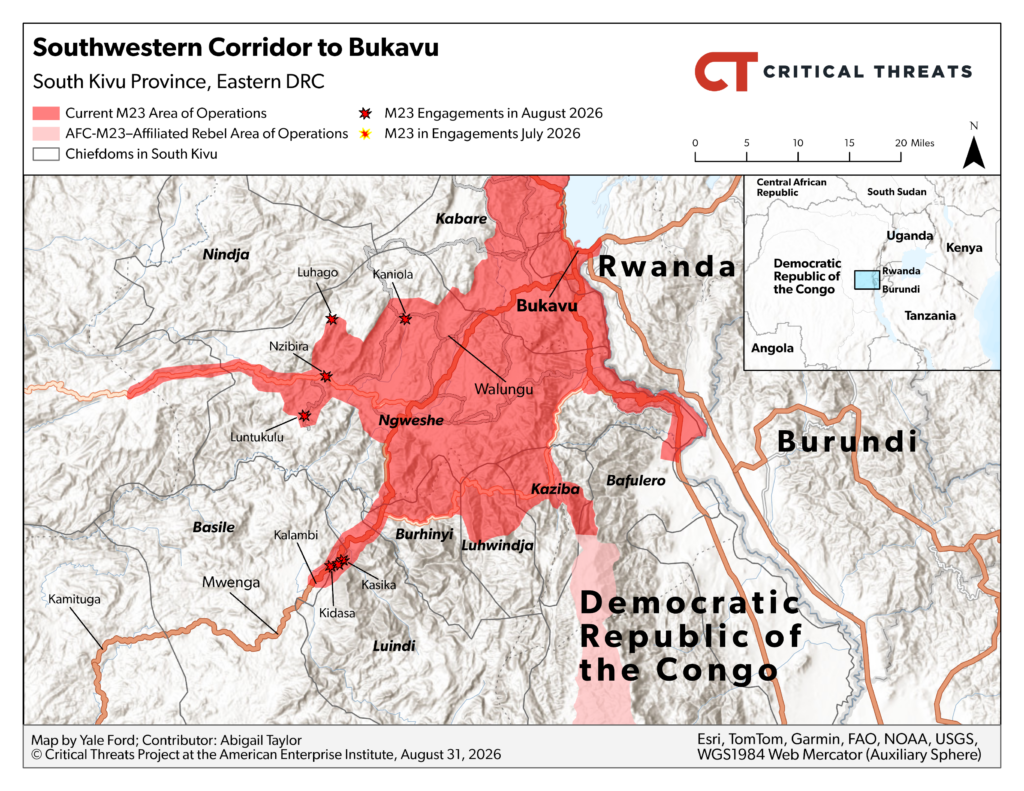
Pro-Congolese government forces are conducting a separate offensive in the Walungu and Mwenga highlands in South Kivu that likely aims to pressure M23’s western flank, including a significant M23-controlled mineral trading hub and critical transport corridors to Bukavu, the South Kivu provincial capital. Heavy fighting broke out in the Walungu district highlands in three separate areas in South Kivu for the first time since May 2026 in mid-August. Local reporting indicates that pro-Congolese government Wazalendo fighters and possibly FARDC special force units attacked M23 near Kaniola village, which is about six miles west of Walungu town.[116] M23 quickly repelled the attacks around Kaniola, likely in part because the M23-appointed South Kivu governor was present in central Walungu when the fighting broke out.[117] Coalition forces then likely conducted attacks on M23-controlled Luntukulu village, which is about 10 miles south of Nzibira town in Walungu, on August 20.[118] M23 then likely conducted counterattacks on Wazalendo positions in the Luhago group, a remote area that is roughly eight miles north of Nzibira on a local road.[119]
Nzibira is an important tin and gold mining town and logistics hub with an airfield about 20 miles southwest of Walungu town. Nzibira, which M23 had captured in late September 2025, dominates access north into southern Kabare district on rural roads, south and southwest toward the Mwenga highlands, and west toward Shabunda district on the RP503, a regional road. Control of Nzibira would enable pro-Congolese government forces to support operations in the southwestern Walungu highlands, while providing a potential launch point for an offensive toward Walungu town to the north that would increase pressure on Bukavu, which is about 20 miles north of Walungu town on the RN2 highway. Control of Nzibira would likely also allow pro-Congolese government forces to put pressure on M23-controlled areas in southern Walungu, including the Burhinyi, Luhwindja, and Kaziba chiefdoms, and Uvira district to the east. CTP assessed when M23 captured Nzibira that the group’s control of the town and southern Walungu strengthened its control of supply lines to the advantageous mid-level highlands around Uvira.[120]
Pro-Congolese government forces are conducting another offensive on M23 north of Mwenga town on the RN2. FARDC units supported by Wazalendo and FDNB troops reportedly attacked M23 in Kasika village in the Luindi chiefdom on August 31.[121] The Luindi chiefdom is on the northern end of the Itombwe Mountains and borders the RN5 highway to the east in northern Mwenga. Kasika, which is the seat of Luindi that M23 had captured in late November 2025, is about 14 miles north of the government-controlled town of Mwenga on the RN2. Greater DRC coalition control over Kasika and frontline areas in northern Mwenga would strengthen its control of the RN2, which is the only road capable of transporting vehicles into M23-controlled areas in southern Walungu from Mwenga and the main route into the northern reaches of the Uvira and Mwenga highlands. The Kaziba and Luhwindja chiefdoms are important transit hubs that M23 used to support a ground assault on pro-Congolese government forces in the Ruzizi Plain in late 2025, launch offensives in the Mwenga highlands and the adjacent Shabunda district, and link with Twirwaneho forces in the midlands and highlands around Uvira.[122]
Figure 8. Southwestern Corridor to Bukavu
Seasonal conditions may have influenced the timing of the new DRC coalition offensives. The timing of these offensives may give coalition forces a final opportunity to move vehicles, supplies, and heavy weapons along key roads at the tail end of the dry season and before seasonal rains make movement and logistics more difficult. The dry season in South Kivu takes place between June and September, whereas the rainy season runs from September to May, bringing heavy rainfall and high humidity. Many local and regional roads become waterlogged during the rainy season, making travel almost impossible and slowing the movement of people, goods, and security forces.