
Key Takeaways:
Burundi’s Expanding Role in the War in the Eastern DRC. Burundi has significantly expanded its military involvement in the eastern Democratic Republic of the Congo (DRC) against Rwanda and Rwandan-backed M23 rebels in the last three and a half years as part of its growing military cooperation with the Congolese government. Burundi has emerged as a strategic military partner to the Congolese government and its allies, providing important manpower and playing a key operational role in the DRC coalition against M23 and Rwanda. Burundi’s heightened involvement against M23 and Rwanda in recent years is an inflection in the scale and focus of prior Burundian military deployments to the eastern DRC.
Burundi–Rwanda Rivalry and Proxy Competition. Burundi and Rwanda have engaged in an escalating proxy competition in the eastern DRC interrupted by short-lived periods of improved bilateral relations for over a decade. Increased regional competition and M23’s expanding territorial control began to reignite bilateral tensions around 2023.
Domestic Political Drivers of Burundi’s DRC Involvement. Burundian elites have strong self-serving incentives to leverage the war with M23 and Rwanda and related ethnic narratives for domestic political purposes. Burundian elites use ethnic narratives to frame regional insecurity in ways that mobilize and consolidate domestic support and justify crackdowns on regime and domestic opponents.
Burundi’s Strategic Interests in the Eastern DRC. Burundi’s involvement in the eastern DRC is likely driven by its interdependence with cross-border informal economic networks in the eastern DRC and Burundian elites’ close economic ties to the Congolese government. Burundi likely backs the Congolese government militarily because it also views South Kivu as its sphere of influence and would face a heightened national security threat if M23 controlled the Burundi-DRC border, as the group did when Uvira town fell to M23.
The War’s Domestic Costs and Political Implications for Burundi. The war could cause heightened instability in Burundi in the short to medium term, as it has exacerbated domestic economic challenges and is reportedly contributing to growing discontent and internal rifts within the Burundian army. Burundian President Évariste Ndayishimiye is jockeying to keep and consolidate power within his ruling party as domestic challenges exacerbated by the Burundian government’s war costs continue to mount.
Burundi’s Role and Implications for the Washington Peace Accords. Burundi has also started to assume a larger political role in support of the Congolese government outside of formal peace processes. Burundi’s lack of inclusion in regional US-backed peace frameworks will almost certainly continue to undermine efforts to build trust, advance peace and regional stability, and facilitate a sustainable end to the war given Burundi’s major regional role. Burundi’s military deployments in the DRC and other areas of interest to the United States may simultaneously enhance its standing with the United States, however.
Assessment:
Burundi’s Expanding Role in the War in the Eastern DRC
Burundi has significantly expanded its military involvement in the eastern Democratic Republic of the Congo (DRC) against Rwanda and Rwandan-backed M23 rebels in the last three and a half years as part of its growing military cooperation with the Congolese government. Direct Burundian support to the Congolese government against M23 and the Rwandan army (RDF) increased initially during Burundi’s participation in the East African Community Regional Force (EACRF). The EACRF was a multinational military mission deployed between 2022 and 2023 to stabilize the eastern DRC. The Burundian army (FDNB) had committed troops to the DRC’s South Kivu province under the EACRF in late 2022, although these forces had already been operating in the DRC since 2021.[1] FDNB troops deployed under the EACRF in March 2023 to North Kivu for the first time to help enforce an Angolan-brokered ceasefire and secure areas that M23 had vacated.[2] Nearly 1,000 FDNB troops under the EACRF mission initiated a withdrawal from several bases in November 2023, however, after they suffered losses to M23-RDF and the Congolese government decided to not renew the EACRF’s mandate.[3]
Burundi and the DRC were simultaneously strengthening bilateral military cooperation. The two allies signed a defense cooperation agreement in March 2023 and a technical agreement to intensify and expand joint operations in August 2023 in undisclosed deals.[4] These agreements enabled Burundian forces to deploy alongside the Congolese army (FARDC) in North and South Kivu for operations against M23 under a new command structure established outside the EACRF.[5] More than 1,000 FDNB troops covertly deployed to North Kivu in October 2023 and into 2024 as ceasefire arrangements collapsed and significant fighting resumed in late 2023.[6] The UN Group of Experts reported that many of these Burundian forces wore Congolese army uniforms and conducted offensive and defensive operations.[7]
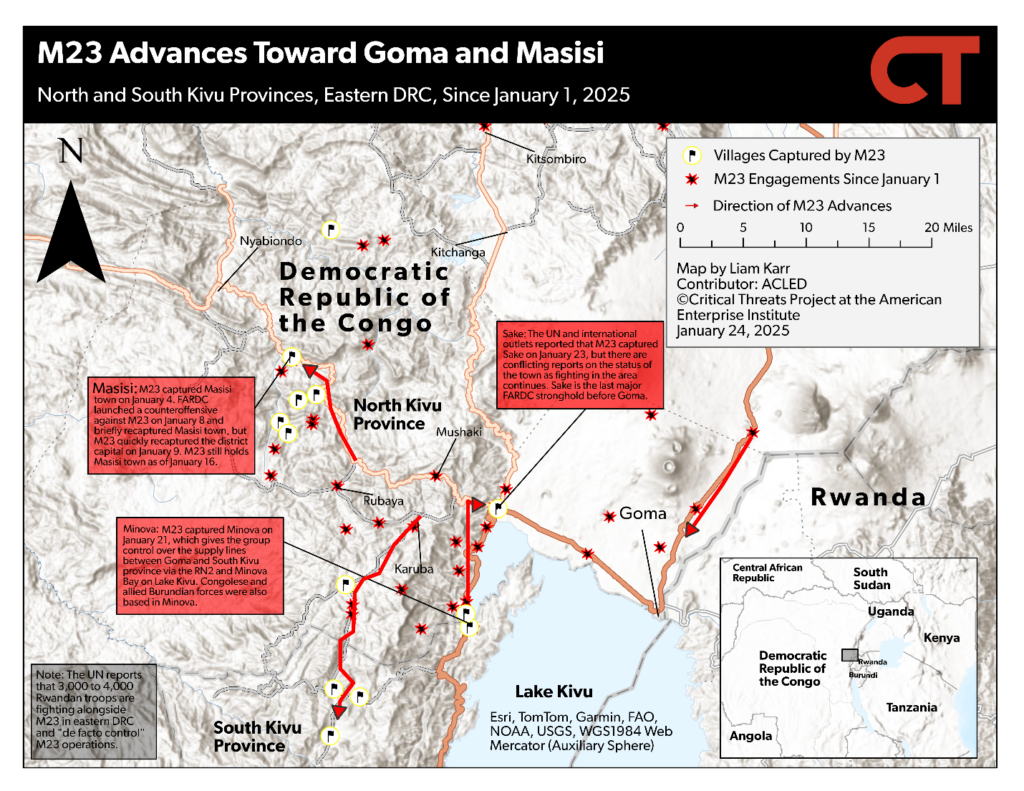
The scale of Burundi’s involvement substantially increased after M23-RDF’s advances in 2024 and peaked in late 2025. The FDNB deployed thousands of reinforcements in South Kivu as M23 and the RDF consolidated territorial gains in southern North Kivu in 2024 and helped defend Goma and Bukavu, the North and South Kivu provincial capitals, respectively.[8] The loss of both cities to M23-RDF in early 2025 forced the FDNB and FARDC to retreat southward and abandon weaponry, and the FDNB briefly withdrew some contingents from South Kivu.[9] The FDNB then redeployed troops to South Kivu and positioned forces in the Ruzizi Plain and Uvira town, with as many as 16 FDNB battalions, or up to 12,000 troops, across the province by April 2025.[10] The FDNB’s deployment grew throughout 2025 to at least 18,000 troops in December 2025, according to multiple security sources cited by French media in late 2025 and mid-2026.[11] Congolese intelligence sources and an internal report from the Congolese Ministry of the Interior and Security said that at least 29,000 FDNB troops in total had completed rotations to the DRC between August 2022 and December 2025.[12]
Figure 1. M23 Advances Toward Goma and Masisi (January 2025)
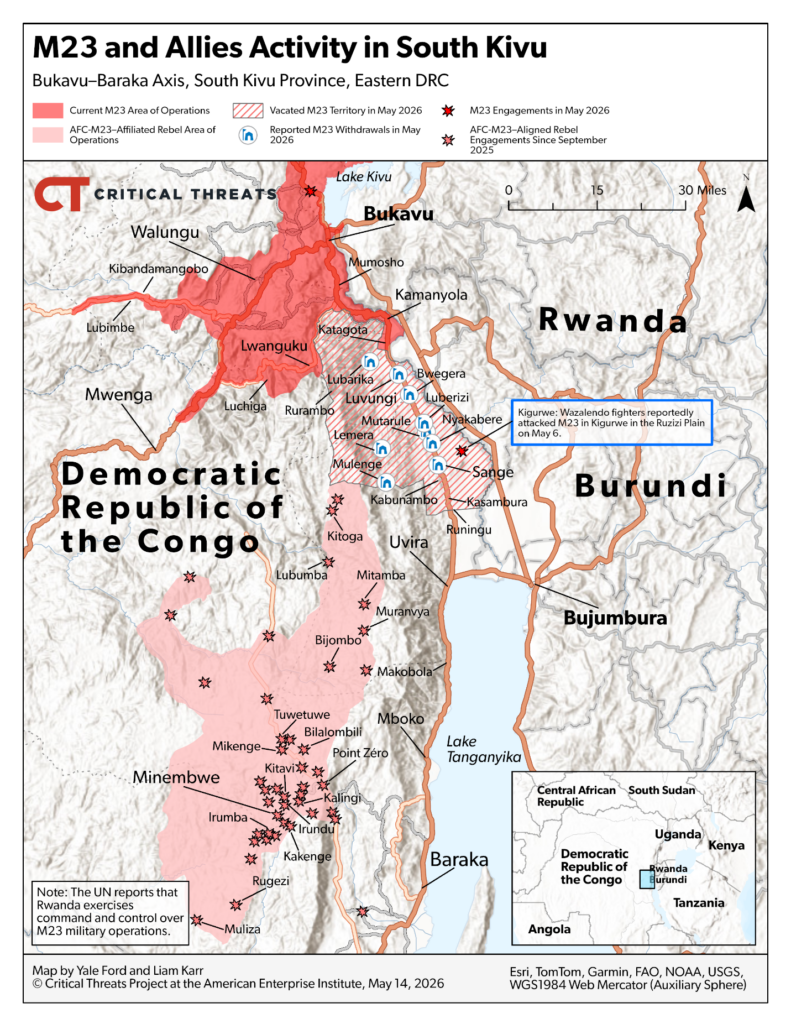
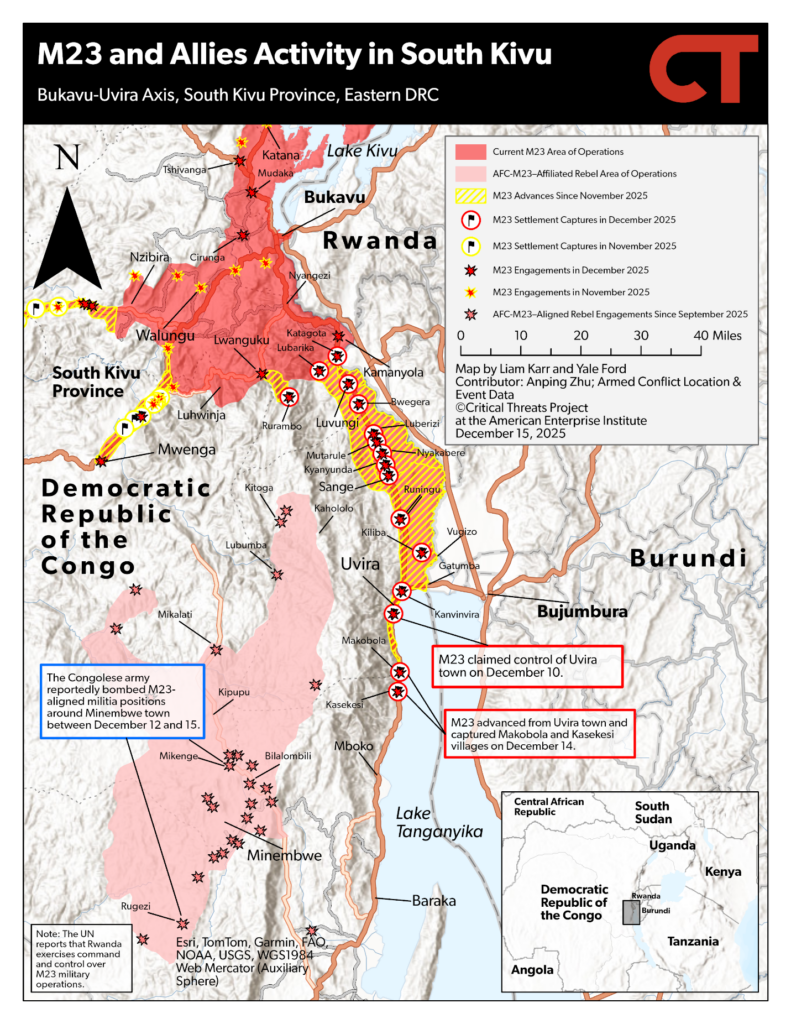
Burundi has withdrawn and redeployed forces to the DRC on a smaller scale since late 2025. M23-RDF forces captured Uvira town in a major offensive in early December, triggering a withdrawal of most FDNB contingents from multiple areas in South Kivu.[13] M23 announced a withdrawal from the town in December 2025 and fully withdrew from the Ruzizi Plain under US political and diplomatic pressure on the group and Rwanda in May 2026, however.[14] The FDNB began using military positions and supply points on the Burundian side of the Lake Tanganyika border to incrementally redeploy forces to South Kivu and Kalemie town in the DRC’s Tanganyika province in late December and then to Uvira, the Ruzizi Plain, and the adjacent midlands in late January.[15] Burundi has built up troops again in South Kivu since early 2026, although on a smaller scale, with more than 6,000 deployed as of mid-June 2026, according to several security sources cited by the French magazine Jeune Afrique.[16] The independent Burundian media outlet SOS Médias Burundi reported that DRC President Félix Tshisekedi and Burundian President Évariste Ndayishimiye agreed to reinforce troop deployments, expand drone capabilities, and strengthen military intelligence during Ndayishimiye’s state visit to Kinshasa, the Congolese capital, in late June 2026.[17] CTP recorded that Ndayishimiye has made at least 11 publicized trips to Kinshasa between July 2021 and August 2026.[18]
Figure 2. M23 and Allies Activity in South Kivu (May 2026)
Burundi’s heightened involvement against M23 and Rwanda in recent years is an inflection in the scale and focus of prior Burundian military deployments to the eastern DRC. Burundi periodically sought to hunt down Burundian armed opposition groups based in the DRC in the 2010s. The FDNB conducted multiple rounds of joint operations with the FARDC against the Forces nationales de libération (FNL), a Burundian rebel group and former political party, in South Kivu between late 2010 and mid-2014.[19] In the DRC in mid-2014, Burundian intelligence services coordinated military training for the Imbonerakure, civilians of the affiliated youth wing of Burundi’s ruling party, the Conseil National Pour la Défense de la Démocratie–Forces Pour la Défense de la Démocratie (CNDD-FDD), in FDNB uniforms.[20] FDNB members helped traffic arms and ammunition to Congolese militia groups that were fighting Burundian rebel groups in South Kivu in 2017.[21] The FDNB and Imbonerakure militants conducted a series of cross-border incursions and attacks targeting a group called the RED–Tabara in South Kivu between late 2018 and mid-2020.[22] RED is short for Résistance pour un État de Droit au Burundi, and the RED–Tabara is Tutsi-led group that formed in April 2011 after the 2010 elections in Burundi to oppose the Hutu-dominated government. The RED–Tabara later absorbed FDNB defectors who participated in a failed coup attempt in Burundi in May 2015.[23]
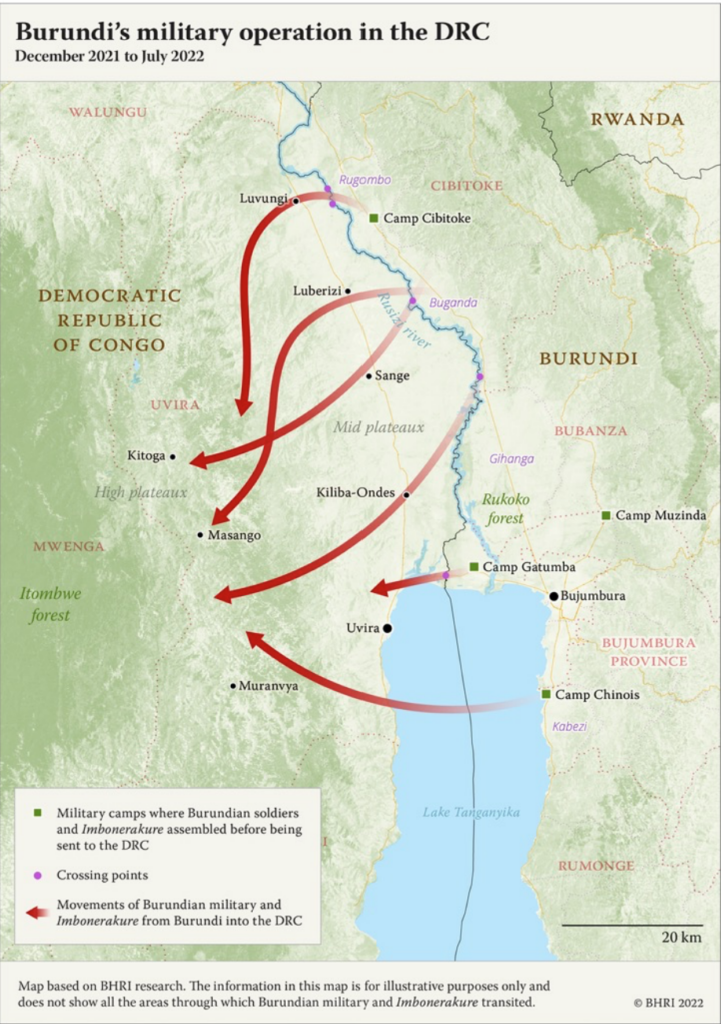
Burundi formalized and began expanding its military presence in the DRC in 2021. Burundi signed its first major bilateral military cooperation agreement with the DRC in early 2021. Ndayishimiye visited Kinshasa for his first significant meeting with Tshisekedi in July 2021, which likely led to the clandestine deployment of several hundred FDNB and more than a thousand Imbonerakure to South Kivu for operations against RED–Tabara and FNL in the South Kivu highlands beginning in December 2021 and continuing in another significant wave in August 2022.[24] The number of Burundian rebel groups with rear bases in South Kivu had increased after 2015, but RED–Tabara’s combat strength and capacity to pose a significant threat to Burundi had weakened.[25]
The operations were a mixed success but allowed the FDNB to expand its footprint in South Kivu. Burundi repeatedly denied that its troops were fighting in the DRC and disclosed little information about troop casualties.[26] The FDNB and Imbonerakure reportedly suffered heavy losses in the fighting in late 2021 and early 2022.[27] Some Burundians who participated in the operations told the Burundi Human Rights Initiative (BHRI) in July 2022 that the operations were “ill-prepared.”[28] UN Experts cited several sources in December 2022 who claimed that joint operations in South Kivu began prioritizing the FNL, after the FNL’s leader allegedly communicated with Alain-Guillaume Bunyoni, Burundi’s former prime minister whom the Burundian government had accused of plotting a coup in September 2022 and later arrested.[29] The FDNB continued to use the Imbonerakure, which further integrated with FDNB troops, during operations and increased collaboration with Congolese armed groups that acted as scouts and proxies in the fighting in late 2022.[30] The FDNB then expanded its area of operations in South Kivu and continued to deploy more troops in late 2022 and early 2023.[31]
Figure 3. Burundi’s Military Operation in the DRC
Burundi has emerged as a strategic military partner to the Congolese government and its allies, providing important manpower and playing a key operational role in the DRC coalition against M23 and Rwanda. Burundian forces serve as the backbone of the coalition’s defense, particularly in South Kivu. The FDNB has participated in every major engagement in North and South Kivu since at least late 2024, often fighting on the front lines alongside the FARDC and pro-Congolese government Wazalendo militia groups. DRC coalition forces, including elite FARDC units, have even retreated and left FDNB troops to fight M23 alone in some major battles.[32] The FDNB deployed 10 of its reported 16 battalions in the DRC in the Ruzizi Plain to anchor the defensive front against M23-RDF on the most important line of southward advance for most of 2025.[33] Two security sources told Jeune Afrique that “several thousand” additional FDNB troops deployed to the front line in the Ruzizi Plain after M23 launched the Uvira offensive.[34] SOS Médias Burundi reported in early May 2026 that Congolese authorities in Uvira have increasingly viewed the FDNB as a “solution,” partly because the Congolese government is unable to control unruly militia fighters that de facto control more territory than state forces in South Kivu.[35] The FDNB’s deployments to Baraka town in South Kivu, which is roughly 50 miles south of Uvira on the RN5 national highway, and to the DRC city of Kalemie in Tanganyika Province—roughly 235 miles further south and the gateway town to the DRC’s mineral-rich Katanga region—serve to block any further southward M23-RDF advance.
The Congolese government relies extensively on Burundian territory as an administrative hub. The Congolese government relocated the South Kivu provincial government to Uvira after the fall of Bukavu in early 2025.[36] Uvira is only 15 miles west of Bujumbura, Burundi’s biggest city and economic capital. FARDC-aligned military actors and Congolese officials, sometimes reportedly escorted by senior FDNB officers, often travel through Bujumbura to reach Uvira and government-controlled areas of South Kivu.[37] M23 claimed that the Congolese government relocated the FARDC’s 33rd Regional Command headquarters, which covers Maniema and South Kivu provinces, to Bujumbura in mid-2025.[38]
Pro-Congolese government forces began expanding their use of Burundi as a key rear base and staging ground in early 2025. SOS Médias Burundi reported in March 2025 that CNDD-FDD members, elements of the FDNB, and members of the Forces démocratiques de libération du Rwanda (FDLR), some of whose senior leaders helped perpetrate the 1994 Rwandan genocide, were training Imbonerakure militants to prepare to deploy and reinforce DRC coalition units engaged against M23 and RED–Tabara in the eastern DRC.[39] The M23-aligned investigative outlet Great Lakes Eye claimed in July 2025 that Romanian private military contractors (PMCs) employed by the Congolese government were training some FDNB units in Burundi.[40] The UN Special Rapporteur on Burundi reported in September 2025 that Imbonerakure militants were training in Burundi to deploy to the DRC.[41] SOS Médias Burundi reported in late March 2026 that several thousand Congolese, Burundian, and Rwandan fighters in the DRC coalition had been conducting large-scale military exercises simulating confrontation scenarios with M23 and Rwandan forces near Bujumbura under the supervision of Belgian trainers since early February.[42]
The DRC coalition is also using Bujumbura’s international airport as a logistics hub for military equipment and troops destined for the DRC. The coalition reportedly expanded its use of Bujumbura’s airport in mid-to-late 2025 to transport weaponry and deploy troops to South Kivu to support intensified joint ground and air operations against M23.[43] Great Lakes Eye claimed in a report in mid-August 2026 that three FARDC air force flights from Kinshasa landed at Bujumbura’s airport in early August with military equipment for forces in South Kivu.[44] The report claimed that Congolese aircraft had received authorization to land in Bujumbura for a three-month period from July through October.[45]
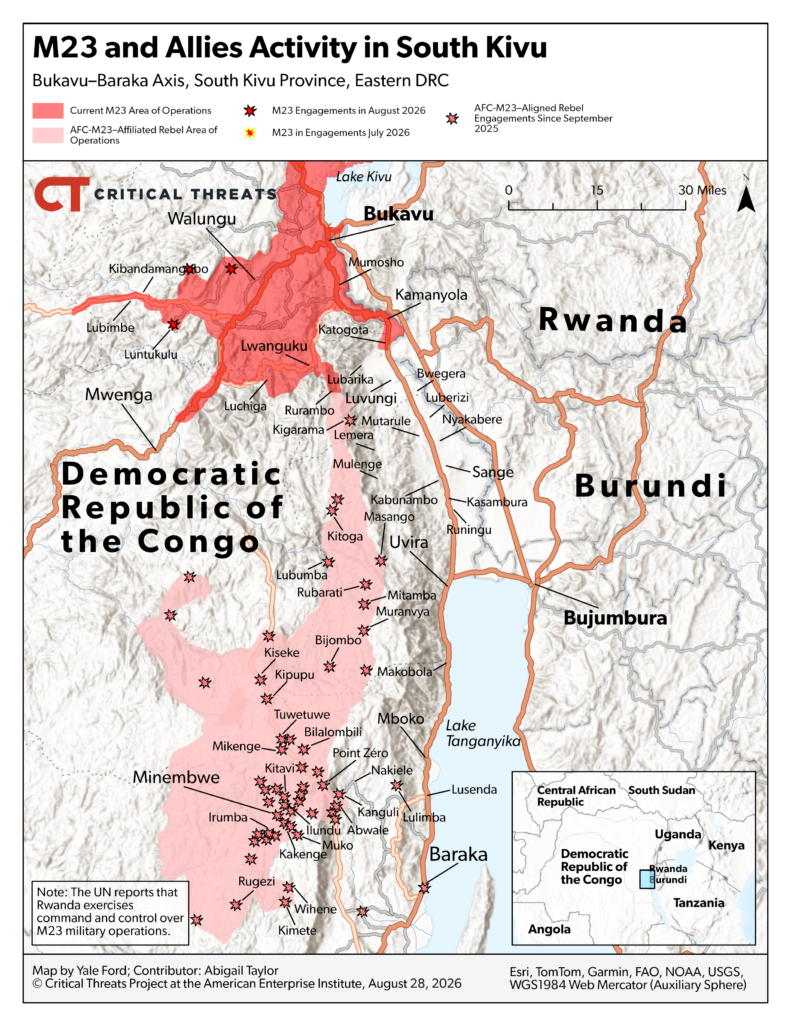
Burundi is also playing a key role in ongoing offensive operations against M23 and allied forces in in the Fizi highlands of South Kivu. The DRC coalition, alongside PMCs from a firm owned by Erik Prince, a US private security contractor with ties to US President Donald Trump’s administration, launched an offensive against allied Twirwaneho forces in the Alliance Fleuve Congo (AFC), M23’s political coalition, around Minembwe town, a majority Banyamulenge area in the highlands roughly 50 miles southwest of Uvira town, in late January 2026.[46] Pro-Congolese government forces and allied PMCs have since increased drone attacks on AFC forces and maintained pressure on Minembwe town since the offensive. The DRC coalition launched a second major offensive on Minembwe in late March, conducted regular air attacks on AFC positions in May, and conducted a third major offensive against AFC in June.[47] SOS Médias Burundi reported in mid-June 2026 that pro-Congolese government forces, likely Congolese government-employed PMCs, are sharing or supplying FDNB contingents with drones in the highlands.[48] AFC forces defeated DRC coalition forces and dislodged them from the highlands in a strategic setback in late June, however. CTP assessed that M23-RDF’s use of airpower and advanced technology likely gave AFC forces a decisive advantage.[49]
DRC coalition forces are conducting a fourth major offensive to try to take Minembwe, likely using Burundian territory as a rear base and key transit corridor into South Kivu. M23-aligned sources claimed that the coalition began deploying thousands of additional troops to Fizi district south of Minembwe in early August in advance of another planned offensive.[50] Prince reportedly met with senior Congolese and Burundian officials, including the FDNB chief of staff, in both Kinshasa and Bujumbura, before crossing over into Uvira in mid-August.[51] Pro-Congolese forces then launched an offensive against AFC fighters in the highlands on August 17.[52] M23 and Rwanda have responded to the latest offensive in the highlands with drone attacks and reportedly targeted high-ranking FDNB and FARDC officers and PMCs who were planning new military operations in the highlands.[53]
Figure 4. M23 and Allies Activity in South Kivu (August 2026)
M23 and Rwanda have taken direct military action to degrade and end Burundian military involvement in the eastern DRC. UN Experts cited sources close to M23 and Rwanda in May 2024 who said that the FDNB’s deployment to fight M23 and the RDF in North Kivu “further increased tensions” between Burundi and Rwanda and that the RDF explicitly targeted FDNB troops on the battlefield.[54] CTP and the UN Experts separately assessed that M23 and Rwanda likely conducted the Uvira offensive in part to knock the FDNB out of the war and disrupt the use of Burundian territory as a rear base supporting pro-government forces in South Kivu.[55] Ndayishimiye claimed in a speech to defense and security forces in mid-December 2025 that Rwanda was seeking to push Burundian forces out of the DRC to “remove obstacles to the conquest” of the DRC.[56]
M23 and Rwanda may have destroyed a major FDNB base in a sabotage operation in Bujumbura in late March 2026. An FDNB weapons depot at a military site known as Base Camp in the southern part of Bujumbura was destroyed in a massive explosion, affecting several districts in the city—some more than three miles away—for several hours on March 31.[57] The blast reportedly killed dozens of people.[58] The FDNB’s spokesperson claimed initially that a fire caused by a “serious electrical accident” in the ammunition storage room detonated explosive material.[59] The depot was not electrified, however.[60] Initial reports from Burundian and French outlets suggested that a “sophisticated drone attack” may have triggered the ignition.[61] Ndayishimiye claimed in mid-May that there was no evidence to suggest foul play, however.[62]
The base was an important logistics hub for the DRC coalition. CTP assessed when Base Camp blew up that its destruction could have affected the FDNB’s operations in the eastern DRC against M23.[63] SOS Médias Burundi cited a local witness who claimed that the base had received a shipment of military equipment from the Tanzanian army the week before the incident.[64] Great Lakes Eye had cited a source close to the FDNB who claimed that the FDNB received significant military shipments in Bujumbura between October and December 2025, including lethal equipment from a Chinese state-owned defense company and another shipment through ports in Kenya and Tanzania.[65]
Burundi–Rwanda Rivalry and Proxy Competition
Burundi and Rwanda have engaged in an escalating proxy competition in the eastern DRC interrupted by short-lived periods of improved bilateral relations for over a decade. Regional observers have described Burundi and Rwanda as “twin states” that share many common national characteristics. Burundi and Rwanda emerged from the 1990s with sharply divergent trajectories, however, although both remain low-income countries. Rwanda’s Tutsi-majority ruling political party, led by Rwandan President Paul Kagame, won a decisive military victory in the Rwandan civil war and established a stable, autocratic one-party state that abolished de jure ethnic identities in response to the 1994 Rwandan genocide against Rwanda’s Tutsi minority, prioritized rapid economic growth, and projected power beyond its borders. Burundi collapsed into a 12-year civil war between 1993 and 2005 that ended in a negotiated power-sharing settlement known as the Arusha Accords. The Hutu-dominated CNDD-FDD quickly began consolidating its authoritarian one-party rule by politically subverting the Arusha Accords, including ethnic power-sharing provisions designed to prevent Burundi’s Hutu majority from dominating national politics.[66] The CNDD-FDD’s gradual consolidation of Hutu-majority rule has strained relations with international donors and increased ethnic tension in Burundi.[67]
Bilateral relations were largely smooth until the first M23 insurgency in 2012 and the 2015 attempted coup in Burundi. Kagame and Ndayishimiye’s predecessor, Pierre Nkurunziza, were on good terms but reportedly fell out over the issue of M23, which Nkurunziza had opposed, in 2012 and 2013.[68] Nkurunziza separately began tightening his grip on power and setting conditions to serve an unconstitutional third term, which provoked a political crisis in Burundi and led to the coup attempt in May 2015.[69] The West criticized, isolated, and sanctioned Burundi after Nkurunziza’s security forces intensified repression on political opponents and civil society following the failed coup.[70] Relations with Rwanda have never fully recovered since Burundi subsequently closed its border with Rwanda and accused the Rwandan government of supporting the coup and refusing to extradite the roughly 20 alleged plotters who had fled to Rwanda.[71] Rwanda and Burundi continue to disagree on the process to remove these individuals from Rwanda, which has further elevated bilateral tensions.[72]
Burundi and Rwanda subsequently engaged in proxy conflict in which they backed each other’s political enemies and eastern DRC-based armed opposition factions. Rwanda reportedly armed and trained RED–Tabara in mid-to-late 2015 and early 2016.[73] Nkurunziza accused Rwanda of supporting RED–Tabara attacks on Burundian military positions in Burundi in late 2019.[74]
Burundi cultivated links with Rwandan rebel groups, including the FDLR and Rwanda National Congress (RNC). Rwanda began accusing Burundi of meeting with and hosting FDLR leaders around 2015.[75] UN Experts reported that Burundi began arming and facilitating recruitment for the P5 group, a coalition of Rwandan opposition groups aiming to topple the Rwandan government that included the RNC, which is led by defectors from Kagame’s government, in 2018.[76] Rwanda accused Burundi of working with Uganda to cement an alliance between the FDLR and the RNC in 2019.[77] Rwanda also began to view the Imbonerakure, which began to play a more militarized role in Burundi in 2015, as a security threat and claimed that the Imbonerakure, Burundian intelligence agents, and the RNC were embedded in armed groups in South Kivu.[78] Militants coming from Burundi conducted an attack in southwestern Rwanda in December 2018.[79] Rwandan and Congolese intelligence officials told the International Crisis Group (ICG) in late 2019 that Burundi was hosting FDLR splinter elements from South Kivu, who had then deployed to Burundi’s border with Rwanda.[80]
Relations improved for a brief period between 2020 and early 2023. Ndayishimiye initially rejected Kagame’s overture to improve relations in July 2020, a few weeks after Ndayishimiye took office in June.[81] Officials from both sides began meeting at several levels of government and the military in August 2020, however, which led to several detainee swaps.[82] In July 2021, Rwanda handed over 19 RED–Tabara combatants to Burundi in July 2021 who had crossed illegally into Rwanda in September 2020. Burundi then transferred 11 FNL combatants to Rwanda in October 2021. [83] The swaps helped lead Burundi to reopen its side of the border in October 2022.[84] Kagame went to Bujumbura for the first time since late 2011 in February 2023 for a regional summit and met privately with Ndayishimiye to discuss regional security challenges.[85] Rwanda encouraged RED–Tabara’s leader to surrender to Burundi in early 2023.[86] The issues of Rwanda’s alleged support for RED–Tabara and the alleged 2015 coup plotters remained unresolved, however.[87]
Increased regional competition and M23’s expanding territorial control began to reignite bilateral tensions. Kagame claimed that Rwanda had the right to intervene militarily in the DRC in a speech in February 2022, following military campaigns that Burundi and Uganda had launched against rebels from their countries based in the DRC in late 2021.[88] The FDNB had begun covertly deploying troops to the eastern DRC, and M23 launched attacks on the FARDC and began receiving substantial military support from the RDF in early to mid-2022, according to UN Experts.[89] Kagame reportedly declined Burundi’s request to intervene for the release of FDNB soldiers that M23 had captured in November 2023.[90]
Burundi cut ties with Rwanda in January 2024 amid a major diplomatic dispute, leading both sides to resume collaboration with proxy groups that has only heightened in subsequent years. Burundi alleged that Rwanda aided RED–Tabara after the group conducted a raid in western Burundi in late 2023. Rwanda denied the accusations, but Burundi eventually suspended diplomatic relations with Rwanda, deployed troops to its northern border with Rwanda, and unilaterally closed its border with Rwanda again in January 2024.[91] Ndayishimiye added to tensions in January 2024, when he called Kagame a “liar” in a speech and told young people to fight until the people of Rwanda put pressure on their government while in Kinshasa for Tshisekedi’s inauguration for a second term.[92] UN Experts reported that both sides then resumed collaboration with proxy armed groups in South Kivu, as Rwanda increased support to RED–Tabara, which also aligned with M23 and Twirwaneho, and Burundi reestablished ties with the FDLR and an FDLR splinter group in South Kivu in 2023 and 2024.[93]
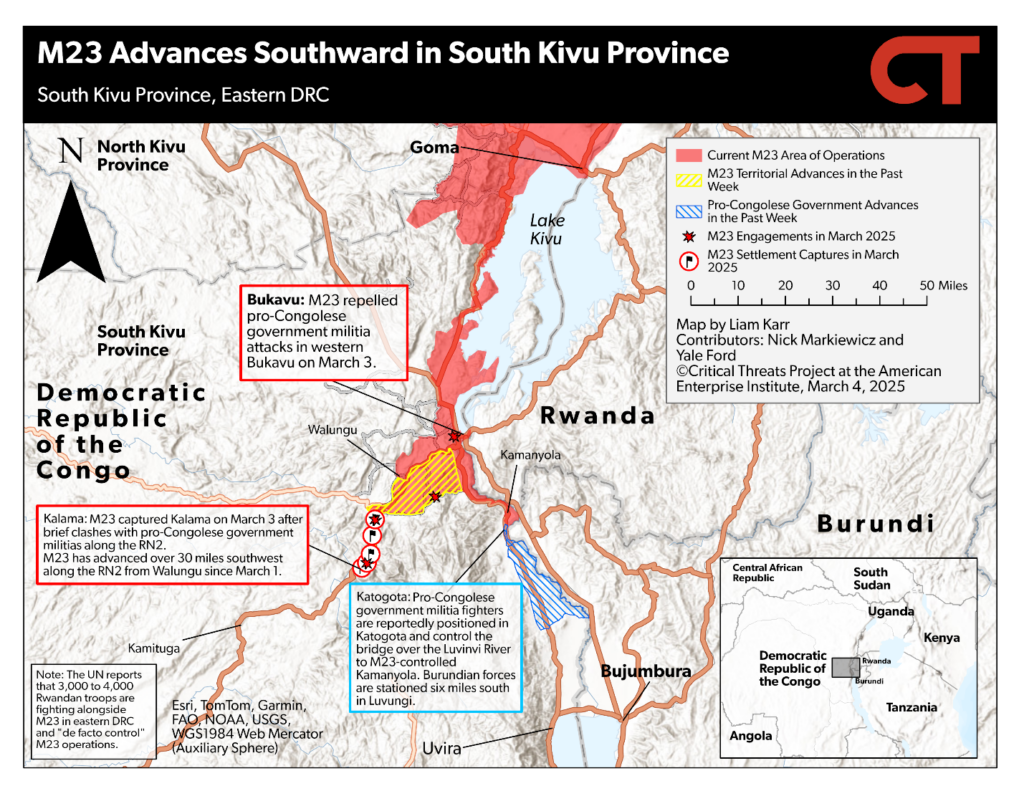
Another fragile détente in 2025 collapsed with the M23-RDF offensive on Uvira, which followed failed efforts to peacefully secure Burundi’s military withdrawal from the eastern DRC. M23 had halted its first southward advance just before the beginning of the Burundi-DRC border in South Kivu in February 2025, which CTP assessed was the result of Burundi and Rwanda likely reaching a deal to deconflict in the eastern DRC.[94] These efforts decreased the risk of a wider regional war between the two countries in the short term, despite multiple politically charged public statements that Ndayishimiye then made against Rwanda.[95] M23 officials unsuccessfully attempted to negotiate the withdrawal of Burundian troops from the DRC in two separate trips to Bujumbura in October and late November 2025, as Burundi was reinforcing the DRC coalition in South Kivu and M23 was setting conditions for the offensive on Uvira.[96] Burundian and Rwandan security officials then met on their shared border to deconflict twice in December after Uvira’s fall.[97]
Figure 6. M23 Advances Southward in South Kivu Province (March 2025)
Domestic Political Drivers of Burundi’s DRC Involvement
Burundian elites have strong self-serving incentives to leverage the war with M23 and Rwanda and related ethnic narratives for domestic political purposes and use ethnic narratives to frame regional insecurity in ways that mobilize and consolidate domestic support and justify crackdowns on regime and domestic opponents. Ethnic discrimination against minorities in Burundi has continued despite efforts after the civil war. A coalition of Burundian civil society groups said in a report to the UN in October 2025 that “some Tutsis” are “automatically perceived” as government opponents and face discrimination, exclusion from public office, surveillance, arbitrary arrest, intimidation, and forced exile.[98] The report said that Burundi formally prohibits ethnic discrimination, but ethnic identity and political loyalty remain closely linked in practice.[99] A Burundian diplomat for the African Union (AU) said on social media in May 2026 that ethnic discrimination against the Tutsi “remains a concern” in Burundi.[100]
Burundian elites weaponize ethnic narratives to help bolster support within and outside of the CNDD-FDD. Human Rights Watch (HRW) and 45 other nonprofit organizations assessed that “hate speech and inflammatory rhetoric” remained prevalent at the “highest level” of the Burundian government in a letter to the UN Human Rights Council in August 2025.[101] HRW reported separately that Imbonerakure members and local officials engaged in “discriminatory practices” against Tutsi in Burundi in 2025, targeting individuals suspected of “interacting” with M23 or Rwanda.[102] A Burundian journalist and director of a private radio station said in May 2025 that Ndayishimiye deliberately amplified “intercommunal tensions” and the perceived security threat from Rwanda to consolidate power ahead of the June 2025 elections.[103] Banyamulenge community members said that their families were “stigmatized” and they were “accused of being Tutsis” with ties to the “the president of Rwanda” and M23 during arrests of Banyamulenge and Congolese students in Bujumbura in February 2025.[104]
Ethnic extremists within Burundi and the Great Lakes region, including hardline factions within the CNDD-FDD, have linked the eastern DRC conflict to a broader conspiracy that the Tutsi want to install another Tutsi-led regime in Burundi as part of broader ambitions to establish regional hegemony. M23 and Rwanda’s expanding influence in the DRC is a factor that plays into this narrative and further fuels racism within these factions against the Tutsi and other ethnic minorities in Burundi.
The Burundian regime has exploited ethnic narratives and the M23-RDF threat more broadly to crack down on regime enemies and domestic opponents. Burundi’s intelligence service (SNR) made a series of arrests, including the secretary-general of Burundi’s football federation, in March 2025 over WhatsApp messages in which some allegedly expressed support for M23.[105] A young person told SOS Médias Burundi in February 2026 during systematic searches of personal belongings in Bujumbura by police officers and Imbonerakure militants, whom are drawn predominantly from Burundi’s Hutu majority, that authorities told him that they had stopped him because he “looked like an M23 rebel” and forced him to open his bag.[106] SNR agents arbitrarily arrested a Congolese aid worker and prominent blogger critical of the Congolese and Burundian governments for an “illegal parking” violation in Bujumbura in late May 2026.[107] Burundian authorities regularly warn the public about the risk of infiltration by destabilizing forces, without specifying who they are referring to.
These regional ethnic politics may be an important political factor influencing the FDNB’s operations around Minembwe or the FDNB’s justification and framing of those operations. Members of the Banyamulenge community, who are Congolese Rwandaphones that migrated to the DRC long ago, primarily inhabit Minembwe and have faced discrimination from Congolese authorities for decades. HRW cited a local Banyamulenge leader in May 2025 who said that Wazalendo fighters, who fight alongside the FDNB in joint operations, told Banyamulenge locals during attacks on several villages in March that they had come to “clean out” the Banyamulenge.[108] The FARDC, FDNB, and allied forces had reportedly encircled and cut off all lines of communication and movement for more than 170,000 people around Minembwe, which blocked humanitarian access and the entry of essential goods and caused basic commodity prices to soar, between May 2025 and June 2026 with temporary pauses in late 2025 and in April 2026.[109] The FDNB spokesperson told the BBC in November 2025 that “those [civilians] who have come from Minembwe are obviously working with the enemy, and they must not pass through.”[110] DRC coalition air attacks have struck livestock, radio stations, schools, health facilities, and churches during the several offensives conducted in early to mid-2026.[111] The deliberate starvation of civilians, including through targeting livestock and humanitarian aid, and indiscriminate targeting of civilian infrastructure are violations of international law.[112] HRW said in April 2026 after three specific attacks on civilians in March that it was “unclear” whether the attacks sought to strike military targets.[113]
These measures are part of a wider political strategy that Burundian elites use to blame external enemies for pressing domestic challenges.[114] Ndayishimiye has repeatedly condemned what he claims is a “small group” in Burundi that is allegedly “plundering billions” and seeking to undermine Burundi’s economy.[115] Ndayishimiye claimed that the cause of widespread fuel shortages in Burundi in 2023 was due to “traitors to the nation.”[116] ICG assessed in February 2026 that some Burundian political leaders may see “upping anti-Rwanda rhetoric” as a means to “rally support” and defuse growing dissatisfaction about the state of the country.[117] Ndayishimiye accused Burundian religious leaders of “politicizing poverty” and “behaving like the eyes of the colonizer” after they denounced the country’s mounting social and economic challenges in a statement in June 2026.[118] The United States and several international nonprofit organizations have cited endemic corruption as the primary reason driving Burundi’s poor business climate and public service provision, which made Burundi the poorest country in the world on a GDP per capita basis in 2025.[119]
Burundi’s Strategic Interests in the Eastern DRC
Burundi’s involvement in the eastern DRC is likely also driven by its interdependence with cross-border informal economic networks in the eastern DRC and Burundian elites’ close economic ties to the Congolese government. Burundi relies on the DRC as an important export market and transit corridor for formal and informal trade. The local economies in Uvira and Bujumbura are intertwined, similar to how Goma and Bukavu are linked to western Rwanda, as Burundi depends on the Uvira-Bujumbura land corridor to import fuel and to transport the 90 percent of its total exports to the DRC.[120] At least two decades of reporting from the UN Experts and regional media outlets has established that Burundi is a conduit for and beneficiary of resources extracted from South Kivu, principally gold and tropical hardwood.[121] Smuggled Congolese gold is often transported to Bujumbura, blended into official Burundian exports, or re-smuggled onward to the United Arab Emirates and other markets.[122] Burundian officials, border personnel, and military elements often engage from these activities.[123] Gold is now Burundi’s most valuable export product and a main source of currency, with official exports tripling in 2025.[124]
The Congolese government has given Burundian elites additional economic benefits for supporting the DRC militarily. Several sources told UN Experts in mid-2024 that Ndayishimiye received “economic incentives” from Tshisekedi, including personal benefits and likely broader financial support for the Burundian government, to deploy troops to the DRC.[125] Several regional reports have claimed that the Congolese government pays up to $5,000 per FDNB soldier deployed in the DRC to the Burundian government in addition to their regular salaries under the August 2023 deal.[126] UN Experts reported in mid-2024 that the DRC agreed to overlook illicit gold smuggling from South Kivu to Burundi facilitated by individuals linked to the CNDD-FDD party and FDNB in exchange for Burundi’s military support.[127] SOS Médias Burundi cited reports from Congolese security sources in June 2026 who claimed that the Congolese government offered Burundian officials additional “benefits related to gold mining” in South Kivu in exchange for increased military support to help the DRC regain control of areas controlled by Twirwaneho in the highlands.[128]
Burundi likely backs the Congolese government militarily because it views South Kivu as its sphere of influence and would face a heightened national security threat if M23 controlled the Burundi-DRC border, as the group did when Uvira fell. Burundi has historically viewed the eastern DRC as a strategically critical sphere of influence, though its direct intervention has fluctuated.[129] The BHRI assessed in July 2022 that FDNB and Imbonerakure fighters likely viewed the initial deployments to South Kivu in late 2021 and early 2022 as an opportunity to “loot crops from fields, steal cattle and carry out abuses against Congolese civilians.”[130] Burundian officials had said repeatedly that Uvira would not fall into the hands of M23. The CNDD-FDD’s secretary-general said in January 2026 that the FDNB’s disengagement from South Kivu in late 2025 after the fall of Uvira was not a real withdrawal because South Kivu was “practically our home” and Burundi could “return whenever we want.”[131]
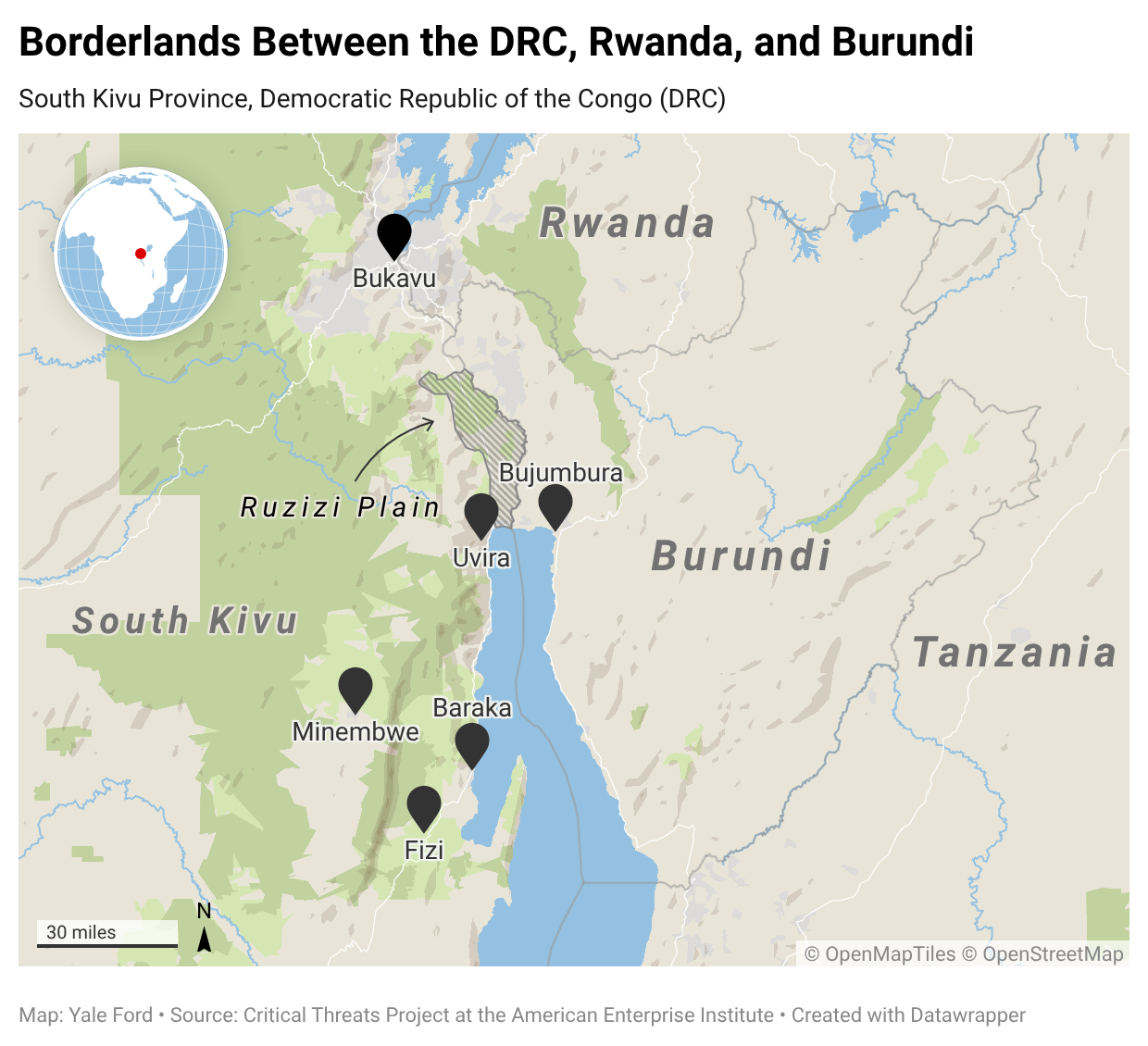
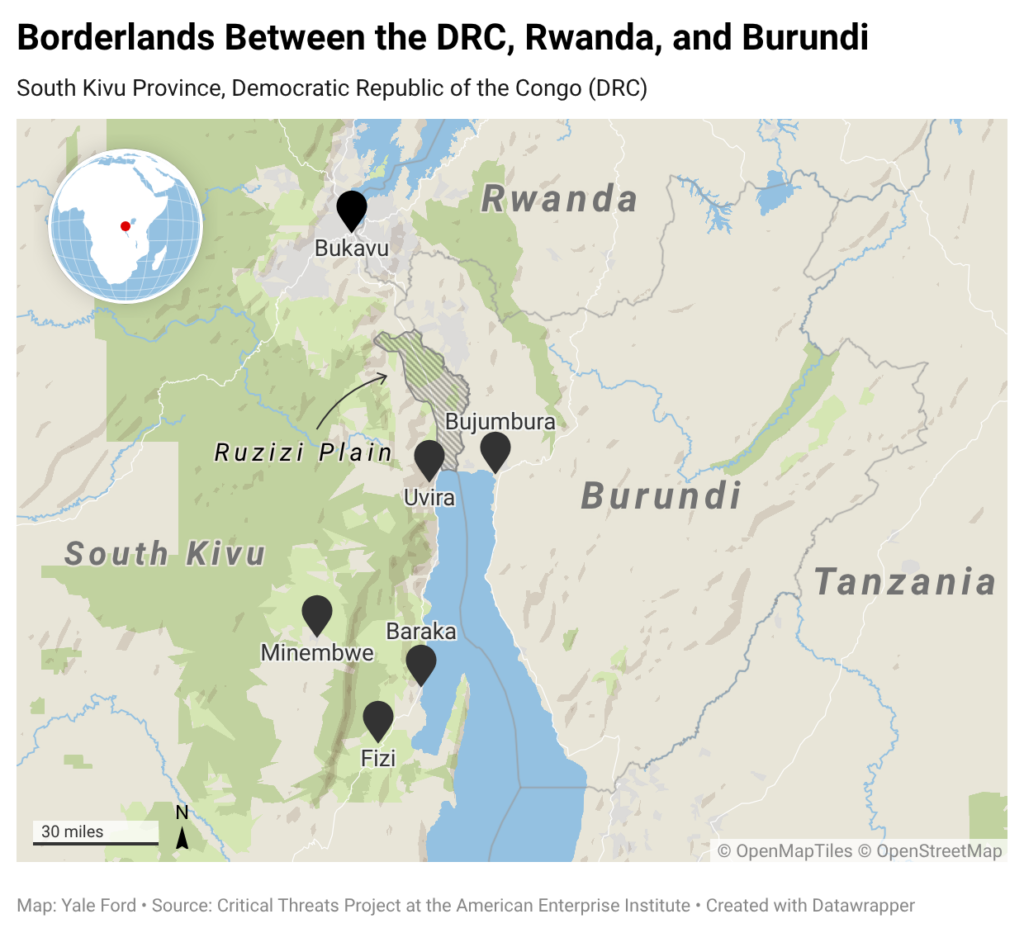
The geography and terrain of the DRC-Burundi borderlands places Burundi at an operational disadvantage against a potential attacker, such as M23, unless it holds a strong military position inside the eastern DRC. Burundi’s low strategic depth—the lack of geographic space between western Burundi and the front lines in South Kivu—means that a strictly defensive posture leaves Bujumbura vulnerable by risking infiltration across Burundi’s extremely porous border with the DRC and ceding the high ground above Uvira and Bujumbura to enemy forces. Uvira, which sits on the northern tip of Lake Tanganyika, is a pivotal regional crossroad that controls access to Bujumbura to the east, the Ruzizi Plain to the north, and mineral-rich areas in the DRC further south. The highlands around Minembwe town in Fizi district sit high above and within artillery range of Uvira and Bujumbura and provide access to the Mwenga highlands to the north, the lakeside lowlands toward Fizi and Baraka towns, and approaches to Bujumbura’s western flank through Uvira. Rwanda to the north and M23’s complete control of South Kivu would effectively encircle Burundi, cutting off nearly half of its land border and leaving Tanzania to the east as its only remaining open land route.
Figure 7. Borderlands Between the DRC, Rwanda, and Burundi
Burundian officials viewed the loss of its positions in the eastern DRC to M23 and Rwanda as a major national security threat. The extension of M23-controlled territory up to Burundi’s frontier and in the highlands threatens Burundi’s influence in South Kivu and the country’s political and economic center of gravity in Bujumbura. The UN Security Council noted that Burundi had viewed the fall of Uvira as a “red line.”[132] The Burundian foreign minister said that “what threatens Uvira also threatens Bujumbura” after M23 captured Uvira.[133] Burundi closed its border with the DRC for 10 weeks, and Burundi and Rwanda both reportedly deployed troops and heavy military equipment initially to the respective sides of their border as tensions rose during the Uvira offensive.[134] Ndayishimiye said in his mid-December 2025 speech to defense and security forces that Burundi had a “bad neighbor” to the north in Rwanda and accused Rwanda of harboring threats against Burundi.[135] Ndayishimiye said in May 2026 that Rwanda maintained “malicious intentions” toward Burundi and that Rwanda posed a threat as long as M23 and the RDF remained near Burundi’s border with the DRC.[136] Ndayishimiye has repeatedly justified Burundi’s intervention in the DRC by invoking a Kirundi proverb that urges people to help a neighbor put out a fire before it spreads to their own home.[137]
The War’s Domestic Costs and Political Implications for Burundi
The war could cause heightened instability in Burundi in the short to medium term, as it has exacerbated domestic economic challenges and is reportedly contributing to growing discontent and internal rifts within the FDNB, however. Burundi has taken substantial manpower losses. At least six senior FDNB officers, major and above, have almost certainly died fighting in the eastern DRC since November 2023, based on local reporting.[138] Some insider sources have estimated that several hundred, or even several thousand, Burundian soldiers have died fighting in the eastern DRC.[139] M23 claimed that it arrested hundreds of FDNB soldiers during the Uvira offensive.[140] DRC coalition forces reportedly took heavy losses when AFC forces repelled a major FARDC-FDNB offensive in the highlands in June and July 2026, with one report indicating that between 100 and 150 FDNB troops died in a single battle.[141] Most FDNB troops deployed to the eastern DRC have little air cover, fight in difficult conditions, and are new recruits trained for only a few months with inadequate equipment or logistics.[142]
Figure 8. Reported Burundian Army Officer Deaths in the DRC Since 2023
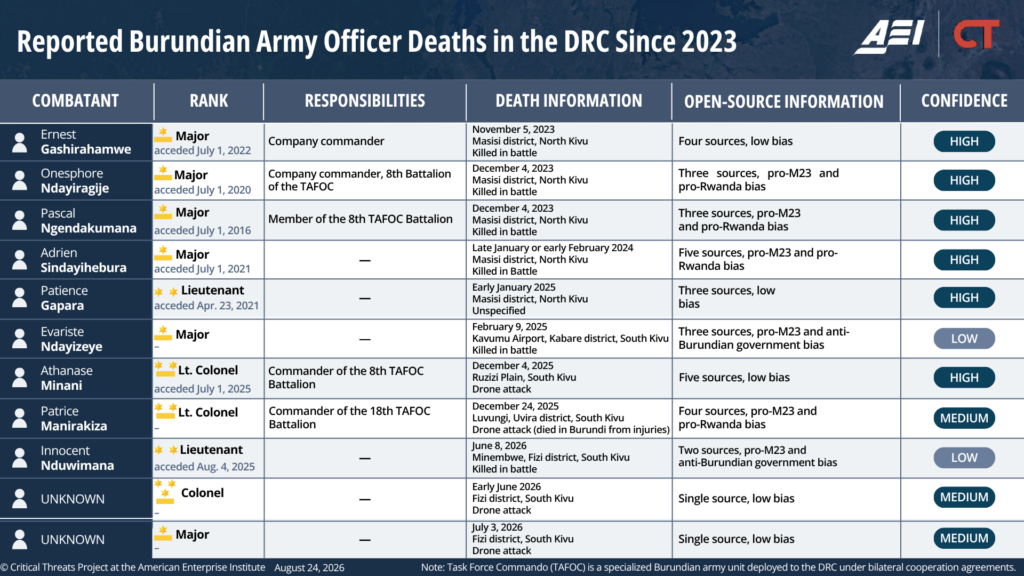
Note: All sourcing is from public online sources and available upon request.
Burundian authorities have tried to suppress information and conceal combat losses to the public, signaling that they see potential public backlash as a domestic vulnerability. The FDNB has never officially acknowledged a single named fatality from the war in the DRC or published a tally of their losses in the DRC. Ndayishimiye said that it was “normal” for Burundian soldiers to die in the DRC “because they signed up for it” in a speech in December 2023, however.[143] The FDNB has reportedly buried fallen soldiers in haste and “total secrecy” without informing their families and barred families from holding their own funerals or communicating with each other.[144] An FDNB officer had said that the government is preventing families from mourning their fallen to conceal Burundian combat losses in the DRC.[145] The Burundian government reportedly also does not compensate families of those who died fighting in the eastern DRC, unlike for families whose soldiers have died in the multinational peacekeeping missions in Somalia.[146]
Figure 9. Notable Burundian Army Losses in the DRC Since 2024
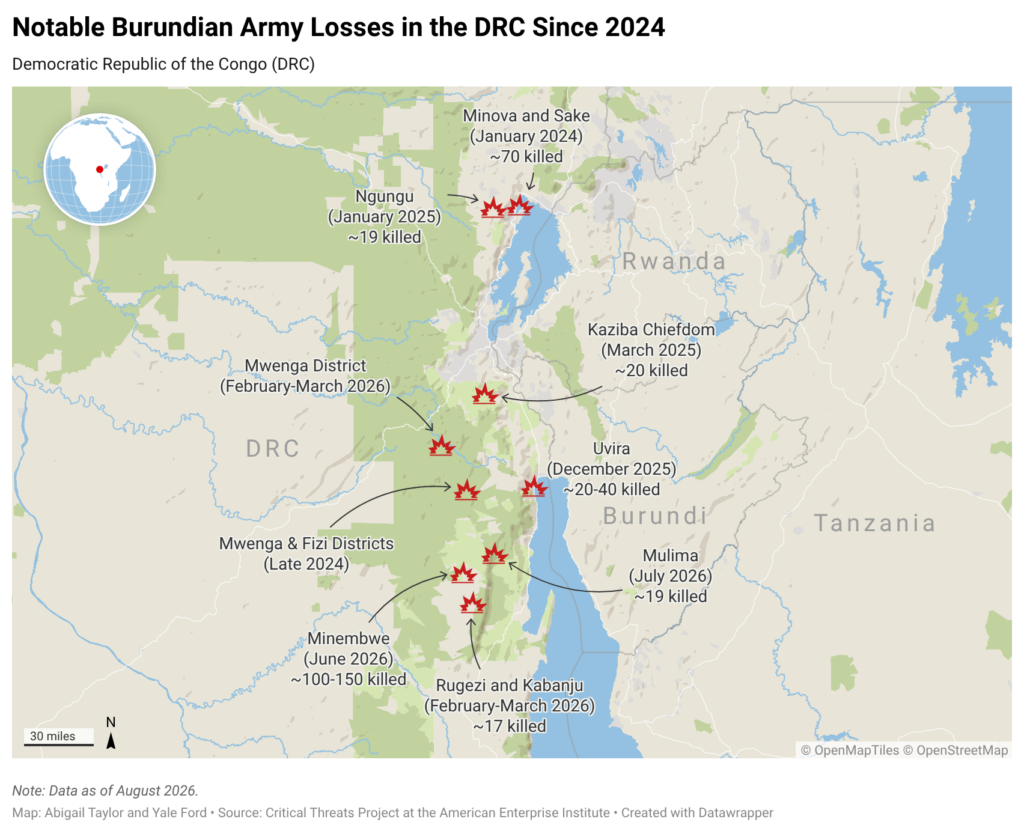
The war has placed additional strain on the Burundian economy. Burundi’s economy has deteriorated steadily since the coronavirus pandemic, as a series of internal and external shocks disrupted supply chains and trade and led to persistent inflation and chronic shortages of fuel, fertilizer, and basic goods. Foreign currency shortages have led to the growth of black-market currency markets and contributed to a decision to devalue the Burundian franc. Burundi has also relied more heavily on Tanzania to export its minerals and as its main source of fuel, fertilizer, and other goods, most of which are transported by road.
Burundi is now experiencing its most severe economic crisis since the civil war. The economy deteriorated even further in 2025 due to chronic fuel shortages, rising prices, and the war in the eastern DRC.[147] Political instability in Tanzania, driven by the Tanzanian government’s crackdown on protesters following rigged elections in November 2025, briefly disrupted trade flows to Burundi and worsened the situation.[148] A source within Burundi’s revenue collection agency told the French investigative outlet Africa Intelligence in December 2025 that a “few more days” of disruption would have led to “serious shortages” of food stocks that Burundi imports from Tanzania’s port in Dar es Salaam.[149] M23’s capture of Uvira put additional strain on the Burundian economy by severing the main informal supply routes for residents in Bujumbura and causing an influx of tens of thousands of refugees.[150]
The rising costs of the war are reportedly fueling growing discontent within the FDNB. The Burundian government arrested and imprisoned between 300 and 500 soldiers who had deserted their positions in North Kivu, reportedly due in part to unpaid compensation and poor service conditions, in November 2023.[151] Africa Intelligence reported in January 2025 that several senior FDNB officers were “unhappy” with inadequate equipment for their troops and persistent leaks of its tactical movements in the DRC, possibly facilitated by regime opponents.[152] The outlet reported separately that M23 was trying to exploit disagreements among top Burundian government and FDNB officials over continued military support to the DRC to pull Burundi into a nonaggression pact during M23’s October 2025 meeting with Ndayishimiye.[153] Great Lakes Eye claimed in an unverified report in December 2025 that Ndayishimiye clashed with several of his senior FDNB officials over the next course of action and continued measures to conceal the FDNB’s deployment in the DRC following the fall of Uvira in December 2025.[154] A Belgian journalist reported in July 2026 that “discontent” has been rising among Burundian elites amid the recent battlefield losses and that Ndayishimiye is “under increasing pressure to recall his troops” from the eastern DRC.[155]
The war could also further deepen ethnic tensions within Burundi’s security services. Deep divisions have existed within the FDNB since the failed 2015 coup, marked by mistrust between some CNDD-FDD-aligned members of the military and former members of the Tutsi-majority Burundian Armed Forces.[156] ICG assessed in June 2024 that the FDNB’s poor service conditions could exacerbate ethnic tensions between Hutu and Tutsi.[157] The Burundian government had created the Force de réserve et d’appui au développement (FRAD), a military reserve intended to provide civilian volunteers with paramilitary training and involve them in national development projects, in 2022.[158] The CNDD-FDD activated the force in 2026 and reportedly staffed its first training cohort with more than 200 veteran Imbonerakure members who had deployed to the DRC.[159] The FRAD effectively gives the party’s predominantly Hutu former-rebel leadership a parallel force that circumvents the constitutional provision that Burundi’s defense and security services cannot be more than 50 percent of any single ethnic group. SOS Médias Burundi reported in May 2026 that FRAD trainees conducting exercises in western Burundi were predominantly Hutu and added to concerns that the CNDD-FDD is potentially seeking to take control over the security sector outside the Arusha power-sharing framework ahead of the 2027 presidential election.[160]
Figure 10. Senior Military Leadership
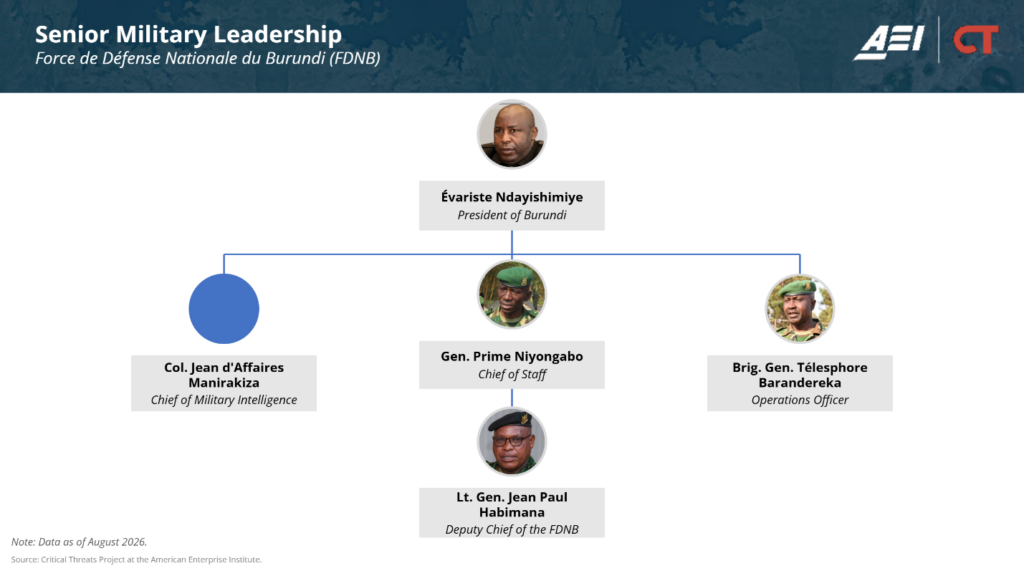
The FDNB’s involvement in the South Kivu highlands may be contributing to ethnic strife in Burundi. The report from the Burundian civil society groups to the UN in October 2025 said that Burundi’s military presence in areas inhabited by the Banyamulenge in the DRC and other ethnic groups is causing heightened ethnic tensions and contributing to regional proxy competition.[161] The civil society groups warned that Burundi’s military presence risks deepening ethnic polarization in Burundi and the DRC, reviving ethnic “stereotypes” that fueled past conflict, and undermining Burundi’s stability and efforts toward “social cohesion.”[162]
Ndayishimiye is jockeying to keep and consolidate power within the CNDD-FDD as domestic challenges exacerbated by the Burundian government’s war costs continue to mount. Ndayishimiye has included members of other CNDD-FDD factions in his government, but tensions within the party were high ahead of a party congress in January 2026.[163] Ndayishimiye has been at odds with Révérien Ndikuriyo, a power broker in the CNDD-FDD who secured a second five-year term for the party’s secretary-general at the January congress.[164] Ndikuriyo leads a rival faction within the party and was a hardline Nkurunziza loyalist, whose networks Ndayishimiye has sought to weaken since taking office.[165] Ndayishimiye had elevated several of his loyalists within the party after the June 2025 elections, raising concerns among some party members that Ndikuriyo was being sidelined, according to Africa Intelligence.[166]
Competing political structures within the CNDD-FDD have been vying for influence for several years. The Burundian presidency controls the FDNB, the SNR, the CNDD-FDD’s decision-making body, and the prosecution service, whereas the party secretariat controls the Imbonerakure and provincial party structures. Ndayishimiye and Ndikuriyo reportedly disagreed over the role of the Imbonerakure, with Ndayishimiye pushing to steer them toward community and development activities, while Ndikuriyo wanted to mobilize them politically and expand their security functions.[167] The government’s removal and subsequent arrest of Bunyoni, a prominent Nkurunziza-era figure accused of plotting the September 2022 coup, weakened a powerful network within the CNDD-FDD aligned with Ndikuriyo and strengthened Ndayishimiye’s position against internal rivals.[168]
The eastern DRC war and the handling of relations with Rwanda is likely a weak spot for Ndayishimiye. Ndikuriyo has maintained a hawkish approach to Rwanda since at least 2017.[169] The BHRI assessed in July 2022 that Ndayishimiye likely authorized the anti-RED–Tabara operations in the DRC in late 2022 to “placate hardliners” in his government, many of whom helped plan the operations and had “perceived him as weak.”[170] UN experts reported in mid-2024 that the failed détente between Burundi and Rwanda and subsequent escalation of bilateral tensions and proxy competition in mid-2023 was a “political failure and humiliation” for Ndayishimiye.[171] The report said that Ndikuriyo’s faction portrayed him as having been “outsmarted” by Rwanda and pressed him to distance himself from Rwanda.[172] Ndikuriyo’s strong influence over the Imbonerakure, which functions as a highly organized grassroots movement that often acts as a parallel security force, and his consistently hawkish views on security have allowed him to appear more decisive on state and security matters than Ndayishimiye at times.
Ndikuriyo’s recent reelection may have been part of a deal to delay a looming power struggle and keep the party united ahead of the 2027 elections. Africa Intelligence reported that Tanzanian and Congolese authorities stepped in to defuse internal tensions ahead of the January meeting.[173] The report said that Ndayishimiye made minor concessions to secure the backing of Ndikuriyo’s wing and preserve access to the CNDD-FDD’s economic networks for the 2027 campaign.[174] The party then named Ndayishimiye as their presidential candidate for a second seven-year term at the next party congress in April 2026.[175]
Ndayishimiye’s administration is now preparing for the upcoming election amid tense intraparty relations. Africa Intelligence reported that Ndayishimiye shifted focus to tackling the country’s economic crisis and poverty challenges, which have been sources of criticism from his electorate and several senior members within the CNDD-FDD since 2022, after the reconciliation with Ndikuriyo.[176] The outlet had reported in April 2024 that several CNDD-FDD lawmakers criticized Ndayishimiye for deflecting responsibility for his government’s shortcomings onto senior officials and for blaming people facing poverty for their own circumstances.[177] Ndayishimiye framed himself as the leader who rescued Burundi from crisis and pointed to certain state efforts to improve the economic crisis in an interview with the BBC in August 2026.[178] Africa Intelligence reported in August 2026 that an arrest campaign that has been ongoing since March 2026 may be part of an effort to purge the CNDD-FDD ahead of the elections, amid what party members described as an “atmosphere of mutual surveillance” in which members are encouraged to denounce anyone seen as “potentially subversive.”[179]
Burundi’s Role and Implications for the Washington Peace Accords
Burundi has also started to assume a larger political role in support of the Congolese government outside of formal peace processes. Ndayishimiye and Kenyan President William Ruto, who is a close ally of Rwanda, were the two African guarantors of the US-mediated Washington Peace Accords (WPA) signed in December 2025 between the DRC and Rwanda.[180] Rwanda has remained skeptical of Burundi’s assumption of leadership roles in the AU and other regional forums, arguing that Burundian involvement as a major state actor in the war undermines its credibility as a neutral mediator. Ndayishimiye assumed the rotating chairmanship of the AU, which is also a guarantor to the WPA and plays regional mediating role, in February 2026.[181] The Rwandan foreign minister said in in February 2026 that Rwanda was demanding that Ndayishimiye refrain from “gaining the upper hand” by interfering in negotiations led by the AU.[182]
Burundi often supports positions defended by the DRC in various regional forums. Burundi has been the most outspoken EAC member in opposing Rwanda’s role in eastern DRC. Ndayishimiye rebuked his own foreign minister after he criticized Qatar’s “negative role using its influence and cash to dissuade” the United States from taking action against Rwanda in a now-deleted post on social media in January 2026.[183] The Burundian foreign minister released a statement in early June 2026 saying that the WPA have “not been fully respected” after meeting with a Tshisekedi adviser in Bujumbura.[184]
Burundi is also now helping mediate internal Congolese politics. Ndayishimiye acted as a direct intermediary between Tshisekedi and the opposition and civil society members when he hosted them to discuss a potential Congolese national dialogue and various political challenges facing the DRC in early July 2026.[185] Tshisekedi then committed in mid-July to organize a national dialogue after the meeting and what CTP assessed was broader diplomatic pressure from his close regional allies.[186]
Figure 11. Key Players in the Congolese National Dialogue
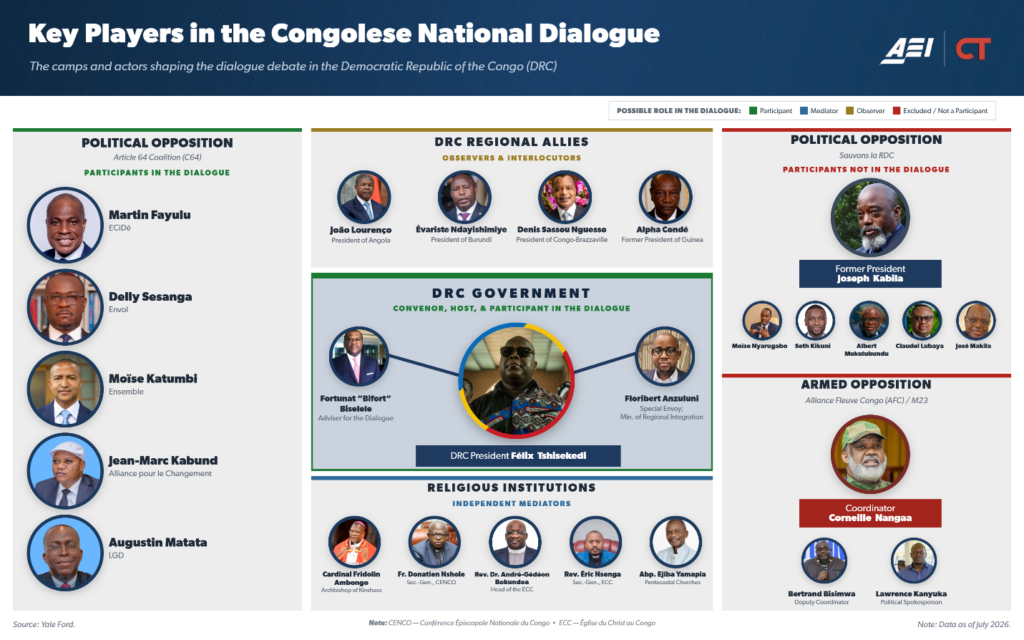
Burundi’s lack of inclusion in regional US-backed peace frameworks will almost certainly continue to undermine efforts to build trust, advance peace and regional stability, and facilitate a sustainable end to the war given Burundi’s major regional role. Burundi’s formal absence from the WPA has been one significant factor undermining the WPA. The WPA aims to de-escalate fighting in the eastern DRC as a first step to a more comprehensive political solution by instituting a ceasefire between Congolese and Rwandan state forces, addressing security and political concerns that each side maintains, and cutting both countries’ support for nonstate actors. The framework does not account for Burundi, however, as the third state party in the war that has its own incentives for its involvement and ties to local nonstate groups. Critical Burundian military support to the Congolese government has effectively provided the DRC with a loophole to continue supporting and escalating military operations against M23 and AFC backed by Rwanda amid limited international pressure on the Congolese government to pursue a political solution with M23. The continued escalation of military operations is contrary to ceasefire efforts and the WPA’s stated intents for a “negotiated, political resolution” over a military solution and to “prevent a renewal of hostilities that may harm the peace process.”[187] Rwanda has cited Burundi’s involvement and military support to the DRC coalition as a spoiler to de-escalation efforts and a residual security threat, thereby disincentivizing Rwanda from fully complying with the WPA and setting conditions for Rwanda to justify not complying with its security obligations under the WPA and withdraw its troops fully from the eastern DRC.
Burundi’s involvement also increases the risk of wider regional escalation that could derail US peace efforts. Burundi retains both the capability and the incentive to unilaterally undermine any DRC-Rwanda agreement that threatens its strategic interests in eastern DRC, particularly in South Kivu, while its own security concerns provide plausible deniability for maintaining a military presence in the DRC. These interests include much-needed direct economic support from the DRC, opportunities to sustain elite patronage networks, and political factors tied to the conflict that Ndayishimiye and the CNDD-FDD use to consolidate and compete for power domestically. The lack of a lasting peace agreement between the DRC and M23 additionally limits regional pressure or scrutiny on Burundi that would meaningfully constrain its military involvement or deter actions that could undermine de-escalation. Burundi’s deepening military and political alignment with the DRC outside of the WPA also contributes to mutual distrust between Burundi and Rwanda, given their history of strained relations and animosity.
Burundi’s military deployments in the DRC and other areas of interest to the United States may simultaneously enhance its standing with the United States, however. Burundi is reportedly in active discussions to join the UN-backed multinational force proposed to secure the Gaza Strip in the Middle East under a US-brokered postwar plan.[188] Burundi is also already part of the AU peacekeeping mission in Somalia, where the United States has sought to off-load more responsibility in the fight against al Qaeda affiliate al Shabaab to regional partners.
Growing defense cooperation with the United States creates a foundation for increased US investment and deeper economic cooperation, particularly regarding Burundi’s substantial underdeveloped reserves of nickel and rare earth elements. Burundi signed a contract with an American lobbying firm to help attract US investment two weeks after the WPA’s signing in December 2025.[189] The US State Department facilitated the signing of a three-year deal between US mining company KoBold Metals and the Burundian government to support the development of the country’s mining sector by digitizing Burundi’s geological data and using artificial intelligence to identify prospective mineral deposits in March 2026.[190] The State Department facilitated a separate deal between Australian company Lifezone Metals and Burundi to support the development of Burundi’s largest nickel deposit in March.[191] The Atlantic Council noted in April that Burundi holds strategic importance for the United States with its minerals and contributions to multinational peacekeeping and that its involvement in the eastern DRC war makes it “more relevant” to US policymakers who want to shape regional “security outcomes.”[192]