
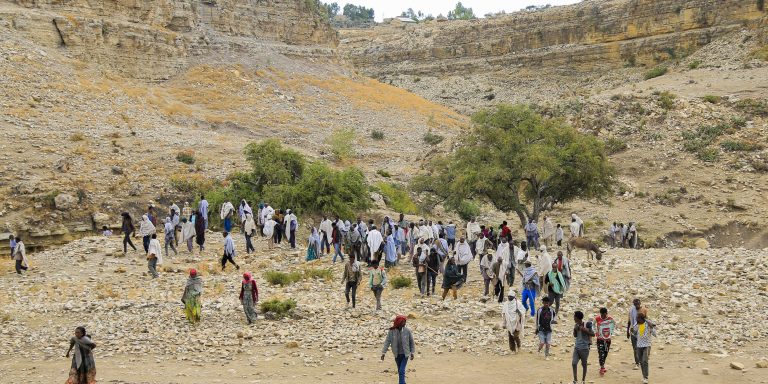
Tensions between the Ethiopian Government’s National Defense Force (ENDF) and the ethno-nationalist Tigray’s Liberation Front (TPLF) have escalated in recent weeks, with a drone strike on the city of Mekelle, nestled in the south-east of the Tigray region in Ethiopia, marking the most recent incident.
While the 2020-2022 Tigray War was disastrous in its own right, a new war between the ENDF and TPLF has the potential to draw in far more external actors than the last conflict.
While Ethiopian leader Abiy Ahmed continues to vie for access to the Red Sea, Saudi Arabia and Egypt have thrown their weight behind Eritrea, and by extension the TPLF, to counter those ambitions.
Should hostilities escalate between Ethiopia and Eritrea, and a proxy war ensue, the United States would be forced to navigate a delicate balancing act between competing Gulf partners — partners that it very much needs to collaborate closely with as war with Iran continues.
Tensions between the Ethiopian Government’s National Defense Force (ENDF) and the ethno-nationalist Tigray’s Liberation Front (TPLF) have been escalating in recent weeks, with a drone strike on the city of Mekelle, nestled in the south-east of the Tigray region in Ethiopia, marking the most recent incident. This development follows months-long clashes between the two forces, both of which have been massing forces along the border of the Tigray region and the rest of Ethiopia, risking a potential resumption of the brutal two-year Tigray war, which left 600,000 Ethiopians dead and millions more displaced between 2020 and 2022. The Pretoria Peace Agreement ended the conflict in 2022, and that fragile peace held until 2025, when renewed low-level clashes between the two forces flared again.
The Tigray war significantly reshaped Ethiopia’s political landscape and drew in a number of regional actors. Most notably, neighboring Eritrea played an instrumental role in the original conflict, helping to support the ENDF, as it also hoped to neutralize the threat of the TPLF on its border. However, the Pretoria Agreement omitted Eritrea, which kick-started tensions between Asmara and the Ethiopian federal government. Over the years, hostilities between the two countries have only increased, leading Eritrea to fully back the TPLF in its operations against Addis Ababa.
Last week represented another major escalation in the conflict. On August 3, senior Eritrean military members crossed over into Ethiopian territory touting Eritrean flags in the border town of Zalambesa. Three days later, a formal coalition between TPLF and the Eritrean government known as “Tsimdo” deployed tanks and heavy weaponry into the Tigray region. Subsequently, fighting erupted in Western Tigray as the ENDF and TPLF went back and forth over who initiated the clash.
Many experts assess that these simmering tensions could boil over into a renewed conflict between the TPLF and ENDF, effectively ending the Pretoria Agreement. While the 2020-2022 Tigray War was disastrous in its own right, a new war has the potential to draw in far more external actors than the last conflict. Since 2022, the TPLF has made many new alliances with different players in the region, taking advantage of a broader regional dissatisfaction with Ethiopian Prime Minister Abiy Ahmed, who alienated Eritrea, and has been in recent conflict with Egyptian President Abdel Fattah El-Sisi over the construction of the now-inaugurated Grand Ethiopian Renaissance Dam (GERD) on the Blue Nile as well as three additional planned hydropower dams. This waterway provides about 85 percent of Egypt’s fresh water, and concerns have grown in Egypt, as well as in Sudan, over how Ethiopia will manage downstream water releases.
Egypt has been a close ally of Eritrea since the latter gained independence from Ethiopia in 1993. Cairo has consistently supported Asmara in its disputes with Addis Ababa, particularly over Ethiopia’s efforts to regain access to the Red Sea after Eritrea’s secession left the country landlocked. Egypt has long been wary of Ethiopia’s Red Sea ambitions, also signing a security pact with Somalia in 2024 after Abiy attempted to make a play for the sea through Somali ports. Since 2025, Abiy has been escalating his rhetoric related to the Red Sea, asserting his country’s historic “right” to access it through Eritrea, only worsening hostilities between the two countries. For El-Sisi, limiting Ethiopia’s influence along the Red Sea is a strategic priority, as Cairo perceives Addis Ababa’s growing regional ambitions as a challenge to its own position and influence in the Horn of Africa.
Egypt shares this perspective on Ethiopia with its close ally across the Red Sea, Saudi Arabia. Riyadh would much prefer Eritrea retain access to the Red Sea, as it has a long-standing relationship with the country, dating back to support for its independence during the Cold War, and its backing of Eritrea’s dispute with Yemen in the 1990s over the Hanish Islands. Strategic competition in the Red Sea has always been a core national security priority for Saudi Arabia, but it has only been heightened by Washington’s war with Tehran and the subsequent closure of the Strait of Hormuz, which has raised the strategic and economic importance of the Red Sea. At the same time, renewed conflict with Yemen’s Iran-backed Houthis has threatened Riyadh’s hegemony over the waterway. Houthi forces have repeatedly attacked commercial vessels and threatened blockades, causing severe disruptions at the Bab el-Mandeb chokepoint between Yemen and the Horn of Africa. The Red Sea experiences substantial global tanker and container traffic. Disruption to this traffic has incurred higher insurance costs for shipping companies, supply-chain delays, and an overall direct impact on global trade.
Much of what drives conflict across the Red Sea is Saudi Arabia’s broader on-again, off-again rivalry with the United Arab Emirates, which stems from a clash of regional ambitions and often manifests in proxy conflict, such as those in Yemen and Sudan. Saudi Arabia, along with Egypt, backs Eritrea via strategic geopolitical alignment, diplomatic mediation, and infrastructure investments. On the other hand, the UAE has heavily invested in Ethiopia and provided military assistance to Addis Ababa to counter Saudi influence in Eritrea and challenge Saudi dominance of the Red Sea.
The UAE and Ethiopia are also tied together in their support for the Rapid Support Forces (RSF) in the Sudan Civil War. The UAE is the main backer of the RSF, which has been condemned by multiple human rights organizations for the genocidal conditions it created and perpetrated in its offensive in Darfur. The Sudanese Armed Forces (SAF) have also accused Ethiopia of allowing the RSF to establish bases and training camps in its western region, as well as acting as a facilitator for UAE weapons shipments.
Renewed conflict between Ethiopia and Tigray risks drawing in a range of actors already embedded in a complex web of strategic alignments across the Horn of Africa. Saudi Arabia, Egypt, Eritrea, the Somali Federal Government, and the Sudanese Armed Forces (SAF) would likely align with the TPLF against Addis Ababa, while the United Arab Emirates (UAE) and the Rapid Support Forces (RSF) would be more inclined to support the Ethiopian National Defense Force (ENDF). Cameron Hudson, analyst at the Center for Strategic and International Studies (CSIS), told France24 that a conflict here could escalate into “Africa’s second world war.”
The United States has long had a vested interest in deterring conflict in the Horn of Africa, as it seeks to manage tensions between two of its key regional partners, the United Arab Emirates and Saudi Arabia. In addition, the economic fallout from a conflict that has the potential to spill over into the Red Sea would be dire for the global economy, which has already been severely impacted by the Iran War. Washington has recently demonstrated a renewed interest in mitigating tensions in the Horn; in May, it lifted five-year-old sanctions on Eritrea to stabilize Red Sea shipping lanes and ease friction between Asmara and Addis Ababa. Should hostilities escalate between Ethiopia and Eritrea, and a proxy war ensue, the United States would be forced to navigate a delicate balancing act between competing Gulf partners — partners that it very much needs to collaborate closely with as war with Iran continues.