
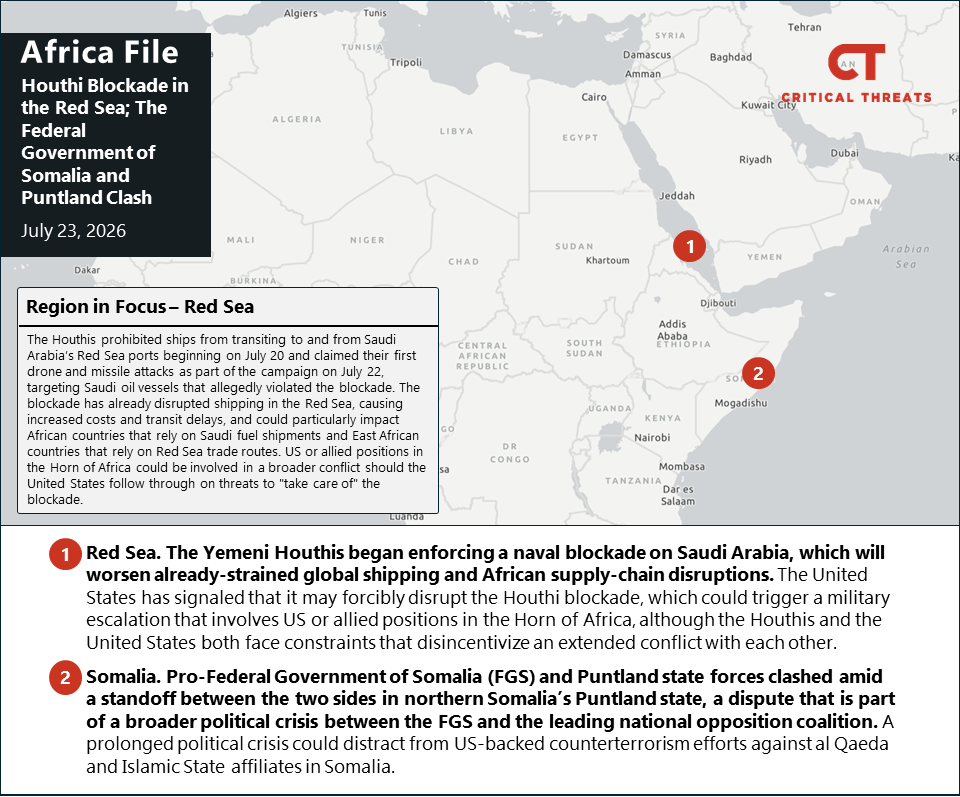
Key Takeaway:
Red Sea. The Yemeni Houthis began enforcing a naval blockade on Saudi Arabia, which will worsen already-strained global shipping and African supply-chain disruptions. The United States has signaled that it may forcibly disrupt the Houthi blockade, which could trigger a military escalation that involves US or allied positions in the Horn of Africa, although the Houthis and the United States both face constraints that disincentivize an extended conflict with each other.
Somalia. Pro-Federal Government of Somalia (FGS) and Puntland state forces clashed amid a standoff between the two sides in northern Somalia’s Puntland state, a dispute that is part of a broader political crisis between the FGS and the leading national opposition coalition. A prolonged political crisis could distract from US-backed counterterrorism efforts against al Qaeda and Islamic State affiliates in Somalia.
Figure 1. Africa File, July 23, 2026
Assessment:
Red Sea
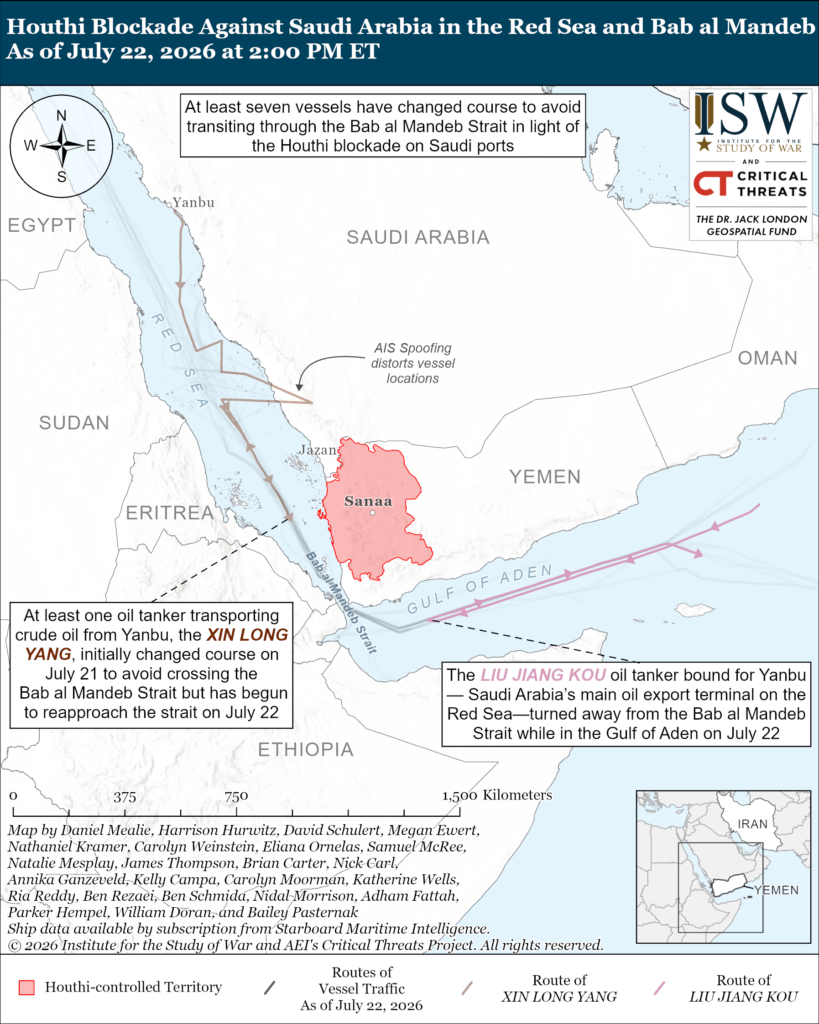
The Yemeni Houthis began enforcing a naval blockade on Saudi Arabia after the two sides attacked each other’s territory for the first time in years. The Houthis prohibited ships from transiting to and from Saudi Arabia’s Red Sea ports beginning on July 20, alleging that Saudi Arabia has conducted its own blockade on Yemen since 2015.[i] The Houthis have warned ships about the blockade via radio and by directly contacting shipping companies, several of which have rerouted ships around Africa to avoid the Red Sea.[ii] A US-led multinational maritime security organization reported on July 21 that the Houthis have positioned drones and missiles near the Bab el Mandeb Strait, which is the southern gateway to the Red Sea.[iii] The Houthis claimed their first drone and missile attacks as part of the campaign on July 22, targeting Saudi oil vessels that allegedly violated the blockade.[iv] The strikes targeted the vessels off the coast of the Saudi port city of Jizan, with one of the attacks reportedly occurring approximately 70 miles southwest of Jizan.[v] The attacks reportedly damaged at least one of the vessels.[vi]
Figure 2. Houthi Blockade Against Saudi Arabia in the Red Sea and Bab al Mandeb
Source: Critical Threats Project at the American Enterprise Institute; Institute for the Study of War.
The blockade comes after the two sides exchanged strikes in mid-July 2026 for the first time since they had agreed to a United Nations-brokered ceasefire in April 2022.[vii] Saudi Arabia conducted airstrikes on the airport in Sanaa, the Houthi-controlled Yemeni capital, on July 13 over concerns that Iran was going to transport matériel to the Houthis via an Islamic Revolutionary Guards Corps–affiliated airline that had just resumed flights to Yemen.[viii] The airstrikes hit the runway, preventing the target flight from landing in Sanaa.[ix] The Houthis retaliated by launching missiles at the Abha airport in Saudi Arabia, although Saudi Arabia said that it intercepted the missiles.[x]
The Houthi blockade also supports Iran, a key Houthi ally, amid continued hostilities between the United States and Iran, although the move is primarily tied to the Houthis’ own interests. The United States conducted its 12th straight night of airstrikes on Iran on July 22 after a ceasefire collapsed in late June 2026, while Iran has stepped up attacks on vessels in the Strait of Hormuz.[xi] US President Donald Trump threatened on July 22 that the United States would strike Iranian bridges and power plants if Iran continued attacking vessels in the Strait of Hormuz.[xii] Iranian Foreign Minister Abbas Araghchi pledged a “powerful and decisive response” to strikes on infrastructure.[xiii] Reuters reported on July 16 that Iran had requested that the Houthis prepare to blockade the entire Red Sea if the United States strikes Iranian power plants, although Houthi and Iranian regime–affiliated sources have repeatedly threatened to open a second front in the Red Sea since the beginning of the Iran war in April.[xiv] CTP has assessed that the current Houthi blockade supports Iran’s objectives but that the Houthis made the decision according to their own interests.[xv] These interests are related to the Saudi violation of the 2022 ceasefire and broader demands that Saudi Arabia end restrictions on Yemeni air and sea ports and pay other reparations and financial concessions.[xvi]
The blockade will worsen the preexisting strain on global shipping routes, increasing fuel shortages and disrupting supply chains to Africa. The Iran war has already severely hampered shipping in the Strait of Hormuz, through which over 20 percent of global oil and natural gas shipments typically transit.[xvii] The Iranian and US blockades on the Strait of Hormuz have caused the strait to partially or completely close at multiple points since late February 2026.[xviii] The World Bank projected in late April that global energy and fertilizer prices would rise by 24 and 31 percent, respectively, in 2026, based on the assumption that shipping through the Strait of Hormuz would rebound to near prewar levels by October.[xix] Shipping on the route has almost completely stopped, as Iran has attacked at least nine vessels around the Strait of Hormuz since July 6 amid intensified hostilities with the United States.[xx]
The Houthi blockade has already disrupted shipping in the Red Sea, causing increased costs and transit delays. The maritime trade firm Kpler reported that shipping through the Bab el Mandeb Strait declined by 34 percent on July 21 compared with July 20.[xxi] Multiple other firms have reported that several vessels have rerouted away from the Bab el Mandeb Strait to the Suez Canal to instead travel around Africa, including four vessels transporting almost 4 million barrels of fuel combined.[xxii] The Houthis’ disruption will further increase fuel shortages, as Saudi Arabia has managed to maintain a reduced level of oil exports during the Iran war by rerouting its shipments away from the Strait of Hormuz.[xxiii] Saudi Arabia has approximately quadrupled its oil exports from the port of Yanbu on the Saudi Red Sea coast via an east–west pipeline connected to Saudi oilfields near the Strait of Hormuz, leading Saudi oil exports to reach about over half of their pre–Iran war levels.[xxiv]
These disruptions will further strain the global economy. Alternative shipping routes between Asia and Europe that sail around the Cape of Good Hope can add multiple weeks and several million dollars per vessel more than the route through the Bab el Mandeb Strait.[xxv] The Houthis’ interdiction campaign in the Red Sea in 2023 increased global shipping costs by 30 percent and increased the Asia–Europe transit time by two weeks.[xxvi] Oil prices worldwide already reached $100 a barrel on July 23, with economists previously forecasting that oil would reach $150 a barrel if the Houthis closed the Bab el Mandeb Strait.[xxvii]
The blockade will severely impact African countries who rely on Saudi fuel shipments and trade through the Red Sea. Saudi Arabia was the fourth-largest fuel supplier to Africa as of 2023, according to the World Bank’s World Integrated Trade Solution platform.[xxviii] Saudi Arabia has supplied up to 75 percent of crude oil to Egypt and 25 percent to South Africa, which are the two largest economies in Africa.[xxix] Wider disruptions to Red Sea shipping would further harm East African economies. Several countries in East Africa, including Ethiopia and Sudan, rely on the Red Sea shipping routes for a large portion of their imports and exports.[xxx] Djibouti and Egypt earn billions of dollars each year from the shipping route, as the two countries collect revenue from their ports and, for Egypt, the Suez Canal.[xxxi] Fuel shortages could impact ongoing and simmering conflicts in the Horn of Africa, such as the Sudan civil war and tensions in northern Ethiopia. CTP previously assessed that the Ethiopian government likely decided against a military operation to crack down on the Tigray People’s Liberation Front partially due to fuel shortages related to the Iran war.[xxxii]
The United States has signaled that it may forcibly disrupt the Houthi blockade, which could lead to military escalation that involves the United States or US allies in the Horn of Africa. US President Donald Trump stated on July 21 that the United States would “take care of” a Houthi blockade, referencing previous US strikes against the Houthis.[xxxiii] The US military conducted an air campaign against the Houthis from March to May 2025 due to Houthi targeting of shipping in the Red Sea, leading to the Houthis agreeing to refrain from targeting US ships.[xxxiv] Saudi Arabia stated on July 20 that it would “take all necessary measures to protect its ships,” while the United Arab Emirates (UAE) declared its “solidarity” with any Saudi response.[xxxv]
The US base in Djibouti—Camp Lemonnier, which is less than 100 miles from the Yemeni coast—is key to Red Sea maritime security operations but is unlikely to be part of a direct conflict between the Houthis and the United States. The United States stations more than 4,000 personnel at Camp Lemonnier, along with drones nearby, for counterterrorism and maritime security initiatives in the Red Sea and Horn of Africa.[xxxvi] Camp Lemonnier has not been kinetically involved in past Houthi-US engagements, however, as Djibouti has prohibited the United States from launching operations against the Houthis from Djibouti.[xxxvii] Djibouti has additionally backed the Houthis’ support for the Palestinians, refusing to condemn the Houthis’ retaliatory campaign in the Red Sea.[xxxviii] CTP has previously assessed that these factors decrease Houthi incentives to target US assets in Djibouti, which has likely taken a conciliatory approach to the Houthis to avoid any military escalation that could jeopardize its status as a major international basing and shipping hub.[xxxix]
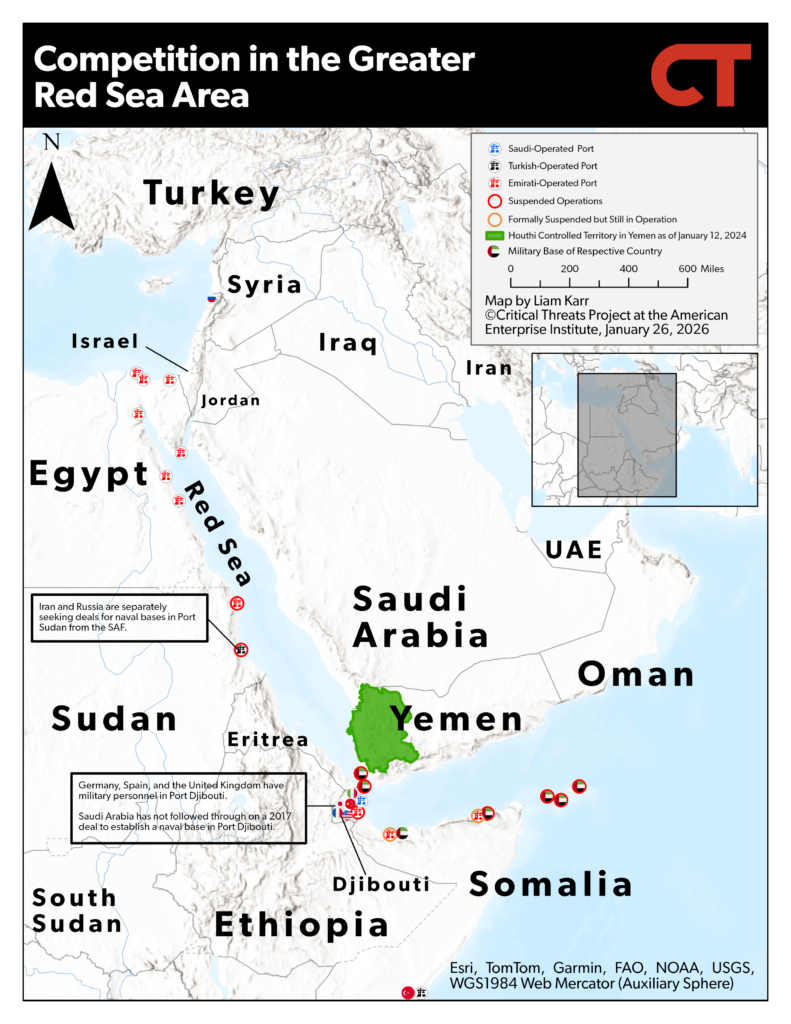
US allies, such as Israel or the UAE, could be involved in a direct conflict. The UAE has military bases near Emirati-managed ports in the semiautonomous Puntland state in northern Somalia and the neighboring de facto independent breakaway Somaliland region.[xl] The UAE previously used its presence in northern Somalia to support operations against the Houthis as part of its involvement in the Yemeni civil war.[xli]
Figure 3. Competition in the Greater Red Sea Area
Source: Liam Karr.
Israeli forces have reportedly deployed to Somaliland since Israel recognized Somaliland independence in December 2025. Agence France-Presse reported in March 2026 that Israeli forces were “already present” at the Emirati base in Berbera, Somaliland, and CNN reported in June 2026 that Israel had set up a covert military base in Somaliland.[xlii] The pro-Turkish investigative outlet Middle East Eye separately reported that Israel had deployed 50 troops to Somaliland, although Israel denounced the claim as “fake news.”[xliii] Houthi leader Abdul Malik al Houthi warned in December 2025 after Israel initially recognized Somaliland that any Israeli assets in Somaliland would be considered legitimate military targets.[xliv] The Houthis have already conducted strikes on Israel as part of the Iran war and announced a naval blockade on Israel in June 2026.[xlv]
The Houthis and the United States face constraints that disincentivize prolonged direct action against each other, however. The Houthis face resource constraints due to pressure on supply lines from Iran. CTP assessed in April 2026 that repeated combined force strikes on Bandar Abbas in Iran, which is the origin point of Iranian smuggling routes to the Houthis, and intensified Yemeni counter-smuggling operations had degraded Iran–Houthi supply chains.[xlvi] These inputs are critical for missiles and drones, even though the Houthis have focused on improving their domestic weapons production and diversifying their supply networks in recent years.[xlvii] Anonymous Houthi officials told the Associated Press in March 2026 that the group’s missile stockpiles were running low after sustaining operations since October 2023, although it still had large drone stockpiles.[xlviii]
Figure 4. Houthi Weapon Smuggling Routes
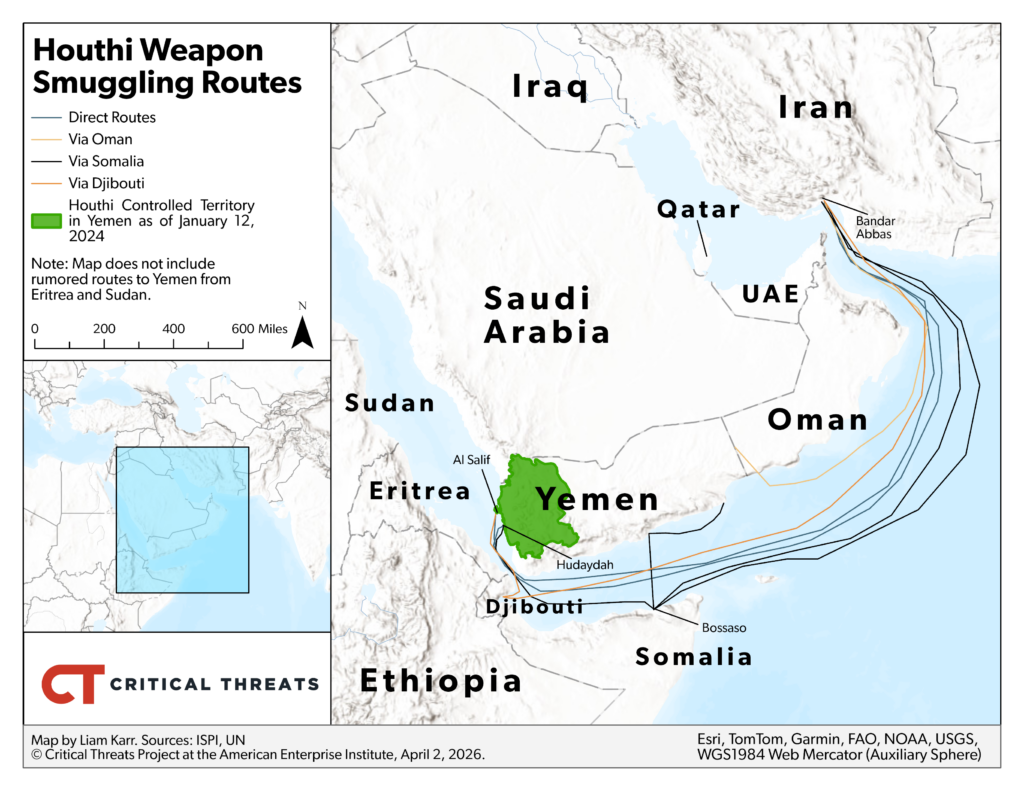
The Houthis have limited their blockades to Israel and Saudi Arabia thus far and have also only conducted limited strikes against both countries, likely to avoid provoking a significant regional response. CTP assessed in April 2026 that the Houthis were unlikely to pursue a major military confrontation with Saudi Arabia due to their economic relationship, although the blockade signals that the Saudi violation of the 2022 ceasefire in July may have changed the Houthis’ calculus.[xlix] Saudi Arabia pays billions of US dollars annually to cover Yemeni civil servant salary payments, including in some Houthi-controlled areas, as part of the 2022 UN-brokered ceasefire.[l] The cessation of these salary transfers would fuel unrest in Houthi-controlled areas, especially as military operations and sanctions have already severely weakened the Houthi economy in recent years.[li] CTP also assessed in April that the Houthis likely wanted to avoid another round of military retaliation, as Israeli and US airstrikes throughout 2024 and 2025 degraded Houthi military capabilities and caused more than $1 billion in damages.[lii]
The United States also faces resource constraints as the Iran war continues. The United States would presumably have to divert intelligence and military resources from its main effort in the Iran campaign and Strait of Hormuz to the Bab el Mandeb Strait and Yemen for any large-scale operations against the Houthis. US officials have noted that many of the intelligence resources and high-end US weapons systems that enabled the 2025 Yemen campaign, such as aircraft carriers and B-2 bombers, are already occupied in the Iran war.[liii] The US Navy had deployed approximately 40 percent of its battle-ready ships to support the Iran war effort by February 2026, and US officials noted in July 2026 that US warships and their crews had already been at sea for longer than usual given the Iran war.[liv] Another major conflict with the Houthis would also further stretch the already-strained US defense budget and interceptor and missile stockpiles, taking resources away from the Iran war and future needs in other theaters, such as the Indo-Pacific region.[lv]
Somalia
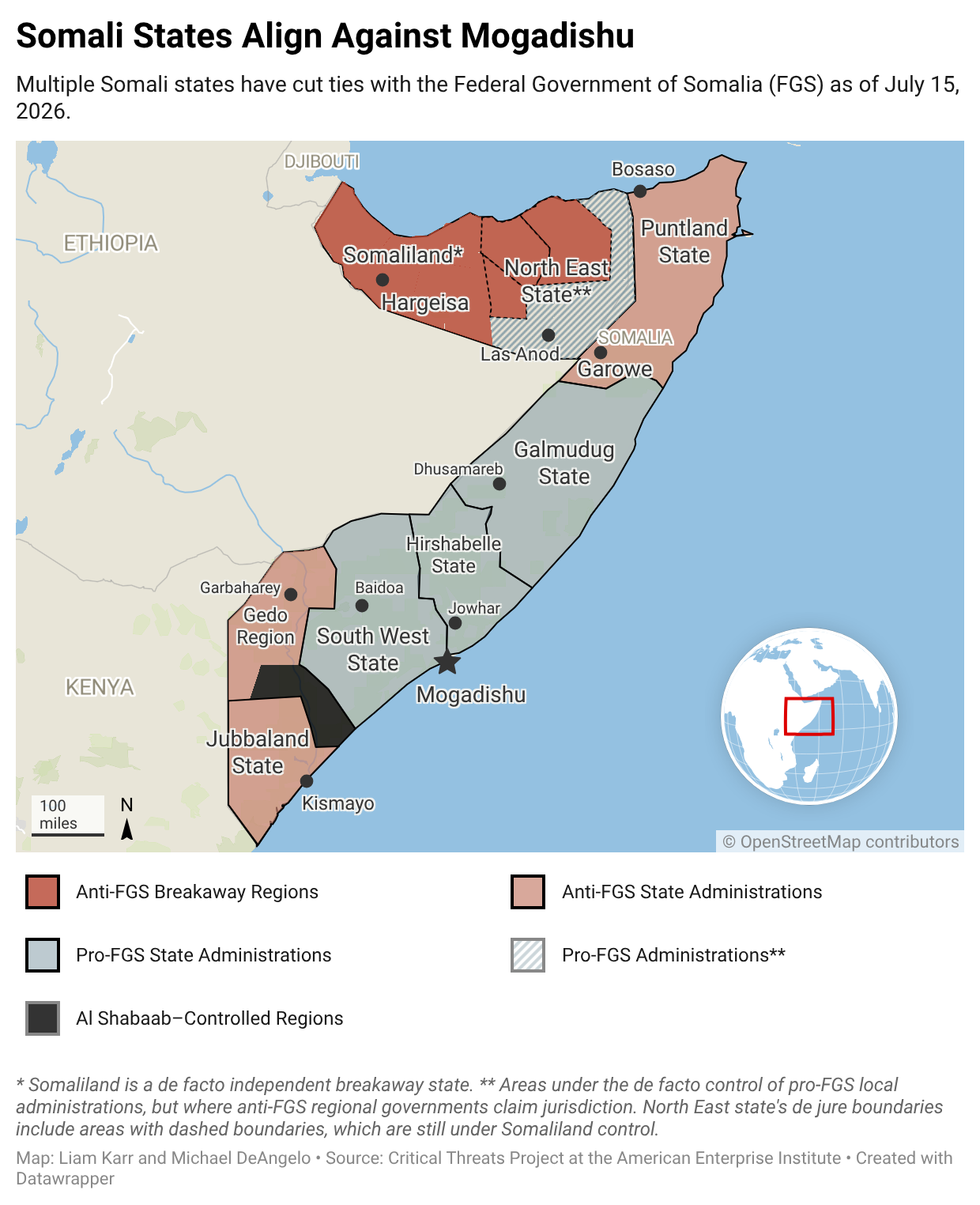
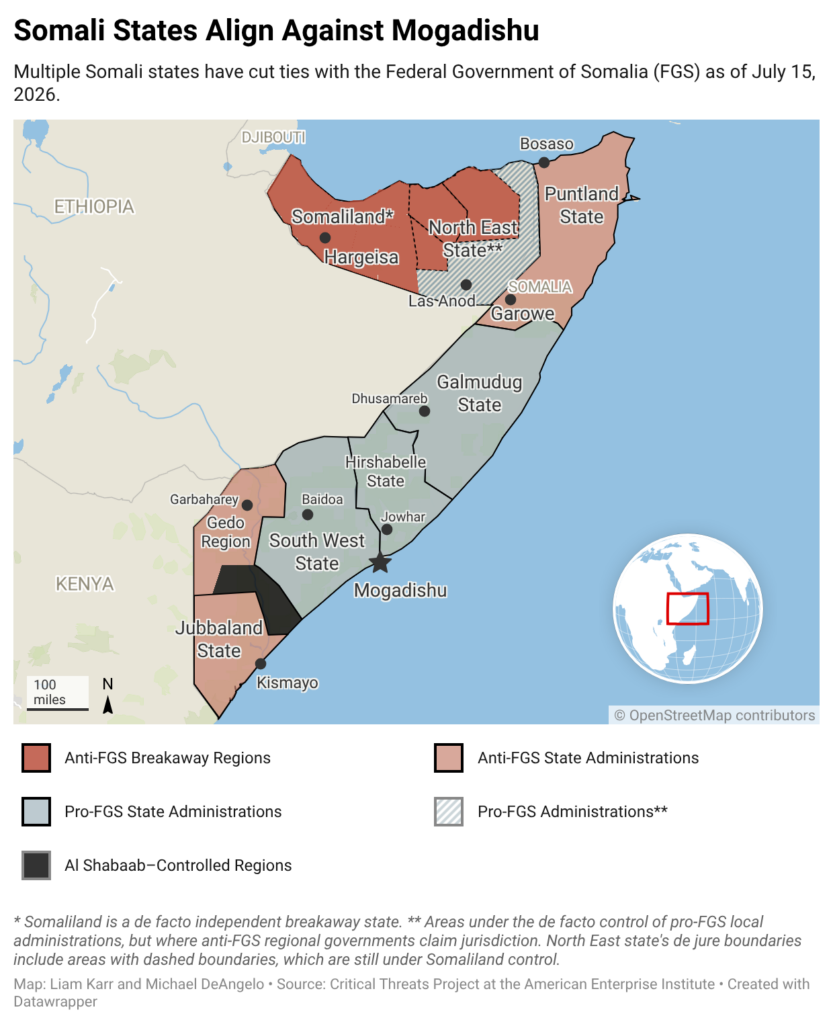
Pro-Federal Government of Somalia (FGS) and Puntland state forces clashed amid a standoff between the two sides in northern Somalia’s Puntland state. Puntland state forces stopped a Puntland Security Force (PSF) convoy traveling from Bosaso near Laag—located 20 miles south of Bosaso, Puntland’s main port city—on July 20, sparking the clash.[lvi] The PSF is a counterterrorism force nominally under the control of Puntland state forces, but it has increasingly aligned with the FGS amid disputes with the Puntland state government since 2021.[lvii] Puntland state forces routed the PSF convoy and reportedly forced the unit to withdraw to Bosaso, capturing several soldiers and seizing vehicles.[lviii] Puntland state’s counterterrorism bureau declared on July 21 that that the PSF convoy was affiliated with the FGS and that Puntland state forces had secured the area.[lix]
The Puntland state government has opposed the FGS’s attempt to co-opt security forces in Puntland, which initiated the standoff in mid-June 2026. The FGS had unilaterally appointed a new commander of the Somali National Army’s (SNA) 54th Division, which is based in Garowe, the capital of Puntland.[lx] The unilateral appointment led the Puntland state government to begin restricting SNA and other FGS-aligned force movements in Puntland on June 18.[lxi] The FGS and Puntland state government proceeded to mobilize forces, especially near a 54th Division base in Garowe.[lxii] Multiple Somali news outlets reported in mid-July that the new SNA commander and Puntland state government had reached at least a temporary agreement to de-escalate and halt mobilizations, reducing tensions around Garowe.[lxiii]
CTP previously assessed that the de-escalation around Garowe did not address the two sides’ broader dispute and the FGS’s campaign to co-opt security forces in Puntland, however.[lxiv] The Somali news outlet Garowe Online and a senior PSF official claimed in July 2026 that the FGS had officially subsumed the PSF into an SNA unit based in Bosaso.[lxv] The Puntland state government accused the FGS and third-party countries—likely referencing Turkey—of sponsoring armed groups to destabilize Puntland and gain access to additional maritime trade routes.[lxvi] Puntland previously stated on July 5 that it opposed Turkish maritime operations, including efforts to develop a naval base, off the coast of neighboring North East state, which Puntland claims as its own territory.[lxvii]
The clashes underscore the risk of further clashes between the FGS and members of the leading national opposition coalition amid stalled recent talks in their dispute over the FGS’s constitutional and electoral agenda. Puntland and other members of the Somali Future Council (SFC) opposition coalition have opposed the FGS’s extension of Somali President Hassan Sheikh Mohamud’s term and implementation of direct elections, which the SFC members believe will jeopardize the influence they currently have under the current clan-based quota and indirect election power-sharing system.[lxviii] The FGS has cracked down on the opposition and sought to co-opt uncooperative federal member states, leading to clashes between FGS and opposition forces in Puntland, South West state, and Mogadishu, the Somali capital.[lxix] Multiple rounds of internationally mediated talks on behalf of the United States, Turkey, and the European Union have not yet yielded a resolution.[lxx] The most recent talks on July 20 reportedly stalled due to SFC’s desire to establish state election commission separate from the FGS-influenced national commission to oversee state elections.[lxxi] Another sticking point was reportedly the SFC’s objections to FGS intervention in Galmudug and South West states.[lxxii]
Figure 5. Somali States Align Against Mogadishu
A prolonged election dispute could distract from US-backed counterterrorism efforts against al Qaeda and Islamic State affiliates in Somalia. The Puntland forces involved in the recent clash have played a key role in counterterrorism campaigns against al Shabaab and the ongoing Operation Hilaac against the Islamic State Somalia Province (ISS).[lxxiii] The Somali news outlet Kaab TV reported that some of the forces redeployed from the Cal Miskaad mountain range, which is the epicenter of Puntland counterterrorism efforts against ISS, to the Bosaso area before the clash.[lxxiv] ISS may have already exploited a reduction in counterterrorism pressure in late 2025 and early 2026 to reconstitute, leading to a resurgence in activity in March.[lxxv] Puntland forces have sustained intensified operations against ISS since mid-April in response to the group’s resurgence.[lxxvi]
Al Shabaab has also exploited the security vacuums created by past political disputes and could benefit from upcoming reductions in international support to the FGS. Al Shabaab took advantage of the violent dispute over delayed federal presidential elections from 2021 to 2022 to consolidate control of areas of southern Somalia surrounding Mogadishu and increase suicide bombings in the Somali capital.[lxxvii] The United States also announced in early July 2026 that it would not renew its financial support for United Nations office in Somalia in 2027, cutting a vital source of logistics support to the African Union Support and Stabilization Mission in Somalia (AUSSOM).[lxxviii] AUSSOM plays a key frontline role in combating al Shabaab in southern and south-central Somalia, including on key roads linked to Mogadishu.[lxxix] AUSSOM is already struggling with funding shortfalls, and the African Union has said that the funding cuts will have “significant implications” on AUSSOM’s ability to continue operating.[lxxx]