
Key Takeaway:
Somalia. Federal Government of Somalia (FGS) and Puntland state forces have been engaged in a standoff since mid-June 2026, which is part of a broader dispute between the FGS and the leading national opposition coalition. The FGS has tried to counter opposition to its constitutional and electoral agenda and consolidate control of Federal Member States.
Federal Government of Somalia (FGS) and Puntland state forces have been engaged in a standoff in recent weeks over the FGS’s attempt to exert control over security forces in northern Somalia’s Puntland state. The FGS sparked the standoff in mid-June 2026 when it appointed a new commander of Somali National Army’s (SNA) 54th Division, which is based in Garowe, the capital of Puntland state.[1] Multiple Somali news outlets reported that the appointment marked the first time under the current federal framework that the FGS had unilaterally appointed an SNA divisional commander in Puntland.[2] The Puntland state government responded on June 18 by rejecting the appointment and ordering its security forces to restrict SNA and other FGS-aligned force movements in Puntland.[3]
The recent tensions are a symptom of a broader political dispute between the FGS and Puntland over the FGS’s constitutional and electoral reforms, which Puntland views as threatening its influence and autonomy within Somalia’s federal system. Puntland has been semiautonomous for three decades but has seen itself as part of a Somali federal framework.[4] Puntland cut ties with the FGS and declared that it would act as an “independent government” in March 2024, however, after the FGS had approved constitutional reforms that gave the Somali president more power and instituted direct presidential elections.[5] Puntland views the FGS’s agenda as a unilateral centralization of power, particularly with the direct election system, which Puntland believes will not protect its interests as the current clan-based quota and indirect election system does through power-sharing.[6]
Ties between the FGS and Puntland have continued to deteriorate as the FGS has implemented its constitutional and electoral agenda. Puntland denounced the FGS’s extension of Somali President Hassan Sheikh Mohamud’s term in March 2026 as an “illegal” power grab.[7] Puntland State President Said Abdullahi Deni stated in April 2026 that Puntland had foiled existential plots against the state government amid reports that the FGS was mobilizing allied forces due to Puntland’s opposition.[8] The Puntland state government stated on June 18 that it would continue operating separately from the FGS until the two sides reached a comprehensive settlement to their broader political dispute.[9]
The FGS has recruited, mobilized, and reportedly supplied forces in and around Puntland as part of the recent standoff. The FGS has stationed the 54th Division commander in Las Anod, the capital of neighboring North East state, in preparation for his deployment to Garowe.[10] The Somali prime minister and interior minister separately stated in early July that the FGS would recruit prospective SNA soldiers in Puntland despite opposition from the state government.[11] Puntland state forces reportedly arrested two SNA officers linked to the 54th Division for recruitment in early July.[12] The Somali news outlet Garowe Online reported that it had obtained a June 25 letter from an SNA supply unit detailing weapons transfers to recently recruited FGS forces in Puntland, which the state government has accused the FGS of doing to destabilize the state.[13]
The FGS has furthered its mobilization and mobilization efforts by reportedly establishing a new SNA unit in Puntland. Garowe Online reported in late June that the FGS had ordered the creation of a new SNA unit based in Bosaso, the main port city in Puntland, although CTP has been unable to verify whether the unit is operational.[14] The unit would reportedly bypass the regional command structure and report directly to the FGS, undermining Puntland control of security forces operating in the state.[15] These FGS efforts build on alleged FGS-aligned clan mobilizations against the Puntland state government in April, although CTP was unable to verify the April mobilizations.[16] The national Somali Future Council (SFC) opposition coalition, which includes Jubbaland and Puntland states and leading Somali opposition figures, has accused the FGS of seeking to destabilize Puntland with the mobilizations.[17]
Puntland state forces have responded with their own mobilizations. The state government followed up on its June 18 order restricting SNA and other FGS-aligned force movements by banning FGS-aligned militias from recruiting within Puntland and requiring FGS officials to receive permission from the state government to operate in the state.[18] The state government has reportedly deployed additional forces to checkpoints in Bosaso, Garowe, and Galkayo, the latter a major city split between Puntland and neighboring Galmudug state.[19] The Somali news outlet Hiiraan Online reported on June 29 that Puntland state forces had surrounded FGS-aligned positions around Garowe, including a 54th Division base.[20] The Somali news outlet Puntland Post additionally alleged in an unverified report that the SNA forces at the base had fired on Puntland state forces.[21] Deni stated on July 1 that the FGS was subverting the federal constitution and Puntland would not accept intervention by FGS forces.[22]
FGS and Puntland state forces may have agreed to de-escalate in the immediate term, although the broader political dispute remains unresolved. Deni reportedly began consultations with an informal committee of local leaders on June 28 to prevent FGS-Puntland clashes from breaking out.[23] The Somali news outlet Kaab TV reported on July 8 that the committee had brokered an agreement for both FGS and Puntland state forces to demobilize the additional forces that they had called upon and for Deni and the 54th Division commander to engage in dialogue, although CTP has been unable to verify whether the two sides have implemented an agreement.[24] The Puntland Post and the Somali news outlet Caasimada Online conversely reported that the two sides did not reach an agreement, as Deni refused to allow the commander to enter Garowe without relinquishing his command.[25] A local agreement to de-escalate does not address the broader political dispute causing friction between the FGS and Puntland. Mohamud stated in early July that there is “no room for talks” with Puntland, as the state government had cut ties with the FGS.[26]
The FGS-Puntland dispute is part of a national crisis between the FGS and SFC in which the FGS has tried to counter opposition to its agenda and consolidate control of Federal Member States. Puntland and the other members of the SFC formed the opposition coalition primarily to prevent the FGS from holding direct elections.[27] The SFC has threatened to hold parallel elections and establish new governance structures if the FGS continues to implement its agenda, and other members’ ties with the FGS have deteriorated similarly to Puntland’s.[28] Multiple rounds of talks between the FGS and SFC, including an internationally sponsored round, failed before the May 15 deadline when Mohamud’s term extension took effect, which CTP assessed would likely lead to clashes between the two sides.[29] Clashes broke out in Mogadishu, the Somali capital, in early June over the SFC’s plan to hold protests against the FGS, and the FGS managed to temporarily gain the upper hand after restricting opposition leaders’ movement and foiling the planned protests.[30]
International actors have pressured FGS and SFC to resolve the crisis and managed to reduce tensions in the short-term. The United States, United Nations, and over a dozen European countries released statements condemning the early June clashes, and Turkey has stepped in to mediate.[31] There have not been additional large-scale clashes since.
The two sides have not yet reached a settlement as the FGS stands by its direct elections model, however. The SFC compromised on June 20 by proposing a transitional hybrid election system incorporating aspects of both direct and indirect elections, which was a departure from its complete opposition to direct elections.[32] The FGS did not publicly respond to the proposal and has doubled down on its stated intention to hold direct elections.[33] The FGS and SFC held direct talks on July 7 and July 9, although Jubbaland and Puntland refused to participate due to Turkey’s support for the FGS.[34] Turkey mediated the July 7 talks and jointly mediated the July 9 talks with the United States, the United Kingdom, and the European Union.[35] The talks did not yield a settlement, but the FGS and SFC reportedly scheduled an additional round of talks for July 20.[36]
The FGS has also tried to consolidate control of pro-FGS Federal Member States to prevent additional opposition to its agenda. The FGS has focused its efforts on South West state after deposing South West State President Abdiaziz Hassan Mohamed (Laftagareen) in March 2026 due to his opposition to Mohamud’s term extension and delayed elections.[37] The FGS quickly moved to install a puppet state government with a handpicked successor as state president, who was inaugurated on July 6.[38] The FGS and South West state forces have struggled to consolidate control of the state, however, as Laftagareen-aligned forces are seeking to overthrow the new state government.[39] The opposition forces have repeatedly attacked Baidoa, the de facto capital of South West state, and advanced into the city.[40] The most recent clashes occurred on July 15 and July 16, when the opposition forces reportedly targeted a Turkish-backed SNA Gorgor base.[41]
Figure 1. Somali States Align Against Mogadishu
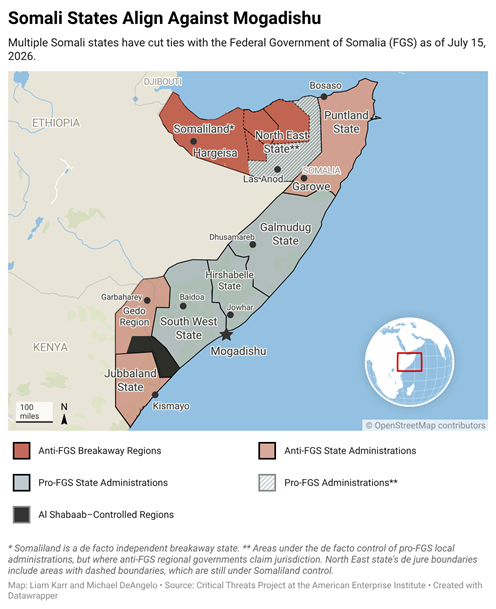
The FGS has separately sought to solidify its hold over Galmudug and Hirshabelle states. The FGS began deploying forces to Dhusmareb, the capital of Galmudug state, in May 2026 to pressure Galmudug State President Ahmed Abdi Karie (Qoor-Qoor) to step aside in upcoming state elections, which mirrored its approach in South West before the takeover.[42] Qoor-Qoor had previously opposed FGS appointments of state officials.[43] FGS pressure eventually led Qoor-Qoor to announce on June 26 that he would not stand for reelection.[44] The FGS has also deployed forces to Jowhar, the state capital of Hirshabelle, since April, reportedly to pressure Hirshabelle State President Ali Gudlawe Hussein to step aside in upcoming state elections in favor of an FGS-backed candidate.[45] Gudlawe announced in late June he is standing for reelection, although he also declared his allegiance to Mohamud’s ruling party in a show of support for the FGS.[46]