
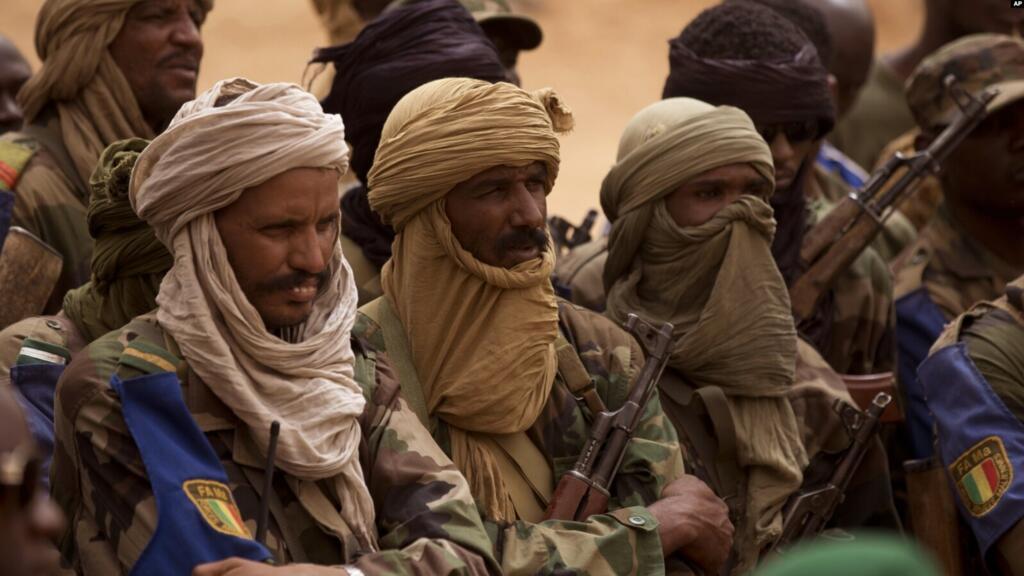
A Tuareg-led separatist group in Mali has insists it is not a “terrorist” organisation despite carrying out coordinated attacks with al-Qaeda-linked fighters that hit military targets and killed the country’s defence minister last month. The group, known as the Azawad Liberation Front (FLA), was formed in December 2024 and is seeking independence for northern Mali.
The FLA issued a statement on Friday rejecting the term “terrorist”, which has been used by Mali’s transitional authorities and by several international actors in response to the coordinated attacks on 25 April.
Fighters from the FLA and militants from Jama’at Nusrat al-Islam wal-Muslimin (JNIM), a group linked to al-Qaeda, carried out the attacks across the country, hitting the main army base outside the capital and killing Defence Minister General Sadio Camara.
The group presents itself as a politico-military movement and rejects the label.
“The FLA is not a terrorist organisation because it carries the aspirations of an entire people,” Mohamed Elmaouloud Ramadane, the group’s spokesperson, said in its statement. “It has a political project for the self-determination of the people of Azawad.”
Independence drive
Tuareg separatists with the Movement for the National Liberation of Azawad (MNLA) declared independence in April 2012.
“The FLA is simply the continuation of a struggle that has long been waged by this population, which has suffered so many massacres and is now resisting,” Ramadane said. “The FLA is fighting for a population that aspires to live freely and with dignity on its own territory.”
The rebels are allied with JNIM fighters, who have targeted civilians, taken hostages and imposed blockades on communities.
“It is a tactical military coordination to confront a common enemy,” Ramadane said. “The FLA is in no way responsible for the actions carried out by JNIM.”
He also said the FLA does not target civilians and accused the Malian army and its Russian partners from the Wagner paramilitary group, now known as Africa Corps, of abuses.
‘Violent methods’
The alliance with JNIM has led some analysts to argue the FLA should be classified as a terrorist group.
“It has entered into an explicit operational alliance with JNIM, which is affiliated with al-Qaeda, to carry out coordinated actions against strategic Malian positions,” Ahmadou Touré, director of the Bamako-based Centre for Research on Governance, Mediation and Security in the Sahel, told RFI.
This “hybridisation of separatism and international jihadism” goes beyond a rebellion and threatens Mali’s stability, Touré said.
“Through its violent methods, the FLA threatens Mali’s territorial integrity, causes population displacement and undermines national stability,” he said, adding that claiming a political cause does not justify working with a group designated as terrorist by the UN, the United States and others, or using force against a sovereign state.
“Genuine peace talks require disarmament as a precondition and a clear rejection of terrorism.”
Peace deal collapse
The debate reflects a wider pattern seen in conflicts around the world.
The armed groups that now make up the FLA are the same actors that signed a peace agreement with Bamako in 2015.
The deal reduced violence, kept separatists within the Malian state framework and distanced them from jihadist groups, but its implementation was slow and incomplete.
Mali’s military-led government, which took power after coups in 2020 and 2021, withdrew from the agreement in 2024, creating conditions for renewed conflict.