
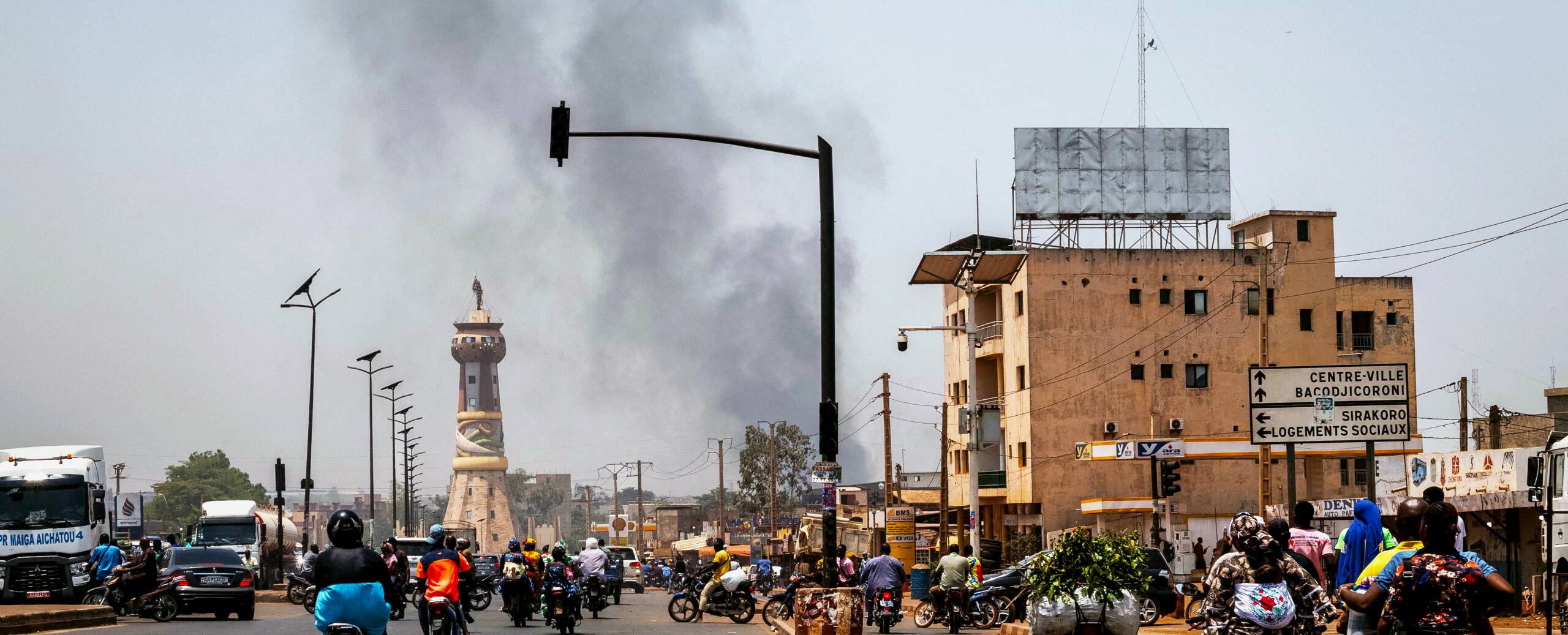
The synchronized militant Islamist and separatist attacks across Mali reflect a steady deterioration in security that will require a broader coalition of domestic, regional, and international partners to reverse.
The coordinated attacks across Mali on April 25-26 are not an isolated escalation, but the latest manifestation of a steadily deteriorating security trajectory. Over the past several years, militant Islamist groups in Mali—particularly those comprising Jama’at Nusrat al Islam wal Muslimeen (JNIM)—have expanded their reach, increased operational coordination, and intensified pressure on key military, political, and economic centers.
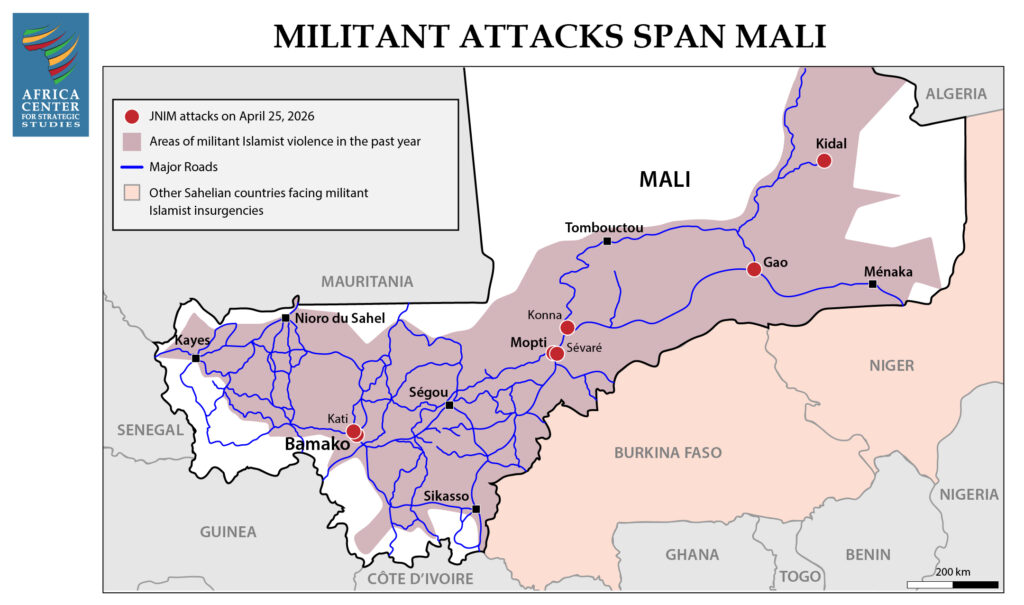
The attacks—claimed by JNIM and conducted in coordination with Tuareg separatist forces from the Front de libération de l’Azawad (FLA)—targeted sites spanning from Bamako in the south to central and northern Mali. The scale and geographic spread of the attacks punctuate patterns that have been building over time and reflect the increasingly fragile security environment facing the ruling junta, which seized power from a popularly elected government in 2020.
Highly Orchestrated Attacks Across Mali
Early on April 25, armed groups launched near-simultaneous attacks against military installations and strategic sites across multiple regions of Mali. In Bamako and Kati—the latter a central hub of military power and the residence of junta leader Assimi Goïta and other high-level military officials just outside of Bamako—explosions and sustained gunfire were reported around military bases and the international airport.
JNIM claimed responsibility for these attacks in which Defense Minister Sadio Camara was killed. Additional senior officials were injured or remain missing.
At the same time, attacks were reported in Gao in the north and Sévaré and Mopti in central Mali. These locations are strategically significant, linking northern conflict zones with the country’s economic and population centers in the south.
In the north, FLA forces have regained control of Kidal, a longstanding symbolic and strategic stronghold. Kidal has been at the center of repeated struggles for control between the Malian military and Tuareg separatist groups. Its loss would represent a major setback to the junta’s narrative of consolidating territorial authority.
JNIM has steadily expanded operations into new geographic areas, increased the scale and coordination of attacks, and targeted infrastructure and economic lifelines.These attacks follow a broader pattern observed over the past year in Mali and across the Sahel. JNIM has steadily expanded operations into new geographic areas, increased the scale and coordination of attacks, and targeted critical infrastructure and economic lifelines. Annual fatalities linked to militant Islamist groups in Mali have tripled under the military junta. The April 25-26 attacks represent a continuation—and intensification—of this trajectory.
Attacks Carry Broader Strategic Significance
Beyond the losses of life, territory, and military leadership, the attacks across Mali carry a broader significance for the trends of this long-running insurgency.
Demonstration of Complex Coordination and Nationwide Reach
The attacks highlight JNIM’s capacity to operate across vast distances—roughly 1,500 km from Bamako to Kidal.The attacks highlight JNIM’s capacity to operate across vast distances—it is roughly 1,500 km from Bamako to Kidal—in a coordinated manner. Rather than isolated incidents, the events reflect a synchronized effort to target strategic nodes across Mali’s security architecture.
Over the past year, JNIM has extended operations from northern and central strongholds into western and southern regions, targeting key population centers and economic corridors. This shift has increased pressure on Bamako and surrounding areas while linking previously distinct zones of conflict. This pressure coincides with increased operational sophistication and capacity demonstrated by JNIM, enhanced by growing revenue flows from its control of key economic arteries and kidnapping for ransom. The most prominent incident of the latter reportedly entailed a payment of $50 million by the United Arab Emirates for the release of two of its citizens.
These attacks reinforce a pattern observed across the western Sahel (Mali, Burkina Faso, and Niger) in which militant Islamist groups are expanding into more populated areas nearer to the capitals while consolidating control in the peripheries.
Strategic Targeting of Political and Military Centers
The attacks on Bamako and Kati are particularly significant. These locations represent the core of the junta’s political and military authority. By targeting leadership compounds and high-value installations, the attacks send a clear message about the vulnerability of the country’s most secure zones. Even if temporary, such penetrations have outsized psychological and political effects, undermining confidence in the military’s ability to provide security.
Convergence of Insurgent and Separatist Agendas
The coordination between JNIM and the FLA represents a convergence of interests between militant Islamist and separatist actors, even if their long-term objectives differ.
For the FLA, the recapture of Kidal reflects a continued effort to reassert control over the north following the Malian junta’s decision to end the Algiers Accord and take Kidal by force in November 2023. The move by the junta to open a second front against the Tuareg, instead of focusing on the militant Islamist threat elsewhere, resulted in dramatically overstretched military supply lines amid an already resource constrained environment.
The convergence between JNIM and FLA also complicates the security landscape by linking local territorial disputes with broader insurgent campaigns.
Escalation Within an Ongoing Offensive
The coordinated attacks are the latest phase in an ongoing offensive that has accelerated over the past year. JNIM’s operations—including attacks on transport routes, fuel supplies, and key urban access points—reveal a strategy focused on isolating major population centers.
By controlling access, movement, and supply of these larger towns and cities—rather than holding territory outright—JNIM is exposing the junta’s inability to maintain control across key regions and lack of legitimacy.
Need for Regional Security Cooperation
A perplexing paradox of the junta security strategy has been its rejection of regional and international partners in the face of the escalating militant Islamist threat. This includes troops from member states of the Economic Community of West African States (ECOWAS), the United Nations peacekeeping force (MINUSMA), the European Union, and others. In total, there were roughly 20,000 regional and international troops in Mali prior to the coup. Instead, the junta has relied on an estimated 1,000-2,500 Russian Wagner Group paramilitary forces (later transitioned to the Africa Corps). Whether these forces are primarily oriented toward countering the insurgency, advancing Russia’s geostrategic aims, or shoring up regime security remains an open question.
Implications for Mali’s Security Trajectory
Heavy-handed tactics by security forces have contributed to the deteriorating security environment by fueling recruitment into militant Islamist groups. Since 2023, civilian fatalities linked to security forces and allied militias in Mali and Burkina Faso have exceeded those attributed to jihadist groups. JNIM has capitalized on the junta’s use of violence against civilians—including abuses by junta-aligned Russian paramilitary forces—to expand its appeal and local influence. As a result, rural populations have increasingly been fleeing from the Malian military and turning to JNIM for protection.
In this sense, the attacks are not unexpected. The ability of armed groups to strike across multiple regions—including the capital city—underscores persistent and interlinked security gaps: distrust of the military by rural communities, weak intelligence, and limited rapid response capability.
Rule by militant Islamist actors could create an expansive safe haven for international terrorist networks to train, recruit, and stage attacks outside of Mali.The fall of Bamako could subject the country of 25 million people to ultraorthodox Islamist rule—a lifestyle foreign to most Malians who have observed more moderate interpretations of Islam. Close ties between the influential conservative imam, Mahmoud Dicko, and the JNIM network’s titular leader, Iyad ag Ghaly, have prompted speculation of the prospective emergence of such a theocratic state. Rule by militant Islamist actors could, in turn, create an expansive safe haven for international terrorist networks to train, recruit, and stage attacks outside of Mali.
Cohesion and Fragility of Military Authority
The targeting of senior leadership and strategic sites raises questions about the resilience of the current junta. Even if the military government remains intact, such attacks will strain internal cohesion, expose vulnerabilities, and spur uncertainty among both elites and the broader population.
The losses and injuries to senior military officials may further complicate decision-making and command structures at a critical moment.
Political Constraints and Limited Off-Ramps
The deterioration in security has unfolded in the context of a systematic tightening of political and civic space by the junta since it seized power. Promises of a transition back to civilian rule have been repeatedly postponed. Prominent civilian figures, including the secular moderate former Prime Minister Moussa Mara, have been detained or sidelined after calling for a return to constitutional governance. This narrowing of political space has limited avenues for addressing governance challenges all the while increasing pressure on the military to manage not just security but also political, diplomatic, and economic crises simultaneously.
As security pressures mount, the silencing of credible civilian political interlocutors risks heightening societal disillusionment and reducing options for stabilizing the situation by mobilizing a wider domestic, regional, and international coalition.
Regional and Cross-Border Risks
The geographic spread of the attacks underscores the transnational nature of the threat. Areas targeted or contested—particularly in western and southern Mali—are closely linked to cross-border trade and migration routes connecting to Mauritania, Senegal, Côte d’Ivoire, and Burkina Faso.
Continued instability in these zones increases risks for neighboring coastal West African countries, which have already faced rising militant activity in border regions.
Challenges to Prevailing Narratives
The attacks disprove claims long made by the military junta that their security strategies have stabilized Mali. Instead, they point to a widening gap between the Sahelian juntas’ claims and the conditions on the ground. Furthermore, the intensive Russian-sponsored information operations—extolling Russia’s successes and those of the Sahelian juntas in combatting the violent extremist insurgencies—have provoked a parallel battle of narratives throughout West Africa, irrespective of the security realities.
The scale of the attacks, the loss of strategic territory, and the ability of armed groups to strike high-profile targets all serve to puncture the myths of these narratives and suggest that militant Islamist groups are gaining significant operational capacity and freedom of movement.
Looking Ahead
The insurgent threat exceeds the capacity of the Mali military to counter on its own.While the attacks represent a major shock, they are best understood as part of a broader and worsening trend. Militant Islamist groups have demonstrated increasing capacity to coordinate operations, target strategic nodes, and exert pressure across multiple regions simultaneously. The risk of state collapse in Mali is real.
These trends underscore the need for a course correction. The insurgent threat exceeds the capacity of the Mali military to counter on its own—and is now posing heightened risks for Mali’s coastal West African neighbors. Expanding political space and reintroducing credible civilian leadership options could help ease pressure on military authorities facing simultaneous security, economic, and governance challenges. Engaging a broader coalition of domestic stakeholders can help mobilize wider popular support to counter the threats faced. This, in turn, can facilitate rebuilding security and economic cooperation efforts regionally—among neighboring countries, ECOWAS, the United Nations, and other international partners.