
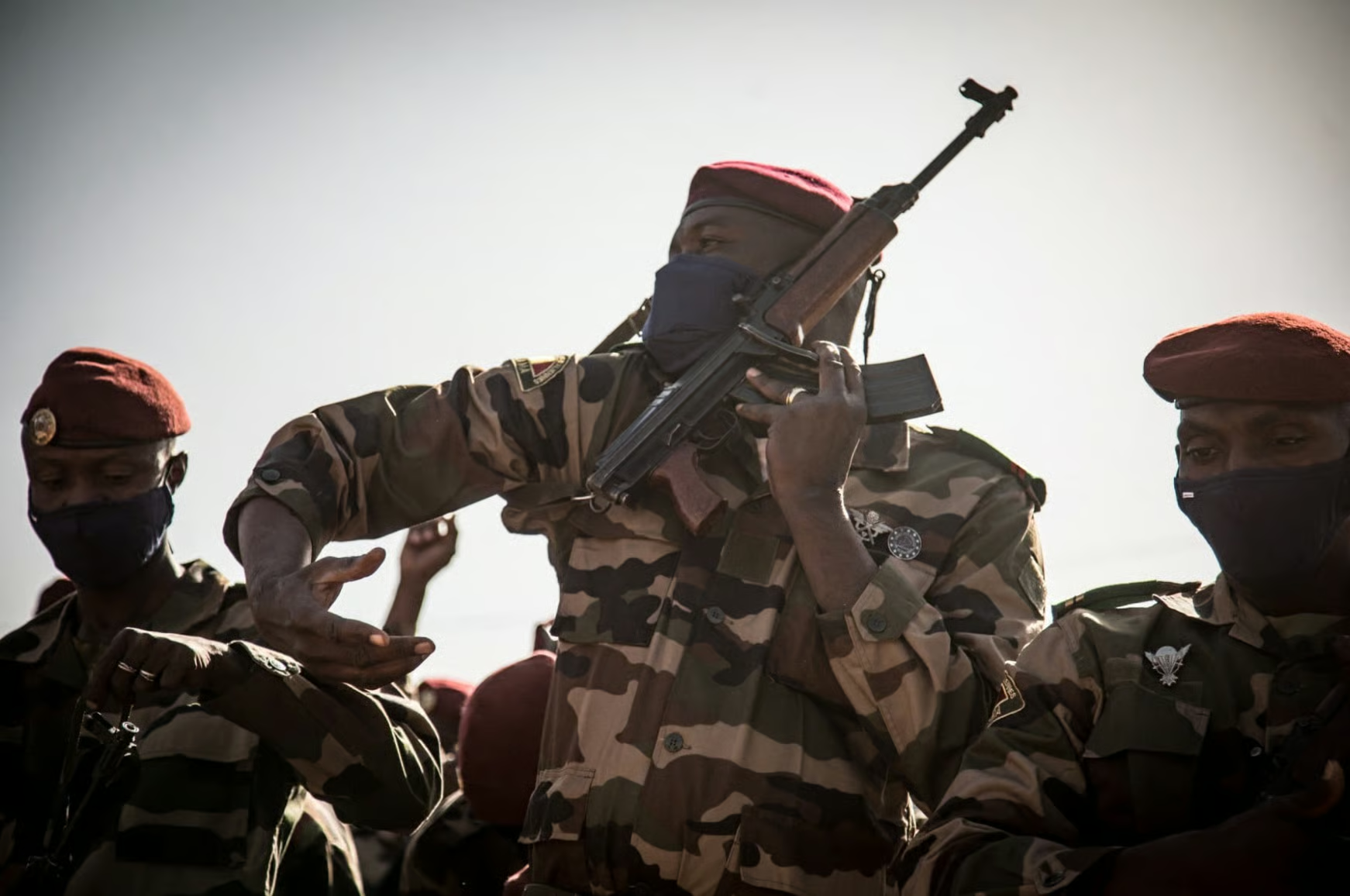
As strategic towns fall and the defence minister’s home is destroyed, an unprecedented pact between the FLA and Jnim signals a dangerous new chapter for President Assimi Goïta.
The situation in Mali remains volatile following a coordinated offensive launched on 25 April against several towns. While the authorities claim to have regained the upper hand, several strategic locations, including Mopti and Kidal, were partially or totally outside state control by yesterday evening.
Unprecedented cooperation between armed groups
In a major development, the Azawad Liberation Front (FLA) and the Group for the Support of Islam and Muslims (Jnim) have explicitly acknowledged their coordination for the first time. Until now, the two entities operated on distinct tracks: one separatist, the other jihadist.
This convergence opens a new chapter in the Malian conflict. In a statement, the FLA confirmed a broader political strategy, calling for “convergence” with any actor sharing the goal of a change of power in Bamako and denouncing the junta as a “major obstacle” to a political outcome.
Jnim: a show of force and political overtures
Alongside this large-scale offensive, Jnim has increased its political signalling. The jihadist group extended an unexpected hand to Russian forces deployed in Mali, in what appears to be an attempt to fracture the alliance between the Malian Armed Forces (FAMa) and their foreign partners.
This strategy follows a logic observed elsewhere, notably in Syria with Hayat Tahrir al-Sham, from which Jnim seems to draw inspiration in its quest for political legitimacy. The objective is twofold: to demonstrate its capacity for disruption while positioning itself as an essential interlocutor.
In line with this approach, a statement announcing the release of hostages linked to the Malian army was released, echoing local negotiations already undertaken by certain Malian religious figures, including Imam Mahmoud Dicko.
Mopti under Jnim control, Kidal under the FLA
On the ground, the situation remains confused. The town of Mopti reportedly fell under Jnim control on the evening of 25 April—a first since the start of the conflict. If confirmed, this capture would represent a strategic turning point.
Intense fighting may be taking place around Sévaré, a logistical and military hub where Malian forces and Russian mercenaries are stationed. Residents there remained holed up in their homes yesterday evening.
In the north, Kidal remains in the hands of the FLA, despite reports of ongoing fighting this Sunday. According to several corroborating sources, only a pocket of resistance remained on Saturday in the former Minusma camp, held by Russian elements.
Sources close to the FLA suggest an agreement may have been reached to allow the evacuation of these elements in exchange for total control of the city. If confirmed, this information would illustrate the shifting dynamics on the ground.
Bamako under tension as AU condemns attacks
In Bamako, pressure remains high. The capital has been cordoned off by security forces, while authorities maintain that the situation is “under control” across the country. The government has reported only 16 injuries, a figure deemed barely credible given the scale and simultaneity of the attacks reported in several regions.
The home of General Sadio Camara, the Minister of Defence, was completely destroyed at the start of the offensive. According to a Malian security source, this was a suicide attack carried out by Jnim. All worshippers at the nearby mosque were killed in the blast, except for the imam.
The Malian defence minister has not made a public appearance since, and he is now believed to have died in the blast. President Assimi Goïta has also not spoken since the attacks.
On the diplomatic front, condemnations have mounted. The Senegalese president, Bassirou Diomaye Faye, denounced the attacks “in the strongest possible terms”, expressing Dakar’s solidarity with Bamako and calling for a concerted regional response.
In a statement, the African Union (AU) said it was following the attacks with “profound concern”, firmly condemning the acts and reaffirming its determination to promote peace and stability. The chairperson of the AU Commission, Mahmoud Ali Youssouf, sent a message of total solidarity to the Malian people, security forces, and authorities.