
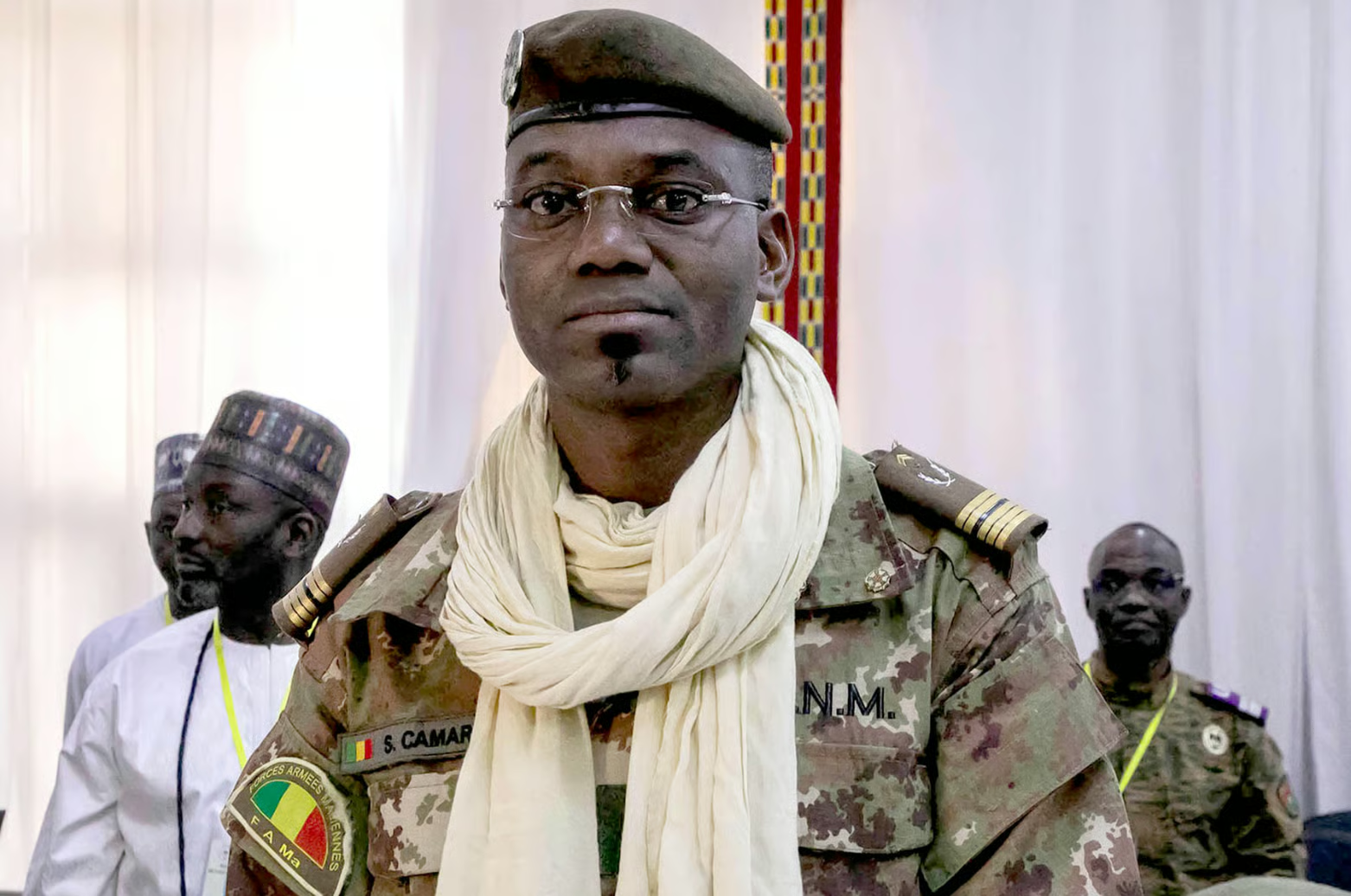
The powerful defence minister and Russia’s key ally in the Sahel was killed in a car bomb attack at his residence in Kati.
According to multiple security sources, Sadio Camara was killed during an attack targeting his home in Kati, near Mali’s capital Bamako, on 25 April. The assault, attributed to the Group for the Support of Islam and Muslims (JNIM), was reportedly carried out using a car bomb driven by a suicide bomber. The blast, which was particularly powerful, completely destroyed the defence minister’s residence.
The attack was part of a simultaneous offensive by JNIM and the Azawad Liberation Front (ALF) across several regions of the country. As the architect of the junta’s military strategy, Camara embodied the hardline stance adopted by Bamako against armed groups, particularly since the strengthening of partnerships with Russian actors.
A major setback for the junta
The death of Sadio Camara constitutes a major blow to the transitional authorities, both militarily and politically. In recent months, the minister had overseen a significant consolidation of power in Bamako, successfully placing his loyalists within the high military command and the Malian government.
A former director of the Kati military academy (PMK), he had imposed his vision since the junta came to power. It was under his leadership that Western forces, led by the French Operation Barkhane, were asked to pack their bags to make way for Russian Wagner mercenaries, who were recently replaced by Africa Corps.
The former PMK director developed his Russian connections early on. After ranking poorly in entrance exams for foreign war colleges, he opted for Russia. In late 2019, he flew to Moscow for a three-year training programme. The first year was dedicated to learning Russian, followed by two years of military instruction. The 2020 coup took place before he could complete the cycle.
‘Reconquest’ operation in doubt
Since 2020, Camara had consistently demonstrated his mastery of the Malian military apparatus, leaving Assimi Goïta with overall control of the state. While the relationship between the two men had grown increasingly tense, the defence minister remained a pillar of the ruling junta.
This April, the colonel-turned-general had launched Operation Dougoukoloko (“Reconquest of the Territory”), with the stated aim of ensuring Mali would never again be “humiliated or weakened by terrorist groups”. The initiative was intended to mark a shift toward a structured strategy to guarantee stability, restore administration, and secure citizens against the terrorist threat.
The operation involved intensifying the hunt for jihadists and armed group fighters in strategic locations such as Timbuktu, Kidal, and Gossi. Camara relied on a hand-picked circle of officers known for their loyalty and tactical prowess. His death in the 25 April attacks, claimed by both JNIM and the ALF, marks a clear halt and a significant setback for the operation.