
Key Takeaway:
The United States is increasingly involved in direct competition with Russia in Africa as the United States seeks to cultivate influence with Russian-aligned, authoritarian regimes in Africa as part of its transactional approach to the continent. These African states have shown openness to US engagement as part of efforts to diversify their partnerships but are ultimately seeking to balance ties among several countries.
Assessment:
US President Donald Trump’s administration has pursued several transactional partnerships with authoritarian, Russian-aligned regimes in Africa since taking office. Trump’s approach is a departure from that of former US President Joe Biden’s administration, which oscillated between pragmatic engagement and more confrontational approaches with non-US-aligned authoritarian or coup governments. The Biden administration sanctioned Malian officials linked with the Kremlin-funded Wagner Group in 2023 and most notably admonished the Nigerien junta for its growing ties with Iran and Russia shortly after the junta took power in 2024.[i] These actions had a minimal effect in Mali and backfired in Niger, which annulled defense deals with the United States that caused the withdrawal of 1,000 US forces and the loss of two US bases, including a $110 million drone base.[ii] The Biden administration demonstrated a more pragmatic approach in other African countries, including a failed attempt to reengage the Russian-aligned Central African Republic (CAR) government and continued engagement with a new junta in Gabon, which China views as a potential site for an Atlantic base.[iii]
The Trump administration has expanded this pragmatic, transactional approach across the continent, including reversing the Biden administration’s approach in the Sahel. Senior US diplomatic and military officials have met with their counterparts in the Alliance of Sahel States (AES)—Burkina Faso, Mali, and Niger—since 2025, and the acting Senior Bureau Official for African Affairs Nick Checker met with senior leaders in all three AES countries in the first quarter of 2026, marking the senior-most engagement yet.[iv] Official US statements on the Sahel during these visits explicitly framed previous US actions as a mistake and adopted the same talking points that AES officials used to condemn the United States, such as respect for sovereignty.[v] Checker and Trump’s Africa adviser, Massad Boulos, have reinvigorated Biden-era efforts to reengage the CAR under the Trump administration playbook and launched their own efforts to engage the new junta in Madagascar, which has also grown ties with Russia, after the junta toppled the democratically elected president following mass protests in late 2025.[vi]
US outreach has put the United States in more direct competition with Russia in Africa. Many of these partnerships are at least partially concentrated on regime security, which has been the cornerstone to Russia’s partnerships with many African countries. Russia has developed a “regime security package” that insulates its authoritarian partners through allyship in international bodies, the deployment of Russian military units and political advisers, and information operations.[vii] The Trump administration has begun offering some elements of the Russian regime security package, such as contracts with US-linked private military contractors. The Malagasy junta leader has discussed coup-proofing support in multiple meetings with US officials and Erik Prince, informal adviser to President Trump and private military contractor, since late 2025.[viii] Contractors with Prince’s company have already been active on the front lines of the conflict in the eastern Democratic Republic of the Congo in support of the Congolese government in 2026.[ix]
US defense partnerships have created opportunities for economic cooperation, which is a distinct US advantage over Russia. The United States is exploring opportunities to cooperate on critical minerals and other economic sectors alongside defense cooperation. US officials have discussed efforts to restart the Toliara project, which is a $700 million US-backed critical minerals project that holds titanium, zirconium, rare earth, and radioactive minerals, with the Malagasy junta.[x] A US company signed an agreement in late 2025 with Mali’s state-owned mining company to resume production at an $11 billion gold mine, and Mali is courting further US investment into critical mineral deposits.[xi]
Russia lacks the capacity to be a major economic partner in Africa.[xii] European Union (EU), Chinese, and US foreign direct investment in Africa is exponentially higher than Russian investment.[xiii] This imbalance extends to trade, with Russia’s total 2024 trade with Africa of nearly $25 billion only being a tenth of Chinese and European trade and less than a quarter of US trade.[xiv] Russia has pursued greater mineral access with its authoritarian partners but has largely been unable to operationalize initial agreements related to industrial mining and has instead abused access to underregulated artisanal mines.[xv]
Russian influence in these countries poses a direct threat to both US engagement with these partners and US interests across Africa. The 2026 US intelligence community annual threat assessment noted that “Russia retains the capability to selectively challenge U.S. interests globally by military and nonmilitary means,” including through “gray zone” tools, such as disinformation and influence operations.[xvi] These global interests include Africa, where CTP has repeatedly assessed that Russia is pursuing strategic aims related to eroding global Western influence and expanding its naval power projection around Africa’s coastlines to reassert its great-power status. Russia has helped cultivate footholds in Africa through developing an information ecosystem of pro-Russian politicians, civil society actors, and traditional and social media sources that it uses to falsely portray the United States and the West as an exploitative power.[xvii] The Kremlin is playing a zero-sum game as it seeks to erode Western influence on the continent and has even targeted US humanitarian efforts, such as a counter-malaria nonprofit organization backed by the Gates Foundation in Burkina Faso.[xviii]
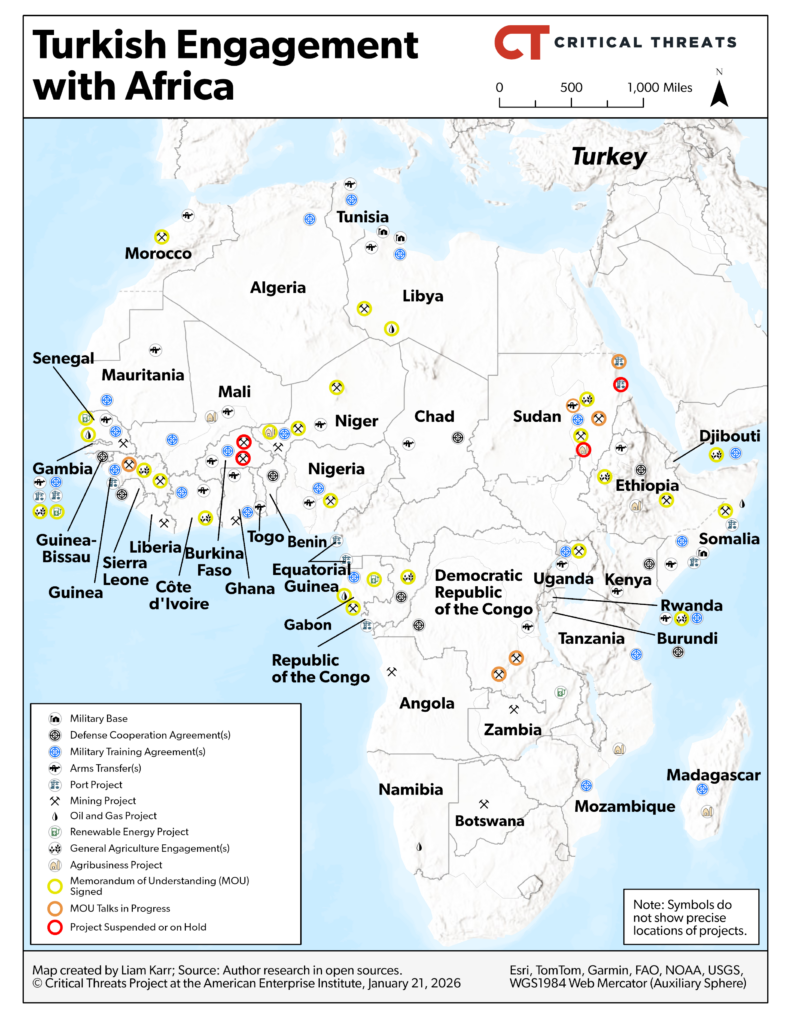
Russia and the United States are also competing with increasingly prominent “middle power” actors, such as Turkey and the United Arab Emirates (UAE), as these African countries look to diversify their partnerships and balance several external partners. Turkey has emerged as a major defense partner in recent years, especially in the Sahel. Niger and Turkey have signed several agreements related to the deployment of Turkish trainers to Niger, and there are also isolated reports of Turkish advisers or mercenaries being present in several other West African countries.[xix] Turkey has become the leading provider of drones across the continent, including in West Africa, where the AES countries each own several Turkish drones.[xx]
Figure 1. Turkish Engagement with Africa
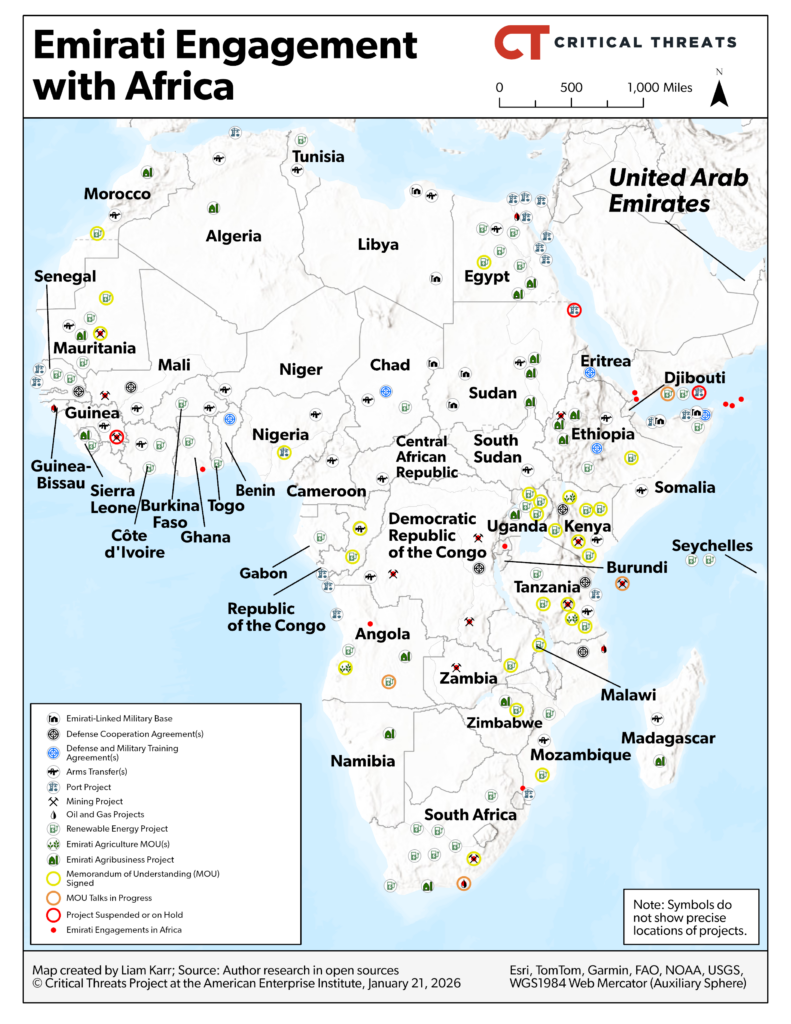
The UAE has also become an increasingly prominent economic and defense partner. The UAE is currently the fourth-leading investor in Africa, trailing only China, the United States, and the EU.[xxi] The UAE has strengthened relationships with the Central African Republic (CAR) and the new Madagascar junta, as it pursues interests related to the Sudanese civil war in the CAR and economic interests in Madagascar.[xxii] The UAE’s growing role as a weapons provider in Africa has also established links with these same countries, as well as the AES countries.[xxiii]
Figure 2. Emirati Engagement with Africa
West Africa
The Alliance of Sahel States (AES) countries have continued increasing defense and other cooperation with Russia so far in 2026. The French investigative outlet Jeune Afrique reported in February 2026 that Russia was deploying 1,000 new Africa Corps soldiers to Mali “in the coming months,” raising the total number of Africa Corps forces in Mali to 3,500.[xxiv] Russia sent new batches of military equipment to Mali via Guinea in early April 2026, which is a possible indicator of Africa Corps reinforcements given that the last major Russian shipments occurred during the transition from the Wagner Group to Africa Corps in mid-2025.[xxv] Nigerien junta leader Abdourahmane Tiani and Defense Minister Salifou Modi met with Russian Deputy Minister of Defense Yunus-bek Yevkurov in Niamey, the Nigerien capital, in late January 2026 to discuss expanding Africa Corps’ training and support role to include more involvement in counterinsurgency operations, as seen in Mali.[xxvi] Burkina Faso has continued to keep its small Africa Corps contingent focused on training and regime security, but the Burkinabé foreign minister visited Moscow in mid- February 2026 to sign several bilateral deals on economic, military, and political cooperation.[xxvii]
CTP has assessed previously that the AES is a multidimensional, strategic project for Russia that advances its goals to assert itself as a revitalized great power by undermining Western influence in Africa and creating leverage with the West. Russia has used defense cooperation and regime security as the foundation for its partnership with the Sahelian juntas. Russia has been the primary security partner for the AES countries since they cut ties with Western forces. This shift effectively resulted in the withdrawal of at least 4,300 French, 1,000 American, and 10,000 UN troops and the arrival of roughly 2,500 Russian personnel across the three countries between 2022 and 2024.[xxviii] Russian personnel are most visible in Mali, where they actively take part in combat missions, but they are present across all three countries, conducting information operations and supporting elite units in charge of ensuring the survival of the three juntas.[xxix]
The AES bloc supports the Kremlin’s interests in eroding Western influence in Africa and multilateral institutions. Their allyship extends to international institutions, such as the UN, where the AES countries regularly vote with Russia and have even signed deals with the Kremlin on political cooperation in the UN.[xxx] The AES countries have withdrawn from and undermined several neutral or Western-aligned regional and political security institutions, including the Economic Community of West African States (ECOWAS), the Sahel G5, and the Multinational Joint Task Force.[xxxi] The AES also serves as a pro-Russian alternative to these institutions, attracting countries such as Chad and Togo, which have grown closer to Russia as they have grown closer to the AES.[xxxii]
The Kremlin has also used its influence to expand cooperation on nuclear energy and natural resource extraction, which is key to its efforts to mitigate sanctions, although many of these deals remain unrealized. All three AES countries have signed agreements with Russian state-owned nuclear energy company Rosatom to build nuclear powerplants, although none of the projects have entered the construction phase.[xxxiii] CTP assessed previously that these projects aim to expand and strengthen long-term Russian influence through lengthy projects that depend on Russian financing, technology, and expertise.[xxxiv] Some of these agreements and separate deals include provisions for mining lithium, uranium, and other minerals.[xxxv] Russia does not produce lithium domestically, which is a US-listed critical mineral due to its use in rechargeable batteries for mobile phones, laptops, and electric vehicles, and its main suppliers in South America stopped exporting to Russia in 2022 due to Western sanctions.[xxxvi] The Kremlin’s pursuit of uranium aims to increase its grip on the nuclear energy market to improve its leverage with countries that seek to cut Russian gas purchases.[xxxvii]
Russia’s entrenched presence in the Sahel creates long-term opportunities for the Kremlin to pressure NATO’s southern flank. CTP has previously noted that Russia’s positions along key nodes in trans-Saharan migration networks in the Sahel and Libya provide an opportunity for the Kremlin to bolster its campaign to manufacture migration crises to destabilize Europe through local or national partners that wield influence over these networks.[xxxviii] CTP has also noted that while there is no evidence that Russia plans to base drones in the Sahel, doing so would pose a direct threat to NATO positions in the Mediterranean.[xxxix]
Figure 3. Growing Russian Presence on Trans-Saharan Migration Routes in West Africa
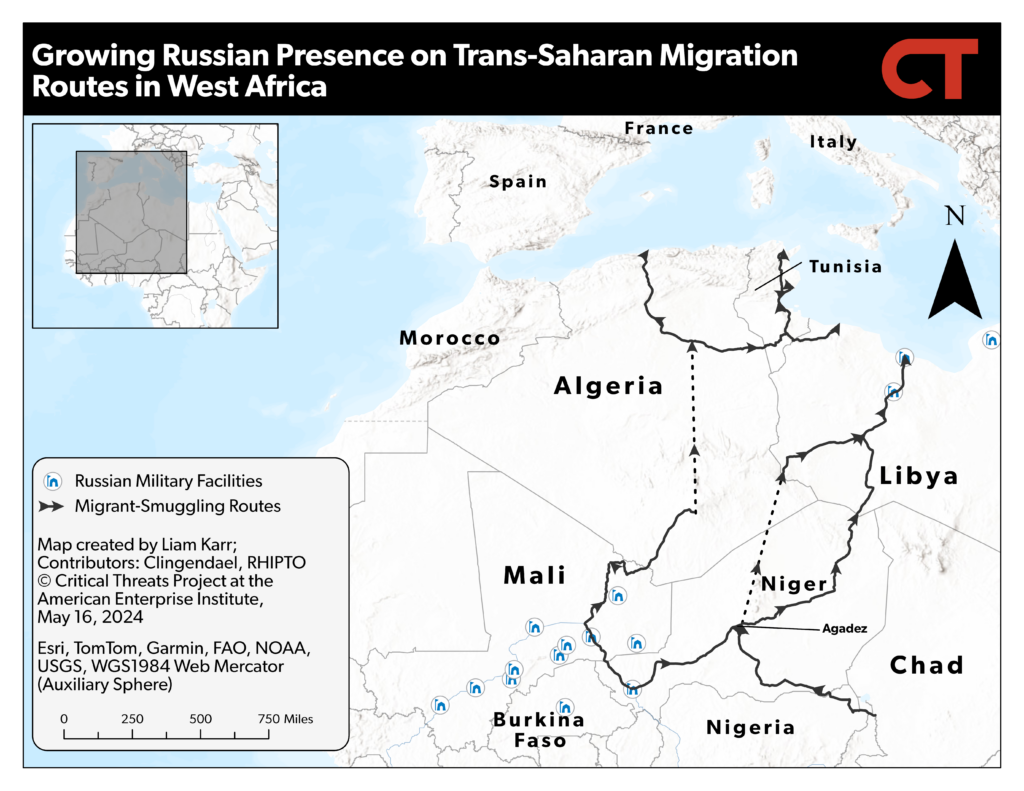
Figure 4. Prospective Range of Iranian-Made Shahed-136 Drones from Agadez, Northern Niger
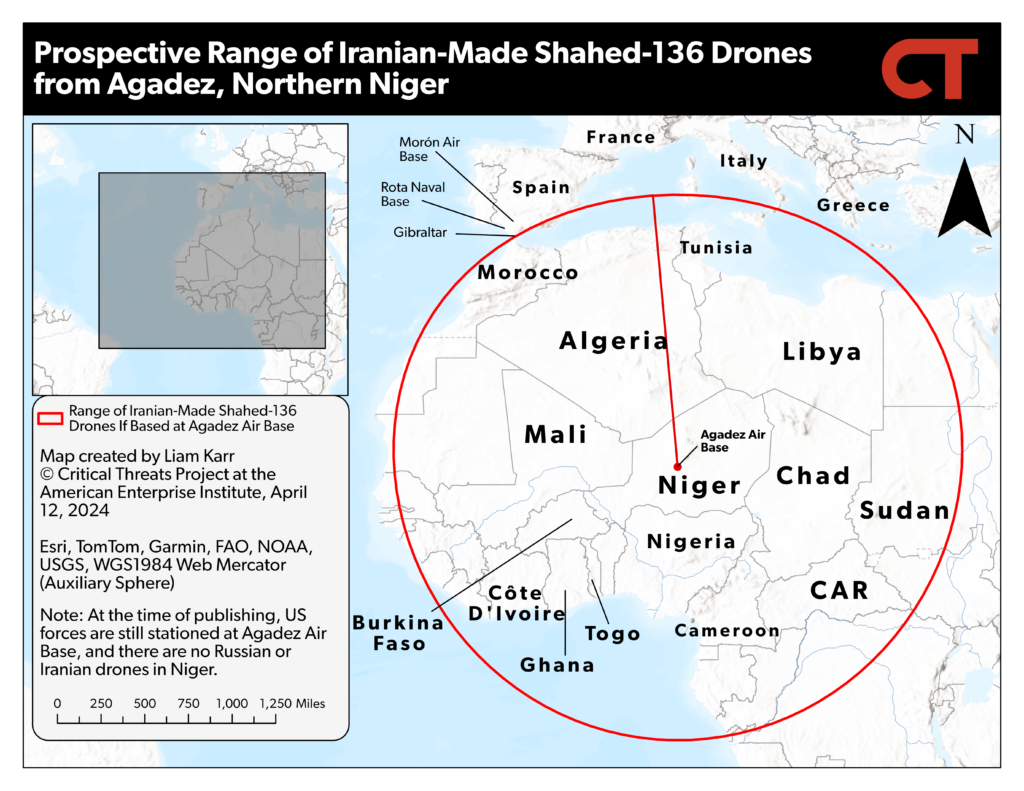
Note: US forces are no longer stationed at Agadez Air Base, as they withdrew in 2024 after this map was published. There are still no Russian or Iranian drones in Niger, however.
Source: Liam Karr.
The AES countries have also been gradually diversifying ties with other actors, however, including the United States, as the United States looks to reenter the Sahel. Cooperation between Mali and the United States has continued to grow since the Trump administration entered office and reestablished ties with Mali in 2025. US Acting Senior Bureau Official for African Affairs Nick Checker met with senior government and economic officials in Bamako, the Malian capital, in early February 2026.[xl] Checker engaged in “substantive” discussions with Malian Foreign Minister Abdoulaye Diop in areas of common interest, such as the fight against terrorism and promoting economic development.[xli] The US State Department framed the meeting as a “reset” in US-Mali relations and emphasized the United States’ respect for Mali’s sovereignty, while Diop and the Malian Foreign Affairs Ministry said the renewed ties aligned with Trump’s pivot to a “trade not aid” foreign policy and a “win-win” partnership.[xlii]
The US-Mali bilateral relationship has continued to improve following Checker’s visit. The US Treasury Department removed 2023 sanctions on Defense Minister Sadio Camara and two other senior Malian military officials in February 2026 that were related to these individuals’ ties with the Kremlin-funded Wagner Group.[xliii] Reuters reported in early March that the United States and Mali are nearing a deal to resume US-led intelligence, surveillance, and reconnaissance (ISR) flights over the country.[xliv] The US ambassador met with Camara and other high-level Malian officials on April 10.[xlv]
The United States is also slowly reestablishing ties with Mali’s AES allies, Burkina Faso and Niger. Checker met with Burkinabé Foreign Minister Karamoko Jean-Marie Traoré in Ouagadougou on March 12, then he met with Nigerien Foreign Minister Bakary Yaou Sangaré and Nigerien Prime Minister Ali Mahamane Lamine Zeine in Niamey on March 13.[xlvi] Checker discussed economic and security cooperation during both meetings.[xlvii] All parties released separate statements signaling that there would be future discussions to continue enhancing cooperation.[xlviii]
The growing US-AES ties build on sustained reengagement efforts since 2025. The Nigerien prime minister visited Washington, DC, in late April to discuss strengthening bilateral and commercial ties.[xlix] Former Deputy Assistant Secretary of State for African Affairs Will Stevens held several separate high-level meetings with his Burkinabé, Malian, and Nigerien counterparts in mid-2025 as he spearheaded the initial US efforts to rebuild partnerships with all three AES countries.[l] US counterterrorism adviser Rudolph Atallah met with the Malian Foreign Minister Diop in early July to discuss bilateral counterterrorism cooperation.[li] Diop eventually spoke with US Deputy Secretary of State Christopher Landau in November 2025 after lengthy negotiations.[lii] Other US diplomats and senior military officials also attempted to resume normal relations with their Sahelian counterparts throughout 2025.[liii]
The United States is primarily pursuing security-related interests, in addition to exploring opportunities for cooperation on critical minerals and other economic areas. The United States has identified the strengthening Salafi-jihadi insurgencies as a major threat to its interests in Africa and increased efforts to partner with African countries to support counterterrorism efforts. The 2026 US intelligence community’s threat assessment warned that al Qaeda and ISIS pose a heightened threat to US interests and citizens in Africa, while the 2026 US National Defense Strategy identifies neutralizing Islamist terrorist organizations as a defense priority in Africa.[liv] The United States has already increased counterterrorism activity in Nigeria and Somalia, deploying 200 troops to Nigeria to train local forces and significantly increasing the frequency of drone strikes across both Nigeria and Somalia.[lv]
The United States is attempting to rebuild its ISR capabilities in the Sahel. The United States abandoned its newly built air bases in Niamey and Agadez, in northern Niger, which were major staging grounds for ISR flights across the Sahel, after deteriorating relations with the Nigerien junta forced a US withdrawal from the country in 2024.[lvi] US officials have said that the US interest in resuming intelligence flights is partially driven by the desire to find an American pilot who was kidnapped in Niger by al Qaeda’s Sahelian affiliate and is believed to be held in Mali.[lvii]
The Trump administration also seeks to protect and expand US access to critical minerals in the Sahel. The AES countries possess significant reserves of key minerals, including lithium and uranium, which are classified as critical minerals, and other valuable minerals and resources, such as gold and oil.[lviii] The US mining company Flagship Gold Corporation signed an agreement in October 2025 with the Malian state-owned SOREM mining company to resume operations at the Morila gold mine in southern Mali, which contains an estimated 2.5 million ounces of gold reserves valued at roughly $11 billion.[lix] SOREM began circulating a list of further US investment opportunities in critical minerals, including gold, manganese, lithium, and uranium deposits.[lx] Al Qaeda–linked insurgents attacked the Morila site in January 2026, and increasing insurgent attacks across mineral rich southern and western Mali threaten potential US investments, however.[lxi]
Turkey has also strengthened economic and defense partnerships with the AES countries, particularly Niger. The AES countries have significantly grown defense ties with Turkey as part of their efforts to diversify defense partnerships. Nigerien defense minister Modi signed a memorandum of understanding for Turkish troops to deploy to Niger to train Nigerien forces when meeting his Turkish counterpart in Ankara, the Turkish capital, on April 7.[lxii] The United Kingdom–based, pro-Turkish outlet Middle East Eye initially reported in September 2025 that the agreement would involve “at least four battalions,” mostly consisting of veterans from Turkish deployments in Iraq and Syria, providing training and adviser support.[lxiii] Niger and Turkey had already signed a military financial cooperation agreement, which aims to help Niger acquire Turkish drones, other weapons, and Turkish trainers, in July 2025.[lxiv] Multiple sources also claimed in 2024 that Turkey had deployed Turkish-backed Syrian mercenaries from the Turkish private military SADAT International Defense Consultancy company to Burkina Faso and Niger to protect Turkish economic interests.[lxv] Turkey has also sought to expand preexisting training efforts with Mali in recent years and has sold drones to all three AES countries.[lxvi]
Turkey is seeking primarily to address domestic concerns and cultivate long-term leverage with international partners, both as a leader of the Islamic world and as an indispensable international partner.[lxvii] Turkish President Recep Tayyip Erdoğan has used partnerships in the Sahel to support domestic objectives, including patronage, energy independence, and cracking down on domestic opposition abroad. Turkish defense sales and mercenary deployments also directly support Erdoğan’s allies, including his son-in-law, who runs the Baykar Defense drone company, and another close associate who runs SADAT.[lxviii] Turkey imports 74 percent of its energy supplies but has sought to boost its nuclear energy capacity.[lxix] Turkey has turned to Africa, particularly Niger, to secure the uranium needed to fuel nuclear reactors.[lxx] Erdoğan also uses his partnerships with the Sahelian and other African countries to crack down on domestic opposition abroad, such as the Gülen movement, which he has blamed for a failed coup attempt in 2016.[lxxi]
Turkey’s growing partnerships in the Sahel bolster Turkey’s international clout as an Islamic alternative to Chinese, Russian, or Western partnerships, while cultivating leverage with these same global competitors. Experts have branded Turkey’s foreign policy approach in Africa as “neo-Ottoman,” as it aims to cultivate influence in areas with Ottoman-era ties and a shared Muslim identity.[lxxii] Turkey then pairs soft-power tools to capitalize on these shared cultural ties with state-led investment and eventual defense ties to present an alternative to great power engagement. This strategy is especially evident in Niger, which Turkey has labeled as a “strategic investment” and “strategic partner” that is important to revitalizing historical Ottoman influence in the Sahel.[lxxiii] Turkey’s growing role in the Sahel positions it to contribute to international counterterrorism and security cooperation, which generates leverage with China, Russia, and the West.
These same external partners are battling for influence in Togo, which is also seeking to diversify yet balance its external partnerships, and other coastal West African countries. Russia is attempting to expand its influence in coastal West Africa to create a logistic network running from the Mediterranean to the Atlantic and bolster its naval power projection. The Kremlin has also increased ties with Togo, São Tomé and Príncipe, and Equatorial Guinea in recent years, including with defense deals that involve port access in Togo and São Tomé, as well as Africa Corps’ deployment to Equatorial Guinea and a possible future deployment to Togo.[lxxiv] The Kremlin’s primary short-term aim with outreach to coastal countries is creating a logistics corridor running from the Mediterranean to the Atlantic via Libya, the Sahel, and Togo, but Russian submarine patrols and naval exercises also indicate a long-term interest in projecting naval power into the Atlantic.[lxxv]
Figure 5. Russia Pursues Mediterranean Sea to Atlantic Ocean Corridor
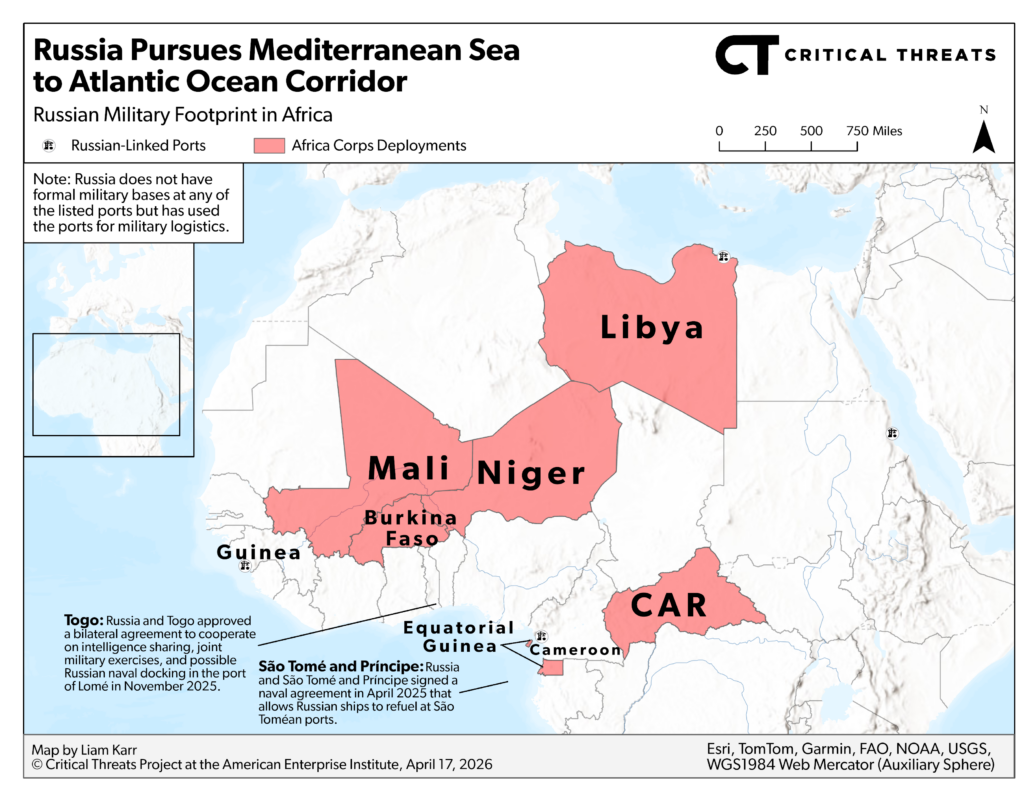
Togo is seeking to balance among Russia, the West, and other partners, however. Togolese Foreign Minister Robert Dussey wrote an op-ed in the US media outlet The Hill in late July 2026 advocating greater Togolese-US security cooperation.[lxxvi] Togo has also framed itself as a regional economic partner and taken a greater role in supporting the US-backed Democratic Republic of the Congo peace process as the African Union representative in the process.[lxxvii] Togo is separately expanding economic and military partnerships with other countries, such as Turkey and the United Arab Emirates. Togo hosts a small number of Turkish military instructors, has purchased Turkish drones and Emirati armored vehicles, and acts as a transit hub for Emirati gold exports.[lxxviii]
Madagascar
Madagascar has been expanding military and political ties with Russia since a junta seized power in a coup in Madagascar in late 2025. The head of junta, Colonel Michaël Randrianirina, led a powerful faction within the Malagasy military, which mutinied and deposed the sitting president, Andry Rajoelina, in response to weeks of massive youth-led, anti-corruption protests in October 2025. Rajoelina fled the country amid the coup and remains in exile in the United Arab Emirates (UAE).[lxxix] Randrianirina suspended all democratic institutions and established a transitional government.[lxxx]
Russia immediately began courting the new junta and has increased military cooperation as the basis for a new partnership. Randrianirina hosted an official Russian delegation led by Yunus-bek Yevkurov, the Russian deputy defense minister and de facto head of Africa Corps, in Antananarivo in late December.[lxxxi] Russia then began delivering a stream of weaponry—including one-way attack drones and anti-tank rocket launchers—and deployed dozens of instructors to train Malagasy army units and Randrianirina’s presidential guard.[lxxxii]
Military cooperation between the two countries has strengthened since Randrianirina traveled to Russia in mid-February, the first such trip by a Malagasy leader in nearly 50 years. Randrianirina and several of his ministers traveled to Moscow for his first official state visit outside of the country and met with Russian President Vladimir Putin in mid-February.[lxxxiii] New Malagasy leaders have historically visited France for their first trip abroad.[lxxxiv] Randrianirina said that the visit had marked a “new era of cooperation” between Russia and Madagascar.[lxxxv] The French investigative outlet Africa Intelligence reported in early April that the junta has been requisitioning fuel from French energy company TotalEnergies to supply Russian aircraft transporting personnel and equipment to the airport in Antananarivo, the Malagasy capital.[lxxxvi] Randrianirina personally received a Russian delivery of two Mi-8 helicopters, military transport trucks, and humanitarian aid following a tropical cyclone in late February.[lxxxvii] Russian military instructors completed the training of an initial class of about 200 Malagasy soldiers in early March.[lxxxviii] Russia then delivered a shipment of weapons, ammunition, two tanks, and other military equipment to the junta on April 1.[lxxxix]
Russia is gaining political influence in Randrianirina’s circle. Russia has been using its relationship with Siteny Randrianasoloniaiko, the president of the Malagasy National Assembly and a longtime Russian ally who is close to Randrianirina, to sway the junta in Russia’s favor. Africa Intelligence reported in March that Malagasy politicians and political networks with links to Russia have seen a “resurgence” in Antananarivo, as part of warming relations between the two countries.[xc] A Malagasy politician with links to Russian networks in Madagascar launched a pro-Russian political party that advocates for closer relations with Russia and other countries in the BRICS bloc.[xci] The junta has expressed interest in cooperating with BRICS in recent weeks.[xcii] The Malagasy National Radio launched a program on Russian-Malagasy relations in collaboration with a press agency associated with Russian foreign intelligence in April.[xciii]
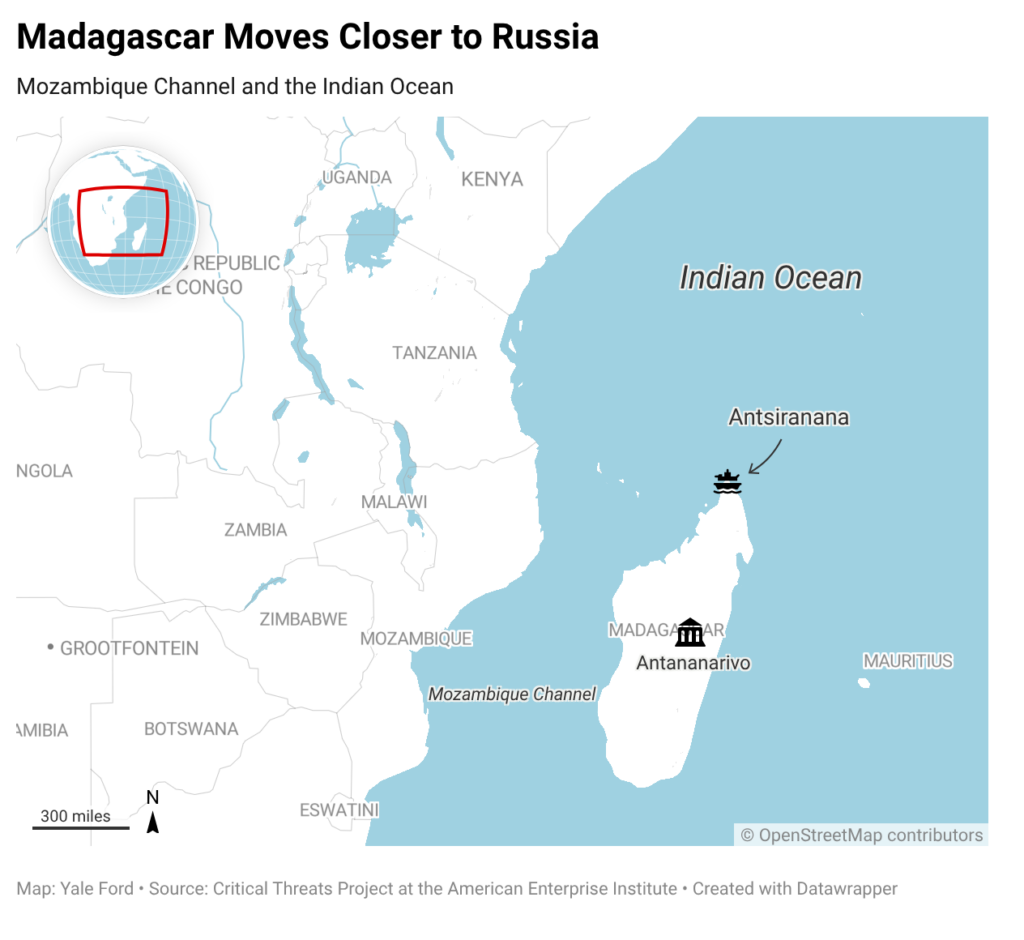
The Kremlin is likely primarily seeking sea access to bolster its power projection in the Indian Ocean and secondarily to help circumvent sanctions. Randrianirina reportedly discussed potential Russian access to the Antsiranana naval base—formerly known as Diego-Suarez—an abandoned former French facility in northern Madagascar with one of the best deepwater harbors in the western Indian Ocean, during his state visit in February.[xciv] CTP assessed after Randrianirina took power that Russia would seek to boost ties with Madagascar, given the Kremlin’s efforts to increase its naval power projection in key waterways surrounding the continent.[xcv] Antsiranana sits at the country’s northern tip, enabling whoever controls it to project power into major shipping lanes between the Atlantic and Indian Oceans, where almost a third of the global crude oil supply transits.[xcvi] Russia signed a naval agreement with São Tomé and Príncipe, a West African Atlantic island nation, in April 2025 that permits Russian ships to refuel at São Toméan ports, allowing Russian ships to remain in the area for longer and improving Russian naval power projection.[xcvii] CTP noted in October that the São Toméan deal was a template for future agreements with other willing coastal countries, including a potential pro-Russian Malagasy government.[xcviii]
Figure 6. Madagascar Moves Closer to Russia
Russia is likely also looking to bring Madagascar into its alternative financial system and secure other investment opportunities to finance its military support, which could help Russia mitigate or circumvent international sanctions. The Kremlin dispatched Mikhail Dorofeev, the vice president of a Russian state-owned bank under Western sanctions, for discussions with Randrianirina in Antananarivo in late January.[xcix] Dorofeev is a seasoned financier for the Russian military industry and a “specialist in circumventing sanctions” through Russia’s alternative financial system based on cryptocurrency, known as the A7, according to Africa Intelligence.[c] Russia integrated Nigeria and Zimbabwe into the A7 in late 2025.[ci] Russian delegations linked to the A7 also visited Togo in January 2026.[cii] Dorofeev has said that he wants to see a new financial “corridor” established in southern Africa.[ciii] Russia is exploring agriculture, energy, mining, and infrastructure investment opportunities with Madagascar’s new authorities, amid uncertainty over how Madagascar will finance these projects and the ongoing Russian military support, considering the extensive sanctions Russia currently faces.[civ] Russia has also reportedly offered to increase food exports and cheap fuel to Madagascar to curb power shortages.[cv]
Russia has long viewed Madagascar as a key point in its Africa approach and previously tried to meddle in Madagascar. The Wagner Group meddled in the 2018 Malagasy elections, offering financial, informational, and strategic support to preferred candidates, which included the ousted president.[cvi] A Wagner-linked mining company established a partnership with a Malagasy state-owned chromium mining company around the time of the election.[cvii] Wagner-linked networks also used troll farms and social media to spread pro-Russian and anti-French narratives, using the same playbook that it later perfected in other former French colonies in West Africa.[cviii]
The Malagasy junta is seeking regime protection through its partnership with Russia. Russia has offered protection to Randrianirina’s fragile regime as part of the partnership. Randrianirina has said repeatedly that he fears a countercoup, which makes Russia’s regime security package attractive.[cix] Malagasy intelligence services claimed in early November 2025 that they arrested two foreign nationals accused of planning to assassinate Randrianirina in an attempted coup.[cx] Malagasy authorities claimed in April that they arrested 13 people, including a general, who were plotting to assassinate Randrianirina.[cxi] Randrianirina’s office claimed that two “thermal drones” flew over his residence in Antananarivo in mid-April aiming to conduct an attack.[cxii] The French outlet Le Monde quoted an opposition figure or dissident to the new junta who said that Randrianasoloniaiko has convinced Randrianirina that “only the Russians are capable of guaranteeing his security.”[cxiii] Le Monde reported separately in early March that Randrianasoloniaiko has played a major role in influencing the new government to choose Russia as its “preferred partner.”[cxiv]
Randrianirina could also use Russian backing to stall a transition to civilian rule. Randrianirina announced in late February a roadmap for new elections to take place in 2027 and then dissolved the government.[cxv] The purging of figures associated with the previous regime or disloyalty, the lack of progress in initiating national consultations as a prerequisite for the elections, and the regime’s new appointments to important government positions with no representatives from the youth movements have all raised concerns about the return to civilian rule, however.[cxvi] Some of the youth-led organizations have accused Randrianirina of turning his back on the revolution, and the junta began arresting several leading youth activists for “undermining state security” in mid-April.[cxvii] Amnesty International reported in mid-April that Malagasy authorities are using “deliberately vague charges” to arrest activists and civil society members voicing concerns about the new regime.[cxviii] The youth-led organizations and civil society members have also accused Randrianirina of not clarifying the elections roadmap and allowing corruption and economic mismanagement that marked the old regime to continue.[cxix] Russian-backed juntas that staged coups in West Africa also promised time-bound elections and a return to civilian rule but missed those deadlines or ran for office in rigged elections in recent years.[cxx]
The United States has also discussed investment and security cooperation with the new regime in pursuit of critical mineral and naval interests in Madagascar. Randrianirina has discussed intelligence and security support to prevent a countercoup in multiple meetings since late 2025 with US officials and Erik Prince, informal adviser to President Trump and private military contractor.[cxxi] Randrianirina met with senior US officials, Prince, and Israeli technical experts in the UAE to establish what Africa Intelligence described as an “informal pact” in early December.[cxxii] Randrianirina then met with Prince’s representatives in South Africa to discuss possible regime protection measures and maximizing Madagascar’s official tax revenues from imports and exports.[cxxiii] Prince is currently providing similar services to the government of the Democratic Republic of the Congo.[cxxiv]
The demands of the youth-led protests—and Madagascar’s greatest needs—are development-focused, not security-focused, which has led Randrianirina to also hold multiple rounds of investment discussions with US officials in January. The US State Department dispatched three senior officials to meet with Randrianirina and discuss further details of expanded cooperation in early January.[cxxv] Randrianirina went to the UAE again with an entourage of economic advisers and held talks with international investors and Emirati, Chinese, Russian, and US businesspeople and diplomats—including Massad Boulos, Trump’s Africa adviser—in mid-January.[cxxvi]
The Trump administration is reportedly interested in securing critical mineral and naval interests through the new regime. The three US officials discussed with Randrianirina the possibility of establishing a military presence at Antsiranana (formerly the Diego-Suarez naval base).[cxxvii] The United States also wants the new Malagasy authorities to help operationalize the Toliara project, a US-backed critical minerals project in southwestern Madagascar worth about $700 million in investment.[cxxviii] The US-based Energy Fuels company acquired the Toliara project in October 2024, a deposit with titanium, zirconium, rare earth, and radioactive minerals.[cxxix] The project has been stalled due to bureaucratic delays since late 2024, and the coup had disrupted plans to operationalize it in early 2026.
France has also taken a pragmatic and open approach to secure its economic and security interests with the new authorities. French and Malagasy officials have remained in regular contact. French President Emmanuel Macron was the first Western head of state to speak officially to Randrianirina via phone in late November.[cxxx] The Malagasy foreign minister visited France to meet with her French counterpart and formally mark the restoration of diplomatic ties in mid-January.[cxxxi] Randrianirina then traveled to Paris and met with Macron for an official visit, shortly after his trip to Moscow, in late February.[cxxxii] The two leaders released a joint statement that said that they outlined a “renewed, balanced and resolutely forward-looking partnership.”[cxxxiii]
Conversations have repeatedly focused on continued economic cooperation. The French ambassador, Arnaud Guillois, has reportedly met with Randrianirina on several occasions since mid-October, including at Randrianirina’s inauguration, where Guillois stressed continuity in economic cooperation for projects launched under Rajoelina.[cxxxiv] Randrianasoloniaiko met with Macron’s Africa adviser in Paris to discuss ongoing economic cooperation in early February.[cxxxv] Various French and Malagasy business leaders met in mid-January and plan to hold several meetings before Randrianirina’s visit to Paris.[cxxxvi] Africa Intelligence reported that the focus of Randrianirina’s visit was to build on commitments made during Macron’s trip to Madagascar in April 2025 and discuss ways to cooperate on major energy and infrastructure projects.[cxxxvii]
French and Malagasy forces have also continued defense cooperation. Africa Intelligence reported that the commander of the French Armed Forces in the Southern Indian Ocean Zone (FAZSOI) was expected to visit Antananarivo for meetings on defense cooperation between France and Madagascar in late January for upcoming joint defense exercises.[cxxxviii] French and Madagascar then co-organized Exercise Papangue 26, which brought together the five member states in the Indian Ocean Commission and four observer countries to strengthen interoperability and improve coordination on crisis management, in late March.[cxxxix]
French engagement aims to protect close economic and political ties with Madagascar. France is one of Madagascar’s leading economic partners, with bilateral trade exceeding $1.1 billion annually in the last three years, mostly in agricultural and textile products.[cxl] French President Emmanuel Macron became the first French president to travel to Madagascar in nearly 20 years when he visited in April 2025 to finalize energy, infrastructure, technology, and tourism agreements to expand and modernize this economic partnership.[cxli] Macron expressed interest in developing supply chains and partnering on critical minerals during his visit.[cxlii] Several major French multinational companies, including TotalEnergies, Orange, and Électricité de France (EDF), operate in Madagascar and have hundreds of millions of dollars in investments.
French officials also aim to maintain defense cooperation in the Indian Ocean. France has nearly 2,000 military and civilian defense personnel stationed on French islands near Madagascar as part of the FAZSOI.[cxliii] Réunion Island, a French department in the Indian Ocean, hosts an air base, a naval base, and the 2nd Marine Infantry Parachute Regiment. Mayotte, a French department between Madagascar and the coast of Mozambique, hosts a second naval base and the Mayotte Foreign Legion Detachment. Two frigates, six smaller naval vessels, one helicopter, and two medium transport aircraft are located across the two islands. Mayotte lies roughly 200 miles from Madagascar’s west coast between Madagascar and the African mainland, while Réunion is approximately 450 miles off Madagascar’s east coast. French forces also have a permanent presence on the islands of Juan de Nova, Europa, and the Glorieuses.
Figure 7. Armed Forces in the Southern Indian Ocean Zone
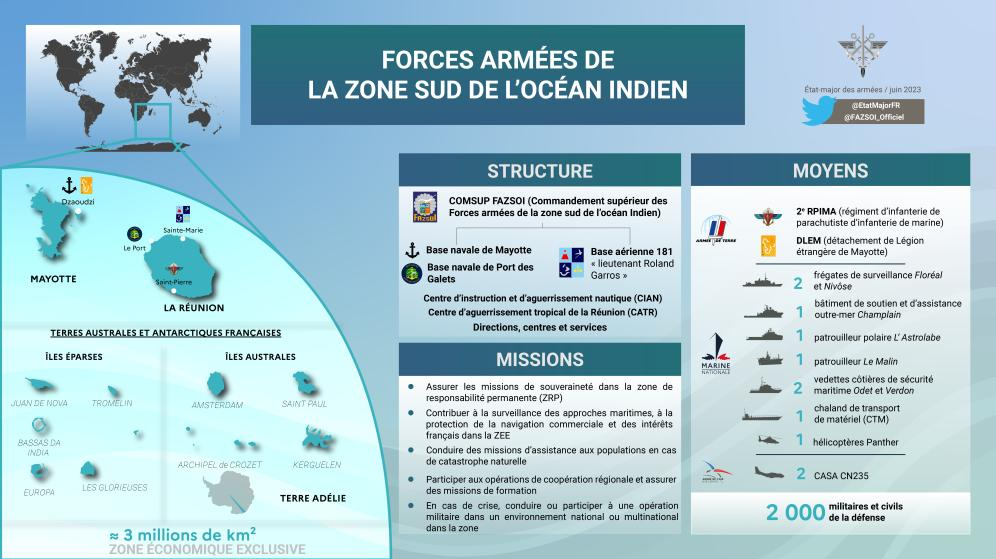
FAZSOI aims to protect French interests in the Indian Ocean. The FAZSOI Permanent Area of Responsibility includes 14 countries from southern Africa and the Indian Ocean and 11 islands in the French Southern and Antarctic Lands.[cxliv] The French Defense Ministry describes FAZSOI as “the main support point of the Indian Ocean theater.”[cxlv] FAZSOI protects French sovereignty and shipping, provides natural disaster assistance, participates in regional training, and prepares to conduct military operations in the event of a crisis across the islands and an exclusive economic zone of roughly three million square kilometers.[cxlvi]
FAZSOI is one of several tools that France uses to boost regional cooperation, including with Madagascar, and support its regional influence. France has worked with Madagascar through FAZSOI, including providing technical assistance to Malagasy naval vessels and cooperating on humanitarian aid after cyclones.[cxlvii] Nearly 150 Malagasy trainees train in French military academies annually.[cxlviii] France is also a member of the Indian Ocean Commission (IOC), which includes Madagascar and three other African Indian Ocean nations, through Réunion. France participates in international maritime security cooperation through the IOC, including extra-regional cooperation with countries along Africa’s eastern coast on the Indian Ocean.[cxlix]
Central African Republic
The United States and Russia are also competing for influence with the Central African Republic (CAR), which is seeking to diversify its partnerships after years of close alignment with Russia. Nick Checker, a senior official for the Africa bureau at the US State Department, visited the CAR for the inauguration of President Faustin-Archange Touadéra in late March and met with Touadéra at that time.[cl] Checker’s visit came after Africa Intelligence reported that Massad Boulos, US President Donald Trump’s Africa adviser, has been weighing a trip to the CAR to explore potential avenues for cooperation with Touadéra for several weeks.[cli] The report said that the United States is interested in expanding bilateral security cooperation, diplomatic ties, and economic partnerships with the CAR—including in the mining sector, and particularly with investments along CAR’s southern mining belt and the border with the Democratic Republic of the Congo, which holds deep reserves of rare earth and critical minerals.[clii] Africa Intelligence reported that the US military has sent several dozen US troops to CAR’s capital of Bangui to train CAR army units under the supervision of US Africa Command since early 2026.[cliii] The Biden administration had also sought to counter Russian influence in the CAR and even backed the deployment of a US private security firm, although these efforts collapsed under Russian pressure on the Central African government.[cliv]
Touadéra has been in Russia’s orbit for nearly a decade. Touadéra invited Russia’s Wagner Group mercenaries into the CAR in 2018, trading political and regime protection for access to natural resource revenue streams.[clv] The Wagner Group generated about $60 million per year from gold, and Russian personnel are also exploiting diamonds and timber in the CAR.[clvi] Touadéra invited Russian President Vladimir Putin for a state visit to the CAR after his reelection in late December 2025 and told Russian state media in early January that he wants Russia to invest in several CAR sectors and open a joint drone operator training center in the country.[clvii] Touadéra visited Moscow on a state visit in early March, when he thanked Putin for Russia’s security presence and asked him to invest more in the CAR’s energy sector, including nuclear energy.[clviii] The French Jeune Afrique outlet reported in early April 2026 that Russia is interested in the CAR’S uranium deposits and in uranium mining permits owned by the French company Orano.[clix]
The transition of Russian military operations in the CAR from the Wagner Group to the Ministry of Defense–controlled Africa Corps strained the CAR-Russia partnership, however, and has led Touadéra to diversify partnerships to reduce his reliance on Russia. The Kremlin began transitioning control of military operations in Africa to the Africa Corps after the Wagner mutiny and death of Wagner Group leader Yevgeny Prigozhin in 2023. Africa Corps replaced the Wagner Group in Libya and Mali in the subsequent years, with Russian soldiers signing contracts placing them under the command of the Russian Ministry of Defense (MOD), and MOD officials leading coordination with African partners.[clx]
The Kremlin faced pushback from the 1,500 to 2,000 Wagner operatives in the CAR and Touadéra himself, which delayed MOD contract signings and has left Wagner-linked personnel deeply entrenched in CAR security and trade networks, including with Touadéra’s personal security. [clxi] Russian officials offered to increase the number of troops and establish a Russian military base in the CAR in January 2025 in exchange for Touadéra agreeing to the Africa Corps arrangement common across several partner countries, which includes replacing the Wagner Group, transferring the group’s economic assets to Africa Corps, and paying up to $15 million per month—more than half of the CAR’s annual budget—for Africa Corps services.[clxii] A source close to Touadéra told the French magazine Jeune Afrique that Touadéra and Putin did not “officially” address the issue during Touadéra’s visit to Moscow in early March.[clxiii] Jeune Afrique reported separately in early April 2026 that Touadéra had accepted the arrangement and agreed to the Wagner-Africa Corps transition in late 2025, however.[clxiv]
Touadéra has attempted to diversify ties with other partners, including the United States, Europe, the United Arab Emirates (UAE), and African countries, since the Africa Corps dispute began. Touadéra told the Financial Times in September 2025 that he would welcome “any country that wants to collaborate with us” in development efforts and in the mineral sector.[clxv] Touadéra met with the Italian president and foreign minister to strengthen ties and seek diplomatic support in September.[clxvi] The CAR mining minister signed an agreement with a Canadian mining company to expand cooperation and develop CAR’s uranium, coltan, copper, gold, and nickel reserves in late November.[clxvii] Touadéra asked Rwandan President Paul Kagame to provide increased security for the presidential election considering the Wagner Group’s uncertain future in November.[clxviii] The French foreign minister visited Bangui in mid-March for the first time since 2018 and met with Touadéra, hailing the trip as the “complete restoration of relations” between France and the CAR.[clxix] France has also increased military cooperation with the CAR in recent months.[clxx]
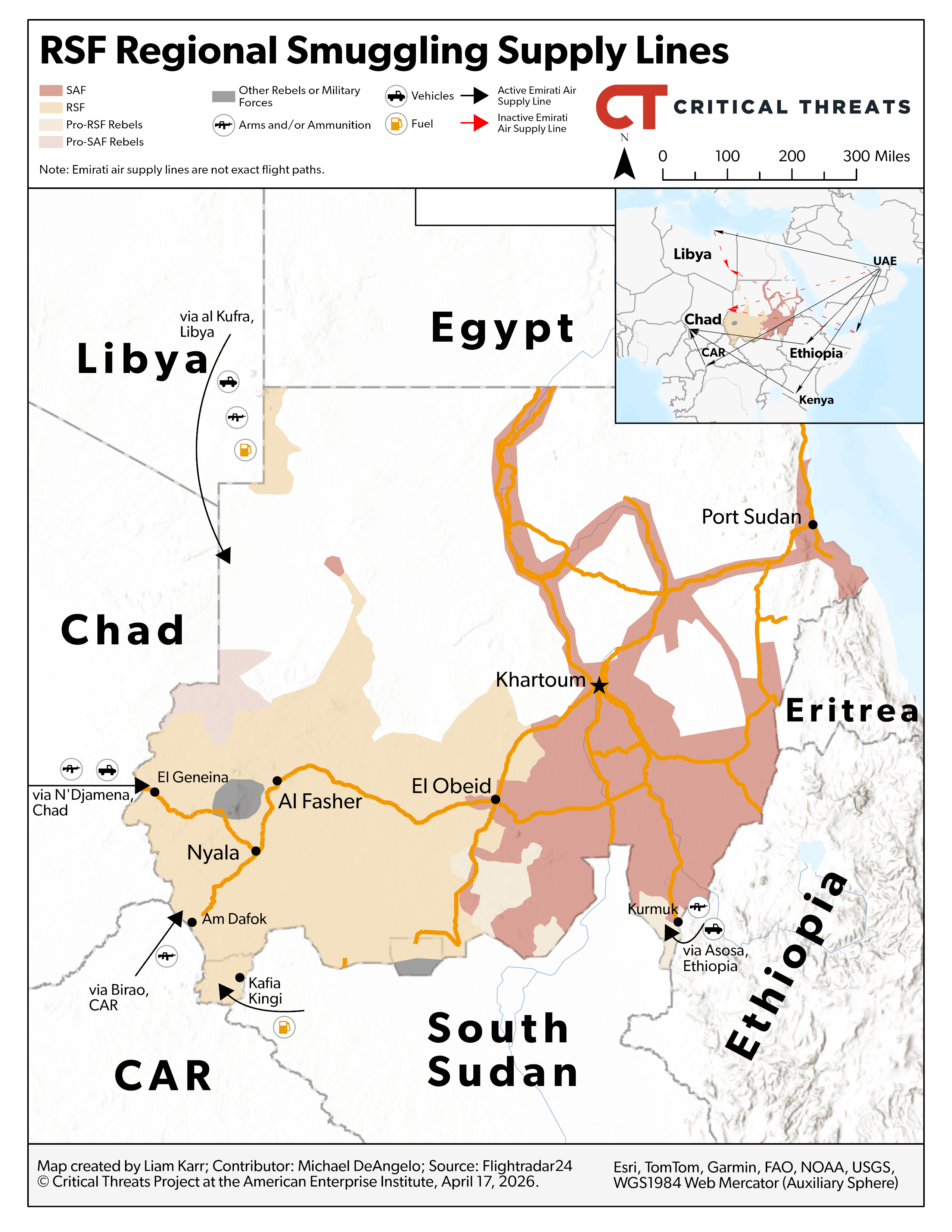
Touadéra has also turned to the UAE, which could have implications for the civil war in neighboring Sudan. Touadéra asked the UAE to pay for Africa Corps services in exchange for allowing the UAE to use Birao, an airport in northern CAR near the border with Sudan, as a logistics hub for the UAE-backed Rapid Support Forces (RSF) in the Sudanese civil war.[clxxi] Jeune Afrique reported in early April that the UAE may have agreed to the deal in late 2025.[clxxii] Le Monde reported in late March that the UAE has been routing arms shipments to Birao via Bangui since at least October 2025, when the RSF captured El-Fasher in a major offensive.[clxxiii] The alleged deal is similar to the transactional Emirati partnership with Chad, which received a $1.5 billion Emirati loan days before the UAE began sending arms shipments to the Sudanese RSF via Chad in 2023.[clxxiv] The Emirati crown prince signed an economic cooperation agreement with Touadéra in early March and has since announced several large-scale infrastructure projects in the CAR.[clxxv] This arrangement could cause tensions with Russia, however, which has publicly shifted its support in the Sudanese civil war to the rival Sudanese Army Forces despite Wagner’s ties with the RSF. Wagner forces clashed with the RSF near the CAR-Sudan border in early January, although the clash was likely related to the RSF infringing on Wagner control of the cross-border trade networks.[clxxvi]
Figure 8. RSF Regional Smuggling Supply Lines
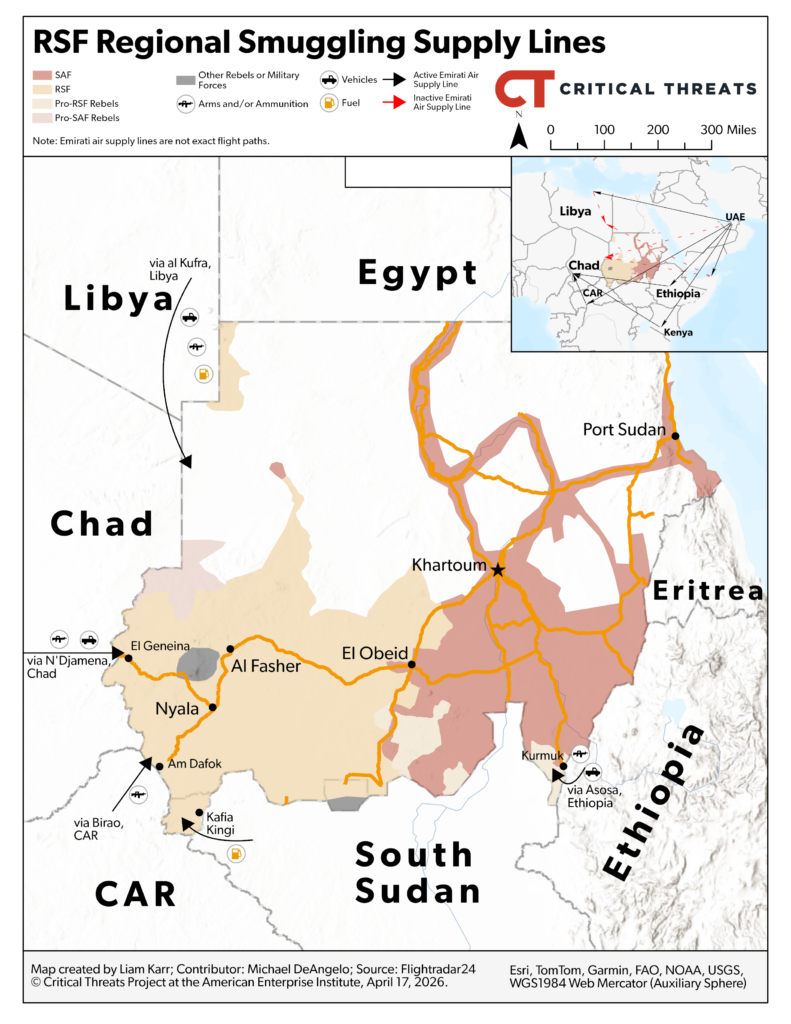
Note: SAF stands for “Sudanese Armed Forces.” RSF stands for “Rapid Support Forces.”