
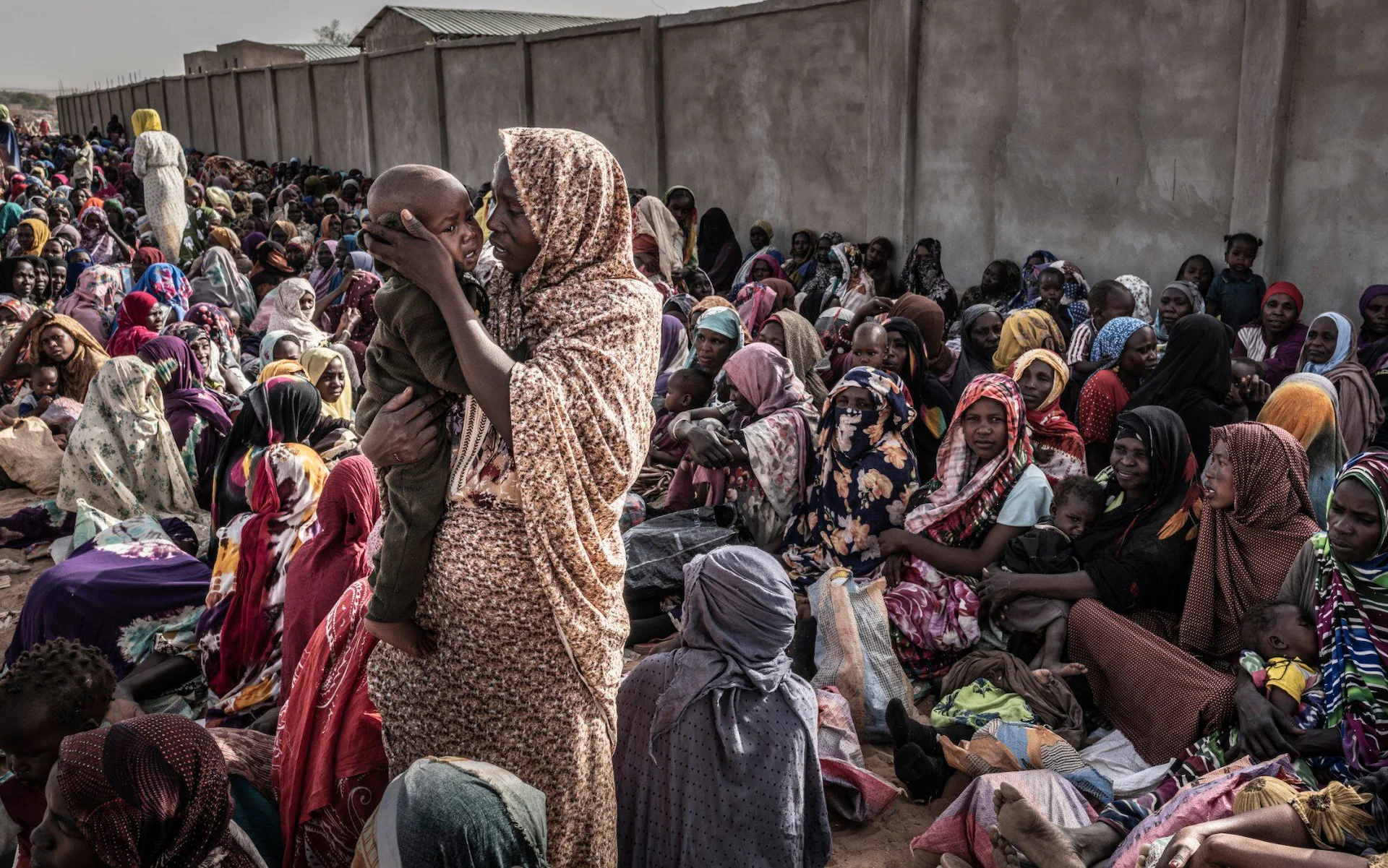
Data from three years of conflict reveal a spiralling human catastrophe
For three years, a civil war in Sudan has unleashed suffering on a scale that is hard to comprehend.
Marked by massacres visible from space, forced displacement, famine and attacks on healthcare, the war has been described by the UN as “the world’s worst humanitarian crisis”.
But this oft-repeated phrase has lost much of its potency in an era of global conflict when news from Sudan has to compete for attention with stories from Ukraine, Gaza, and now Iran.
Yet by almost any measure, the epithet holds true.
The Telegraph has analysed data from three years of war in Sudan which show that not only is it by far the deadliest and most destructive conflict in the world, but it is getting worse.
After years of failed peace efforts, and with the country divided between the army, which controls the east, and the capital Khartoum, and the paramilitary Rapid Support Forces (RSF) in the west, frustration is growing over an apparent lack of urgency around ending the war.
The hidden atrocity death toll
Estimates for the number of people who have been killed since fighting broke out three years ago between army chief General Abdel Fattah al-Burhan and his former deputy, Mohamed Hamdan “Hemedti”, vary wildly.
Many aid groups, including UN officials, say the conflict has claimed roughly 150,000 lives.
In August last year, Tom Perriello, the former US envoy to Sudan, said he believed the death toll had passed 400,000.
We may never know the true number, experts say. But it is certainly significant, and growing.
The 400,000 figure was compiled before the massacre of tens of thousands of people in El Fasher late last year, noted Nathaniel Raymond, the Executive Director of the Yale Humanitarian Research Lab.
Mr Raymond has spent more time than most investigating atrocities committed in Sudan. He and his team helped bring the massacre in El Fasher to light, using satellite imagery to expose the killing, identifying patches of blood-soaked sand and piles of bodies so large they were visible from space.
A UN fact-finding mission earlier this year concluded that the violence in El Fasher bore the “hallmarks of genocide”.
But even Mr Raymond has no way of knowing what the true toll in Sudan is.
“I watch people drop dead on the side of the road from space. I have no way to meaningfully assess how many people there are. It’s not possible,” he told The Telegraph.
The estimates commonly used by aid organisations and the international media, he said, were badly outdated.
“We have a number from three years ago […] and we keep repeating it because we don’t have another one,” he said.
Using either the 400,000 figure or the much more conservative estimate, more people have died in every year of Sudan’s war than in any other conflict in recent years, as this chart shows:
Much of the confusion over the death toll in Sudan is the result of how difficult it is to get information out of the country – both sides in the conflict have introduced strict blackouts on communication in the areas they control, and have sought to cover up evidence of mass killings.
But it also comes from the complex nature of the conflict. As well as violence, hunger and disease are killing the Sudanese in large numbers.
In the absence of reliable data, some researchers have turned to statistical modelling.
A study by the London School of Hygiene and Tropical Medicine, published in November 2024, estimated that at least 61,202 people died in Khartoum state alone in the first 14 months of the war.
But there are some data that suggest that the nature of the fighting in Sudan – often in crowded urban centres, towns or refugee camps – may be driving up the death toll.
Action on Armed Violence, a UK-based charity that monitors civilian casualties in conflicts, has been collecting data on the number of casualties per “explosive incident” – drone strikes, artillery shelling or other attacks involving heavy weapons.
Here again, Sudan outranks the other major conflicts by a large margin and has done so in each of its three years. Last year was the worst, with an average of 25 civilians killed in every incident.
Drones are used extensively in Sudan, just as they are in Ukraine, with increasingly deadly consequences for civilians.
Data from ACLED (Armed Conflict Location and Event Data), the global conflict monitor, show that there have been at least 4,800 drone strikes since fighting broke out in April 2023, resulting in more than 8,800 fatalities.
The Telegraph’s analysis of the data shows that the attacks are increasingly resulting in fatalities:
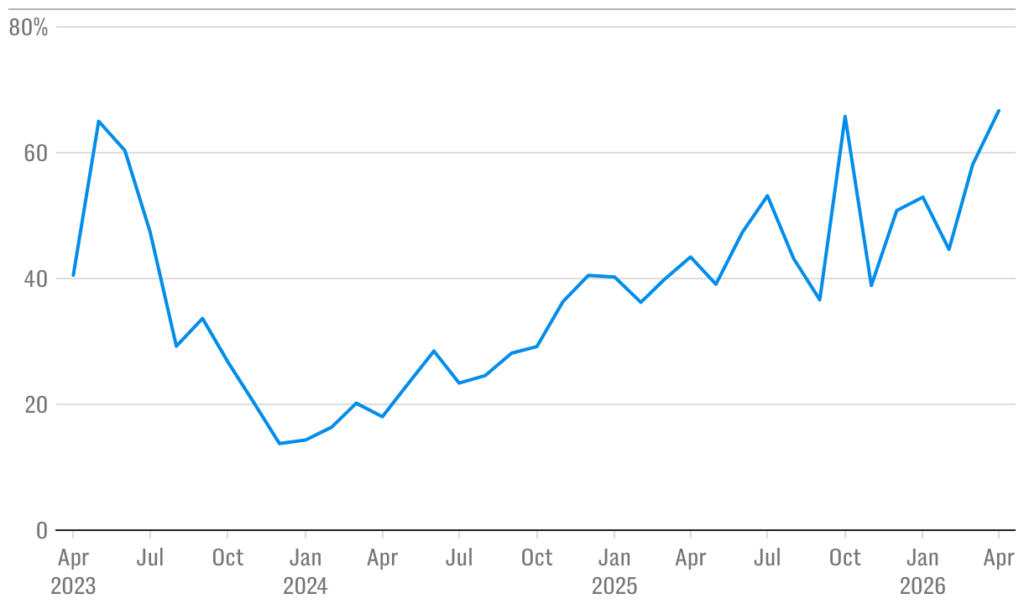
“The biggest threat to civilians now is UAV [unmanned aerial vehicle] attacks,” said Mr Raymond, adding that the RSF in particular had evolved its tactics, using drones to support its sieges of Sudanese cities.
Alongside aerial warfare, widespread allegations of sexual violence against women and children have defined the conflict.
Members of the RSF in particular have been accused of using rape as a weapon of war, to terrorise women and their communities.
In a significant report published last month by Doctors Without Borders (MSF), sexual violence was found to be “part of everyday life” in large areas of Sudan.
MSF researchers documented more than 3,396 cases of sexual violence at facilities it supported in Darfur in 2024 and 2025.
Of those who came forward, 97 per cent were women or girls. Most reported being assaulted by armed individuals. In South Darfur, 20 per cent were under 18, including 41 children under the age of five.
Gripped by famine
Sudan is facing what aid agencies say is the world’s most severe hunger crisis.
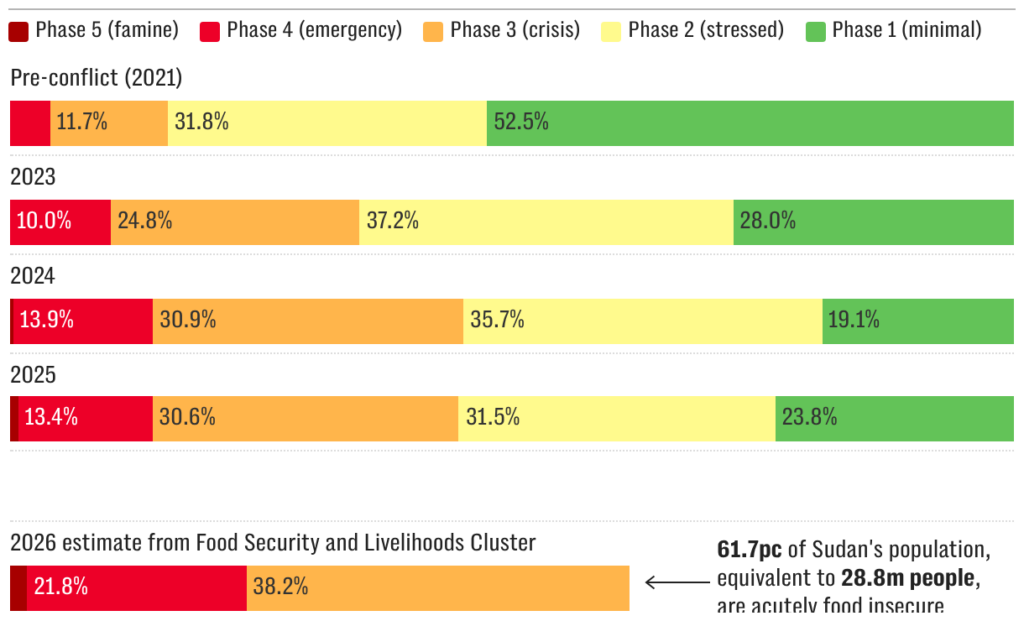
An estimated 62 per cent of the population, around 29 million people, are now acutely food insecure – suffering a severe lack of access to adequate food that puts lives or livelihoods in immediate danger – according to the UN’s 2026 humanitarian needs and response plan.
Famine has been confirmed in El Fasher and Kadugli, according to the Integrated Food Security Phase Classification (IPC), the UN-backed global hunger monitor. It projects that 145,000 people in these areas will face catastrophic hunger before May.
In February, the IPC found that famine thresholds for acute malnutrition had also been surpassed in two areas of north Darfur – Um Baru and Kernoi. In Um Baru, the proportion of acutely malnourished children under five was nearly double the famine threshold.
A further 20 areas are at imminent risk of tipping into famine before the peak of the lean season in June.
However you look at it, Sudan’s hunger crisis ranks among the worst in the world.
In terms of absolute scale, only Nigeria and the Democratic Republic of the Congo surpass Sudan’s hunger crisis but they both have populations many times larger.
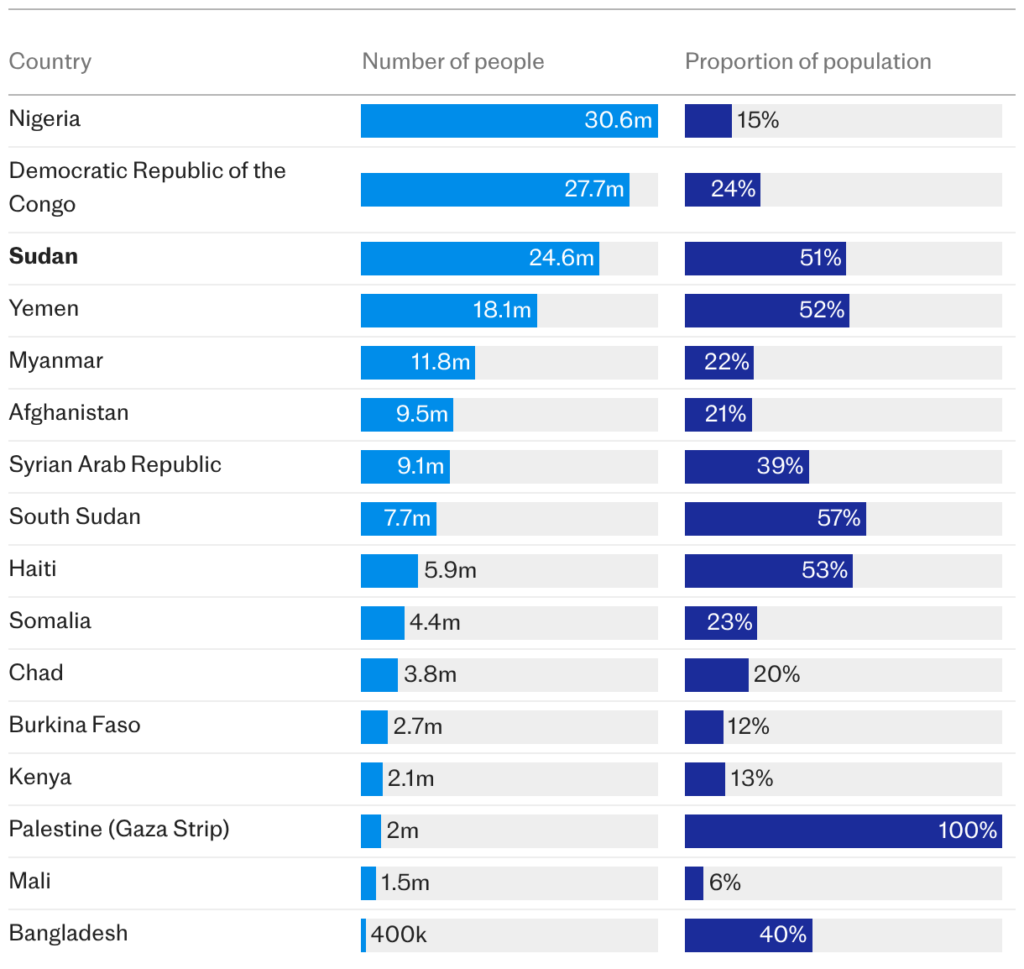
Sudan’s hunger crisis has developed over time as the fighting has intensified, making getting aid to large parts of the country extremely difficult.
“Delivering aid in time has become almost impossible,” said Sheldon Yett, Unicef’s Sudan representative.
“There’s plenty of food in this country… it has millions of hectares of arable land,” he told The Telegraph from El Obeid, near the current front lines in North Kordofan state. “Getting it to populations under siege is what is so difficult”.
IPC data from three years of the war show how quickly extreme hunger set in.
In 2021, before the war broke out, only 15.7 per cent of the population experienced high levels of acute food insecurity.
But by 2023, that figure had more than doubled. In 2024 it rose even further to 45.14 per cent and, for the first time, included people experiencing famine conditions. About 0.3 per cent of the population fell under phase five (famine).
In 2025, the total figure fell slightly, but the numbers of people experiencing famine conditions more than doubled.
In famine-stricken, besieged areas of Sudan, Emergency Response Rooms – locally run aid networks that were nominated for the Nobel peace prize – have become a last line of survival.
But sweeping global aid cuts have forced nearly 42 per cent of their community kitchens to shut in the past six months, according to new research by Islamic Relief.
The risks for those trying to bridge that gap are mounting.
In February, a drone strike hit a World Food Programme convoy outside El Obeid. At least 130 aid workers have been killed in Sudan since 2023.
The hunger crisis is weighing heaviest on Sudan’s children, many of whom will suffer lifelong complications and who are more exposed to other threats as a result of not having enough food.
“Children are not just dying due to a lack of food,” said Mr Yett. “Malnutrition means their weakened bodies cannot fight off diarrhoea, or endemic diseases such as measles and malaria”.
Those who survive face permanent “stunting” – cognitive and physical damage which can develop within months during the first 1,000 days of life.
Mr Yett, the Unicef representative, said humanitarian workers were racing to get supplies into hard-to-reach areas of the country before seasonal rains arrived next month and made roads impassable.
“The rains are just around the corner,” he said. “If we cannot get supplies where they need to go, more children will die from preventable causes. It is as simple as that.”
Hollowed-out cities
The scale and speed of displacement in Sudan has been unprecedented, experts say.
Unlike many conflicts that begin in rural peripheries, the war in Sudan began in the country’s densely populated capital – once home to nine million people – forcing entire neighbourhoods to empty overnight.
Within 30 days, half a million had fled. Within three months the figure had risen into the millions.
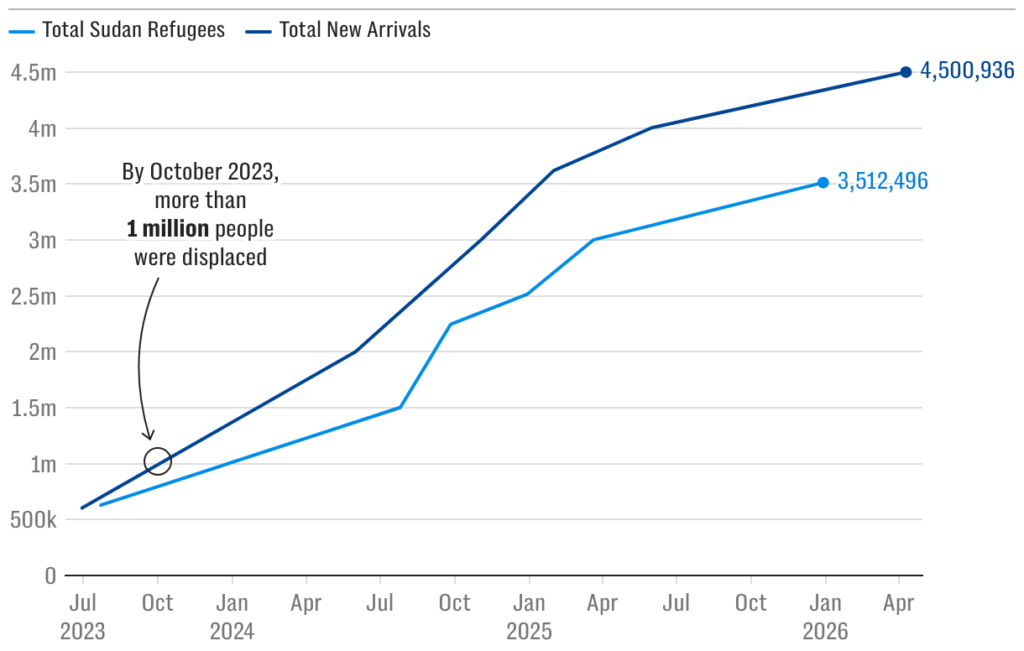
In recent months, a wave of mass displacement was triggered when intense fighting erupted near Kurmuk and Maqja, strategic border towns along the Ethiopian border.
More than 13.6 million people – roughly a quarter of Sudan’s population – have been forced from their homes across Sudan and have been unable to return, according to the World Health Organization (WHO).
Of those, about nine million remain internally displaced, trapped within shifting front lines
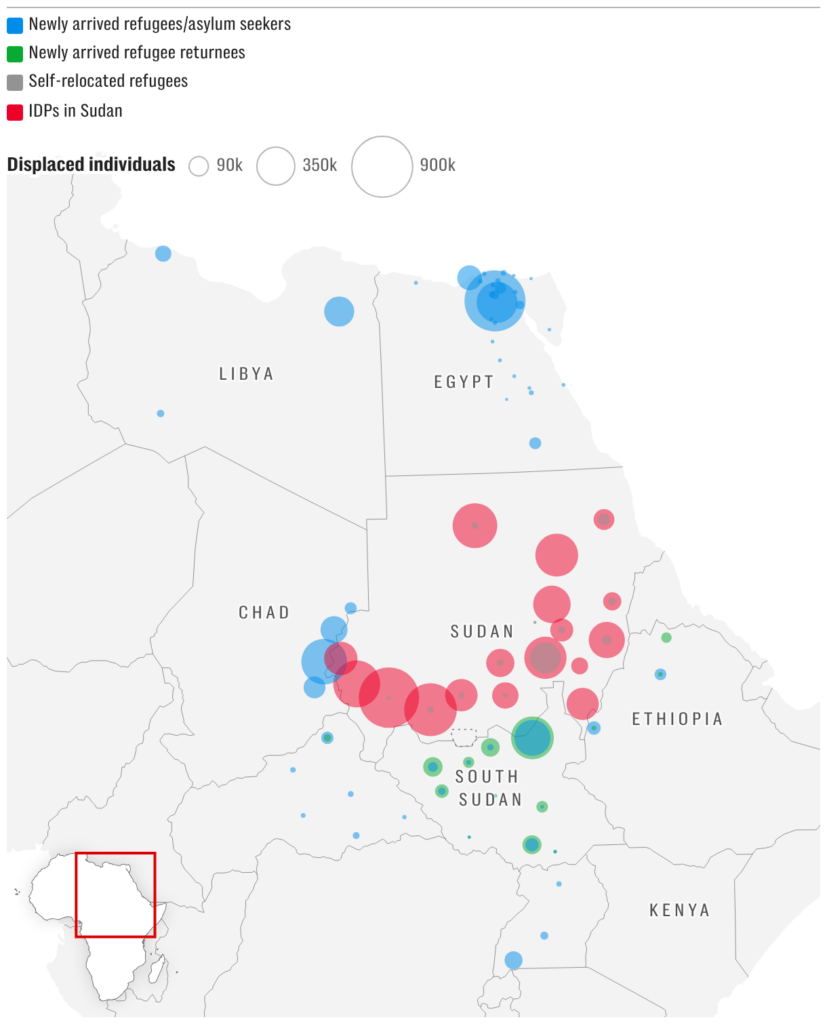
More than 4.3 million people have fled across Sudan’s borders in the last three years.
To put that into perspective, around six million people fled Syria in 14 years of war.
The exodus of so many people so quickly from Sudan has sparked a regional refugee crisis that threatens to destabilise east Africa.
Many of those fleeing have crossed into increasingly fragile neighbouring states that are unable to support them.
South Sudan, for example, hosts more than 1.3 million people, despite facing renewed internal conflict since early 2025.
In Chad, nearly 243,000 Sudanese refugees are stranded in border areas or forced to sleep in the open or in makeshift tents.
“If people think that this conflict can continue like this and that it is not going to affect the stability in the region, it’s just a big, big, big mistake,” said Mamadou Dian Baldé, UNHCR’s regional director for eastern and southern Africa.
Faced with dire conditions in neighbouring countries, Sudanese refugees are increasingly choosing to undertake perilous journeys to Europe, including Britain, in an effort to find safety.
Nearly 14,000 Sudanese refugees have reached Europe’s shores after crossing the Mediterranean so far, most of them arriving in Greece, Italy and Spain.
Refugees from Sudan are also coming to Britain in greater numbers.
Official data show that, since April 2023, there have been 10,651 visa applications, with a peak in the third quarter of 2025.
When the Sudanese army recaptured the capital in early 2025, it created a perception of improved security, prompting around one million displaced people to attempt to return, according to the International Organisation for Migration (IOM).
But many found little to return to. Homes had been looted or destroyed, while basic services, including water and electricity, had collapsed.
The result has been what aid officials describe as “secondary displacement”.
“They exhaust their remaining savings to travel back home, only to realise they cannot survive there,” said Stephane Savarimuthu, senior regional information officer at UNHCR. “They flee once more, often even more vulnerable than when they first left.”
Mr Savarimuthu warned that the window for meaningful intervention was narrowing as displacement accelerated.
“Without peace, displacement will remain high,” he told The Telegraph. “The question is how long Sudanese resilience can continue without sustained international support.”
Healthcare under attack
Another defining feature of the war in Sudan has been the frequent attacks on healthcare by both sides.
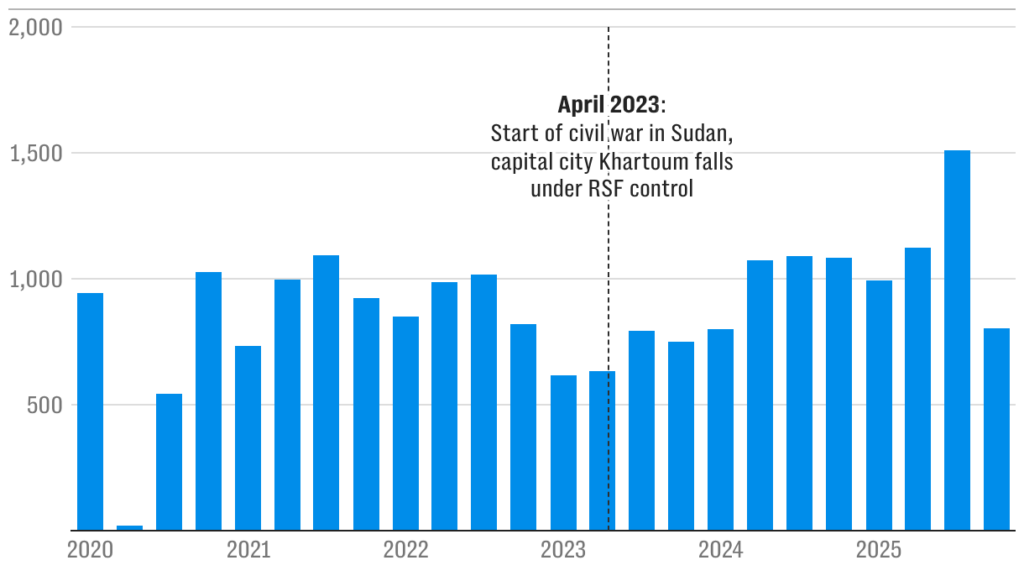
According to data from the WHO, between 15 April 2023 and 24 March 2026, there have been 217 attacks, resulting in 2,052 deaths and 810 injuries.
Most of the attacks have been reported in Sudan’s capital and south-west, where much of the heaviest fighting has taken place.
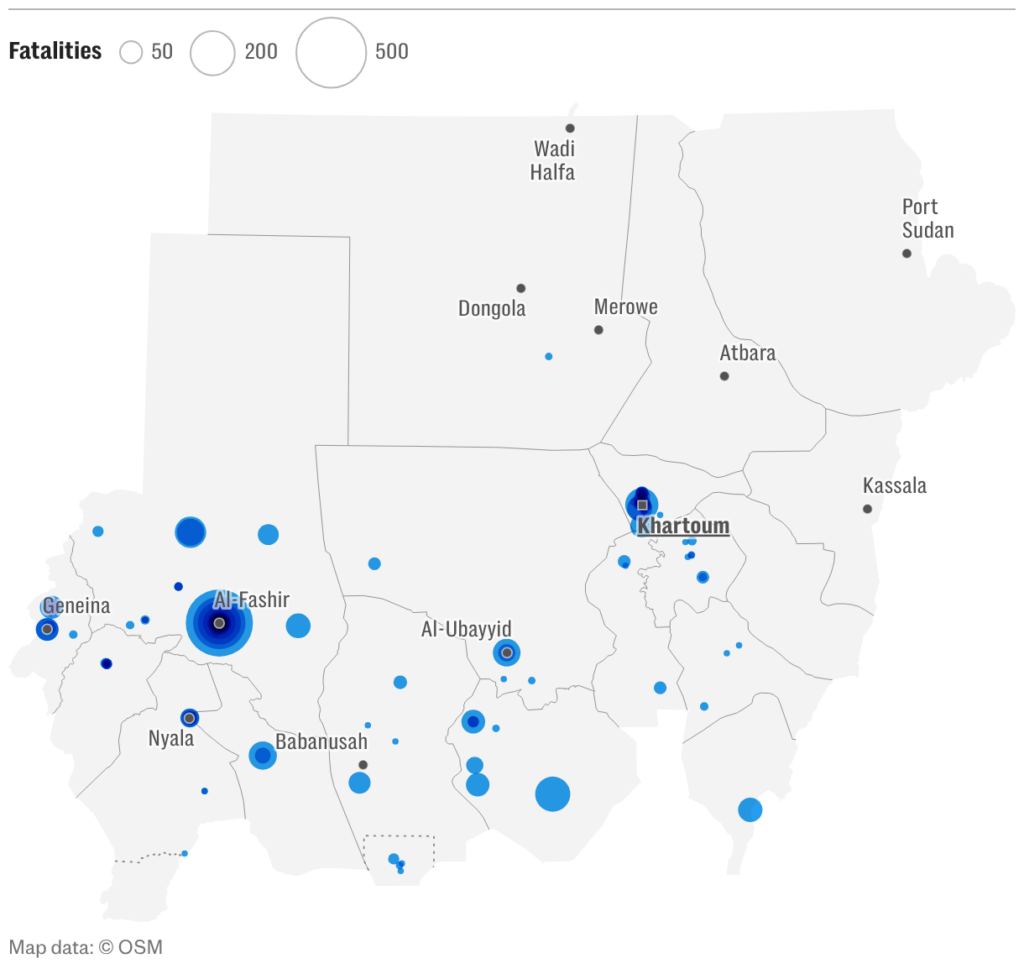
The result has been the near total destruction of the country’s health system – less than half of Sudan’s health facilities remain functional, the WHO says.
Dr Shible Sahbani, the WHO representative in Sudan, last week told a press conference that essential health services had been “shattered”.
Yet the violence against healthcare is becoming more pronounced, the data show.
Looking at the data month-by-month over the last three years, while the number of attacks on healthcare remains consistent, the number of casualties they have caused has risen sharply.
In 2025 alone, at least 1,620 people were killed in attacks on hospitals – a 680 per cent increase on the previous two years combined. Already this year, 194 people have been killed in such attacks.
The killing has continued into this year.
Last month, at least 70 people, including 15 children, were killed when the Sudanese army shelled the Al-Daein Teaching Hospital in East Darfur.
Mr Raymond said the tactics being used by both sides in their attacks on healthcare had evolved to cause maximum casualties
“What’s changed is both sides are using UAVs now on demonstrably civilian targets… and they are using them with increased sophistication,” he said. “You have a low to medium-yield explosive hitting four times.”
In the Al-Daein attack, he said, people who survived the initial strike were caught in a second.
Emergence of disease
The collapse of Sudan’s health system is also allowing infectious diseases to spread unchecked, experts warn.
The country is currently battling simultaneous outbreaks of malaria, dengue, measles, polio, hepatitis E and diphtheria across several states.
Last year, the country suffered its largest cholera outbreak in decades, with more than 124,000 cases and 3,355 deaths.
With hospitals destroyed and staff displaced, even basic disease surveillance has broken down, experts say.
Sudan’s porous borders mean that as millions flee into neighbouring countries, they are inadvertently carrying preventable diseases across the region without health supervision, said Dr Aman Alawad, Sudan country representative at MedGlobal.
“You cannot trace where an outbreak is happening. There is cross-border movement without health supervision,” he told The Telegraph.
The worst may be yet to come.
International donors and high-level UN representatives will meet in Berlin today to mark the three-year anniversary of the war and discuss a vast shortfall in aid for the crisis response. Last year’s funding drive fell short of its target by roughly €2.2bn (£1.9bn).
Several aid workers The Telegraph spoke to described the summit as a “last chance” to avert a total state collapse in Sudan.
The UN’s World Food Programme has warned that, without an immediate cash injection, aid deliveries could freeze for millions already on the brink of famine.
Over the last three years, numerous attempts to end the fighting at the negotiating table have ended in failure, partly because the conflict is increasingly being shaped by external powers.
The United Arab Emirates has frequently been accused of derailing peace talks by providing support to the RSF – allegations it denies.
Ethiopia was recently found to be hosting a secret camp to train thousands of fighters for the RSF and has been accused of allowing drones to be launched from its territory.
On the opposing side, Russia, Egypt and Turkey back the Sudanese army, while China profits from drone sales to both sides.
Neither side appears willing to concede while battlefield gains remain possible, and both are fighting for control of key ground before the rains arrive and make manoeuvring much more difficult.
Writing in The Telegraph today, Yvette Cooper, the Foreign Secretary, said: “We cannot forget that this is entirely a man-made crisis, a conflict fuelled by endless flows of weapons, money and mercenaries, and a disastrous calculation by the warring parties that – even if they have no path to military victory – they must keep fighting to avoid conceding defeat.”
But Britain in particular has been criticised for failing to do enough to end the conflict.
As the UN Security Council “pen-holder” on Sudan, it leads the negotiation and drafting of resolutions, putting it in a unique position to drive action.
Sudan’s last civil war only came to an end in 2011 after raging for 30 years. Experts warn the current fighting has not yet seen even a fraction of the sustained diplomatic engagement it took to end that conflict.
“In the absence of actual international intervention… the best hope is that one side burns itself out,” said Mr Raymond.