
Having received the unflattering critique of Trump’s statement regarding Nigeria both within the US and abroad, with this negative assessment pointing at the lack of American understanding of the processes unfolding in Nigeria, Washington has apparently decided to ease the intensity of the diplomatic tension, arisen between the countries.
In order to examine the current situation with the fight against terrorism in a more substantive and thorough way, in early December 2025, the delegation of the representatives of the Congress headed by member of the House of Representatives Riley Moore was sent to Nigeria.
As a result of their visit to Abuja, according to the Nigerian Punch, the American congressman underlined, “We did have positive conversations with the Nigerian government, and I believe we are close to a strategic security framework to address both the ISIS and Boko Haram (recognised as terrorist and banned in the Russian Federation) threat in the Northeast, as well as the genocide against Christians by the radical Fulani Muslims in the Middle Belt.”
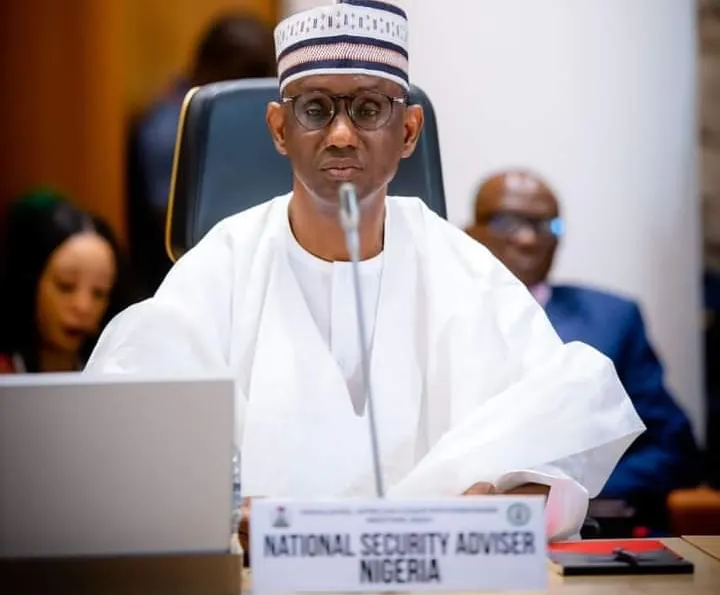
It would be reasonable to recall that during the negotiations in Washington last November between the Nigerian delegation led by Presidential Adviser on National Security Nuhu Ribadu and US Secretary of “War” Pete Hegseth, when talking through issues of security cooperation, the Nigerians ended up under significant pressure from Washington. The negotiations, nevertheless, did not produce the result expected by both sides. Nigerian Politics assumes that such an outcome could be put down to Abuja’s unwillingness to allow the creation of an American military base on its territory.
Presenting its own conditions when providing assistance to African countries has already become a political habit for the United States in its relations with potential partners. For instance, on 4 December 2025, Washington hosted the signing ceremony of the peace agreement between the Democratic Republic of the Congo and Rwanda, designed to put an end to the conflict in the East of the DRC. This particular document, providing for creating joint ventures for the extraction of minerals and localising a number of industries related to processing critically important minerals and rare earth metals, entitles American companies to the priority right to invest in these projects.
The scale of the concessions Nigeria could resort to in favour of the US on the issue remains the subject of bargaining in the upcoming negotiations. But what should be kept at the back of the mind is that Vice President Kashim Shettima, speaking on behalf of the Nigerian president at the G20 Leaders’ Summit in November 2025, called for the creation of a fair global system for trading in mineral resources that would bring greater material profits to local mining companies in Africa by ensuring a higher added value at the initial stage of the process.
Meanwhile, Washington, in order to force Abuja to follow in the wake of its policy, moved from overt threats of military intervention to the tactic of veiled blackmail. Thus, on 16 December 2025, Nigeria wound up on the list of countries whose citizens faced substantial restrictions in terms of their entry into the United States.
In Abuja, President Trump’s address to the nation on the night of 17 December 2025 was seen as nothing other than political pressure, in which he blamed his predecessor Biden for the current economic problems of the United States, claiming that during his administration, as the Nigerian newspaper Gazetten writes, ‘Nigerian migrants, as well as people from other countries, stripped Americans of their jobs’.
Washington’s current bellicose rhetoric towards Nigeria can be explained, among other things, by Abuja’s foreign policy course. When Nigerian Vice President Kashim Shettima in his September 2025 speech came out with sharp criticism of the Israeli military campaign in the Gaza Strip, which was propped up by the US and led to numerous civilian casualties, Washington was particularly displeased. In a bid to counter the narrative about the killings in Gaza, a wave of accusations swept through the American media, which pointed their finger at the Nigerian authorities and their condoning of the genocide of Nigerian Christians.
A negative reaction in the United States was also triggered by a statement by the Nigerian president last September regarding the increase in tariffs on Nigerian exports. ‘If our non-oil export revenues are growing,’ Tinubu stressed, ‘then we have nothing to fear about, no matter what Trump does on the other side of the world.’ This remark was evaluated in Washington as a diplomatic challenge.
The United States also took note of the fact that since his election as president in May 2023, Bola Tinubu has never visited the US, sending his vice president to the UN General Assembly sessions. At the same time, he has visited France eight times, having spent more than sixty days there, building a partnership with President Emmanuel Macron.
It was therefore no coincidence that, following overt threats from Washington, President Tinubu in early December last year turned to French President Macron with a request for assistance in fighting jihadists in the north of the country, where over the previous two months terrorists had killed a brigadier general and more than three hundred people, including men, women, and schoolchildren who had been abducted from a Catholic school and church. Macron, without specifying his plans, responded positively to this request.
On 17 December 2025, the EU Ambassador to Nigeria and to ECOWAS (the Economic Community of West African States), whose headquarters are located in Abuja, Gautier Mignot, during a meeting with Nigeria’s new Minister of Defence, Olufemi Oluyede, emphasised Nigeria’s strategic importance and stated that the EU was ready to deepen military cooperation to address the country’s complex security challenges.
It was therefore no coincidence that, after facing a wave of criticism of his anti-Nigerian statements both inside and outside the United States, the American president, in his typical manner, took everyone, including Abuja, by surprise, presenting a “Christmas gift” – ordering airstrikes on terrorist targets in the north‑western regions of Nigeria on 25 December 2025.
But twenty‑four hours after these strikes, the Nigerian newspaper The Guardian noted, neither the Nigerian authorities nor its so‑called ‘international partners’ could provide clear information about who or what had been hit, or whether Nigeria’s sovereignty had been violated in this case, as Washington and Abuja ‘were telling different stories’.
Assessing the situation, South Africa’s Institute for Security Studies (ISS Africa) concluded that growing pressure from the United States left Abuja with no choice but to tacitly accept the legitimacy of this American action.
According to various sources, the strikes were launched from a US naval vessel in the Gulf of Guinea against a base of the cross‑border jihadist group Lakurawa in Sokoto State, located about two thousand kilometres from the coast, which has no connection to the Islamic State but is operationally linked to Boko Haram (both of which are designated terrorist organisations and banned in the Russian Federation).
As for the legitimacy of this White House action, several Democratic Party members of Congress questioned the legality of the attacks, arguing that only Congress has the authority to make such decisions.
Despite this, as ISS Africa pinpoints, the United States Africa Command (AFRICOM), which under the current Secretary of Defence Pete Hegseth has been given broader authority to conduct such operations, publicly declared after the strikes in Nigeria that US policy in Africa, aimed at restoring its military presence, would henceforth be ‘more active and aggressive’.
As for Nigeria’s position on the involvement of external players in helping it fight terrorism, as the Nigerian newspaper Prime Times emphasises, it is open to cooperation with all countries, provided that this does not compromise its sovereignty or undermine its image as a leading regional power.
It is worth paying attention to the fact that after the US and Israeli attack on Iran, according to Foreign Policy, thousands of Shia Muslims in Nigeria took part in nationwide protests organised by the Islamic Movement of Nigeria in support of Iranian Shias, who make up the majority of the country’s population. This prompted the US Embassy in Nigeria to urge its citizens to take precautions and avoid places with large crowds.
Without a doubt, the impetus for the intensification of Washington’s relations with Nigeria was the three‑day state visit at the end of February this year by Nigerian President Bola Tinubu, heading a high‑level government delegation, to Turkey, where nine agreements in various fields were signed.
As the Nigerian newspaper The Nation notes, Turkish President Erdoğan offered Nigeria assistance in training military personnel, developing the defence industry, and starting intelligence sharing.
Both sides broadly reaffirmed their commitment to boosting strategic cooperation.