
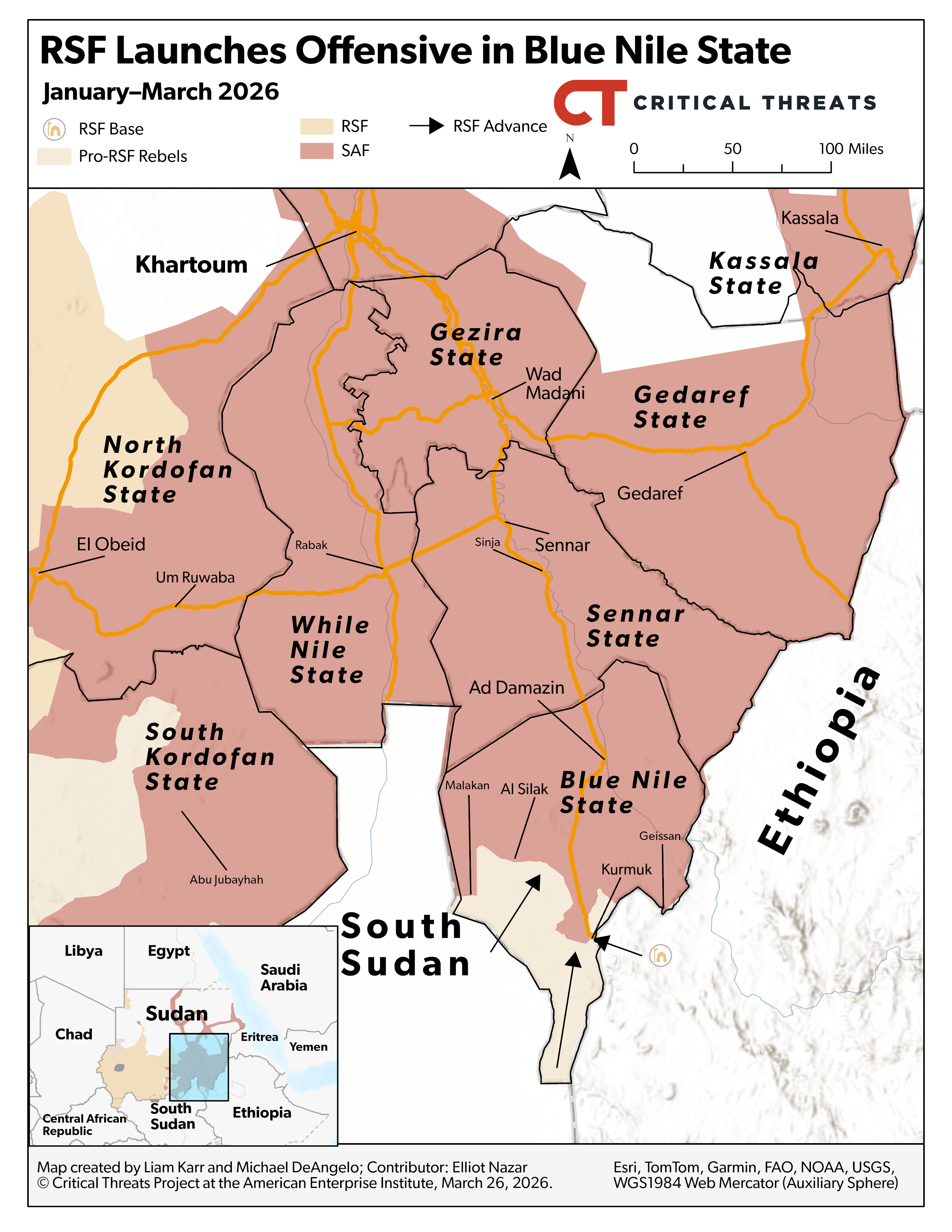
Key Takeaways:
- Morocco. Moroccan and Spanish authorities disrupted a terror cell with links to IS affiliates in Africa and an attack plot in Spain, further indicating that IS is targeting Morocco as a bridge from Africa to Europe via Spain. The cell highlights the prominent role of IS’s Africa affiliates in the IS global network, including these affiliates’ potential links to external attack plots.
- Democratic Republic of the Congo—M23. Recent efforts to jump-start the Washington Peace Accords likely contributed to Rwandan-backed M23 rebels’ unilateral withdrawal from northern Lubero and possibly Walikale districts in North Kivu province.
- Somalia. The South West state government cut ties with the Federal Government of Somalia (FGS) amid a political and military campaign by the FGS to install a more favorable state government due to constitutional, electoral, and leadership disagreements. South West could align with the leading national opposition coalition against the FGS, which would increase the scale of likely election disputes and political violence in 2026 and 2027.
- Sudan. The Rapid Support Forces consolidated control of a key supply line linking its rear bases in western Ethiopia to southeastern Sudan, opening a potential axis of advance toward key agricultural areas in the Nile River Valley and Khartoum, the Sudanese capital.
- Chad. Chad has reinforced its border with Sudan in response to recent clashes between the Rapid Support Forces (RSF) and forces aligned with the Sudanese Armed Forces (SAF) that spilled over into Chad. Chadian operations to secure its border could involve Chadian military activity in both RSF- and pro-SAF-controlled areas, but Chad is unlikely to completely cut its support of the RSF due to Chad’s reliance on the United Arab Emirates, the RSF’s primary backer.
- Mali. The Malian junta is using both diplomatic and military tools in southwestern Mali to alleviate the Jama’at Nusrat al Islam wa al Muslimeen blockade, which has eased in early 2026.
- Democratic Republic of the Congo—ISCAP. Congolese and Ugandan forces killed a senior ISCAP commander during a military operation in the eastern DRC. The commander’s death could degrade ISCAP’s support and shadow governance networks and weaken its ability to carry out attack plots involving explosives in the DRC and Uganda.
Figure 1. Africa File, March 26, 2026
Assessments:
Morocco
Moroccan and Spanish authorities disrupted a small terror cell with members linked to IS affiliates in Africa and an attack plot in Spain, further indicating that IS is targeting Morocco as a bridge between its affiliates in Africa and Europe via Spain. The Moroccan Central Bureau of Judicial Investigations announced on March 25 that Moroccan and Spanish security services carried out simultaneous operations to disrupt an IS cell operating across both countries.[1] Security forces arrested two cell members in Tangier, Morocco, and the cell leader in Majorca, Spain.[2]
Morocco in recent years has disrupted several IS cells, leading Moroccan authorities to claim that IS is making a concerted effort to “recruit, arm, and direct sympathizers to carry out attacks in Morocco.”[3] Moroccan security forces disrupted two separate IS attack cells in January and February 2025, the first of which allegedly had “direct ties” to a leader in IS Sahel Province (ISSP).[4] The UN reported in July 2023 that IS recruiters and facilitators in the Sahel had established transit corridors between southern Europe and the Sahel and established a thwarted attack cell that operated out of Morocco and Spain.[5]
Figure 2. Disrupted IS Cells Linked to Africa
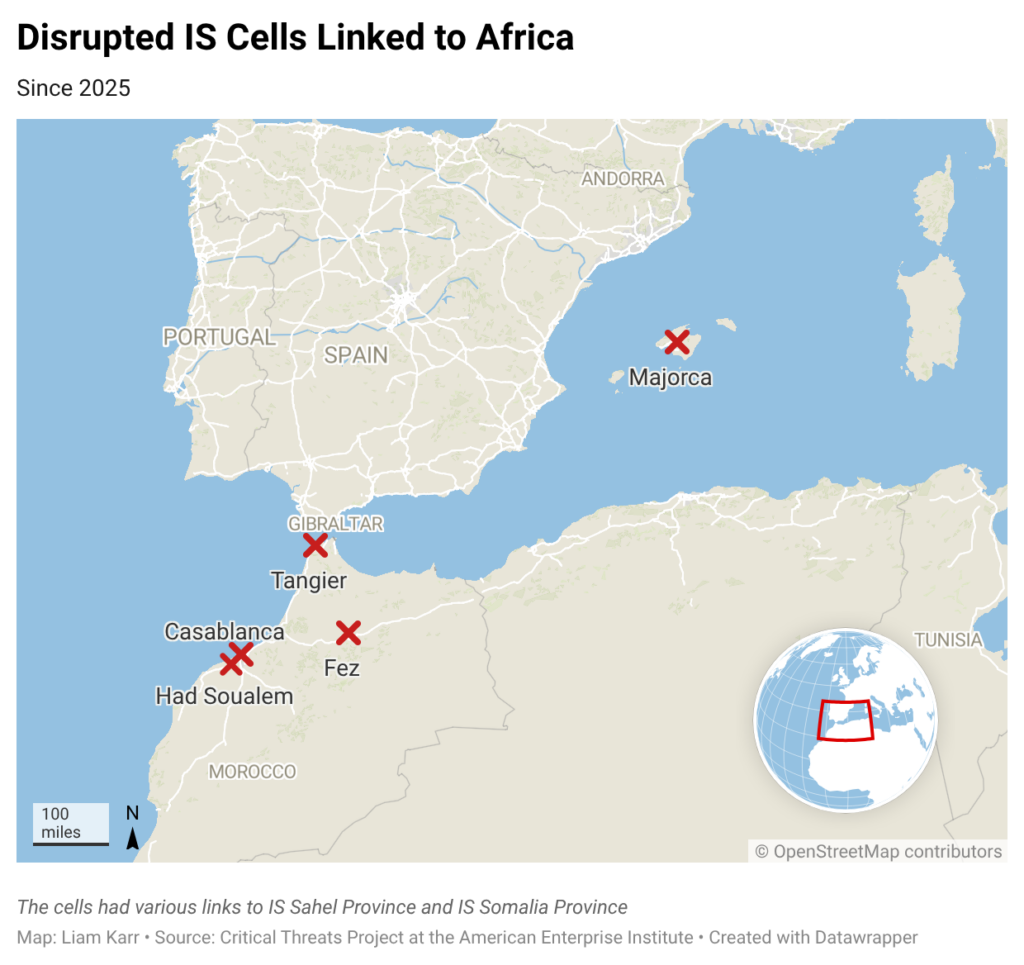
The cell highlights the growing role of IS’s Africa affiliates in the IS global network, including these affiliates’ links to external attack plots. CTP has previously warned that both ISSP and IS Somalia Province (ISS) have posed increasing external attack risks in recent years. Both ISS and ISSP have become hubs for foreign fighters in recent years, which increases their transnational threat risk.[6] ISS plays a key logistic role, given the former ISS emir’s alleged role as the head of the Global Directorate of Provinces, which oversees operational guidance and coordinates funding to all of IS’s global affiliates, plays a central role in external attack operations, and oversees internal administrative high-level affairs within provinces.[7] CTP further warned after Morocco disrupted the IS cells in early 2025 that “ISSP is conducting a campaign to establish attack capabilities in Morocco and potentially use Morocco as a bridge for attacks in Europe.”[8]
The recently disrupted cell is evidence that the same networks moving funds and foreign fighters in and out of Africa are also actively plotting external attacks in Europe. The cell member based in Spain was allegedly “planning a terrorist operation . . . using methods inspired by individual terrorism,” implying a lone wolf attack.[9] The other two cell members based in Morocco, however, were providing financial and logistic support to IS provinces in the Sahel, Somalia, and “south of the Sahara,” which implies ISSP, ISS, and possibly Nigeria-based IS West Africa Province, Democratic Republic of the Congo–based IS Central Africa Province, or IS Mozambique Province.[10] African affiliates were not directly linked to this particular attack plot, but these networks enable future use of funding or fighters from Africa, especially dual citizens living in former European colonies or returnee foreign fighters who have migrated to Africa through these networks.
Democratic Republic of the Congo—M23
Rwandan-backed M23 rebels withdrew unilaterally from northern Lubero district in North Kivu province in the eastern Democratic Republic of the Congo (DRC), after controlling the area for more than a year. M23 reportedly withdrew its forces and military equipment from at least a dozen positions near the front line in northern Lubero between March 23 and 24.[11] This included Kipese and Kitsombiro villages, which are about eight and 15 miles southeast and south of Lubero town, respectively. Security sources told Congolese media on March 25 that the group maintained a forward position in Katondi, about four miles north of Kitsombiro and 10 miles south of Lubero on the RN2 road, however.[12] M23 forces reportedly headed toward southern Lubero district after withdrawing.[13] The front line has been largely frozen in Lubero since February and March 2025, when M23 had advanced to capture areas near the Lubero district capital, before the Ugandan army (UPDF) deployed a significant number of troops to establish a de facto buffer zone and the offensive stalled.[14] The UPDF has been deployed to the north in Ituri province in the eastern DRC for joint counterterrorism operations with the Congolese army against the Islamic State Central Africa Province since late 2021.
Figure 3. M23 Withdraws from Northern Lubero
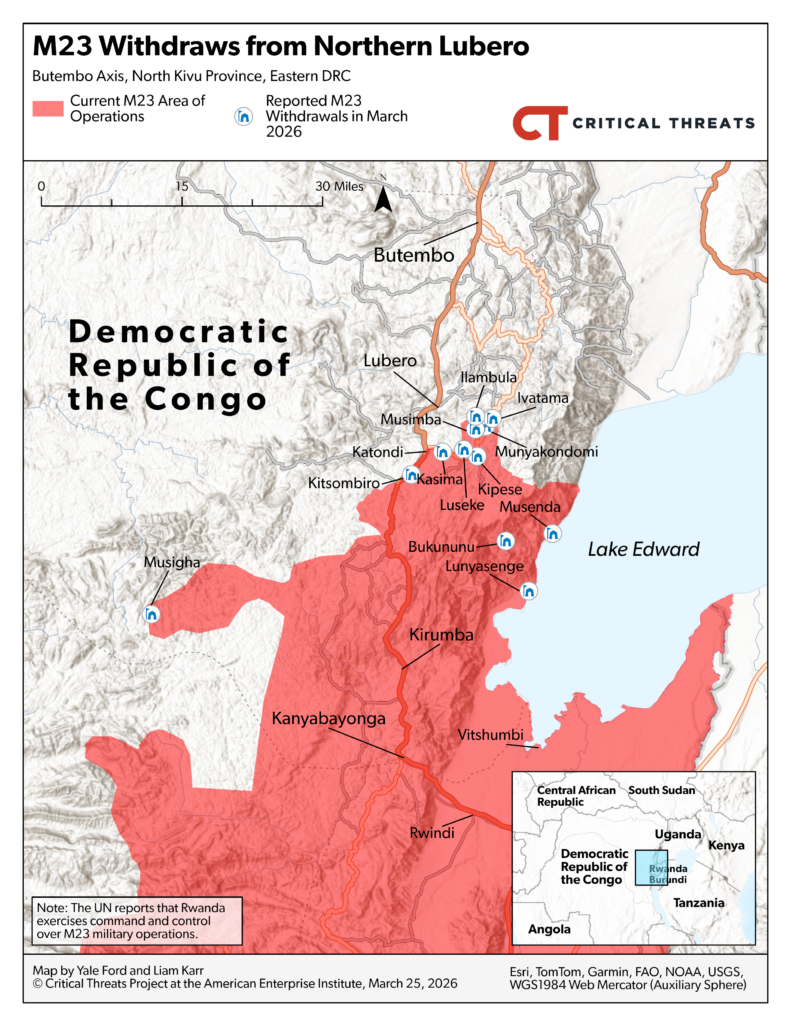
Some reports indicate that M23 also pulled back from the front line in Walikale district in North Kivu. Pro-Congolese government media outlets reported on March 26 that M23 is preparing to withdraw from two forward positions on the RP1030 road in Walikale district, about 12 miles east of Pinga, a military and logistic hub.[15] CTP is unable to confirm these reports. M23 has maintained pressure on Pinga, which is key due to its vital infrastructure and location as a potential launching pad for any M23 offensive into the DRC interior, since late 2024.
Efforts to jump-start the Washington Peace Accords likely contributed to M23’s withdrawal. The United States hosted senior representatives from the DRC and Rwanda for the first meetings in the Washington process since late 2025 in mid-March. Envoys for the Congolese and Rwandan presidents participated in bilateral meetings with US officials on March 17 and a trilateral meeting in Washington, DC, on March 18.[16] Massad Boulos, US President Donald Trump’s Africa adviser, warned that the United States would sanction both parties if they violated their commitments during the March 18 trilateral meeting.[17] The last technical meeting related to the US-mediated peace process took place in Washington in November 2025.[18]
The restart of the Washington process aims to build confidence in peace efforts and stabilize the security situation. The United States, the DRC, and Rwanda released a joint statement after the trilateral meeting that said that the DRC and Rwanda agreed to a “series of coordinated steps to de-escalate tensions and advance progress on the ground.”[19] Implementation of the peace framework has been piecemeal since an initial US-brokered peace agreement in June 2025, and Rwanda backed a major M23 offensive in South Kivu province in December that prompted the United States to sanction the Rwandan army for violating its commitments and derailed the process, among other setbacks.[20] The Washington process and efforts to achieve a regional ceasefire through a UN-supported ceasefire mechanism are closely linked to a separate, Qatari-mediated peace process between the Congolese government and M23, which also faces numerous challenges and has not led to a permanent ceasefire. The DRC and M23 have signed agreements to allow the UN and the International Conference on the Great Lakes Region to support the implementation of a ceasefire since early February, but continued fighting, logistic and financial constraints, and M23’s constraints on humanitarian access to areas under its control have delayed operationalization.
Somalia
The South West state government cut ties with the Federal Government of Somalia (FGS) on March 17 amid FGS efforts to install a more favorable government due to a dispute over constitutional and electoral changes and state leadership. South West officials accused the FGS of interfering with the state government to replace South West President Abdiaziz Hassam Mohamed (Laftagareen) and cited the FGS’s approval of a new constitution on March 4 as a reason for severing ties.[21] The new constitution extends Somali President Hassan Sheikh Mohamud’s term by a year—thereby delaying federal elections scheduled for 2026 until 2027—and institutes direct parliamentary elections.[22] South West had aligned with the FGS’s push for direct elections under the condition that the FGS continues to support Laftagareen remaining in office, but the FGS has reportedly been seeking to replace Laftagareen with a Mohamud ally.[23] Potential replacements reportedly include Minister of Ports Abdulkadir Mohamed Nur and Parliament Speaker Aden Madobe.[24]
The FGS has attempted to purge leadership positions and appoint pro-FGS officials throughout South West state since it approved the new constitution and South West cut ties. The FGS summoned federal security officials stationed in South West to Mogadishu—the Somali capital—on March 14, causing the South West state government to prohibit officials from leaving the state.[25] The FGS grounded domestic and international flights to South West on March 15 in an unsuccessful attempt to prevent Laftagareen from returning from Saudi Arabia, where he was performing Umrah.[26] This action has obstructed federal and state officials from South West from traveling to the state.[27] Somalia’s Ministry of Interior then declared on March 22 that the South West state government’s term had expired and assumed responsibility for appointing a new state government.[28] The FGS has since ordered the replacement of several federal and state officials from South West, which South West has refused to recognize.[29] The FGS established parallel governments in Bakool region and Hudur and Wajid districts from March 24 to 25.[30]
South West has reaffirmed its decision to cut ties, which has caused splits in the FGS and leadership of the Justice and Solidarity Party (JSP)—Mohamud’s federal ruling party. Laftagareen resigned from his position as deputy chairman of the JSP on March 19.[31] Several FGS officials from South West have resigned from their positions in support of the state government.[32] The JSP’s secretary-general then resigned on March 25, citing his disapproval of FGS’s centralization of power and unilateral election plans.[33] South West declared that it will hold indirect state elections in 2026 under the current clan-based power-sharing system and appointed a commission to oversee the elections on March 23.[34] The commission stated on March 26 that state parliamentary elections would occur by March 29.[35]
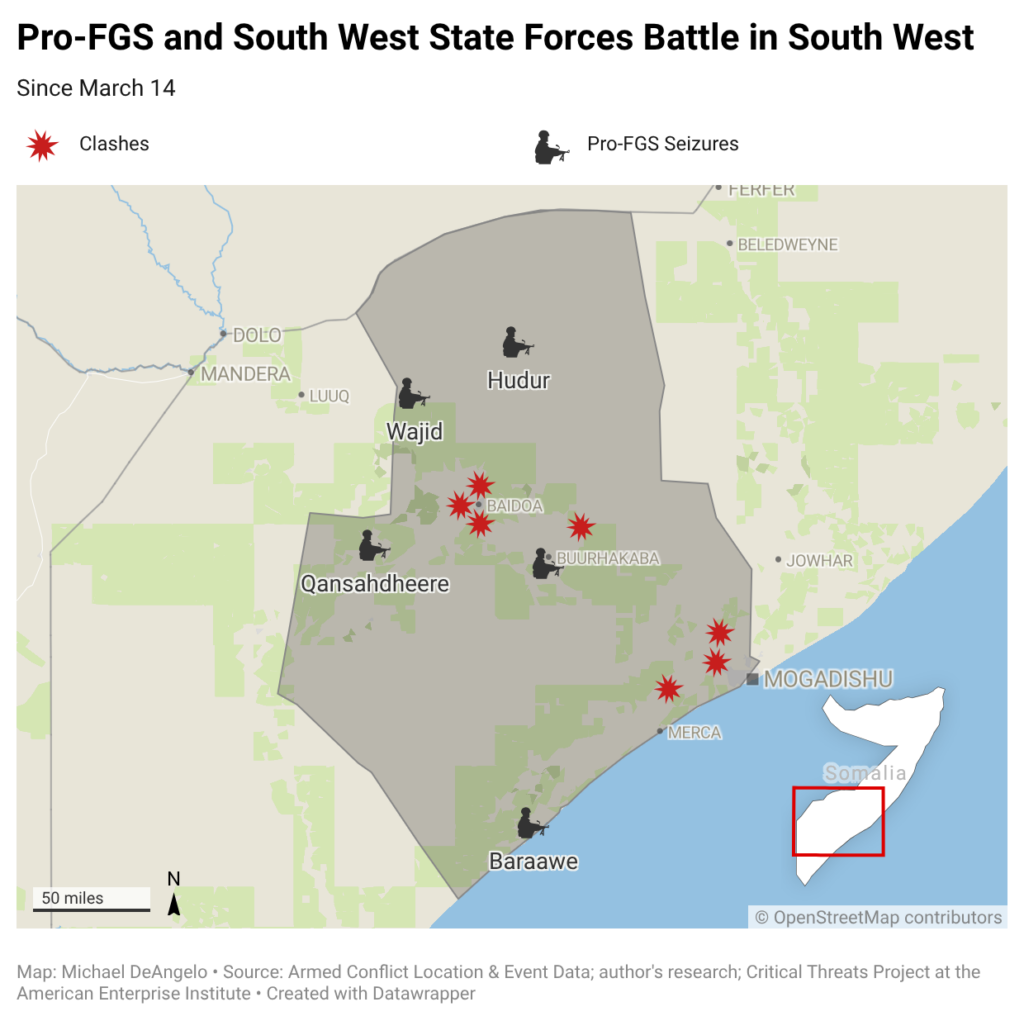
The FGS has also attempted to forcibly take control of South West state. Pro-FGS state opposition forces and South West state forces began mobilizing after the constitution’s approval, and clashes broke out on March 14 in Laftagareen’s absence.[36] Pro-FGS state opposition forces have since seized localities across South West, including Baraawe—the de jure state capital.[37] South West state forces have dislodged state opposition forces from multiple other localities, however, and retained control of Baidoa—the de facto state capital—after clashes.[38]
Figure 4. Pro-FGS and South West State Forces Battle in South West
Source: Armed Conflict Location & Event Data; Michael DeAngelo.
The FGS has backed the state opposition forces and deployed its own forces to South West. South West accused the FGS of arming and mobilizing state opposition forces to overthrow the state government in its announcement cutting ties with the FGS.[39] Multiple FGS officials have traveled to South West to support state opposition forces since the clashes broke out.[40] The FGS has deployed federal security forces—including Turkish-trained Gorgor units—to South West, contributing to the FGS’s seizure of Baraawe.[41] South West has deemed the FGS deployments an “invasion” and continued mobilizing its own forces to retain control of localities.[42] The South West state government has threatened to ground FGS flights to South West to stop weapons shipments to state opposition forces.[43] South West state forces reportedly interdicted an FGS plane on March 23.[44]
South West could align with the leading national opposition coalition against the FGS, which would increase the scale of likely election disputes and political violence. South West cutting ties with the FGS means that only three states—Galmudug, Hirshabelle, and North East—and the Banadir capital region are aligned with the FGS’s constitutional and electoral changes. The anti-FGS Somali Future Council (SFC) coalition consists of significant Somali opposition figures and Jubbaland and Puntland states, both of which have already cut ties to the FGS due to the FGS’s plan to implement direct elections.[45] The SFC declared on March 19 its support for South West cutting ties with the FGS and holding its own elections, warning the FGS, Galmudug, and Hirshabelle not to interfere.[46] Galmudug offered to mediate between the FGS and South West on March 20, but SFC members have since called for Galmudug and Hirshabelle to also hold elections independently of the FGS.[47]
Figure 5. Somali States Align Against Mogadishu
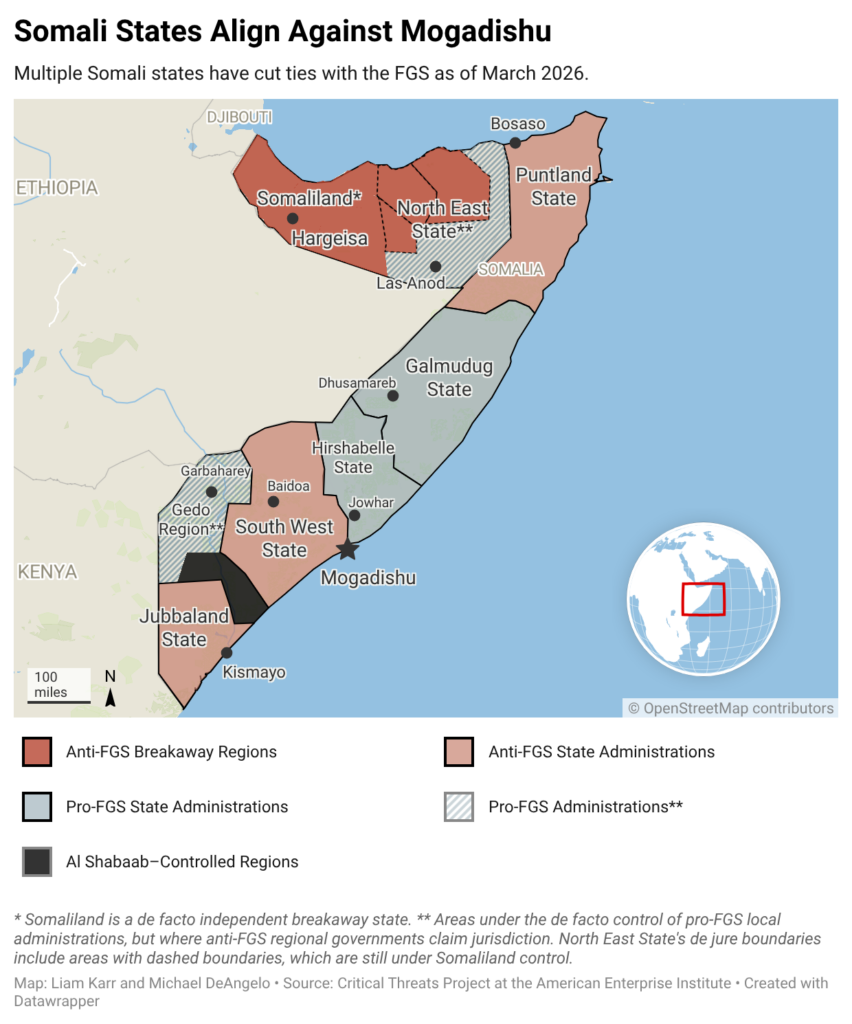
Recent talks between the FGS and SFC collapsed, furthering the possibility of the SFC holding parallel political processes. The SFC has threatened to hold parallel political processes if the FGS does not agree to a consensus-based approach to elections.[48] Mohamud and SFC leaders failed to agree on an election roadmap in late February 2026.[49] The SFC then denounced the FGS’s approval of the new constitution as illegitimate and demanded elections in 2026.[50]
Past election disputes have sparked large-scale political violence across Somalia. South West’s 2018 state presidential election turned violent when then-Somali President Mohamed Abdullahi Mohamed (Farmaajo) intervened and barred candidates from participating.[51] Farmaajo’s delay of federal presidential elections in 2021 led to violence in Mogadishu.[52] FGS and Jubbaland forces clashed in 2020, 2024, and 2025 over disputed elections.[53]
The discord between the FGS and South West creates security gaps in operationally critical areas for the fight against al Shabaab. South West’s main coastal road connects Jilib—al Shabaab’s headquarters in southern Somalia—to Afgoi, a South West district capital on the outskirts of Mogadishu. Al Shabaab has used this corridor to support operations in Mogadishu, including complex attacks with vehicle-borne improvised explosive devices.[54] Pro-FGS state opposition forces have clashed with South West state forces over the Afgoi checkpoint, with South West officials warning that clashes would cause insecurity.[55] The Somali outlet Baidoa Online also reported on March 24 that al Shabaab increased its presence on the Baidoa–Mogadishu road near Baidoa.[56] Laftagareen has stated multiple times since March 21 that the recent FGS deployments obstruct anti–al Shabaab efforts.[57]
The FGS-South West dispute creates a new point of tension between Ethiopia and the FGS due to Ethiopia’s security-based partnership with Laftagareen, and Egypt could stand to benefit. Ethiopia has cultivated ties with Laftagareen to create a buffer zone against al Shabaab on its border with South West, deploying several thousand troops to the state.[58] Ethiopia has reportedly backed Laftagareen in the FGS-South West dispute. Mohamud reportedly canceled a planned meeting with Ethiopian Prime Minister Abiy Ahmed after Abiy refused to support the FGS’s plan to replace Laftagareen.[59]
Ethiopia has had strained relations with Somalia over Somaliland recognition and Ethiopian sea access. Ethiopia signed a memorandum of understanding with Somaliland in January 2024 in which Somaliland would grant Ethiopia commercial sea and naval access in exchange for potential Ethiopian recognition of Somaliland as an independent state.[60] Somalia cut diplomatic ties with Ethiopia until December 2024, when Turkey mediated a deal in which Ethiopia would obtain commercial sea access via southern Somalia.[61] Ethiopia and Somalia have since retained normal relations, although the two countries have not implemented the Turkish-mediated deal, with Ethiopia continuing to classify sea access as an existential matter.[62]
Ethiopia’s regional rival Egypt has previously taken advantage of Ethiopia-Somalia tensions to develop closer ties with Somalia as a point of leverage with Ethiopia. Egypt signed multiple strategic agreements with Somalia amid the Somaliland standoff that enabled it to deploy over 2,000 troops to Somalia for counterterrorism purposes.[63] South West officials have accused the FGS of distributing Egyptian-supplied weapons to the pro-FGS state opposition forces that have clashed with South West state forces in the current dispute.[64] Egypt and Ethiopia are strategic rivals, with Egypt viewing Ethiopia’s naval access ambitions and construction of dams on the Nile River as potential existential threats.[65]
Sudan
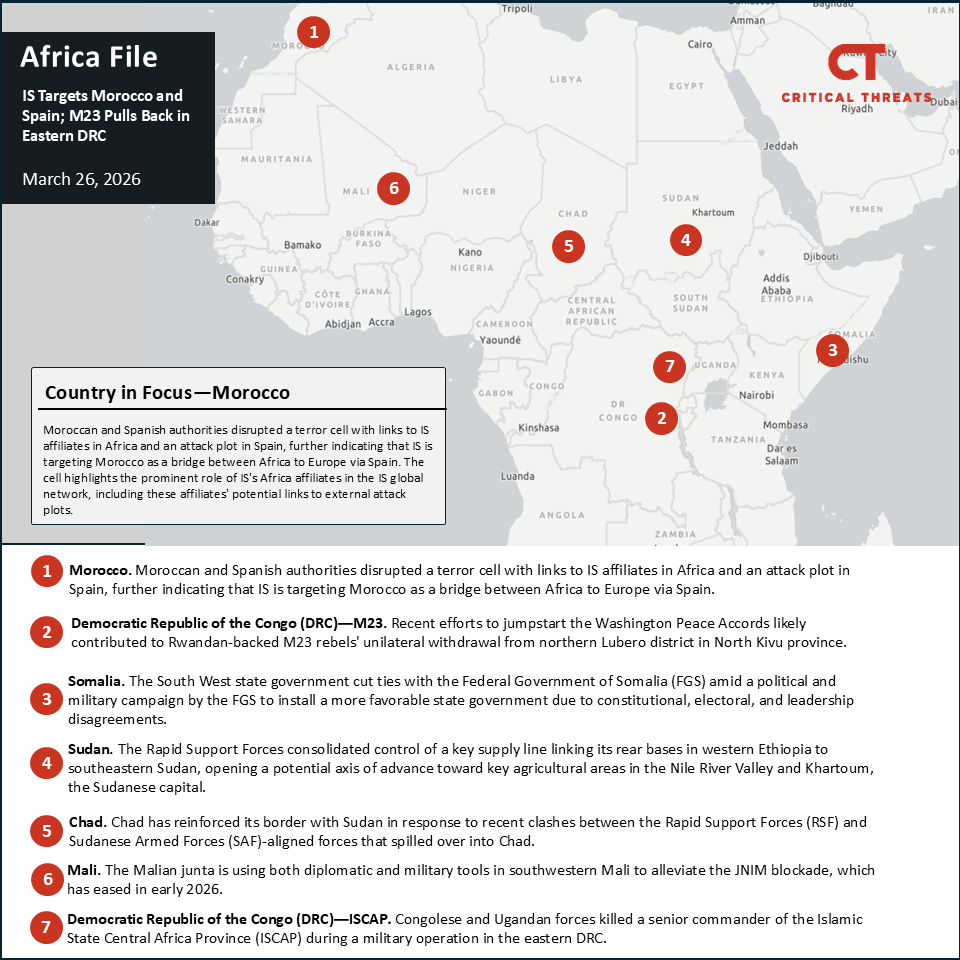
The Rapid Support Forces (RSF) consolidated control of a key supply line linking its rear bases in western Ethiopia to southeastern Sudan, opening a potential axis of advance toward key agricultural areas in the Nile River Valley and Khartoum, the Sudanese capital. The RSF and allied Sudan People’s Liberation Movement–North (SPLM-N) al Hilu militia captured Kurmuk—located approximately 100 miles south of ad Damazin, the Blue Nile state capital—on March 23.[66] The RSF and SPLM-N al Hilu also seized al Baraka and al Keili, which are located approximately five and 30 miles north of Kurmuk, respectively.[67] The RSF and SPLM-N al Hilu reportedly attacked from the south and east, using rear bases in western Ethiopia’s Benishangul-Gumuz region.[68] The SAF-aligned Kurmuk provincial governor described the attack as an “invasion” that Ethiopia “supported.”[69]
Figure 6. RSF Launches Offensive in Blue Nile State
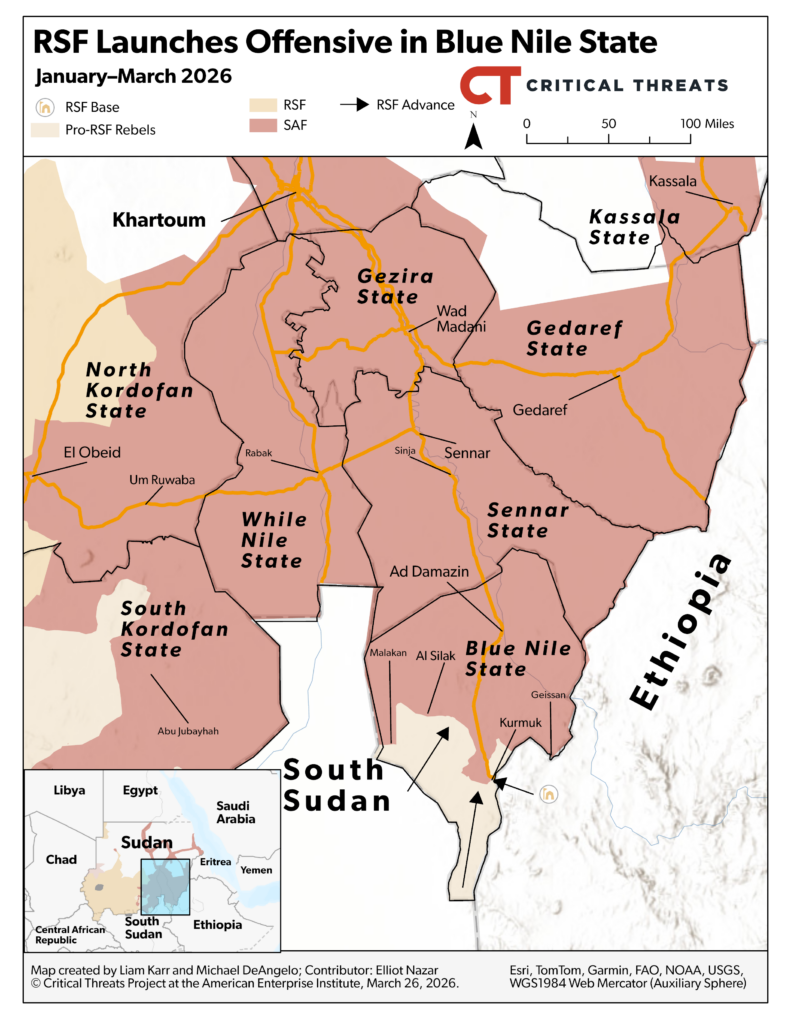
The RSF and SPLM-N al Hilu have prioritized capturing Kurmuk due to its location on a highway on the Ethiopian border since they launched their offensive in Blue Nile in late January 2026.[70] The RSF established a camp in Benishangul-Gumuz in late 2025, and SPLM-N al Hilu has additional rear bases in the region.[71] Ethiopia has become a key transit point in Emirati–RSF supply lines due to disruptions to other points.[72] The United Arab Emirates has significantly increased suspected weapons shipments—likely including drones—to the RSF via western Ethiopia since November. These shipments have continued despite the Iran war.[73] The SAF-led Sudanese government accused Ethiopia on March 2 of allowing the RSF to conduct drone strikes in Sudan from Ethiopia following a substantial increase in strikes in Blue Nile since mid-February.[74]
RSF control of Kurmuk gives the RSF a foothold in resource-rich Blue Nile and opens another potential axis of advance toward major cities up the Nile River valley. Blue Nile is the agricultural hub and location of one of the biggest dams in Sudan.[75] A highway also links Ad Damazin to Sennar, Wad Madani, and Khartoum, which are located approximately 150, 210, and 325 miles to the north, respectively.[76] An official in the RSF’s parallel government described the capture of Kurmuk as “the key to full control” over the Blue Nile and Sennar states.[77]
Another RSF pincer movement captured an operationally significant crossroads town further east, which severs supply lines between SAF positions in Baw and Geisan districts and could set conditions to envelop these positions. The RSF and SPLM-N al Hilu captured Magaja on March 26.[78] Magaja is on a side road that connects SAF positions on the main north–south road in Dindiro to SAF frontline positions in Baw district along the South Sudanese border. Further RSF advances northwest would flank SAF positions in al Silak and Malakan, while RSF advances northeast would flank SAF positions around Kurmuk or even Geisan, which is located approximately 50 miles northeast of Kurmuk on the Ethiopian border. Sudan Tribune reported on March 26 that the RSF and SPLM-N al Hilu are mobilizing forces near Geisan district.[79]
Chad
Chad has reinforced its border with Sudan in response to recent clashes between the Rapid Support Forces (RSF) and forces aligned with the Sudanese Armed Forces (SAF) that spilled over into Chad. The RSF briefly seized the Sudanese side of Tine—a town split by the Chad-Sudan border—on March 16, but the SAF-aligned Joint Forces militia launched a counterattack to recapture the area.[80] The RSF then conducted drone strikes in the Chadian side of Tine on March 18, killing 20 people.[81]
Figure 7. Sudan War Spills Over into Chad
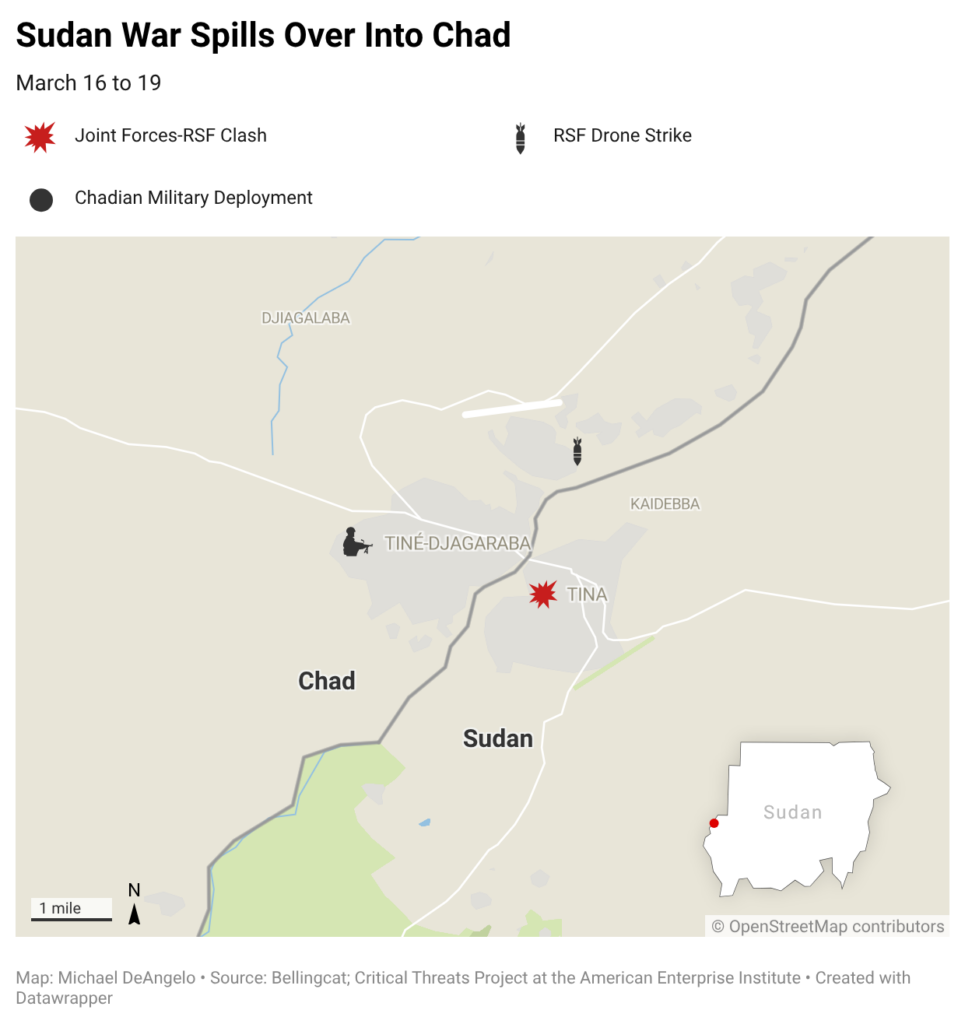
Chad immediately denounced the strikes and vowed retaliation.[82] Chadian President Mahamat Idriss Déby convened a meeting of top security officials on March 18 and stated that the spillover from Sudan’s civil war is an issue of “national security that cannot be tolerated” and reaffirmed the closure of the Sudanese border.[83] Chad’s government pledged that the Chadian military would retaliate against Sudanese actors who attack Chad, specifically citing both the RSF and SAF.[84] Chad has become increasingly concerned about spillover into its territory since mid-January 2026, when the RSF killed seven Chadian soldiers in a cross-border attack.[85] The RSF then attacked a Chadian military base near Tine in late February, killing five Chadian soldiers.[86] The attack prompted Chad to close the border, citing violations by both the RSF and SAF.[87]
Chad has deployed forces to the Sudanese border and undertaken several security measures. The Chadian military has reportedly deployed hundreds of vehicles to the border.[88] Chadian forces have conducted house-to-house weapons seizures targeting localities with many Sudanese refugees.[89] The pro-SAF outlet Sudan Tribune reported that Chadian forces have reinforced the border by building berms and trenches between the Chadian and Sudanese sides of Tine.[90] Chad’s army chief, defense minister, and immigration and public security minister have also arrived in the area to evaluate border security under Déby’s orders.[91]
Chad’s operations to secure its border could involve Chadian military activity in both RSF and pro-SAF- controlled areas. The Joint Forces have rear bases in Chad due to shared ethnic ties with Zaghawa border communities, with some Chadian Zaghawa people even fighting against the RSF in the current civil war.[92] Chadian security measures have targeted these border areas and rear bases, which the Joint Forces have used to regroup from RSF assaults in western Sudan’s Darfur region and launch counterattacks.[93] Chad announced after the RSF’s drone strike in Tine that it would potentially conduct operations in Sudan, and the Sudan Tribune reported that Chadian forces are planning cross-border operations, which indicates that these operations would include both Joint Forces- and RSF- controlled border areas.[94] Sudanese outlet Darfur 24 reported that the Chadian military has already conducted a separate cross-border operation into RSF-controlled Central Darfur state—near the Chad–Central African Republic–Sudan border—on March 23 that killed five people.[95]
Chad is unlikely to completely cut its support of the RSF, however, due its reliance on the United Arab Emirates (UAE)—the RSF’s primary backer. The UAE is a key financial supporter of Déby’s regime, having loaned Chad $1.5 billion in 2023 and pledging $6 billion more in 2025.[96] Chad was the key transit point in the Emirati–RSF supply line from 2023 to 2025, allowing the UAE to ship weapons to the RSF via Chadian airports and border crossings.[97] Chad has regained importance as a transit point amid disruptions to other points since December.[98] Open-source analyst Rich Tedd has continued to track Emirati-linked flights carrying suspected weapons shipments transit through Chad despite the RSF’s cross-border attacks earlier in 2026.[99]
Déby faces internal pressure due to his handling of the war, however. Déby reduced Chad’s support of the RSF in 2025 due to opposition from Chadian security forces, forcing the UAE to reroute supply routes through Libya.[100] Former Chadian President Idriss Déby—Mahamat Déby’s father—was Zaghawa, and Zaghawa have since held key positions across Chad’s government, including in the security forces.[101] Déby’s Zaghawa political allies have historic border tensions with RSF-linked Arab militias, and the RSF has committed atrocities against Zaghawa in Darfur.[102]
Mali
The Malian junta is using both diplomatic and military tools in southwestern Mali to alleviate the JNIM blockade, which has eased in early 2026. The Malian army launched a major counterterrorism operation in several areas within western Mali’s Kayes region from March 14 to 21. The Malian army destroyed two major JNIM bases, killed forty militants, and liberated twelve hostages according to an official military statement.[103] The Malian army also recovered large quantities of arms, munitions, drones, radios, and stolen goods from local populations, including over 3,000 liters of fuel, two vehicles, and a bus.[104] The March operation targeted Yélimané town and Ségala, Ambidédi, and Diboli communes in Kayes cercle.[105]
The junta also allegedly reached a truce with JNIM to halt attacks on fuel tankers in southwestern Mali until May 27. The Malian government freed over 100 suspected jihadists from detention in exchange for a freeze on JNIM attacks against fuel convoys on March 22, according to local elected officials and security sources.[106] The truce will allegedly last until the Muslim festival Eid al Adha, which is scheduled to occur between May 26 and 27.[107] The Malian government stated that they do not negotiate with terrorists when asked about the agreement by French outlet Radio France International.[108] The freed prisoners include a large number of Fulani men, a marginalized ethnic group often associated with Salafi-jihadi groups in the region, including JNIM’s Katiba Macina subgroup, which operates in central and southern Mali.[109]
Figure 8. Malian Forces Degrade JNIM Blockade
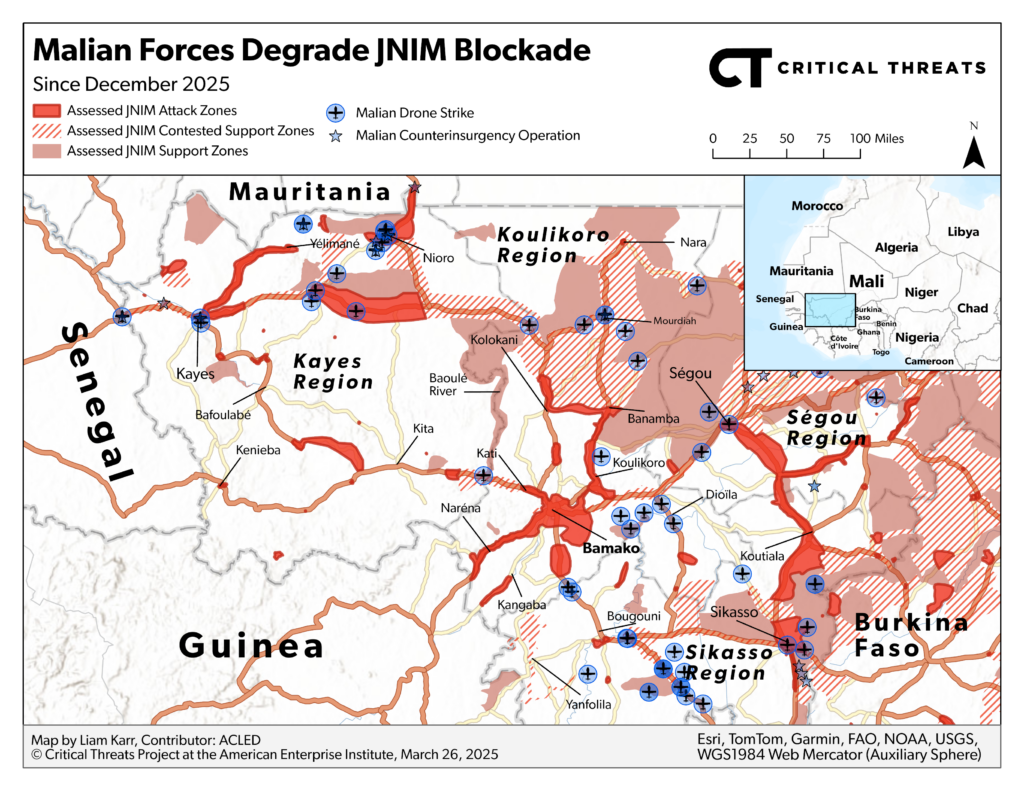
JNIM’s blockade on southwestern Mali has diminished electricity supply in Bamako and other major cities across Mali since it began in September 2025. The blockade initially targeted supply corridors from Senegal and Côte d’Ivoire, which carry nearly 95 percent of Malian petroleum imports.[110] JNIM expanded the blockade on November 1 to include Bamako’s eastern supply corridor from Niger via central Mali, despite the Malian junta’s efforts to facilitate local negotiations with the group in early October.[111] JNIM had destroyed more than 300 tankers by late 2025, causing fuel prices to more than double, closing gas stations across Mali, and leaving citizens waiting for hours in line at the stations still operable.[112] The diversion of limited fuel resources to the Malian army and the state-owned Énergie du Mali forced many businesses and institutions to remain closed between late October and mid-November, while major towns in other part of the country, such as Mopti, were left without power for over a month.[113]
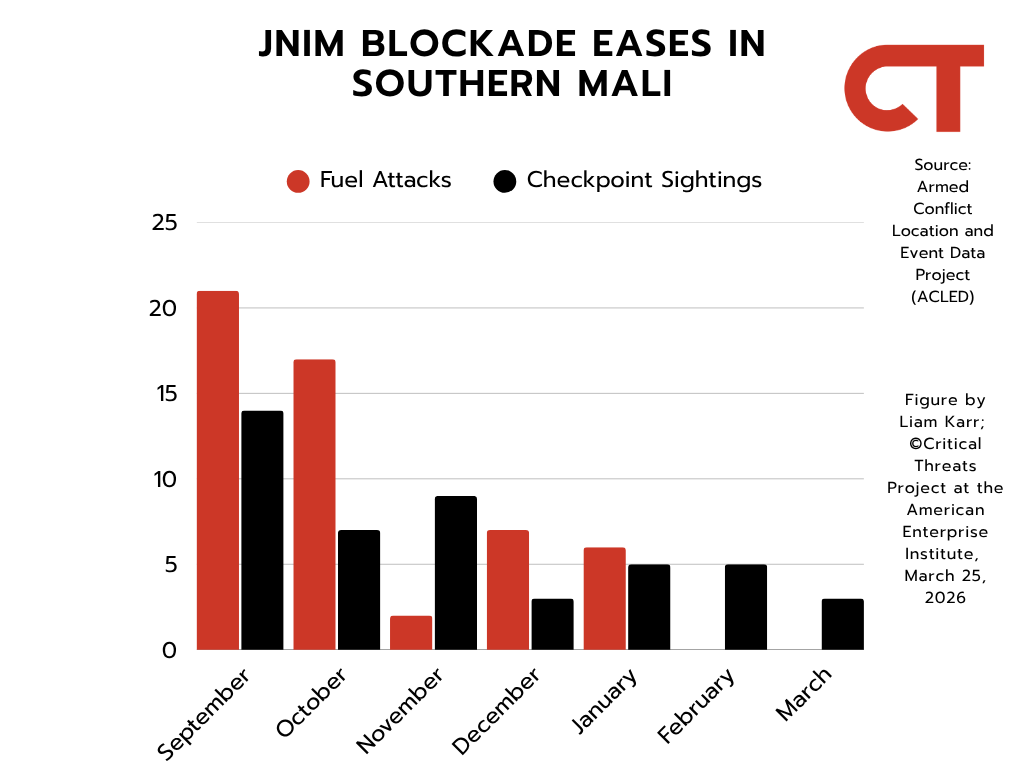
JNIM has decreased attacks and overall pressure since late 2025, however. JNIM has not attacked any fuel convoys since late January, after averaging nearly 12 such attacks per month since September 2025. The group has also established fewer roadside checkpoints throughout the southern half of Mali since December 2025. Armed Conflict Location and Event Data recorded an average of 10 JNIM checkpoints per month in the southern half of Mali from September to November but only an average of four since December.
Figure 9. JNIM Blockade Eases in Southern Mali
Several factors could be causing the decrease in JNIM activity. CTP previously reported that JNIM reinforcements sent to support the campaign in late 2025 left the group vulnerable to its regional rival—IS Sahel Province—in northern Mali.[114] Competition between the two groups has continued through early 2026, providing a cause for JNIM to reallocate resources toward. The Malian army has also waged other counterinsurgency campaigns and supported various negotiation tracks since late 2025, all of which is likely contributing to the de-escalation of the campaign.[115] The Malian army began escorting fuel tankers in late 2025 and conducted 69 drone strikes against JNIM in southern Mali’s Kayes, Koulikoro, and Sikasso regions between September and December, half of which were in December, after only conducting seven drone strikes in the rest of 2025.[116] Fewer tankers may also be entering Mali due to fear, political unrest, and high insurance rates. The National Union of Drivers and Truck Drivers of Mali conducted a 24-hour strike on all activities between Bamako and the Senegalese border to demand the repatriation of their colleagues’ corpses who were killed during the JNIM fuel convoy attacks on January 29.
Democratic Republic of the Congo—IS Central Africa Province
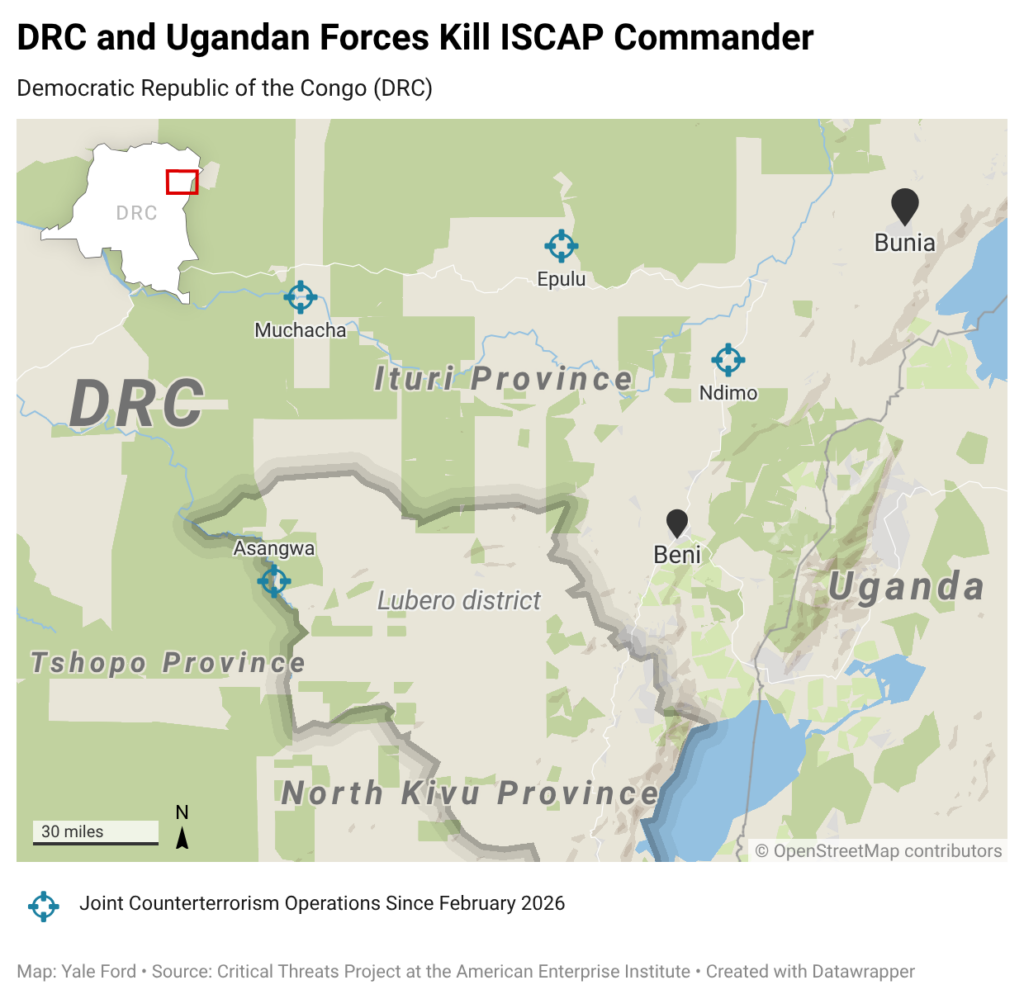
Congolese and Ugandan forces killed a senior commander of the Islamic State Central Africa Province (ISCAP) during a military operation in the eastern Democratic Republic of the Congo (DRC). The Congolese army (FARDC) announced that they killed a senior commander for ISCAP—known locally as the Allied Democratic Forces (ADF)—in joint counterterrorism operations with the Ugandan army (UPDF), as part of the Operation Shujaa campaign, in northern Lubero district in North Kivu province on March 20 and 21.[120] Joint forces targeted an ADF base in Asangwa village near the border with Tshopo province, killing the commander—known as “Defender”—along with four other fighters. Defender was reportedly close to ADF’s leader and the second most senior ADF commander, according to the Ugandan army chief.[121] The FARDC said that the base belonged to an ADF subgroup led by a Tanzanian national, Ahmad Hassan, also known as Abwakasi, which is considered the group’s most lethal faction and was responsible for more than 40 percent of reported civilian fatalities attributed to the group between mid-2024 and mid-2025.[122]
Figure 10. DRC and Ugandan Forces Kill ISCAP Commander
The commander’s death could weaken the ADF’s ability to carry out attack plots involving explosives in the DRC and Uganda and degrade its support and shadow governance networks. Abwakasi is known for his expertise in bomb-making and has been directly involved in planning and carrying out high-fatality attacks, including those involving improvised explosive devices (IEDs).[123] ADF has plotted or executed multiple bombing attacks in the DRC and in Uganda since late 2021, and CTP assessed that the most recent attack in Uganda in mid-2025 indicated that ADF had reconstituted its attack capabilities inside Uganda, although some reports claim that senior UPDF personnel helped facilitate the attack as a false flag to secure more backing for Shujaa operations.[124] Defender had led his own ADF cell in the eastern DRC, before he began moving westward and sent small detachments to join Abwakasi’s group in mid-2024, according to the UN.[125] Congolese media reported that Defender was Abwakasi’s deputy at the time of his death and involved in manufacturing IEDs.[126]
add note
tweet
Defender’s death could also weaken the group’s ability to maintain its support and shadow governance networks. Defender reportedly coordinated ADF activities beyond its primary areas of operation and oversaw contact with “civilian collaborators” in North Kivu and Ituri province.[127] ADF has long been embedded in local power structures and trade routes, engaging both in coercion and in collaboration with local actors.[128] The group shifted focus toward revenue-generation activities in April 2025, expanding its control over artisanal mining sites and imposing direct taxes on local economic activities in North Kivu and Ituri.[129] Armed Conflict Location & Event Data noted in mid-2025 that these activities were “uncommon” for the ADF and pointed to a change in strategy toward territorial control, rather than simply raiding areas for supplies.[130]