
Key Takeaways:
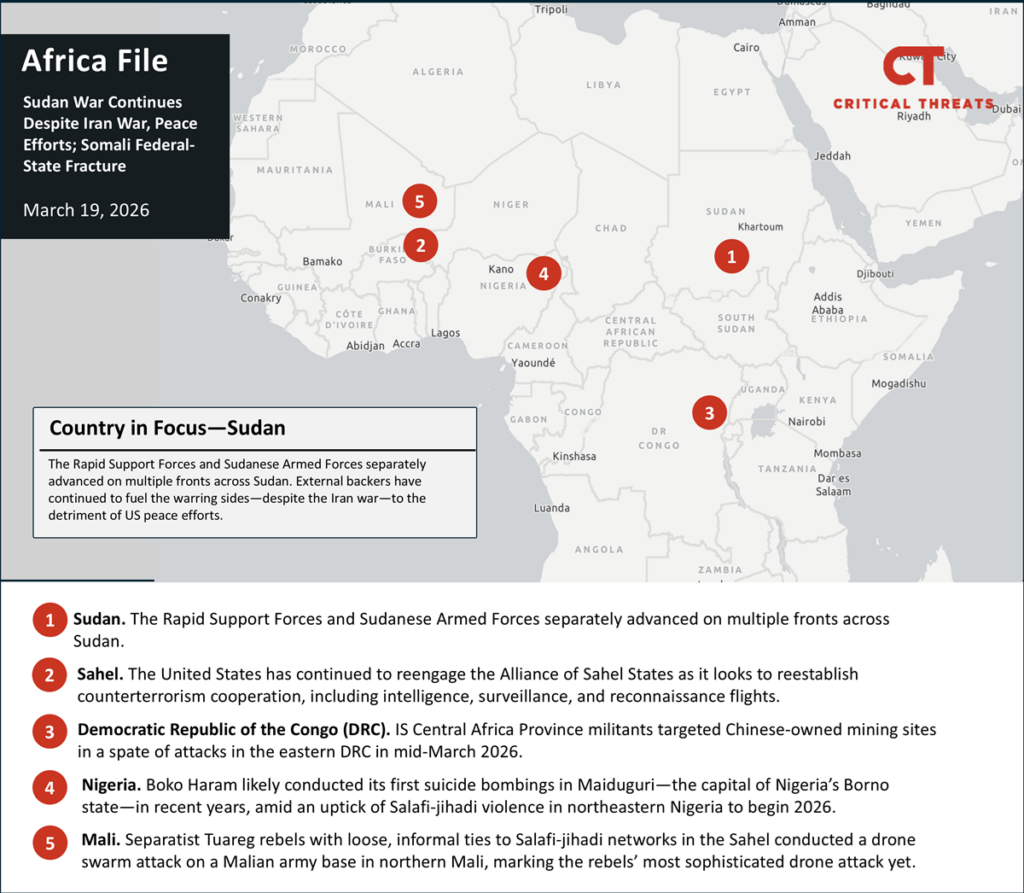
Sudan. The Rapid Support Forces and Sudanese Armed Forces separately advanced on multiple fronts across Sudan. External backers have continued to fuel the warring sides—despite the Iran war—to the detriment of US peace efforts.
Sahel. The United States has continued to reengage the Alliance of Sahel States as it looks to reestablish counterterrorism cooperation, including intelligence, surveillance, and reconnaissance flights.
Democratic Republic of the Congo (DRC). IS Central Africa Province (ISCAP) militants targeted Chinese-owned mining sites in a spate of attacks in the eastern DRC in mid-March 2026. ISCAP likely conducted the attacks to show strength and retaliate in response to recent counterterrorism operations, as well as redirect the focus of or set conditions to retreat from security forces.
Nigeria. Boko Haram likely conducted its first suicide bombings in Maiduguri—the capital of Nigeria’s Borno state in recent years, amid an uptick of Salafi-jihadi violence in northeastern Nigeria to begin 2026.
Mali. Separatist Tuareg rebels with loose, informal ties to Salafi-jihadi networks in the Sahel conducted a drone swarm attack on a Malian army base in northern Mali, marking the rebels’ most sophisticated drone attack yet.
Figure 1. Africa File, March 19, 2026
Assessments:
Sudan
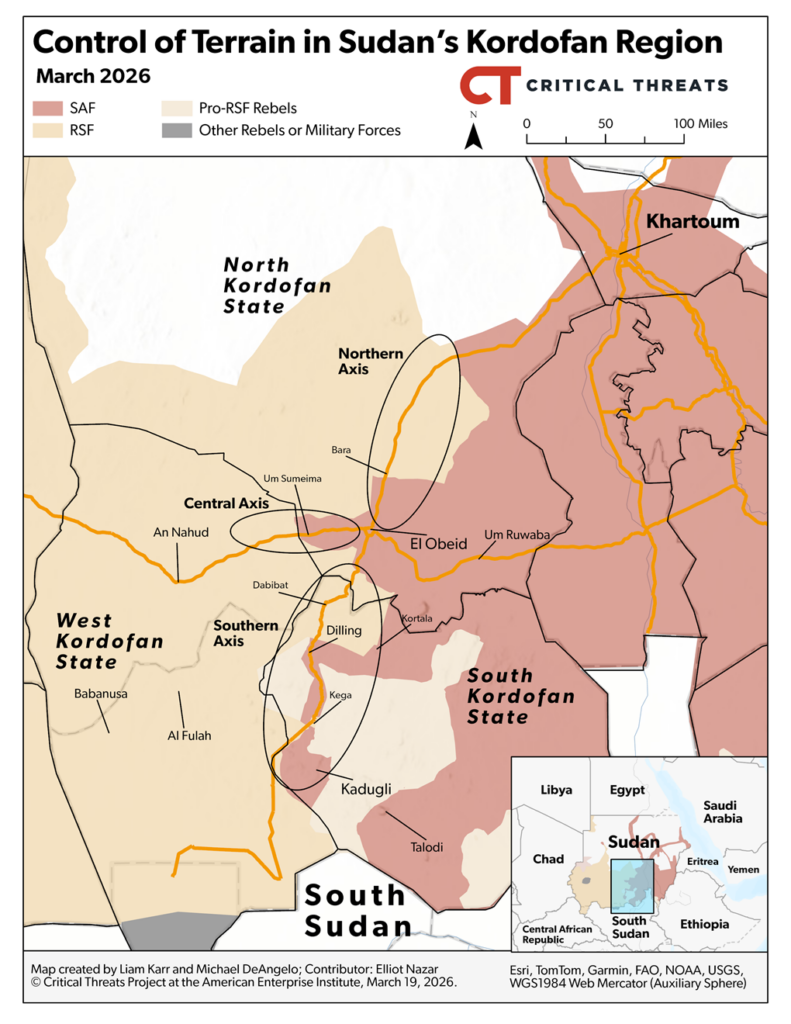
The Rapid Support Forces (RSF) made gains on separate fronts, disrupting Sudanese Armed Forces (SAF) efforts to consolidate control over key supply lines in central Sudan and strengthening RSF control over western Sudan. The RSF captured Bara—located 40 miles north of el Obeid, the SAF’s headquarters in central Sudan, on the highway to Khartoum, the Sudanese capital—on March 16.[1] The RSF reportedly used artillery, drone, and ground assets in its assault, forcing the SAF to retreat south.[2] The SAF previously captured Bara on March 5.[3] The RSF and allied Sudan People’s Liberation Movement–North (SPLM-N) al Hilu militia also assaulted Dilling—a highway town located 100 miles south of el Obeid—from the north and west on March 16, but the SAF repelled the attack.[4] The RSF cut off the highway between Dilling and Kadugli—the South Kordofan state capital, located approximately 85 miles south of Dilling—and briefly disrupted the Dilling–el Obeid supply line in early March, challenging SAF gains from early February.[5]
Figure 2. Control of Terrain in Sudan’s Kordofan Region
Source: Liam Karr; Michael DeAngelo; Elliot Nazar.
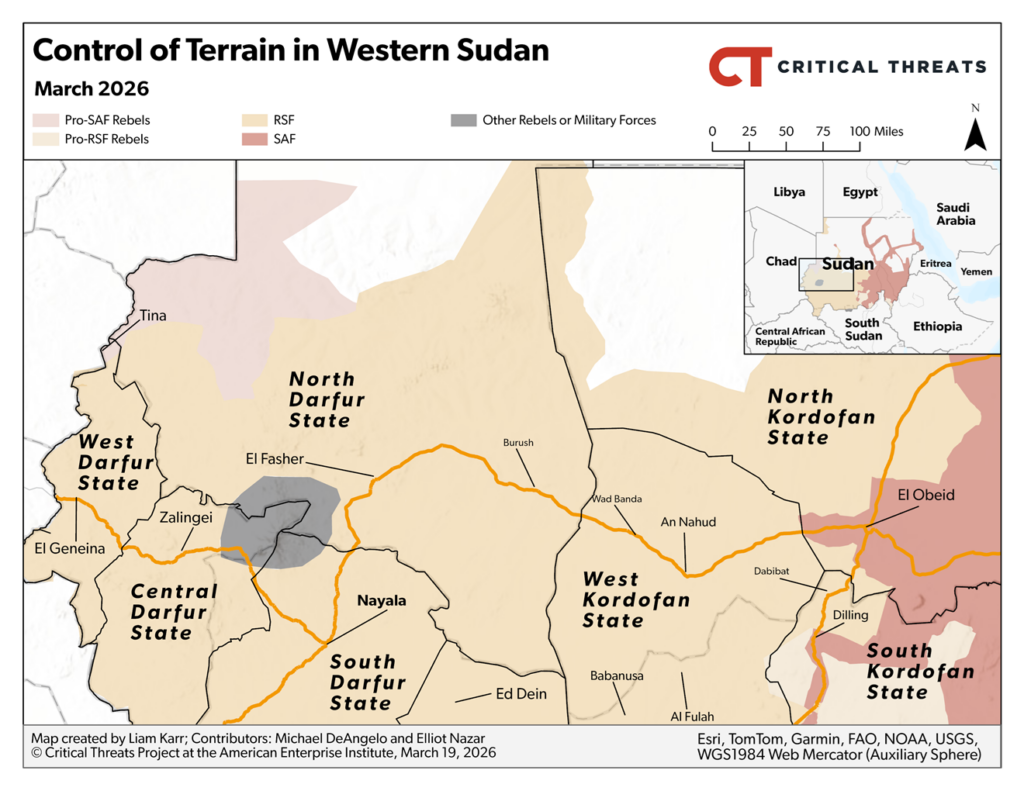
The RSF separately advanced into the final SAF-aligned pocket in western Sudan’s Darfur region. The RSF captured Karnoi—located 35 miles east of Tine, which is on the Chadian border—on March 16.[6] The RSF also briefly seized Tine on March 16 before the SAF-aligned Joint Forces militia launched a counterattack to retake the area.[7]
Figure 3. Control of Terrain in Western Sudan
3 days ago
Sudan War Continues Despite Iran War, Peace Efforts: Africa File, March 19, 2026
Liam Karr, Michael DeAngelo, Yale Ford, Zoe Sommer and Alexis Thomas
TIP
x
Make a text selection to add comments
Contributors: Elliot Nazar and Claire Schreder
To receive the weekly Africa File or triweekly Congo War Security Review via email, please subscribe here. Follow CTP on X, LinkedIn, and BlueSky.
Key Takeaways:
Sudan. The Rapid Support Forces and Sudanese Armed Forces separately advanced on multiple fronts across Sudan. External backers have continued to fuel the warring sides—despite the Iran war—to the detriment of US peace efforts.
Sahel. The United States has continued to reengage the Alliance of Sahel States as it looks to reestablish counterterrorism cooperation, including intelligence, surveillance, and reconnaissance flights.
Democratic Republic of the Congo (DRC). IS Central Africa Province (ISCAP) militants targeted Chinese-owned mining sites in a spate of attacks in the eastern DRC in mid-March 2026. ISCAP likely conducted the attacks to show strength and retaliate in response to recent counterterrorism operations, as well as redirect the focus of or set conditions to retreat from security forces.
Nigeria. Boko Haram likely conducted its first suicide bombings in Maiduguri—the capital of Nigeria’s Borno state in recent years, amid an uptick of Salafi-jihadi violence in northeastern Nigeria to begin 2026.
Mali. Separatist Tuareg rebels with loose, informal ties to Salafi-jihadi networks in the Sahel conducted a drone swarm attack on a Malian army base in northern Mali, marking the rebels’ most sophisticated drone attack yet.
Figure 1. Africa File, March 19, 2026
Source: Liam Karr.
Assessments:
Sudan
Author: Michael DeAngelo with Elliot Nazar
The Rapid Support Forces (RSF) made gains on separate fronts, disrupting Sudanese Armed Forces (SAF) efforts to consolidate control over key supply lines in central Sudan and strengthening RSF control over western Sudan. The RSF captured Bara—located 40 miles north of el Obeid, the SAF’s headquarters in central Sudan, on the highway to Khartoum, the Sudanese capital—on March 16.[1] The RSF reportedly used artillery, drone, and ground assets in its assault, forcing the SAF to retreat south.[2] The SAF previously captured Bara on March 5.[3] The RSF and allied Sudan People’s Liberation Movement–North (SPLM-N) al Hilu militia also assaulted Dilling—a highway town located 100 miles south of el Obeid—from the north and west on March 16, but the SAF repelled the attack.[4] The RSF cut off the highway between Dilling and Kadugli—the South Kordofan state capital, located approximately 85 miles south of Dilling—and briefly disrupted the Dilling–el Obeid supply line in early March, challenging SAF gains from early February.[5]
Figure 2. Control of Terrain in Sudan’s Kordofan Region
Source: Liam Karr; Michael DeAngelo; Elliot Nazar.
The RSF separately advanced into the final SAF-aligned pocket in western Sudan’s Darfur region. The RSF captured Karnoi—located 35 miles east of Tine, which is on the Chadian border—on March 16.[6] The RSF also briefly seized Tine on March 16 before the SAF-aligned Joint Forces militia launched a counterattack to retake the area.[7]
Figure 3. Control of Terrain in Western Sudan
Source: Liam Karr; Michael DeAngelo; Elliot Nazar.
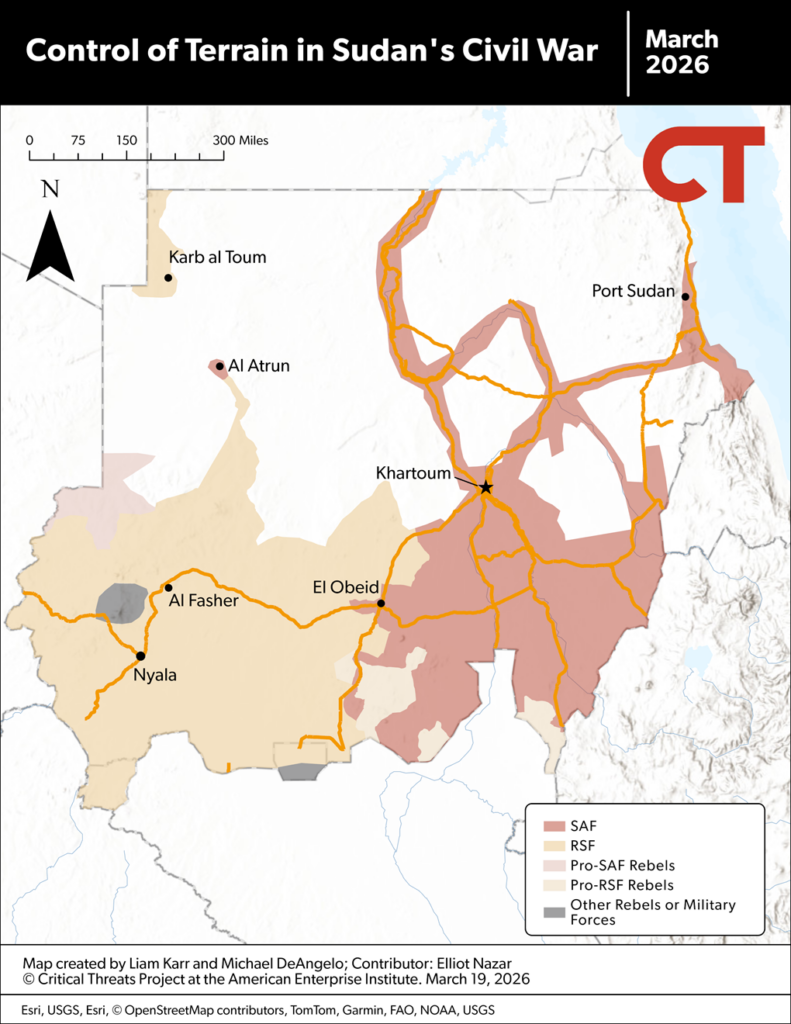
The SAF made its own gains in southeastern Sudan, clearing two RSF-aligned camps near the Ethiopian border. The SAF has cleared three SPLM-N al Hilu camps located directly south of Kurmuk since March 12.[8] The RSF and SPLM-N al Hilu launched an offensive in Blue Nile state in late January 2026 and have recently focused on taking Kurmuk, a key border town linking RSF supply lines from western Ethiopia to Blue Nile.[9]
Figure 4. Control of Terrain in Sudan’s Civil War
External backers have continued to fuel the warring sides—despite the Iran war—to the detriment of US peace efforts. CTP previously assessed that both sides are setting conditions for major offensives with external backing, which is stalling a US-proposed humanitarian ceasefire in the Quad peace process involving Egypt, Saudi Arabia, and the United Arab Emirates (UAE).[10] Open-source analyst Rich Tedd has tracked continued suspected weapons shipments from the UAE to RSF rear bases in Chad and Ethiopia despite Iranian strikes on the UAE.[11] The flights temporarily stopped during the first week of the Iran war, however. Egypt has escalated its involvement on the side of the SAF from mainly providing matériel support to coordinating and conducting drone strikes against the RSF since the RSF captured el Fasher—the North Darfur state capital—in October 2025.[12] The French investigative outlet Africa Intelligence reported that the RSF killed an Egyptian general in a drone strike in Kosti—a major city located approximately 200 miles south of Khartoum—in early March.[13] SAF head and leader of the SAF-led government Abdel Fattah al Burhan reaffirmed on March 16 that there would only be a lasting ceasefire if the RSF surrenders.[14]
Sahel
The United States has continued to reengage the Alliance of Sahel States (AES) as it looks to reestablish counterterrorism cooperation, including intelligence, surveillance, and reconnaissance (ISR) flights. Nick Checker, a senior official for the US State Department’s Bureau of African Affairs, traveled to Burkina Faso and Niger between March 12 and March 13 to discuss increasing cooperation with the two countries. Checker met with Burkinabé Foreign Minister Karamoko Jean-Marie Traoré in Ouagadougou on March 12. The bureau framed the visit as an opportunity to restate US respect for Burkinabé sovereignty and advance shared priorities.[15] Checker and Traoré discussed expanding cooperation in counterterrorism and trade and the potential removal of the US suspension on arms exports to Burkina Faso.[16] The Burkinabé Ministry of Foreign Affairs released a statement after the meetings that affirmed Burkina Faso’s support for renewed relations with the United States despite previous tensions and urging more concrete action.[17] Checker praised the visit as “constructive” and emphasized US interest in rebuilding trust and enhancing cooperation with Burkina Faso.[18]
Checker held bilateral talks with Nigerien Foreign Minister Bakary Yaou Sangaré and Prime Minister Ali Mahamane Lamine Zeine in Niamey on March 13.[19] The US State Department described Checker’s visit as an opportunity to discuss next steps on enhancing bilateral partnerships in security and economic issues.[20] The officials spoke about relaunching counterterrorism and economic cooperation.[21] Niger’s Foreign Ministry announced that talks are expected to continue “while respecting national sovereignty and mutually agreed priorities.”[22]
US rapprochement with Burkina Faso and Niger follows increased engagement with the third AES member, Mali. Checker visited Bamako and engaged in “substantive” discussions with Malian Foreign Minister Abdoulaye Diop about the fight against terrorism and promoting economic development on February 3.[23] The US State Department framed the meeting as a “reset” in US-Mali relations and emphasized the United States’ respect for Mali’s sovereignty.[24] The Malian Foreign Affairs Ministry tweeted after the meeting that both sides view renewed ties as a “win-win” partnership.[25] The United States removed sanctions on Malian Defense Minister Sadio Camara and two other high-profile military officials with ties to the Wagner Group on February 27.[26]
The United States is attempting to rebuild its ISR capabilities in the region. The United States withdrew from air bases in Niamey and Agadez, Niger, which were key for ISR flights across the Sahel, after the Nigerien junta cut defense cooperation with the US amid a diplomatic dispute in 2024.[27] Reuters reported on March 9 that the United States and Mali are nearing a deal to resume US-led ISR flights over the country. [28] Multiple reports say that US interest in resuming ISR flights is partially driven by the desire to find an American pilot who was kidnapped in Niger by al Qaeda’s Sahelian affiliate and is believed to be held in Mali.[29]
Democratic Republic of the Congo (DRC)
IS Central Africa Province (ISCAP) militants targeted Chinese-owned mining sites in a spate of attacks in the eastern Democratic Republic of the Congo (DRC) in mid-March 2026. ISCAP, known locally as the Allied Democratic Forces (ADF), reportedly attacked residential and mining sites, including some operated by Chinese nationals, at Muchacha in the southwestern part of the Okapi Wildlife Reserve in Mambasa district in western Ituri province in the eastern DRC on March 11.[30] Muchacha is the biggest semi-industrial gold mine in the reserve and one of the largest semi-industrial gold mines in the DRC.[31] ADF claimed to have killed at 24 people, abducted over a hundred people, destroyed machinery, and confiscated armaments and equipment in the attack.[32] The group also ambushed a Congolese army convoy that was responding to the March 11 attack, killing an officer and other troops in the area on March 14.[33] ADF then carried out an attack on a wildlife ranger patrol post at Babeusa, roughly seven miles north of Muchacha, on March 16.[34]
The attacks are ADF’s most severe on mining sites and the furthest west attacks in the eastern DRC in several months. The group has not attacked Muchacha before, and the attacks are the most severe in Mambasa district since early January 2026, when ADF intensified attacks on military positions and civilians.[35] ADF has periodically targeted gold miners and clashed with security forces in mining areas, but the attack on Muchacha is the deadliest since ADF killed at least 35 civilians at two mining sites in northern North Kivu province in early June 2025.[36] The attacks on Muchacha and Babeusa are also ADF’s most westward kinetic activity recorded in the eastern DRC since late September 2025, according to Conflict Location and Event Data.
ADF likely conducted the attacks to show strength and retaliate in response to recent counterterrorism operations, as well as redirect the focus of or set conditions to retreat from security forces. The attacks may have been retaliation for recent counterinsurgency operations in Ituri, as ADF has historically conducted retaliatory attacks for joint DRC-Uganda counterterrorism operations, dubbed Operation Shujaa. Joint security forces had launched major operations in Mambasa and the adjacent Irumu district that dismantled an ADF hostage camp, destroyed four operationally significant bases, and neutralized four senior ADF leaders in late February and early March.[37] The Shujaa operation in Mambasa reportedly wounded ADF’s commander and killed his doctor, who was treating the warlord.[38] ADF typically increases the scale of its attacks on civilians in response to intensified pressure from Operation Shujaa.[39] The group promoted the Muchacha attack with a media campaign, following well-established IS propaganda tactics across its global affiliates.[40]
Figure 5. ADF Attacks Chinese-Operated Mining Site in Eastern DRC
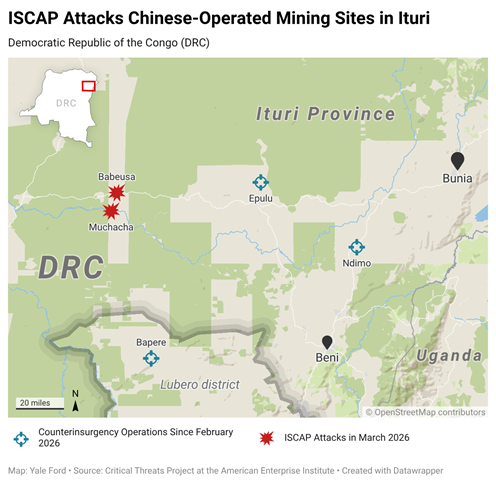
ADF may have also conducted the attacks to retreat from or divert security forces’ attention from ongoing counterinsurgency operations in North Kivu province, tactics the ADF has historically used to respond to counterinsurgency pressure. Locals told Congolese media that they believed the ADF militants who attacked Muchacha and Babeusa were part of a subgroup that came from northern Lubero district in North Kivu province, where security forces supported by local militia fighters had launched a reconnaissance operation in ADF-controlled areas on March 5.[41] Locals said that ADF did not empty its main camps in Lubero, despite the counterinsurgency operation.[42] ADF has adapted to counterterrorism pressure by breaking into smaller, more mobile subgroups, sometimes conducting attacks to draw attention away from larger subgroups in recent years.[43] Locals told Congolese media that the subgroup that conducted attacks in Ituri was also conducting reconnaissance operations in areas where they could flee if counterinsurgency operations in Lubero district intensified.[44]
Nigeria
Likely Boko Haram militants conducted coordinated suicide bombings in Maiduguri in one of the deadliest attacks in Borno state’s capital in recent years. Three suicide bombers separately targeted the El-Kanemi Monday Market, a post office, and the entrance of the University of Maiduguri Teaching Hospital in Maiduguri on March 16. The bombings killed 23 people and wounded 108 others.[45] The attacks occurred after Iftar, when the market was particularly crowded.[46] Direct attacks in Maiduguri city are rare, as attacks Boko Haram and IS West Africa Province (ISWAP) typically conduct indirect fire attacks on the city or target security posts on the city outskirts.[47] The last suicide bombing in Maiduguri was in December 2024, when a suicide bomber attacked a mosque in the city, killing five worshippers.[48]
Boko Haram militants likely committed the attack, as Boko Haram more regularly conducts suicide bombings against civilians than ISWAP.[49] At least three suicide bombers targeted a wedding, funeral, and hospital in coordinated attacks in Gwoza town in June 2024, killing at least 32 civilians.[50] Boko Haram conducted another suicide attack in a fish market in Konduga town that killed 12 civilians in June 2024.[51] Both attacks of 2024 used female suicide bombers, which ISWAP does not use.[52] Boko Haram militants also threatened to “extend their territory from Maiduguri to Abuja” in a recent video they released after kidnapping more than 300 women and children in an attack on Ngoshe village on March 4.[53]
The bombings come amid an ISWAP offensive across northeastern Nigeria, which is overstretching Nigerian security forces and may create gaps for further major attacks. ISWAP separately carried out attacks against two Nigerian military outposts in the Baga and Alijari areas in the outskirts of Maiduguri on March 16.[54] The offensive has increased the rate, severity, and complexity of attacks against military camps across Borno state that have inflicted major casualties against the Nigerian military.[55] ISWAP has increasingly conducted coordinated, simultaneous attacks across northeastern Nigeria, overrunning several camps. Nigerian security forces repelled another complex attack the night of March 18, claiming to kill at least 80 militants.[56]
Mali
Tuareg rebels with loose, informal ties to Salafi-jihadi networks in the Sahel conducted a drone swarm attack on a Malian army base in northern Mali, marking their most sophisticated drone attack yet. The Azawad Liberation Front (FLA), a separatist Tuareg group in northern Mali with informal ties to al Qaeda’s affiliate Jama’at Nusrat al Islam wa al Muslimeen (JNIM), launched 25 kamikaze drones targeting the Gao Airport inside the Fihroun Ag Alinsar military base in Gao, northern Mali, on the morning of March 11.[57] A Russian TOR-M2K interception system stopped 12 of the drones.[58] The FLA launched a second wave of drones armed with fragmentation shells.[59] The FLA assessed that the attack caused significant human and material losses.[60] Independent reports on social media claim the attack damaged or destroyed a TB2 drone piloting station and a Su24 helicopter hangar.[61] Aerial images of the airport taken on March 12 show no visible major damage, however.[62]
Tuareg rebels have been growing their drone capacity since resuming hostilities with the Malian government in 2023. Tuareg rebels conducted 28 drone attacks between 2024 and 2025, including an attack in July 2024 that the rebels claimed downed a Malian military helicopter.[63] Tuareg rebels used attack drones in a deadly ambush on Malian and Russian forces at Tinzaouten in August 2024, which killed up to 84 Russian and 47 Malian soldiers and marked some of Russia’s heaviest losses in the region.[64] Local sources have claimed that the FLA has previously used drones to attack an army base in northern Mali, according to local sources.[65] The FLA used a fiber optic suicide drone for the first time in the Sahel in 2025 and released videos that same year of fighters using a first-person view drone.[66] Drones enable the FLA to conduct indirect fire to harass or fix security force units as the organization seemingly lacks mortar supplies.[67]
The FLA has informal ties to al Qaeda’s Sahelian affiliate JNIM, which has also increased its use of drones in less sophisticated drone attacks in recent years. The factions’ leaders have relationships dating back to at least the 1990s.[68] An al Qaeda–linked Tuareg group that is now a JNIM subgroup initially fought alongside the Tuareg separatist rebels during the 2012 Tuareg rebellion.[69] However, the Salafi-jihadi militants sidelined the more secularist rebels and expanded their offensive into central Mali, which prompted the French military intervention in 2013 and helped formally split the separatist rebels from the al Qaeda–linked insurgents with a 2015 peace agreement.
The groups have kept in contact in subsequent years, made informal ceasefire agreements in their shared support areas, maintained significant areas of operation and membership overlap, and operationally coordinated since 2021. Connections between the two sides have likely strengthened since Malian and Russian forces began attacking the separatist rebels in northern Mali in 2023 following the withdrawal of UN peacekeepers. JNIM took advantage of this development to repeatedly offer to ally with separatist groups and northern communities in the Kidal region against their mutual enemies: the Malian army and the Russian auxiliaries.[70] The UN and French media reported in 2024 that the Permanent Strategic Framework for Peace, Security, and Development—the FLA’s predecessor—and JNIM were interested in establishing a formal nonaggression pact that aims to protect the free movement of fighters and facilitate information sharing but explicitly rules out combined attacks.[71] Outright cooperation would create legitimacy issues for both sides, given their tumultuous history and differing end goals due to the FLA’s secularism and JNIM’s Salafi-jihadi ideology.
JNIM has exponentially increased “drone drop” attacks since first introducing them in 2023. CTP defines drone drops as the use of a commercial drone to drop grenades, improvised explosive devices, mortars, or other explosives onto an enemy position. JNIM conducted five times as many drone drop attacks through November 2025 as it did in 2023 and 2024 combined.[72] Drone drops have supplemented mortar and rocket fire, enabling JNIM to conduct indirect strikes on hardened targets more frequently. The group averaged six indirect strikes a month in 2025, up from three in 2024.[73] JNIM is the only nonstate actor in the world to sustain this level of drone attacks across multiple countries.[74]