
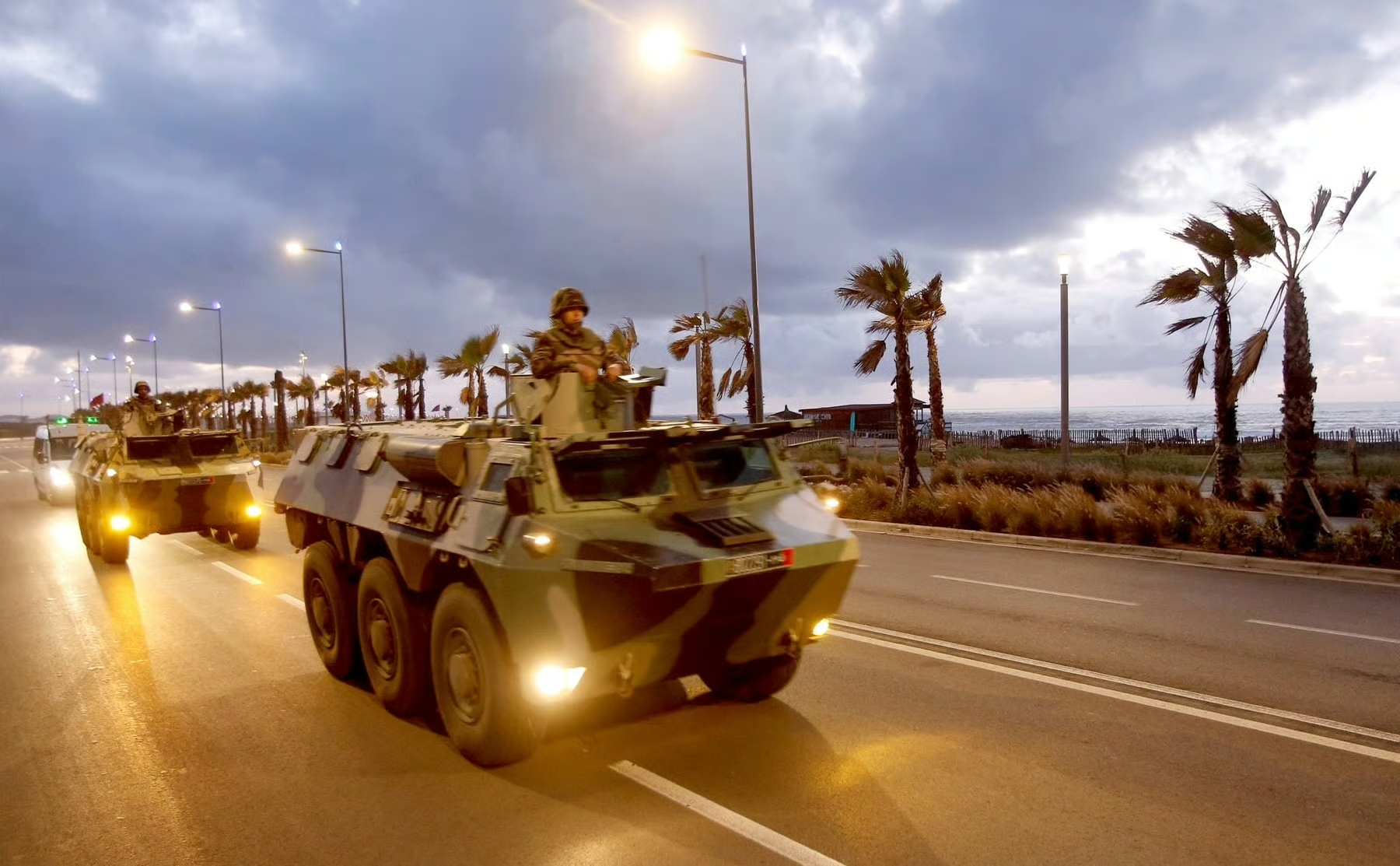
The 2026 report by the Stockholm International Peace Research Institute (SIPRI) confirms the rise in Morocco’s arms purchases, making it the continent’s leading importer between 2021 and 2025.
The Stockholm International Peace Research Institute (SIPRI) published its latest fact sheet on the global arms trade on 9 March 2026.
Entitled ‘Trends in International Arms Transfers’, the document analyses the evolution of major arms flows between states over the period 2021-2025, compared with the previous five-year period (2016-2020).
The report first highlights a global increase of 9.2% in arms transfers, the strongest rise since 2011-2015. This trend, however, conceals major regional disparities.
Arms imports more than tripled in Europe (+210%) and increased in the Americas (+12%), while they declined in Africa (-41%), Asia-Oceania (-20%) and the Middle East (-13%).
Rabat, the continent’s leading buyer
On the international stage, Ukraine has become the world’s leading arms importer (9.7% of global imports), while the US has consolidated its dominance with 42% of global exports. It is within this context that Morocco stands out.
While African arms imports overall have declined, those of the kingdom rose by 12% over the periods 2016-2020 and 2021-2025, making Rabat the continent’s leading arms importer and the 28th worldwide.
The US remains its main supplier (60%), ahead of Israel (24%) and France (10%), with orders still pending, notably with the US and Spain.
This dynamic is unfolding in a regional context marked by the persistent rivalry between Morocco and Algeria, which SIPRI identifies as one of the main drivers of arms demand in North Africa.
While Algerian imports appear to have fallen sharply in recent statistics, the institute notes that the opacity surrounding certain acquisitions could lead to an underestimation of their real scale.
Rivalry with Algiers
To shed light on these trends and assess their strategic implications for Morocco, The Africa Report spoke to retired colonel of the Royal Gendarmerie and geopolitical consultant Hassane Saoudi, founder of Securi-Consulting. He recommends interpreting the figures within the real context of the budgetary and doctrinal choices of the Royal Armed Forces (FAR).
The first key to analysis remains the financial effort devoted to defence. “The defence budget of Morocco for 2026 is $7bn; it represents only 4 % of GDP and remains below the budget for the ministry of education,” he says.
In other words, the increase in arms imports does not necessarily reflect accelerated militarisation but rather gradual modernisation within relatively contained budgetary margins.
The former officer says the budget now covers broader priorities than the simple acquisition of equipment.
“If you add Morocco’s efforts to build defence industry zones, the required investments and the co-location of companies with numerous partners following the path taken by India – whose implementation cost is included in this budget – then the budget is realistic and perhaps even below actual needs,” he says.
Behind the import figures, Rabat is therefore seeking to structure the beginnings of a national defence industry based on technology transfers and industrial partnerships.
Military spending is among the highest on the continent
Regional comparison nevertheless remains unavoidable.
“Compared to the Algerian defence budget of nearly $25bn, the picture becomes clearer since it is the largest item in the state budget. If you add the opacity surrounding this issue in the neighbouring country, SIPRI’s evaluation could prove approximate,” adds Saoudi.
Algeria’s military spending is among the highest on the continent and relies heavily on heavy equipment of Russian origin, such as the Sukhoi Su-30MKA fighter aircraft, T-90 tank battle tanks and the S-300 air defence system.
In this context, the increase in Moroccan imports mainly reflects a technological orientation.
“Nevertheless, qualitative choices play an important role in the rising cost of equipment,” the expert emphasises.
Compared to the Algerian defence budget of nearly $25bn, the picture becomes clearer since it is the largest item in the state budgetThis logic is illustrated in particular by the acquisition of advanced systems such as modernised F-16 Fighting Falcon aircraft upgraded to the F-16V standard and the M142 HIMARS precision rocket launcher systems.
A strategy of autonomy and regional deterrence
The structure of Morocco’s suppliers (dominated by the US, Israel and France) also reflects a broader diversification strategy.
“First, Morocco has long adopted a strategy of diversifying its defence-related imports,” says Saoudi.
“In addition to the countries mentioned – whose cooperation requires interoperability as a major NATO partner – we should also add India, Pakistan and Turkiye.”
This approach aims to preserve a margin of strategic autonomy.
“Second,” the expert continues, “Morocco chooses countries that are leaders in areas of significant technological excellence. This strategy breaks with supplier monopolies and ensures autonomy of decision in selecting providers. Third, Morocco is pursuing the establishment of a defence industry where multiple partnerships are a guarantee of quality and speed.”
Within this framework, military acquisitions respond to a long-term logic.
“Ultimately, Morocco prioritises the added value that equipment can provide over time,” our source explains.
Beyond the figures, regional rivalry remains a structuring factor. SIPRI notes that persistent tensions between Rabat and Algiers partly fuel the arms dynamic in North Africa. Yet for Saoudi, Morocco’s strategy goes well beyond a simple comparative logic.
“Morocco’s geostrategic position, the Atlantic and Mediterranean stakes, and its role as a regional leader are the cardinal criteria determining its choices – including the defence of its geography and its commitments with partners.”
Within this framework, military modernisation is primarily aimed at maintaining credible deterrence capabilities.
“Morocco is preparing a deterrence strategy to avoid a war with its neighbouring country in an environment that is already fragile, volatile and fraught with risks,” the specialist insists.
“Morocco’s non-belligerent stance is reiterated at every opportunity at the highest level of the state, and these signals should be understood at their true value.”
Behind the statistics on arms imports, the expert concludes, Morocco’s strategy above all rests on a balance between military modernisation, international cooperation and the careful management of an unstable regional environment.