
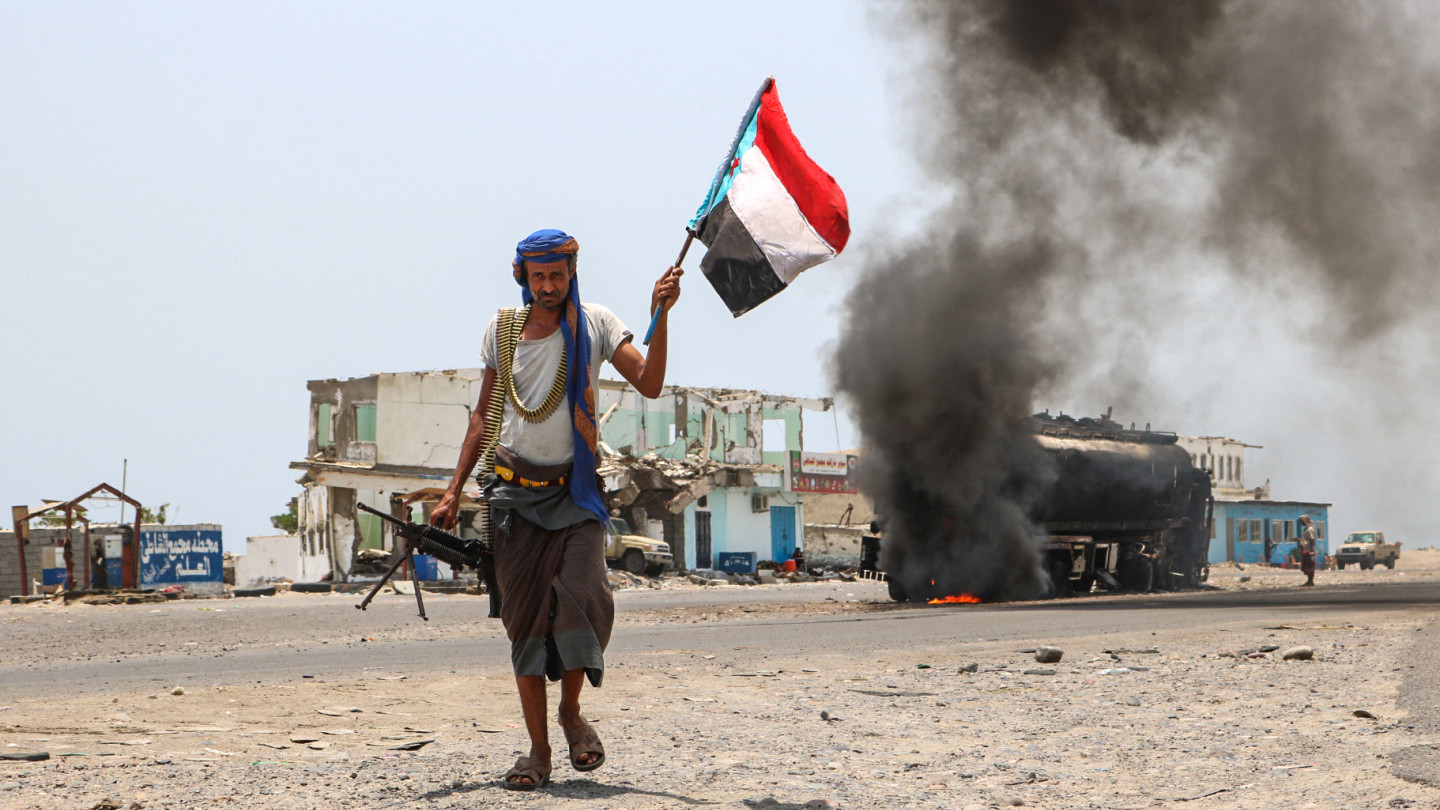
The Southern Transitional Council’s lightning offensive in the south could entrench Yemen’s de facto partition and risks rekindling the 10-year civil war
Yemen’s fragile state of no-peace, no-war has effectively cracked after the southern separatist movement launched an offensive against the internationally recognised government.
The Southern Transitional Council (STC), a UAE-backed separatist group advocating for southern Yemen’s independence, launched a major military operation, which it dubbed “Promising Future,” on 2 December 2025, targeting the oil-rich Hadramawt Governorate.
This offensive marks the most significant escalation in Yemen’s internal power struggles since the 2022 UN ceasefire, pitting STC forces against the Saudi-supported internationally recognised government, represented by the Presidential Leadership Council (PLC), and its allies, including the Hadramawt Tribal Alliance led by Sheikh Amr bin Habreish.
As a result of the offensive, the STC made its most rapid territorial gains since its founding, with a pro-independence group consolidating control over nearly all of southern Yemen for the first time since unification in 1990.
“The STC’s latest moves are driven by its effort to complete its project of extending control over the entire southern territory. Consolidating authority over Wadi Hadramawt and al-Mahra has long been the missing piece in the territorial vision it promotes,” Ahmed Nagi, Yemen analyst at International Crisis Group, told The New Arab.
The STC operation aims to “restore stability” and dismantle what the STC calls “extremist” networks linked to the Muslim Brotherhood, Al-Qaeda, and Houthi smuggling routes.
However, critics state the UAE-backed faction has often used Islamists and Al-Qaeda as a pretext for expanding its operations in favour of cementing control over the south and its oil resources.
The operation was relatively swift with little direct combat. By 8 December, STC forces had seized key territories with minimal resistance, heightening Saudi–Emirati tensions and raising fears of renewed civil war.
During this period, the STC took control of PetroMasila facilities and surrounding positions from the Hadramawt Tribal Alliance. STC control of the PetroMasila oil fields – Yemen’s largest oil producer – temporarily halted production and caused widespread blackouts across parts of Hadramawt and neighbouring areas, according to local sources, deepening the economic fallout.
Moreover, the offensive also led to temporary pauses of flights at the STC-controlled Aden airport.
A shifting Saudi-Emirati power balance
A potential proxy confrontation between Saudi Arabia and the UAE appears to be heating up after Riyadh sent military and security delegations to Hadramawt to meet local tribal leaders aligned with Saudi interests.
STC forces blocked one such visit in Seiyun, which it captured, with little direct Saudi pushback. At the same time, Saudi-backed Yemeni forces in Lahj were reportedly preparing to redeploy to parts of Hadramawt, with Saudi armoured vehicles moving closer to the governorate.
However, beyond any immediate steps toward a southern state, the offensive has shifted the balance of power between Riyadh and Abu Dhabi.
“The STC’s current goal has little to do with establishing a southern state. They appear to be driven by external actors seeking to reshape the balance of power on the ground at the expense of the internationally recognised government,” Ali al-Sakani, a Yemen-based journalist, told The New Arab.
The STC was formally established in 2017, comprising leading figures from southern factions and backed by the UAE alongside aligned militias such as the Security Belt and the Giants Brigades.
While the UAE and the STC joined the Saudi-led coalition against the Iran-backed Houthis in March 2015, STC forces, with Emirati guidance, increasingly diverged from the internationally recognised government, culminating in a 2019 coup attempt in Aden supported by Emirati airstrikes.
Although Saudi Arabia and the UAE averted a major rupture through the Riyadh Agreement later that year, their cooperation rested on fragile compromises.
Still, their dynamic has evolved. Abu Dhabi, which joined the coalition as a junior partner, has increasingly jostled with Riyadh and chipped away at its leadership role, arguably becoming the dominant player in Yemen’s south.
“These developments indicate fundamental changes in the map of control on Yemeni soil. They clearly tilt in favour of the UAE over Saudi Arabia,” Hesham al-Ziady, a Yemeni journalist, told The New Arab.
Andreas Krieg, associate professor at King’s College London, told TNA that the timing favours Abu Dhabi. “Abu Dhabi and the STC are cashing in on a moment when Saudi leverage in Yemen is unusually weak,” he said. “Riyadh has spent the last couple of years trying to de-escalate, wind down its direct military role and focus on a political bargain with the Houthis.”
He noted that the STC’s swift progress in Hadramawt and Mahra takes advantage of this political dynamic, as they are advancing while Saudi Arabia is focused on the northern track and Saudi decision-makers appear hesitant to directly challenge a UAE-supported actor.
“It underlines how far their Yemen end-states have diverged, and how comfortable Abu Dhabi now is in creating faits accomplis on the ground and leaving Riyadh to adjust after the fact.” Despite being close Gulf Cooperation Council (GCC) allies on paper, differences have emerged in Saudi and Emirati foreign policy.
In Sudan, where Abu Dhabi has backed the Rapid Special Forces (RSF) paramilitary group across southern and western Sudan, Riyadh has been quietly uneasy with Emirati backing of that faction and has nudged the US – via the Quad – to push for a political solution.
Are we moving towards a southern state?
The latest STC offensive accelerates a fragmentation process that was already well underway.
The Houthis govern the north with their own institutions and security forces, while the south remains administered by a patchwork of anti-Houthi actors, now dominated by the STC. The country also operates with two rival central banks, one in Aden and one in Sanaa, resulting in separate currencies, monetary policies, and economic systems.
This deepening unofficial split comes as Saudi Arabia and the UAE struggle to maintain a pragmatic truce in their own rivalry. The STC’s gains have exposed widening cracks in their alliance, heightening the risk of a ‘civil war within a civil war’.
And the gravity of this latest crisis was underscored when several PLC members, including President Rashad al-Alimi and the prime minister, fled Aden to Riyadh as STC forces consolidated their grip on the south and the palace of Aden.
Arguably, the current political moment is the most precarious for Yemen’s official leadership since unification.
“The PLC has experienced its most fragile moment since its establishment, and the situation in eastern and southern Yemen is unlikely to stabilise in the near or medium term,” said al-Sakani.
Hesham al-Ziady warns that overreach by the STC carries risks.
“Announcing a state in South Yemen now would be suicidal for the STC and could place it in a difficult position that does not serve its project – even if the UAE quietly supports these aspirations and moves.”
Indeed, since international recognition for the STC remains scant, especially while Saudi Arabia has supported the internationally recognised government, the STC will likely aim to consolidate its gains over the coming period rather than a decisive push for southern independence.
Given the STC’s dependence on Emirati support, it would likely follow Abu Dhabi’s preferences. Across other arenas, from Sudan to Libya, the UAE has backed powerful local actors as a means of securing leverage, often resulting in de facto partition. Yemen appears to be following a similar trajectory.
Even though a southern state is the STC’s declared long-term goal, the current situation is more likely to produce a form of de facto partition rather than a genuine political settlement.
Meanwhile, the STC has bolstered the UAE’s ambition of establishing a dominant maritime network across the Red Sea and Indian Ocean, and it has looked to gain control over ports in southern Yemen, including Aden.
At the same time, the Houthis have consolidated control over northern Yemen. With opposition forces in disarray, this will help ensure the group’s continued dominance. The Houthis have also withstood American, British and Israeli strikes after attacking Red Sea shipping and Israeli territory in support of Palestinians in Gaza under Israel’s siege.
Although concerns remain that the Houthis may resume conflict in the south, reports indicate they have shifted forces toward Marib, a region of heavy fighting before the April 2022 ceasefire. If the coalition falters, the Houthis may seek further gains.
For now, the STC-PLC rupture reduces pressure on the Houthis along the southern front.
“In the end, everything that is happening [in the South] ultimately serves the Houthis,” said al-Sakani.
Although Yemen has so far avoided a return to brutal fighting, these events show that the country’s de facto division, largely influenced by external powers, is becoming increasingly entrenched.