
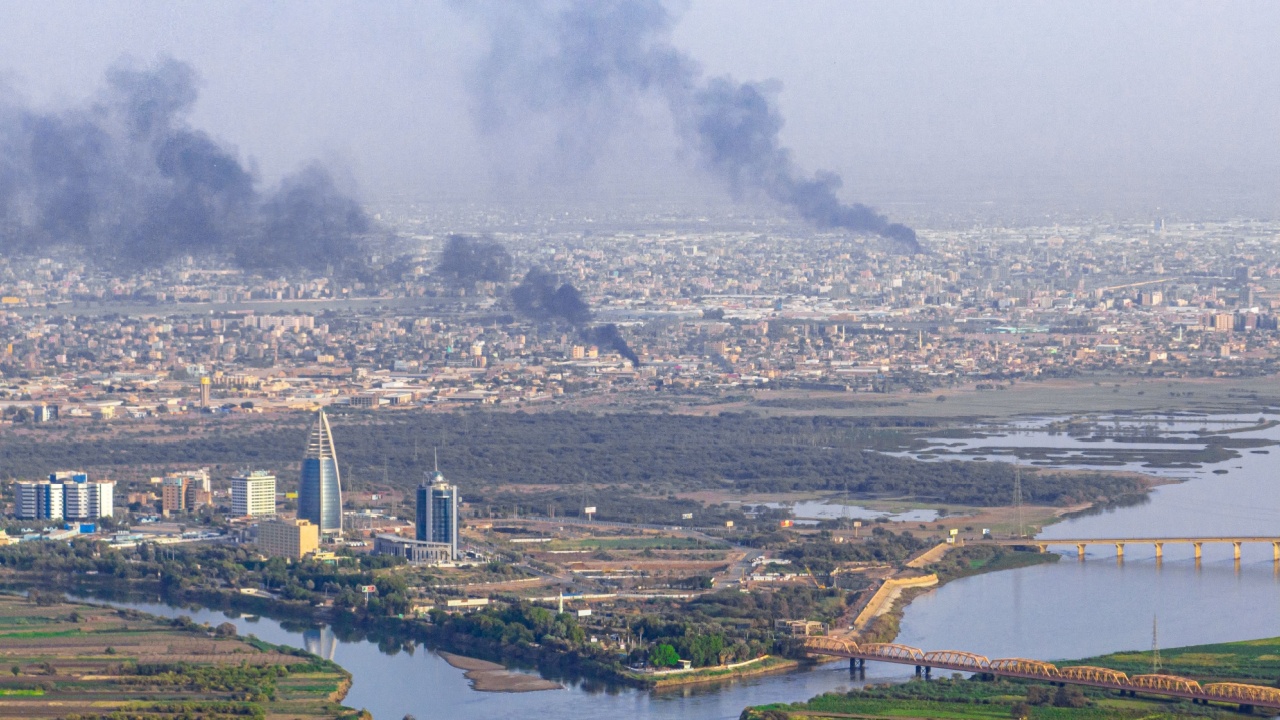
The United States can pressure the regional backers of Sudan’s civil war into a ceasefire and prevent further destruction of the country.
In war-ravaged Sudan, the breakaway rebel militia known as the Rapid Support Forces (RSF) is on the march. If the dynamics that have fueled the war do not change quickly, Sudan will enter a new and even bloodier chapter of its nightmarish civil war.
The RSF has already advanced toward the city of Al-Obeid, the central node connecting the supply and communication lines running between western Sudan and the country’s capital, Khartoum.
If the RSF captures Al-Obeid, it will split eastern Sudan off from the west, effectively dividing the massive country into two semi-independent spheres—a major step toward dismantling the Sudanese state.
Time is running out. The international community can forge a lasting ceasefire that will rush more humanitarian relief to Sudan’s starving population and open space for a political dialogue on the country’s future, and the outside actors who have been fueling the conflict change course. They must embrace constructive participation rather than destructive meddling. Only the United States can orchestrate such a commitment among the spoilers.
The Patrons and Proxies of Sudan’s Civil War
The war persists because of intertwining internal, regional, and international interests. Internally, Sudan is divided between two contradictory visions for the country’s future. The RSF wants to transform its military gains into political legitimacy and permanent influence; the Sudanese Armed Forces (SAF) views any concession to the rebels as the beginning of the end of the state and the army. Each side also believes that it can decisively resolve the war.
Meanwhile, at the regional level, Sudan is becoming a full-fledged proxy war. The UAE provides organized materiel support to the RSF. The rebels have purchased sophisticated weapons, including Chinese-made drones delivered through a complex smuggling network through third countries. The UAE has interests in exploiting gold mines in eastern Sudan, strengthening trade corridors across the Red Sea, and weakening Islamist currents within the Sudanese military. Chad and Ethiopia also back the RSF due to deep historical and tribal ties with Sudan’s Darfur region. The RSF’s decisive victory in Al-Fashir reinforced its credibility and could encourage the rebels’ patrons to send more military and logistical aid.
On the other side, Egypt supports the embattled Sudanese army. Cairo fears that the ongoing war will mean more armed militias along its long southern border, more refugees, more strain on its core water interests, and more difficulty managing the Renaissance Dam. For its part, Turkey has worked with Egypt to arm the Sudanese army with sophisticated Bayraktar drones.
At the international level, the Sudanese war is becoming an arena of open competition among outside powers, all vying for control over a region rich in natural resources with a vital geographic location linking the Horn of Africa to the Middle East. Although the United Nations imposed a strict embargo on arms to Darfur in 2004, the flow of weapons has never stopped.
For example, an Amnesty International investigation in March 2025 reported that the RSF was using Chinese GB50A guided bombs, the first documented global deployment of these munitions. The RSF weapons arrive through organized supply networks on regular cargo flights from Abu Dhabi to eastern Chad, as well as existing smuggling networks through Libya, South Sudan, and Central Africa. Russia—also a major arms supplier to the Sudanese army—used its veto in the UN Security Council to block a November 2024 resolution calling for a ceasefire.
The flow of weapons is the fuel that keeps the war machine rolling. Outside powers are deeply complicit in this tragedy.
The Sudanese people are paying a heavy price. Over three years, this devastating war has claimed some tens of thousands of lives and created approximately nine million internally displaced people and three million refugees. Sudan’s sovereignty is in the hands of external actors. The country as it now exists is heading toward a point of no return.
Yet the world is paying more attention to Sudan’s often-forgotten civil war after the RSF massacres at Al-Fashir. That might open one last chance for a truce. The external actors driving the war may be willing to restrain their proxies if they finally face the type of international pressure that they have heretofore mostly avoided.
For example, Anwar Gargash, the diplomatic advisor to the UAE president, signaled on November 2 that the UAE may be willing to adopt a more conciliatory approach by calling it a “critical mistake” for the Emirates to have supported the generals who overthrew Sudan’s civilian government in 2021; their internal feud later ripped the country apart. The UAE is also facing an uncomfortable media spotlight for supporting the RSF. A shift by the Emiratis could offer a crucial pressure point for international mediation among the external parties to the war.