
Three years after the Pretoria Agreement, the expected ‘peace dividend’ has vanished. Trapped between a liquidity crisis and political deadlock, Tigray’s economy is not just stalling – it is disintegrating.
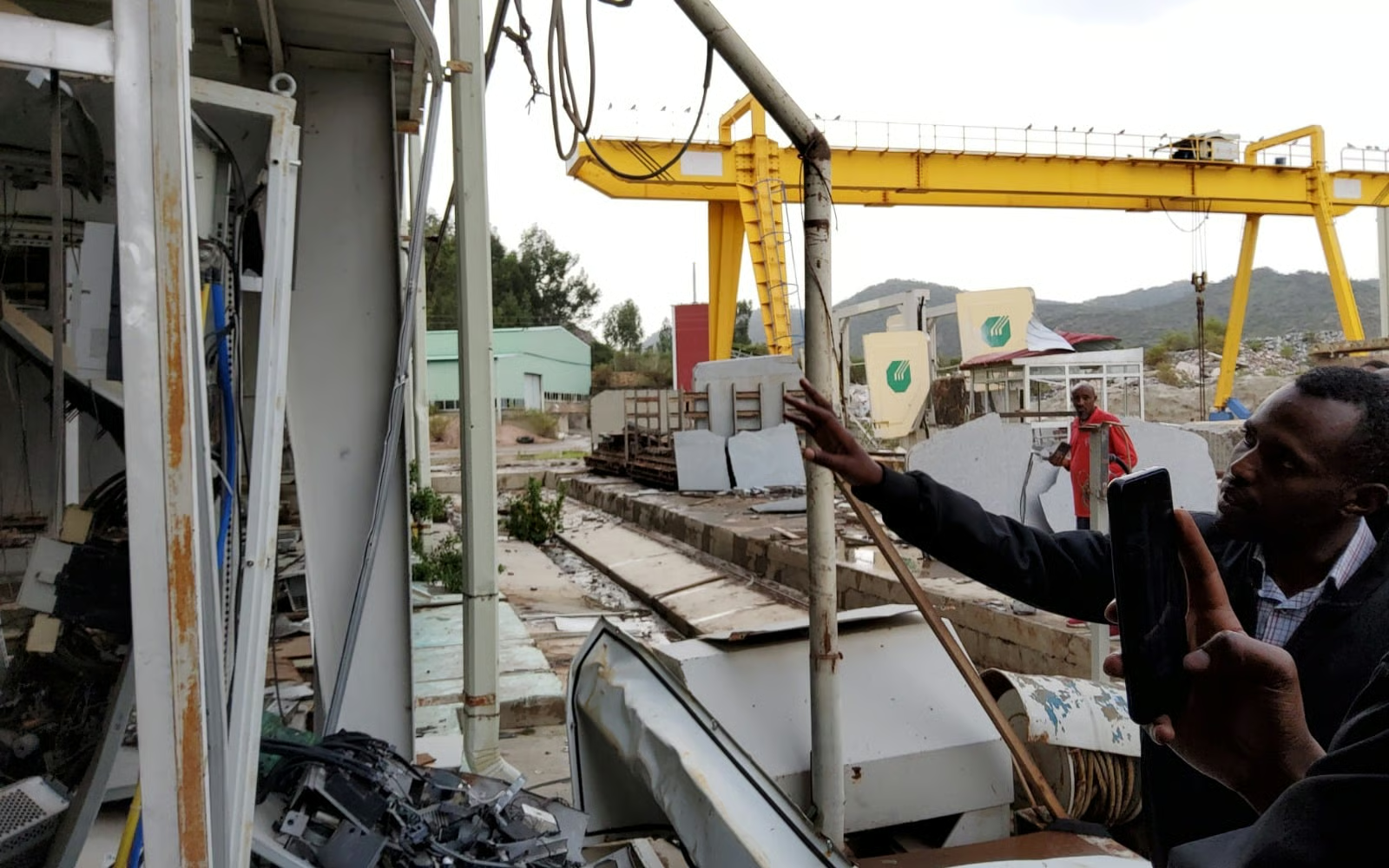
In the quiet halls of the Semayata Dimensional Stone Factory, the high-tech Italian machinery that once helped build Ethiopia’s ministry of defence sits beneath a thick layer of dust and debt.
Tigray is entering a new phase, three years after the war. It is defined less by reconstruction than by paralysis, political fragmentation and a recalibration of alliances that is raising concern in Addis Ababa.
“People are not forgetting. They are calculating,” says a senior political figure recently arrived from Mekelle, speaking to The Africa Report on condition of anonymity. “Survival is now dictating decisions that would have been unthinkable two years ago.”
That calculation is unfolding against a stark economic reality, as business leaders, industry managers and regional representatives point to a region where recovery has stalled and political cohesion is fraying.
An economy frozen in place
At the centre of the crisis is the lack of reconstruction, with the blight of the war and no recovery evident on the ground.
“None. I can say zero improvement,” says Haftay Hagos, executive secretary general at the Tigray Region Chamber of Commerce, when asked how much of the war-damaged industrial base has returned to operation. “We are completely in a kind of blockage. There is no money.”
According to a baseline report by ACAPS on Tigray’s pre-crisis situation, the region’s industry sector accounted for 26.3% of regional GDP in 2016/17, including construction and transportation, and it received a large share of national domestic investment between 1992 and 2017 in agriculture, manufacturing and construction.
“The region hosted 61 capital-intensive, export-oriented industries, generating foreign exchange via sesame, cereals, leather and apparel,” said an analysis in Ethio Panorama, published on 4 August 2025. Post-war, this contribution has plummeted due to destruction, displacement and stalled recovery, likely falling below 2-3%.
Factories that once anchored the regional economy remain idle. At Semayata Dimensional Stone Factory, a major pre-war supplier to national construction projects, operations have yet to resume.
“We are waiting for a decision from the Development Bank of Ethiopia,” says Jemal Abdulkadir, chief executive officer of the factory. “We asked for a loan of around Br1bn [$6.33m] to rehabilitate, but leadership changes at the bank have delayed everything.”
Our leaders are negotiating power. We are negotiating survivalBefore the war, the factory employed 600 permanent workers. Established in 2016 with high-tech machinery imported from Italy, the factory was a cornerstone of the national construction sector.
Before the war, 40% of Ethiopia’s construction materials, including granite for major buildings such as the ministry of defence and INSA (Information Network Security Administration) headquarters, were built with their product. “Orders often had a waiting time of six months to two years, reflecting high demand and production quality. Today, it stands inactive,” Jemal says.
Across sectors, the pattern repeated itself. Liquidity is scarce, credit channels are blocked and infrastructure remains degraded. Fuel shortages have compounded the crisis.
“Right now, it is difficult to do business in Mekelle due to the fuel crisis,” he says. “What existed before has now become three times worse with politics.”
Politics driving economic decline
Business leaders point not only to war damage, but to ongoing political instability.
“There were initial improvements after the war,” Haftay tells The Africa Report. “But due to the political volatility between Tigray forces and leadership, the region and the business community are suffering from a shortage of cash and finance.”
The absence of a unified political direction has left businesses and communities in limbo, with no clear policy pathway for recoveryHe describes a breakdown in coordination between regional and federal authorities, saying: “The relationship with the federal government is poor. Thoughts are clashing. Now it is just like the old days, 2020 to 2022.”
The consequences extend beyond domestic business to major exporters, too.
At Sheba Leather Industry, once a major exporter employing around 900 workers, operations remain suspended as it was demolished by the war.
“Workers are scattered. There is no other job opportunity,” Berhan Haile, a research and development manager at the factory, tells The Africa Report. “An industry that brought foreign currency is now still closed and damaged.”
Before its destruction, Sheba Leather Industry, along with other Tigray-based industries such as Goda Bottle and Glass Share Company ($32m) and Mercy Natural Spring Water ($175m), underpinned the regional economy.
Post-war, these industries have been devastated, leaving workers displaced and halting foreign exchange generation.
Fragmentation within Tigray
These economic pressures are feeding into deeper political divisions.
The trajectory of Debretsion Gebremichael, chairperson of the Tigrayan People’s Liberation Front (TPLF), and his aligned factions is diverging from figures seen as closer to federal structures.
This includes Getachew Reda, a former minister who had served as chief administrator of the Interim Regional Administration of Tigray. Getachew’s transition into a federal advisory role for East African Affairs reflects a redistribution of influence rather than a resolution of differences.
The lack of political cohesion is taking a toll on the population, driving people to look elsewhere in order to find jobs and economic security.
“Our leaders are negotiating power. We are negotiating survival,” says a recent political science graduate from Mekelle University who arrived in Addis Ababa in search of employment.
“The absence of a unified political direction has left businesses and communities in limbo, with no clear policy pathway for recovery,” he says.
“Now it is just like the old days,” says Haftay. “There is nothing new.”