
Democratic Republic of the Congo: The Congolese military increases aerial strikes against the M23
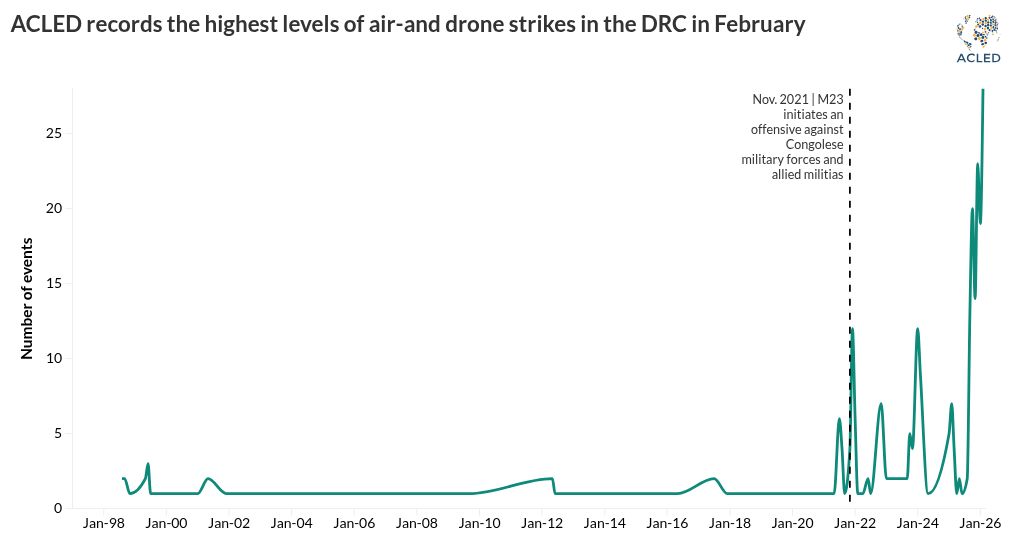
Last month, ACLED records the highest number of monthly air- and drone strikes ever in the DRC. As part of a marked increase in aerial warfare between the Congolese military (FARDC) and the March 23 Movement (M23), a FARDC drone strike killed Willy Ngoma, the M23 military spokesperson, alongside several high-ranking rebel leaders on 24 February.
The FARDC increased its reliance on aerial warfare to support incursions alongside allied Wazalendo militias into M23-held positions in Mwenga, Masisi, and Fizi territories last month, as well as areas of critical resource extraction. It deployed an arsenal of Chinese CH-4 and Turkish TAI Anka drones, along with fighter jets and attack helicopters, during the operations.1 The Congolese military also used numerous private military companies to support these operations, including Vectus — which was officially brought in to support the taxation of mining revenue under the leadership of American Erik Prince, former head of the private military company Blackwater.2
The drone strike that killed Ngoma hit near Rubaya, Masisi, a critical mining area that produces around 15% of the global coltan supply. Moreover, the United Nations estimates it provides the M23 with at least 800,000 US dollars in monthly revenue. The Rubaya mine was promised by the Congolese government to the United States on 5 February in a mineral cooperation deal.3 While making territorial advances, especially in Masisi and Mwenga territories, the M23 mounted counterattacks near the end of the month that forced the Congolese military and Wazalendo to once again retreat from many areas. Facing this barrage of aerial strikes, the M23 also launched several kamikaze drone attacks against the FARDC’s Kisangani military command center, which has served as its primary base for aerial operations. Initial M23 strikes against Kisangani occurred on 31 January, and continued in February and into March.
Ethiopia: The ENDF, TDF, and Eritrean forces mobilize troops in the north
Significant mobilizations of rival Ethiopian National Defence Force (ENDF), Tigray Defense Forces (TDF), and Eritrean Defense Forces (EDF) took place in northern Ethiopia in early February, drawing the region once again closer to outright war, more than three years after the end of the northern Ethiopian conflict in November 2022. Tensions in the region increased following a TDF attempt to reclaim the disputed Tselemt area in late January.
On 6 February, several ENDF tanks and trucks carrying heavy weaponry were observed heading toward Western Tigray. Around 11 February, TDF troops deployed in Dedebit, Tselimoy, Adi Hageray, Adi Dairo, Sheraro, and Shire towns in the North-Western Tigray zone; Bisober in the Southern Tigray zone; and Adi Keyh and Milazat in the South-Eastern Tigray zone. The TDF is also reported to operate in the Berahle zone of the Afar region. Eritrean troops have also been deployed in Sheraro and Shire towns. On 7 February, Ethiopia asked Eritrea to withdraw its troops from its territory and stop supporting rebel groups.4 The Eritrean foreign minister called the accusation “false and fabricated.”5
Additionally, Fano militias, some of which have aligned with the TPLF, and government forces are entangled in an ongoing conflict. On 2 February, the Amhara Fano National Movement (AFNM) clashed with the ENDF and Tekeze Zeb paramilitary force in Tsegede, following AFNM attacks on the Tekeze Zeb. The group clashed with ENDF throughout the month in at least 15 areas in Amhara and took over the town of Shawira in the Central Gonder zone on 22 February. The clash in Shawira resulted in at least 100 fatalities from both sides, making it one of the deadliest events in February.
Mozambique: ISM pushes gains in Cabo Delgado’s Catupa forest
In February, Islamic State Mozambique (ISM) remained on the offensive in and around Cabo Delgado’s Catupa forest. Having overrun two Defense Armed Forces of Mozambique (FADM) positions there on 31 January, they have since resisted state forces from regaining control of the area. According to claims by IS, ISM killed at least nine FADM soldiers in the two weeks following the initial attacks. On 22 February, the group ambushed a commercial convoy on the N380 highway from positions in the Catupa forest near Quinto Congresso village, targeting food shipments. At least four people died in the initial ambush, including a child. Looting by ISM continued into the following day, when reinforcements from the Mozambican and Rwandan militaries, Mozambican police, and the auxiliary Local Force clashed with ISM at the site of the ambush. At least 15 people died in clashes that day. Though reports differ in details, it is clear that state forces suffered significant losses. Local sources suggest that fatalities over the four days are considerably more, so fatality figures are likely to rise. Despite state forces’ air operations in subsequent days, likely led by Rwanda Defence Force Mi-24 helicopters, ISM remains firmly in control of Catupa forest.
See more of ACLED’s coverage on Mozambique.
Sahel: JNIM launches a region-wide offensive following internal defection
In February, Jama’at Nusrat al-Islam wal-Muslimin (JNIM) launched a broad and coordinated campaign against state forces across the central Sahel and into Benin, with Burkina Faso as the main battleground. The offensive followed Sadou Samahouna’s defection to the Islamic State Sahel Province (ISSP). Sadou was a senior JNIM commander in Burkina Faso’s Est region and the younger brother of Abu Hanifa, JNIM’s emir for Niger.6 Although Sadou reportedly defected with only a small group of fighters, his influence and following likely raised concerns within JNIM’s leadership about internal cohesion and the risk of further defections — concerns that appear to have driven the scale and intensity of the subsequent campaign. The first large-scale attack of the campaign took place on 4 February, when JNIM attacked a Nigerien military base in Makalondi, near the area of Boni where Sadou had defected.
JNIM’s campaign then shifted to Burkina Faso, where it targeted the Burkinabe military and the state-backed Volunteers for the Defense of the Homeland (VDP), particularly in the Est, Centre-Nord, and Nord regions. The offensive involved more than 30 attacks in Burkina Faso alone and resulted in the death of more than 120 soldiers, forest guards, and VDP fighters. JNIM’s use of mass violence mirrors tactics often associated with ISSP — an approach that appears to resonate with segments of JNIM’s rank and file. In the meantime, ISSP launched its own offensive in Burkina Faso’s Sahel region on 9 and 10 February. The group attacked and overran JNIM positions in several villages and killed more than 40 JNIM fighters, underscoring the persistent challenge to JNIM’s regional dominance.
See our latest report, Q&A: Why is jihadist violence escalating in the Benin, Niger, and Nigeria border triangle? | ACLED, and more of ACLED’s coverage on The Sahel.
Sudan: The RSF mobilizes to consolidate its control over North Darfur
In February, the Rapid Support Forces (RSF) made gains in North Darfur and continued to carry out drone strikes on army troops in Kordofan and Blue Nile states. There, RSF troops mobilized to gain control of the border towns of Tina and Misteriya. In Tina, the RSF clashed with the Sudanese Armed Forces (SAF) and its allies from 21 to 23 February, forcing Chad to close its borders due to spillover of the violence.7 On 23 February, the RSF mobilized to overtake Misteriya, where it captured Musa Hilal, head of the Revolutionary Awakening Council (RAC) and the Mahameed clan of the Rizeigat ethnic group. The RSF ultimately gained control of Misteriya after a drone strike hit Hilal’s home on 22 February, which killed his son, several RAC commanders, and numerous civilians. The RSF denies the strike. Tension between the RSF and Hilal escalated after the RSF accused him of coordinating the drone strike that killed the group’s security advisor in East Darfur in January.8 Over the past year, both the RSF and the SAF have deployed combat drones to secure territories and disrupt enemy mobilization.