
Key Takeaways:
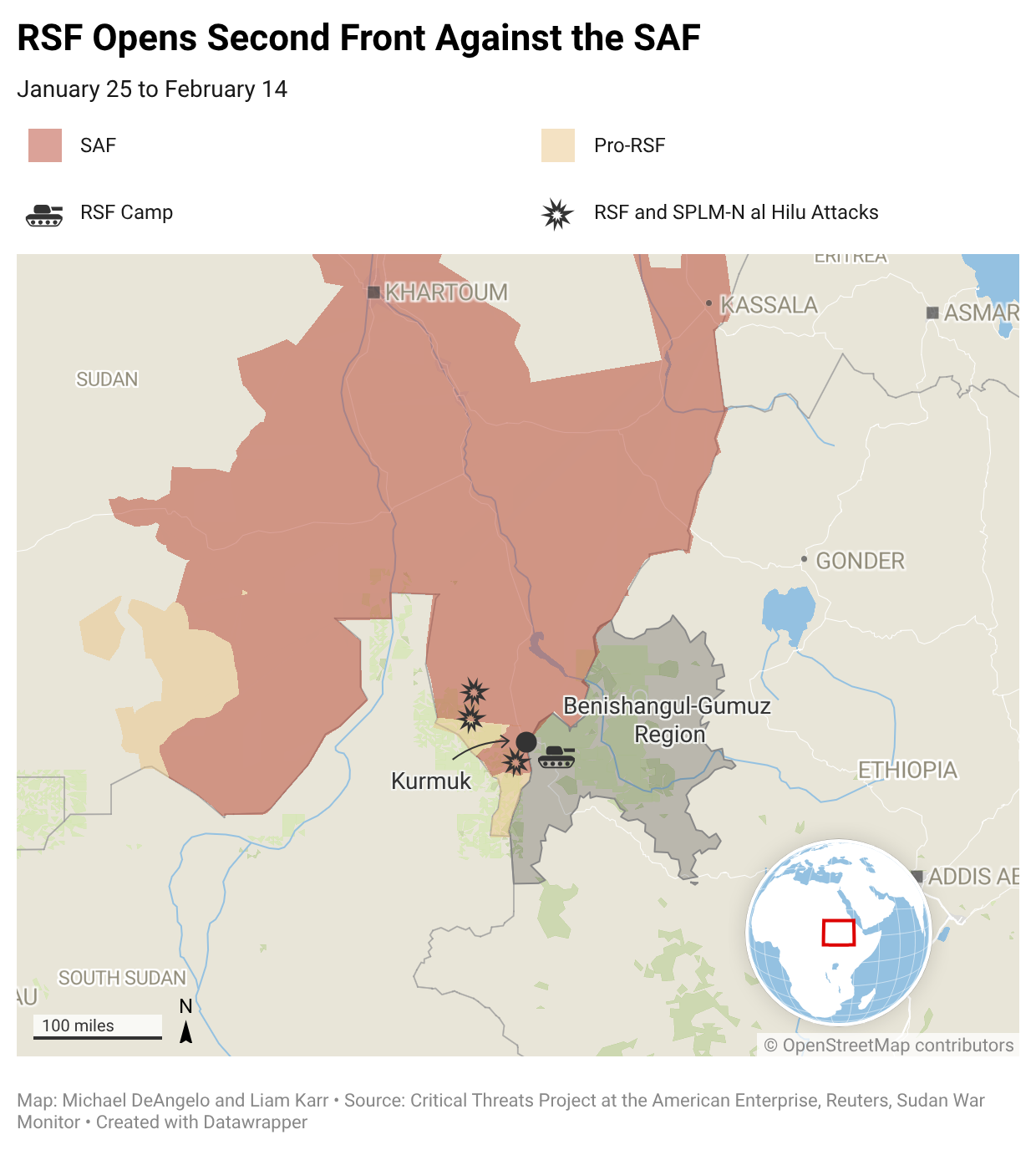
Madagascar. The head of Madagascar’s junta visited Russia on his first official state visit outside the country, which is the latest signal of deepening cooperation between the Kremlin and Madagascar’s new authorities. The junta is also balancing ties with the United States and France, which have also reached out since the junta took power in October, with all three foreign partners looking to strengthen economic and security ties to boost their influence in the Indian Ocean.
Sudan. US-led efforts to broker a temporary ceasefire between the Rapid Support Forces (RSF) and Sudanese Armed Forces (SAF) are stuttering as the RSF, SAF, and their external backers set conditions for major offensives.
West Africa. Recent high-level engagements involving Malian and Nigerien officials highlight continued differences in the foreign policy approaches within the Alliance of Sahel States bloc.
Figure 1. Africa File, February 19, 2026
Assessments:
Madagascar
The head of the Malagasy junta went to Russia for his first official state visit outside the country to strengthen bilateral ties in mid-February. The French investigative outlet Africa Intelligence reported that junta leader Colonel Michaël Randrianirina traveled to Moscow on a Russian government aircraft for an official two-day visit on February 17.[1] Randrianirina is expected to meet with Russian President Vladimir Putin and his foreign minister, Sergey Lavrov, to discuss potential areas of diplomatic, economic, and military cooperation on February 19.[2] These discussions notably include potential Russian access to the Diego-Suarez naval base, an abandoned former French facility with one of the best deepwater harbors in the western Indian Ocean.[3]
Randrianirina took power in a military-led coup in late 2025. Randrianirina led a powerful faction within the Malagasy military, which mutinied and deposed the sitting president, Andry Rajoelina, in response to weeks of massive youth-led, anti-corruption protests in October. Rajoelina fled the country amid the coup and remains in exile in the United Arab Emirates (UAE).[4] Randrianirina suspended all democratic institutions and established a transitional government.[5]
The Kremlin has increased military cooperation with Randrianirina’s regime since the coup as the basis for a new partnership. Russia has tried to bolster its influence with the new regime using its relationship with Siteny Randrianasoloniaiko, the speaker of the National Assembly and a longtime Russian ally, who led an official parliamentary delegation to Moscow and met with Russia’s deputy energy minister in November.[6] Randrianirina hosted an official Russian delegation led by Yunus-bek Yevkurov, the Russian deputy defense minister and de facto head of Africa Corps, in Antananarivo, the Malagasy capital, in late December.[7] Randrianasoloniaiko said after the delegation’s visit that Russia expressed interest “particularly in the area of training and capacity building” for the Malagasy army.[8] Russia has since deployed 140 military instructors to the country and delivered a stream of weaponry, including one-way attack (OWA) drones and anti-tank rocket launchers.[9] Africa Intelligence reported in late January that Russian instructors have been training Malagasy units to operate OWA drones at a military camp near the presidential palace in Antananarivo.[10]
Russia has little to offer beyond regime protection, however. Russian companies have a limited presence in Madagascar. Randrianirina has said repeatedly that he fears a countercoup and has yet to provide a transition roadmap, both factors that would make Russia’s regime security package attractive.[11] Malagasy intelligence services claimed in early November that they arrested two foreign nationals accused of planning to assassinate Randrianirina in an attempted coup.[12] The demands of the youth-led protests and Madagascar’s greatest needs are development-focused, however, not security-focused.
The Kremlin wants to use its new partnership with the Malagasy junta primarily to boost its power projection in the Indian Ocean and secondarily to help circumvent sanctions. CTP assessed after Randrianirina took power that Russia would seek to boost ties with Madagascar, given the Kremlin’s efforts to increase its naval power projection in key waterways surrounding the continent.[13] Diego-Suarez sits at the country’s northern tip, enabling whoever controls it to project power into major shipping lanes between the Atlantic and Indian Oceans. Russia signed a naval agreement with São Tomé and Príncipe—a West African Atlantic island nation—in April 2025 that allows Russian ships to refuel at São Toméan ports, allowing Russian ships to remain in the area for longer and improving Russian naval power projection.[14] CTP noted in October that the São Toméan deal was a template for future agreements with other willing coastal countries, including a potential pro-Russian, or at least anti-French, Malagasy government.[15]
Russia is also looking to bring Madagascar into its alternative financial system and secure other investment opportunities to finance its military support, which could help Russia mitigate or circumvent international sanctions. The Kremlin dispatched Mikhail Dorofeev, the vice president of a Russian state-owned bank under Western sanctions, for discussions with Randrianirina in Antananarivo on January 24.[16] Dorofeev is a seasoned financier for the Russian military industry and a “specialist in circumventing sanctions” through Russia’s alternative financial system, known as the A7, according to Africa Intelligence.[17] Russia integrated Nigeria and Zimbabwe into the A7 in late 2025.[18] Dorofeev has said that he wants to see a new financial “corridor” established in southern Africa.[19] Russia is also exploring mining and infrastructure investment opportunities with Madagascar’s new authorities, amid uncertainty over how Madagascar will finance these projects and the ongoing Russian military support, considering the extensive sanctions Russia currently faces.[20]
Russia has long viewed Madagascar as a key point in its Africa approach and previously tried to meddle in Madagascar. The Wagner Group meddled in the 2018 Malagasy elections, offering financial, informational, and strategic support to preferred candidates, which included the ousted president.[21] A Wagner-linked mining company established a partnership with a Malagasy state-owned chromium mining company around the time of the election.[22] Wagner-linked networks also used troll farms and social media to spread pro-Russian and anti-French narratives, using the same playbook that it would perfect in other former French colonies in West Africa.[23]
The United States has also discussed investment and security cooperation with the new regime in pursuit of critical mineral and naval interests in Madagascar. Randrianirina has discussed intelligence and security support to prevent a countercoup in multiple meetings with US officials and Trump-aligned private military contractor Erik Prince since late 2025.[24] Randrianirina met with senior US officials, Prince, and Israeli technical experts in the UAE to establish what Africa Intelligence described as an “informal pact” in early December.[25] Randrianirina then met with Prince’s representatives in South Africa to discuss possible regime protection measures and maximizing Madagascar’s official tax revenues from imports and exports.[26] Prince is currently providing similar services to the government of the Democratic Republic of the Congo through his private military company, Virtus Global.[27]
Randrianirina also held multiple rounds of investment discussions with US officials in January. The US State Department dispatched three senior officials to meet with Randrianirina and discuss further details of expanded cooperation in early January.[28] Randrianirina went to the UAE again with an entourage of economic advisers and held talks with international investors and Emirati, Chinese, Russian, and US businesspeople and diplomats—including Massad Boulos, Trump’s Africa adviser—in mid-January.[29]
The Trump administration is reportedly interested in securing critical mineral and naval interests through the new regime. The three US officials discussed with Randrianirina the possibility of establishing a military presence at the Diego-Suarez naval base.[30] The United States also wants the new Malagasy authorities to help operationalize the Toliara project, a US-backed critical minerals project in southwestern Madagascar worth about $700 million in investment.[31] US-based Energy Fuels acquired the Toliara project in October 2024, a deposit with titanium, zirconium, rare earth, and radioactive minerals.[32] The project has been stalled due to bureaucratic delays since late 2024, and the coup had disrupted plans to operationalize it in early 2026.
France has also taken a pragmatic and open approach to secure its economic and security interests with the new authorities, despite the coup ousting its key ally in Rajoelina. France has maintained close economic and political ties with Madagascar since Madagascar gained independence from France in 1960. France is one of Madagascar’s leading economic partners, with bilateral trade exceeding $1.1 billion annually in the last three years, mostly in agricultural and textile products.[33] French President Emmanuel Macron became the first French president to travel to Madagascar in nearly 20 years when he visited in April 2025 to finalize energy, infrastructure, technology, and tourism agreements to expand and modernize this economic partnership.[34] Macron expressed interest in developing supply chains and partnering on critical minerals during his visit.[35] Several major French multinational companies, including TotalEnergies, Orange, and EDF, operate in the Madagascar and have hundreds of millions of dollars in investments.
France has nearly 2,000 military and civilian defense personnel stationed on French islands near Madagascar as part of the Armed Forces in the Southern Indian Ocean Zone.[36] Réunion hosts an air base, a naval base, and the 2nd Marine Infantry Parachute Regiment. Mayotte hosts a second naval base and the Mayotte Foreign Legion Detachment. Two frigates, six smaller naval vessels, one helicopter, and two medium transport aircraft are located across the two islands. Mayotte lies roughly 200 miles from Madagascar’s west coast between Madagascar and the African mainland, while Réunion is approximately 450 miles off Madagascar’s east coast. French forces also have a permanent presence on the islands of Juan de Nova, Europa, and the Glorieuses.
Figure 2. Armed Forces in the Southern Indian Ocean Zone
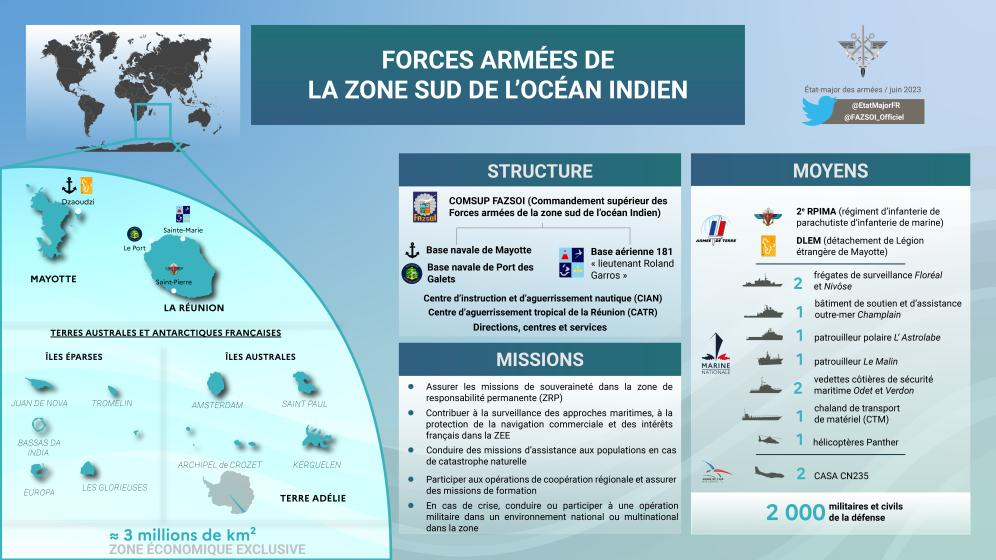
Source: French Army General Staff.
Rajoelina had close ties with France, and the coup dealt a blow to France’s influence in the Indian Ocean, as seen in other coups in former French colonies. Rajoelina’s naturalized French citizenship became public during the 2023 elections, which sparked backlash that he was a French puppet and should lose his Malagasy citizenship and eligibility for office according to Malagasy law.[37] There were isolated cases of anti-French slogans during the October youth-led protests, but such sentiment was not a widespread theme, unlike in West Africa.[38] The juntas that came to power in West African countries cut defense ties with France, pressured French businesses out of their countries, and increased military cooperation with Russia.[39] The French army diverted a military aircraft to exfiltrate Rajoelina from the country after the coup in mid-October.[40] Pro-sovereigntist Malagasy news outlets have amplified articles accusing France of neocolonial practices and plotting to intervene after helping evacuate Rajoelina.[41]
France has cooperated with the junta to preserve its influence in Madagascar. Macron publicly expressed concern about the coup but did not condemn the junta or confirm that France evacuated Rajoelina.[42] Macron was then the first Western head of state to speak officially to Randrianirina via phone in late November.[43] The Malagasy foreign minister visited France to meet with her French counterpart and formally mark the restoration of diplomatic ties in mid-January.[44] Randrianirina is planning to meet with Macron in Paris for an official visit in late February or early March after his trip to Moscow.[45]
Conversations have repeatedly focused on continued economic cooperation. The French ambassador, Arnaud Guillois, has reportedly met with Randrianirina on several occasions since mid-October, including at Randrianirina’s inauguration, where Guillois stressed continuity in economic cooperation for projects launched under Rajoelina, Africa Intelligence reported.[46] Randrianasoloniaiko met with Macron’s Africa adviser in Paris to discuss ongoing economic cooperation on February 10.[47] Various French and Malagasy business leaders met in mid-January and plan to hold several meetings on the sidelines of Randrianirina’s upcoming visit.[48]
Sudan
The Rapid Support Forces (RSF) and Sudanese Armed Forces (SAF) have not accepted the latest US-led ceasefire proposal. Saudi Arabia and the United States sent a draft proposal to the RSF and SAF in late January.[49] The proposal would reportedly curtail external involvement in the war and freeze the frontlines for three-to-six months to allow for the provision of humanitarian aid.[50] Egyptian news outlet Mada Masr reported that the ceasefire entails RSF fighters temporarily withdrawing from population centers while leaving RSF-aligned local administrations in place.[51] The SAF has called for the RSF to withdraw and dismantle political and security structures.[52] Sudanese Prime Minister Kamel Idris reaffirmed the SAF’s unwillingness to grant the RSF political legitimacy through negotiations.[53] An RSF official approved of the US-led efforts, but the RSF has not officially committed to the proposal yet and is drafting its own peace roadmap.[54] The RSF has symbolically supported ceasefires in the past without halting operations to bolster its international image.[55] The RSF has insisted that the SAF should limit the influence of allied Islamist groups—a shared interest of the United Arab Emirates (UAE), the RSF’s primary backer—and not have a role in the post-war governance of Sudan, which contradicts the stated interest of the SAF and SAF backers Egypt and Saudi Arabia.[56]
US Senior Adviser for African Affairs Massad Boulos has continued mediating counter proposals among the warring Sudanese factions and their allies. The SAF sent Boulos an alternate proposal more aligned with its demands.[57] Boulos has since stated that he is in regular contact with SAF head and leader of the SAF-led government Abdel Fattah al Burhan but has had difficulty communicating with RSF head Mohammed Hamdan Dagalo.[58] Boulos said that Burhan is open to the initial Saudi-US proposal but that inaction could result in sanctions on the RSF and SAF.[59] The US Treasury Department levied sanctions on three RSF commanders on February 19.[60] Boulos also met with top Saudi and UAE officials separately on February 14 in advance of a reported upcoming Quad meeting between Egypt, Saudi Arabia, the UAE and the United States.[61] Quad members’ backing of opposing sides in the war has stalled US-led ceasefire efforts.[62] Boulos stated that the Quad is finalizing the proposal, which is allegedly the first step in a broader political process.[63]
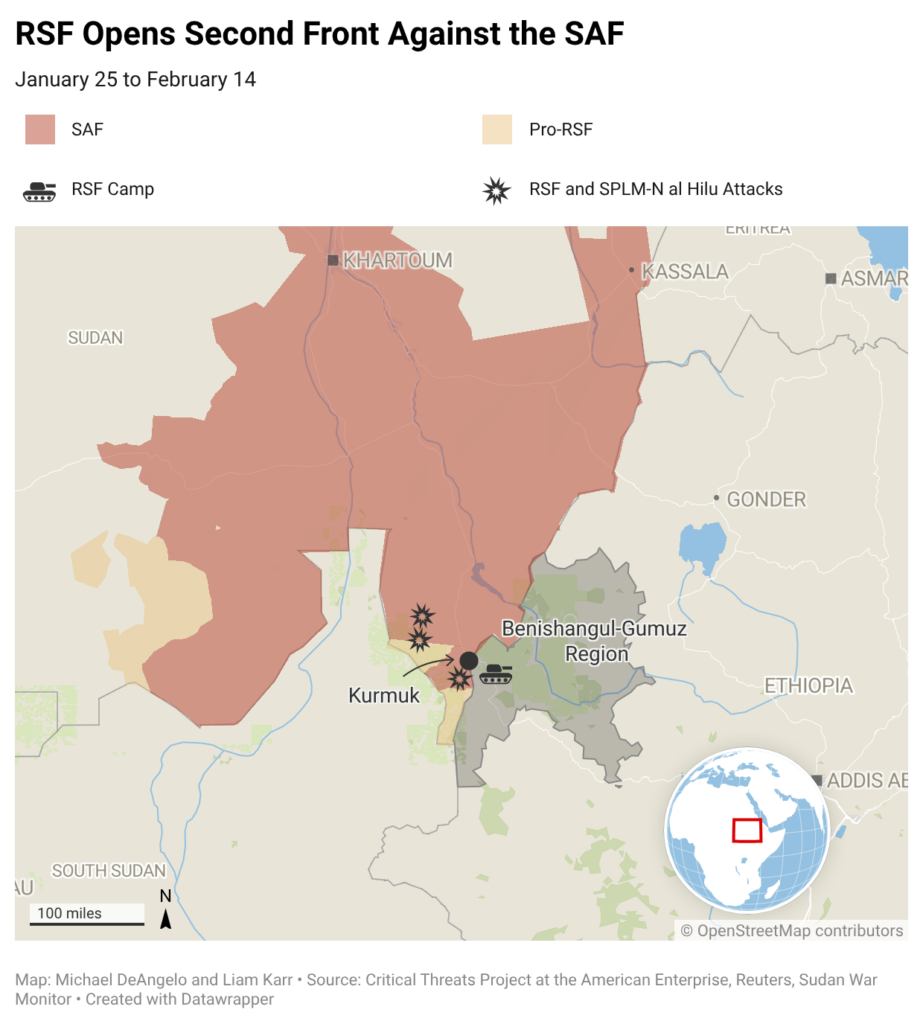
The RSF, SAF, and their external backers are setting conditions for major offensives, further undermining either side’s will to engage in substantive talks. The RSF has opened a second front on the SAF’s eastern flank from western Ethiopia. Reuters recently confirmed SAF allegations that the RSF had established a training camp in Ethiopia’s Benishangul-Gumuz region under the supervision of the Ethiopian military in late 2025.[64] The RSF and allied Sudan People’s Liberation Movement–North (SPLM-N) al Hilu militia have since launched operations in southeastern Sudan’s Blue Nile state, with SAF officials stating that the fighters have transited through neighboring Ethiopia and South Sudan.[65] The RSF and SPLM-N al Hilu has advanced within 15 miles of Kurmuk, which is a key border town along the highway linking RSF rear bases in Ethiopia to southeastern Sudan, causing the SAF to reportedly send reinforcements.[66] Disruptions to RSF supply lines through Libya and Somalia has made Ethiopia a key supply line, as Emirati-linked weapons shipments to Ethiopia have substantially increased since November 2025.[67] Ethiopian officials have also stated that the UAE financed the construction of the RSF camp in western Ethiopia and provided on-site support.[68]
Figure 3. RSF Opens Second Front Against the SAF
The SAF has launched an air interdiction campaign against RSF supply lines and air defense systems to set conditions for an SAF advance toward the RSF’s center of gravity in western Sudan. The SAF destroyed two RSF air defense systems in Abu Zabad and al Dabibat—two towns at a junction connecting to key roads leading west—on February 12 and 15, respectively.[69] The SAF also conducted drone strikes on RSF fuel depots in Adikong and Nyala on February 15 and 16, respectively.[70] Adikong is located on a key supply line on the Chadian border, and Nyala is the RSF’s de facto capital. Egypt and Turkey have increased their support to the SAF since October 2025, providing drones and operational assistance.[71] Egypt, the SAF, and Turkey have coordinated drone strikes against RSF supply lines from a drone base near Egypt’s southwestern border with Sudan.[72] Saudi Arabia has also recently increased support for the SAF, facilitating and possibly funding a potential Pakistan-Sudan arms deal.[73] Boulos said on February 15 that there is an “unprecedented flow of weapons to both sides” in Sudan’s war.[74]
West Africa
The United States has continued to strengthen its relationship with Mali as it looks to reengage the Alliance of Sahel States (AES). US State Department Africa Bureau head Nick Checker visited Bamako, where he met with senior government and economic officials, on February 3.[75] The US State Department framed the meeting as a “reset” in US-Mali relations and emphasized the United States’ respect for Mali’s sovereignty.[76] Checker was expected to speak with Malian junta leader General Goïta according to French magazine Jeune Afrique.[77] Checker engaged in “substantive” discussions with Malian Foreign Minister Abdoulaye Diop about areas of common interest, such as the fight against terrorism and promoting economic development on February 3.[78] Although Diop noted no official statement will be released about the event, he claimed that discussions align with US President Donald Trump’s pivot to a “trade, not aid” foreign policy.[79] The Malian Foreign Affairs Ministry tweeted after the meeting that both sides view the renewed ties as a “win-win” partnership.[80] The post emphasized that revitalized relations must account for evolving geopolitical realties and specifically mentioned that the United States must be willing to also work within the AES framework as part of revitalized relations.[81]
Checker’s visit is the latest step in growing Mali-US cooperation since 2025. Deputy Assistant Secretary of State for African Affairs Will Stevens led US efforts to rebuild partnerships with all three AES states throughout mid-2025. Stevens met with high-ranking Burkinabe and Nigerien officials as part of a regional tour in late May.[82] The Malian foreign minister met with the US ambassador and counterterrorism adviser Rudy Atallah in early July to discuss bilateral counterterrorism cooperation. Pro-junta sources said the meeting discussed technical and logistic support for Malian troops, anti–improvised explosive device training, and intelligence cooperation.[83] Stevens returned to the Sahel on July 22 to discuss security and trade cooperation with Malian officials. Stevens specifically highlighted opportunities to counter terror financing networks and share intelligence in the defense sector.[84]
Burkina Faso and Niger have shown less receptivity to US outreach since 2025. US officials have had some success reengaging Niger. Nigerien Prime Minister Ali Mahaman Lamine Zeine visited Washington, DC, in late April to discuss strengthening bilateral and commercial ties.[85] The US ambassador to Niger formally presented her credentials to Nigerien junta leader Abdourahmane Tiani in May 2025 for the first time since Tiani took power in 2023 and expelled US forces in 2024.[86] The US State Department said that the United States “looks forward” to consulting with Niger in advance of Checker’s recent visit to Bamako, however, and Checker and Zeine spoke over the phone—not in person—during Checker’s February visit to the continent.[87] Stevens met with the Burkinabe foreign minister in late May 2025, but US officials have since been unable to engage Burkinabe officials at this high of a level since, partially due to Burkinabe backlash over US immigration and visa policies.[88]
Niger restored diplomatic relations with Algeria, despite the rivalry between Algeria and Niger’s AES ally, Mali. The Nigerien ambassador to Algeria returned to Algiers on February 12 following a nearly ten-month break in diplomatic relations between the two countries.[89] Nigerien junta leader Abdourahmane Tiani then met with Algerian President Abdelmadjid Tebboune in Algiers on February 16, after which President Tebboune pledged to support Niger “with everything it needs,” including economic and counterterrorism assistance. Tebboune asserted that the meeting “puts an end to an abnormal period of chilled relations.”[90]
Niger had cut relations in April 2025 in solidarity with Mali, amid a still-ongoing diplomatic crisis between Algeria and Mali. Algeria shot down one of Mali’s highest-end Turkish drones for allegedly violating its airspace.[91] The crisis followed months of rising tensions over Malian military activity against Tuareg rebels near the Algerian border, which ended an Algerian-brokered peace deal and raised Algerian anxiety over refugee flows and a potential mobilization of the Tuareg community within its border.[92] Mali withdrew its ambassador from Algeria in response, and Burkina Faso and Niger followed suit.[93] Malian officials have not commented on the meeting and maintain an adversarial relationship with Algeria, which currently hosts prominent Malian opposition figures.[94] Burkina Faso has also not restored formal diplomatic ties with Algeria.
Algeria and Niger have focused on resuming economically vital energy cooperation. The Algerian mining minister visited Niger in late January.[95] Tebboune announced on the day of Tiani’s visit in February that Algeria and Niger would launch the trans-Saharan pipeline project, which aims to link Nigerian oil to Europe via Algeria and Niger, after Ramadan in 2026.[96] Algeria and Niger had signed several deals to advance the project in early 2025 before the diplomatic breakdown.[97] Algeria has also previously discussed plans to help Niger build an oil refinery, petrochemical complex, and a 40-megawatt power station.[98]
Algeria and Niger are also key to each other’s regional foreign policy given political tensions with other neighbors. Algeria is competing with its archrival Morocco for economic and political influence within the AES, and Morocco has exploited the tensions between Algeria and the AES to boost its position.[99] Morocco has also tied this outreach to recognition of Moroccan sovereignty of the disputed Western Sahara region by offering its port project at Dakhla as a sea outlet for the landlocked AES.[100] Niger has become increasingly dependent on Algeria for trade given its ongoing diplomatic standoff with Benin, which has left the Benin-Niger border closed since the Niger coup in July 2023.[101]