
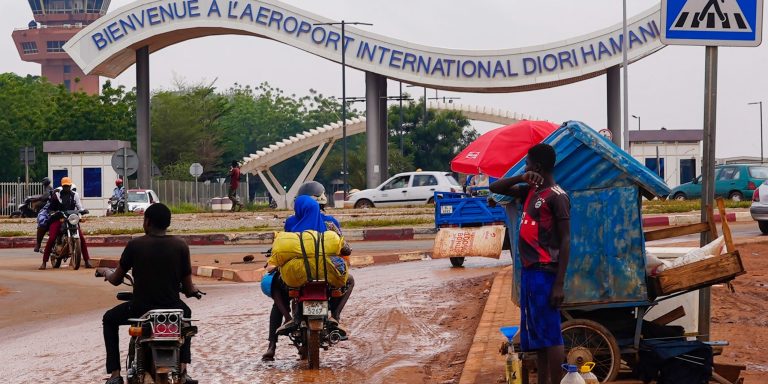
The Islamic State (IS) claimed responsibility for last week’s coordinated attack on Diori Hamani International Airport and the adjacent Air Base 101 in Niamey, Niger’s capital, marking one of the most high-profile attacks for IS-affiliates in the Sahel region.
Evidence from the attack footage indicates the potential presence of militants from other IS affiliates, including from Islamic State – West Africa Province (ISWAP).
IS-Sahel Province’s demonstrated ability to coordinate across affiliates, strike hardened targets, and sustain follow-up operations raises concerns about the group’s growing operational potential.
While in the past Washington kept its distance from the regimes in Mali, Burkina Faso, and Niger, under the Trump administration, a shift appears to be underway, with the United States willing to engage with Bamako, Ouagadougou, and Niamey.
The Islamic State (IS) claimed responsibility for last week’s coordinated attack on Diori Hamani International Airport and the adjacent Air Base 101 in Niamey, Niger’s capital, marking one of the most high-profile attacks for IS-affiliates in the Sahel region. The Islamic State’s Amaq news agency released footage of the attack, depicting armed Islamic State Sahel Province (ISSP) fighters on motorcycles destroying Nigerien military equipment. Reporting also stated that the group used drones and explosives, reflecting the attack’s complexity and coordination. The attack resulted in the death of approximately 20 attackers and the capture of 11 others. Four Nigerien soldiers were wounded, and several civilian aircraft were damaged, and a Nigerien ammunition depot was destroyed, according to The Long War Journal.
The incident prompted heightened security concerns and underscored the vulnerability of strategic infrastructure amid Niger’s deteriorating security environment. The attack also highlights the fragility of the broader region. Several states are ruled by military juntas, backed by Russian mercenaries. Entire swaths of the region are also ruled by violent non-state armed groups, including ISSP and Jama’at Nusrat ul-Islam wa-al Muslimin (JNIM), al-Qaeda’s Sahelian affiliate, which occasionally clashes with IS fighters. Russian mercenaries have waged a scorched-earth counterinsurgency campaign in the Sahel, which has only served to exacerbate the terrorism problem, pushing new recruits into the arms of jihadist groups linked to al-Qaeda and the Islamic State.
Evidence from the attack footage also indicates that the Niamey operation was not conducted by ISSP in isolation. Analysts who have reviewed the footage point to the potential presence of militants from other IS affiliates, including from Islamic State – West Africa Province (ISWAP), which is active in the Lake Chad Basin. Linguistic cues in the footage indicate the possible presence of Hausa and Kanuri, languages mostly spoken in northeastern Nigeria, and suggest the potential for ISWAP participation, including operational and logistical support. Senior Research Fellow Wassim Nasr told France24that militants who monitor drones had been deployed from the Lake Chad region to the Sahel. There has been growing concern for some time that ISSP and ISWAP would begin to coordinate more closely, and this cooperation, including tacit knowledge transfer, could serve as a force multiplier for the militant groups. According to the UN Monitoring Team, which reports on al-Qaeda, the Islamic State, and their respective affiliate groups, closer cooperation between Islamic State-affiliated groups in the Sahel has been promoted by the al-Furqan Office, a Nigeria-based entity that provides the Islamic State with strategic guidance as part of the organization’s General Directorate of Provinces. Al-Furqan is considered one of the most successful financial nodes of the organization’s global network, along with the al-Karrar Office in Somalia and the Afghanistan-based al-Siddiq.
In the days following the assault, ISSP claimed responsibility for a series of attacks both in Niger and Mali, signaling a sustained effort to capitalize on momentum and further undermine the credibility of the Alliance of Sahel States (AES) and their Russian security partners. Notably, Islamic State media reported an ambush of Malian Armed Forces (FAMa) and Russian-backed Africa Corps shortly after the Niamey attack, claiming at least 20 fatalities. Most recently, on February 2, ISSP militants also attacked a Nigerien military camp in Ayorou, continuing its operational tempo. The Ayorou attack, in particular, mirrored tactics employed by ISWAP during its “burn the camps” campaign against the Nigerien military in early 2025, in which jihadists overran bases, destroyed equipment, and released propaganda. ISSP’s replication of these methods further supports assessments of tactical knowledge-sharing within the Islamic State network.
Beyond its immediate impact, the Niamey attack has broader implications for ISSP’s transnational trajectory. Its demonstrated ability to coordinate across affiliates, strike hardened targets, and sustain follow-up operations raises concerns about the group’s growing operations potential. There is also a debate in the counterterrorism community about whether Islamic State affiliates in the Sahel could set their sights on conducting external operations, including into North Africa or along key transit corridors linking West and North Africa. Some ISSP networks extend north into Morocco and south into parts of southern Europe. As conflicts in Ukraine, Gaza, and Venezuela occupy global diplomatic bandwidth, areas like the Sahel continue to be neglected, even as the risk grows.
The attack also intersects with evolving U.S. strategic calculations in the region. In recent months, the U.S. conducted airstrikes in northwest Nigeria, targeting Islamic State-linked factions, including the Lakurawa network affiliated with ISSP. The strikes, carried out in coordination with Nigerian forces in Sokoto State, reflect a renewed effort to reconstitute counterterrorism reach after it handed over its last military base to the junta regime in August 2024. While in the past Washington kept its distance from the regimes in Mali, Burkina Faso, and Niger, under the Trump administration, a shift appears to be underway, with the United States willing to engage with Bamako, Ouagadougou, and Niamey. Nick Checker, the head of the U.S. Bureau of African Affairs at the State Department, plans to visit Mali for discussions and suggested that the United States is also open to cooperating with Burkina Faso and Niger on “shared security and economic interests,” as reported by the BBC. The erosion of U.S. influence and the expanding Russian, Chinese, and Iranian footprints across AES states may reinforce Washington’s concerns.