
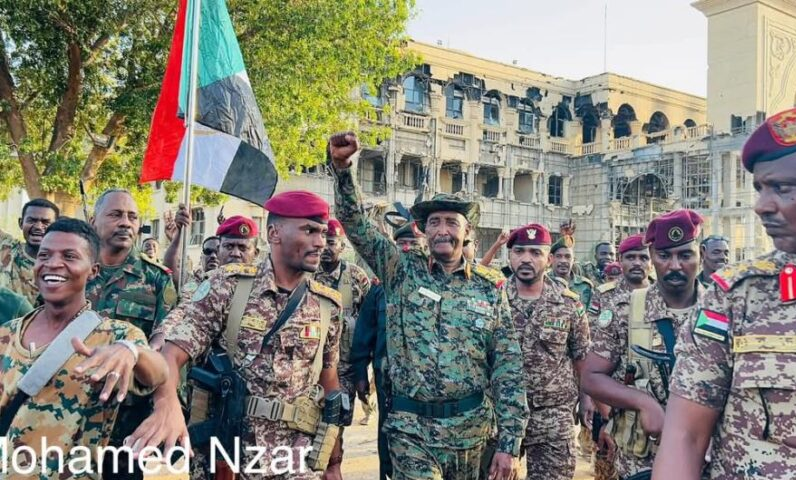
Sudanese army chief and head of the Sovereign Council, Abdel Fattah al-Burhan, lauded the General Intelligence Service (GIS) as a key partner in governing the current phase and the state.
Al-Burhan spoke on Saturday at the graduation ceremony for the 21st qualifying course for security and intelligence non-commissioned officers at the Jibit Institute in eastern Sudan. Jibit was the site of an attempted assassination against al-Burhan by a drone on July 31, 2024.
Addressing the graduating class, al-Burhan stated that the intelligence agency is “a partner in managing this phase and the state because it is one of the institutions that has maintained all its professional cadres.”
He affirmed that the GIS has remained cohesive, much like the army, emphasizing that these two institutions are “the guarantors of national unity.”
“The army operates with complete impartiality and patriotism to preserve Sudan’s unity and security, while the intelligence agency provides it with information to guide its performance. Therefore, they are two sides of the same coin, inseparable,” he added.
Al-Burhan explained that the ongoing conflict has proven the army and the GIS to be Sudan’s safety valve, noting that the latter has participated in battles and offered thousands of “martyrs.”
The army chief reiterated his commitment to continuing the war until the “rebels” – a reference to the Rapid Support Forces (RSF) – are eliminated.
Sudan has been embroiled in a fierce conflict between the army and the RSF since April 15, 2023. International pressure has failed to bring about a negotiated end, with both sides insisting on a military resolution.
Al-Burhan advised the GIS elements who completed the qualifying course in Jibit to act professionally and steer clear of political, tribal, and regional affiliations.
“Everyone is leaning towards tribalism and regionalism, and we want to be a model: we have no tribalism, no regionalism, no partisanship; we only have the slogans of the army and the agency,” he asserted.
For his part, GIS Director Ahmed Ibrahim Mufaddal said that al-Burhan’s steadfast stance and wise leadership “had a great impact in quelling the rebellion and defeating the militia – referring to the RSF – and in the cohesion of the regular forces and fighting forces.”
He stated that since the outbreak of the conflict, the intelligence agency has been integrated with the army, police, joint forces, and mobilized volunteers, with its members making sacrifices.
He explained that the agency has maintained its professionalism in security and intelligence tasks, combating organized and cross-border crime, and counter-terrorism.
In March 2024, the government amended the GIS law, granting its personnel arrest and search powers, along with immunity from civil or criminal proceedings without the director’s approval.
These legal amendments reinstated most of the powers and authorities that the agency enjoyed before they were curtailed by the transitional government, which was overthrown by army chief Abdel Fattah al-Burhan’s coup on October 25, 2021. At that time, it was known as the National Intelligence and Security Service.