
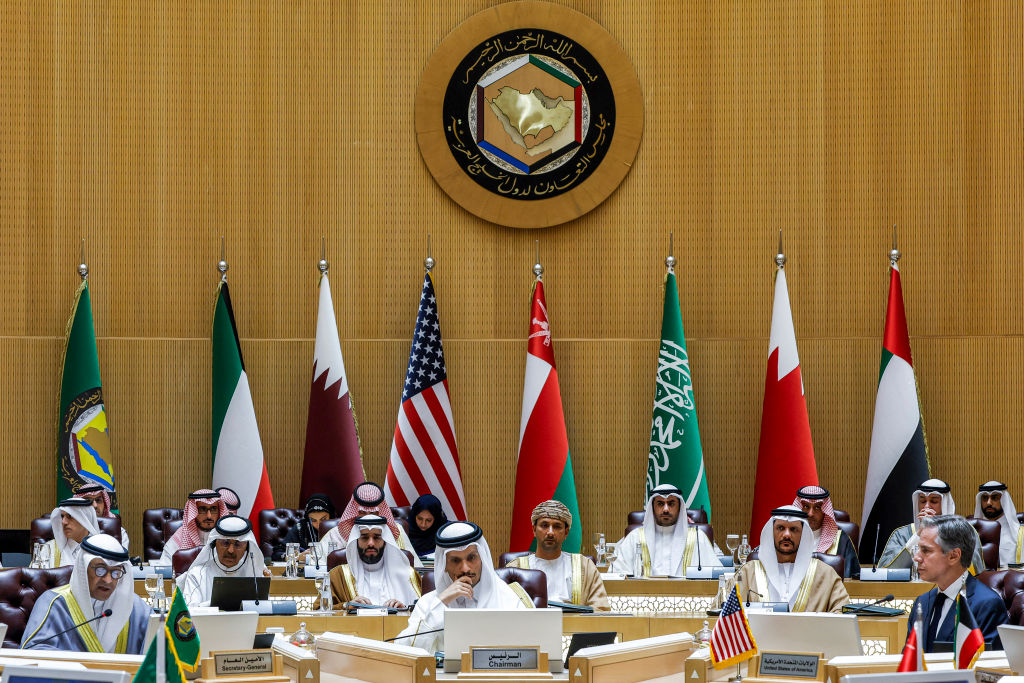
The Gulf Cooperation Council (GCC) — consisting of Saudi Arabia, the United Arab Emirates (UAE), Qatar, Oman, Bahrain, and Kuwait — has formally endorsed the U.S.-led vision for ending Sudan’s devastating civil war, dealing a severe diplomatic blow to the Sudanese Armed Forces (SAF), its commander General Abdel Fattah al-Burhan, and the Islamist factions that prop up his regime.
At its summit last week, the GCC explicitly backed “a political transition through the establishment of a civilian government that excludes extremist groups and entities that have committed crimes against the Sudanese people.”
In the context of Sudan, “extremist groups” unmistakably refers to the Islamist parties — primarily the remnants of Omar al-Bashir’s regime that was overthrown in the 2019 popular revolution — and the various armed factions and political networks that have aligned themselves with the SAF since the war began. The phrase “entities that have committed crimes against the Sudanese people” is equally clear: it targets the Rapid Support Forces (RSF), the paramilitary group originally created by Bashir and the SAF in 2013 from the Janjaweed militias responsible for genocide in Darfur two decades ago. On Tuesday, the Department of Treasury sanctioned a “transnational network recruiting Columbians to fight in Sudan’s civil war” as part of the RSF.
By simultaneously condemning both the SAF-led Islamist coalition and the RSF, while calling for an immediate ceasefire followed by a transition to a civilian government that excludes both the army and the militia, the GCC has thrown its weight behind the framework first articulated in September by the Quad — comprising of the United States, Egypt, the UAE, and Saudi Arabia.
The SAF’s reaction to the peace plan has been predictably hostile. Ever since the Quad roadmap was announced, in September, General Burhan and his allies have rejected any solution that would strip the military and its Islamist allies of power. Even when Burhan dispatched a delegation to Washington for indirect talks — ostensibly to avoid appearing completely intransigent — SAF forces refused to stop the war. Burhan and the Islamists have insisted that the only acceptable outcome is the total surrender and dissolution of the RSF.
The battlefield reality, however, has moved decisively against Burhan and the Islamists. What began in April 2023 as an SAF attempt to crush the RSF in Khartoum has turned into a protracted humiliation for the regular army. After initial gains, the SAF has suffered a string of crushing defeats. In October 2025, the RSF captured Bara, capital of North Kordofan. In November, after a brutal 500-day siege, the RSF captured El-Fasher, the last major SAF stronghold in Darfur. Days later, the RSF announced the seizure of Babnusa, a strategic hub in West Kordofan. With each loss, the army’s supply lines are threatened, its morale collapses further, and its dependence on Islamist militias grows more desperate.
Facing military reversal and mounting diplomatic isolation, Burhan and the Islamists have fallen back on defiance laced with conspiracy theories. Their slogan “bal wa bas”— roughly “only by the sword, nothing else” — has become the rallying cry of a coalition that promises total victory even as it loses province after province. Unable to offer a credible path to battlefield success, the Islamists have instead redirected their propaganda fire outward, accusing the UAE, Israel, the Quad, and most recently U.S. Special Envoy for the Horn of Africa and Sudan, Boulos Massad, of waging a neo-colonial plot to dismember Sudan and hand it to “Zionists” and “secular liberals.”
General Burhan and the Islamist old guard now face a stark choice: accept a negotiated exit that preserves some of their wealth and liberty in exchange for handing power to civilians, or cling to the illusion of total victory until the RSF — or sheer state collapse — removes them by force.
The GCC’s endorsement of the Quad framework, coming on top of near-universal international condemnation, has stripped away the last pretense of legitimacy. The era when Sudan’s generals and clerics could play great powers against each other is over.
Whether Burhan recognizes this before Khartoum falls to the RSF a second time, or whether Sudan must first endure even greater bloodshed, will determine not only his fate but that of an entire nation exhausted by decades of militarism and ideological fanaticism. The world has drawn a line; Sudan’s Islamists and their military protector now stand almost entirely on the wrong side of it.